SAN FRANCISCO — One of the world’s largest online services for backing up documents, photos and other video is opening its files in an initial public offering of stock.
Dropbox is hoping to raise USD$500 million in an IPO that comes 11 years after it started in San Francisco. The company confidentially filed for its IPO in October, but the information didn’t become publicly available until Friday.
The filing reveals Dropbox has lost more than $1 billion since its inception. That includes a loss of $112 million on revenue of $1.1 billion last year.
Dropbox boasts about 500 million registered users, but most of them don’t pay for its service. Only 11 million users pay for premium version of Dropbox’s service, a figure that the company is aggressively trying to increase.
That won’t be easy, given the fierce competition it’s facing. Its rivals in online file storage include three of the world’s most powerful companies — Google, Microsoft and Amazon. A smaller competitor, Box Inc., went public at $14 per share two years ago and the stock shot to $23.23 in its first day of trading. It closed Friday at $23.32.
Dropbox hasn’t yet disclosed how much of its stock will be sold in the IPO, nor the price for each share. That will occur during the next few weeks as its bankers gauge investor demand. The IPO is likely to attract a lot of attention because Dropbox’s service is so widely used.
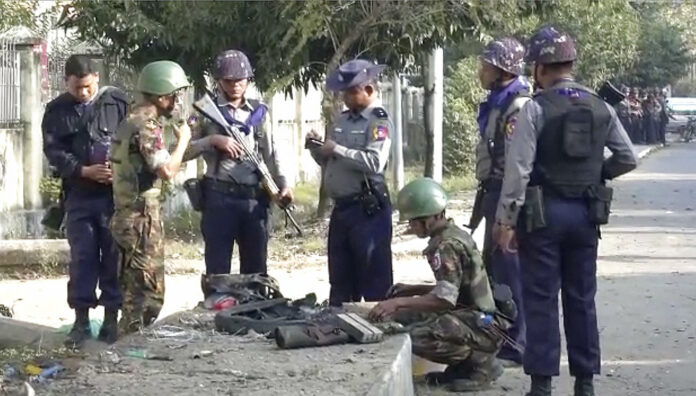
In this image made from video, police and officials inspect the site of a bomb explosion early Saturday in Sittwe, capital of Rakhine State. Photo: Associated Press
BANGKOK — One of several bombs targeting government offices and other places in Myanmar’s troubled Rakhine state exploded Saturday morning, injuring a police officer, authorities said.
In all, three bombs exploded and three unexploded devices were seized in Sittwe, the state capital. One of the explosions was in front of a high-ranking government official’s residence, state police officer Aung Myat Moe said.
“There were three bomb explosions around 4 a.m. this morning where one policeman was slightly injured and we are still investigating crime scenes,” he said
Last month, local police fired at protesters in the ancient city of Mrauk-U, killing at least seven Rakhine Buddhists and injuring a dozen. A township administrator was later found slain in his car by the side of the road.
Communal violence in Sittwe in 2012 displaced more than 120,000 Rohingya Muslims now confined to camps outside of the city, where most Rakhine Buddhists remain.
About 700,000 Rohingya have fled northern Rakhine towns and villages since last August to escape a military crackdown.
KUALA LUMPUR — Malaysian police said a popular ethnic Chinese rapper has been detained over complaints that his latest music video featuring dancers wearing dog masks and performing “obscene” moves insulted Islam and could hurt racial harmony.
It was the second time in two years that Wee Meng Chee, popularly known as Namewee, has been investigated over his music videos.
Police said in a statement that Wee was detained Thursday after they received four public complaints that his video marking the Chinese year of the dog had “insulted Islam and could negatively impact racial unity and harmony.”
In the video entitled “Like a Dog,” Wee sits on a chair in a public square in the government administrative capital of Putrajaya with dancers wearing dog masks around him. Several of them mimic the “doggy-style” sex move. A green domed building in the background led some people to speculate it was filmed in front of a mosque, leading to criticism, but Wee later said it was the prime minister’s office.
The song includes the sounds of dog barks from various countries. In an apparent reference to government corruption, Wee sings that dogs in Malaysia go “mari mari, wang wang,” which in the Malay language means “come come, money money.”
Dogs are considered unclean by Muslims, who account for 60 percent of Malaysia’s 32 million people.
Several ministers have called for Wee to be arrested. He has defended the video as a form of entertainment and said he has no intention of disrespecting any race or religion.
Earlier Thursday, Wee posted a picture on Facebook of himself at the federal police headquarters as he was wanted by police for questioning.
“I am not afraid because I believe Malaysia has justice,” he said.
In 2016, he was detained after enraged Malay Islamic activists lodged complaints that a video titled “Oh My God,” which was filmed in front of various places of worship and used the word “Allah,” which means God in the Malay language, was rude and disrespectful to Islam. He was not charged.
In one of his earliest videos, he mocked the national anthem and was criticized for racial slurs. He also produced a movie that was banned by the government in 2014 for portraying national agencies in a negative way.
Race and religion are sensitive issues in Malaysia, where the ethnic Malay majority has generally lived peacefully with large Chinese and Indian minorities since racial riots in 1969 left at least 200 people dead.
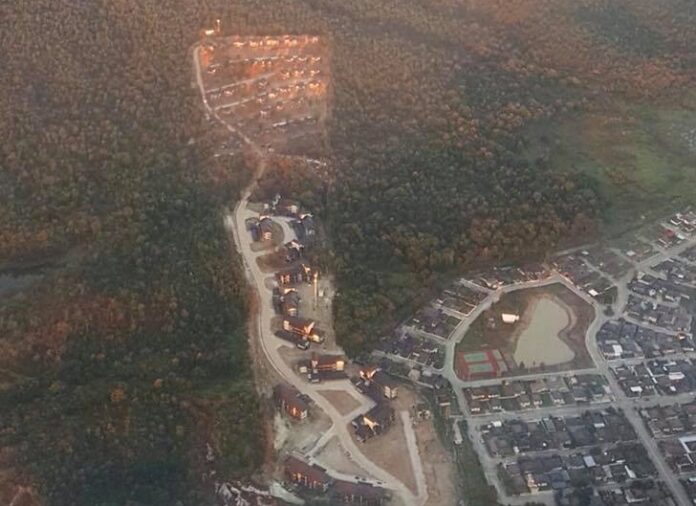
CHIANG MAI — A swath of protected forest on the slopes of Doi Suthep felled for residences enraged many when a photo went viral online, but a land official said Friday that it was a legally approved operation.
Though social media vented fury at the photo, which appears to show land cleared for homes jutting into the forest, Chiang Mai Treasury Department Director Yongyuth Ruengpattarakul said the buildings belong to court officials and were built legally.
“They were permitted to do that,” Yongyuth said, adding that the land originally belonged to the military. “The military granted the land to the court about a decade ago. It was clearly registered.”
The aerial photo was first posted online by Facebook user Kritsada Saetiao on Feb. 16 with a caption “scar of Chiang Mai.” It soon drew outrage from netizens, who assumed they were private residences of some entitled elite. It later surfaced the homes belong to regional appeals court judges, attorneys and staff.
That didn’t lessen the fury.
“So they’re homes for civil servants? WTF!?” Thanut Lerthanapoke wrote.
“How shameless the people who live there must be. They should ask their own heart about that,” Kraisorn Singhanop wrote.
“It’s true. It’s a real scar. Every time I’m on a plane landing in Chiang Mai and see it, I am always perplexed. What the hell are puu yai in our country doing?” Kongnat Neelunchai said in a comment.
Yongyuth, whose department oversees state properties in the province, declined to comment on why the court chose that location on the mountain to build staff homes.
Encroachment in forests or protected lands is a common issue that draws renewed crackdowns every year.
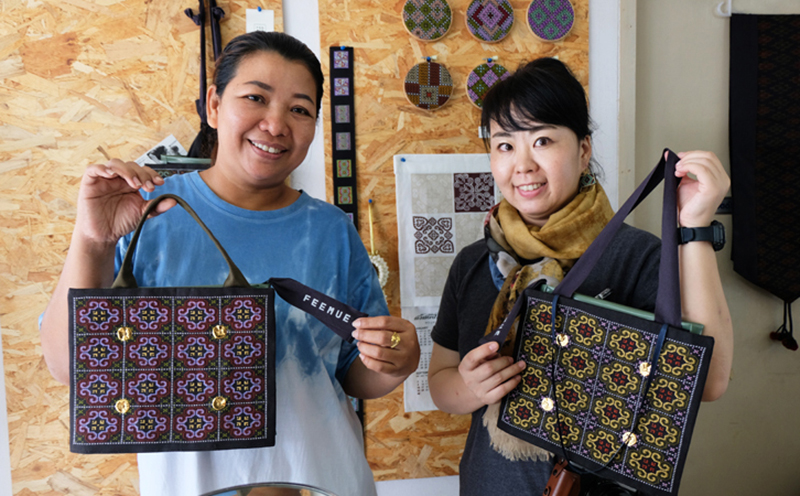
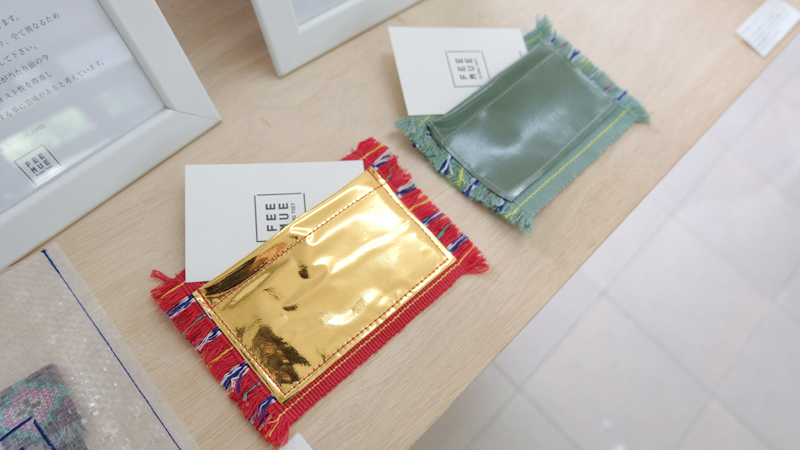
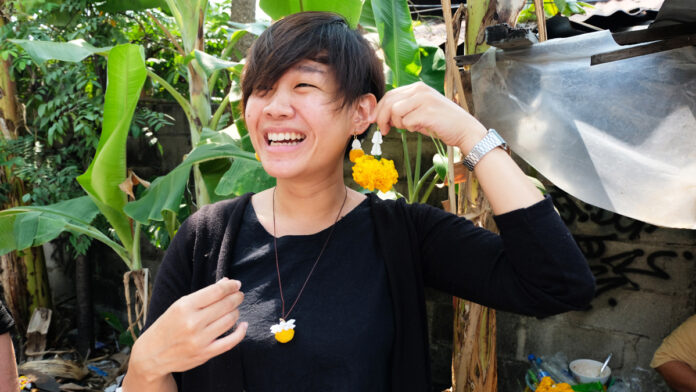
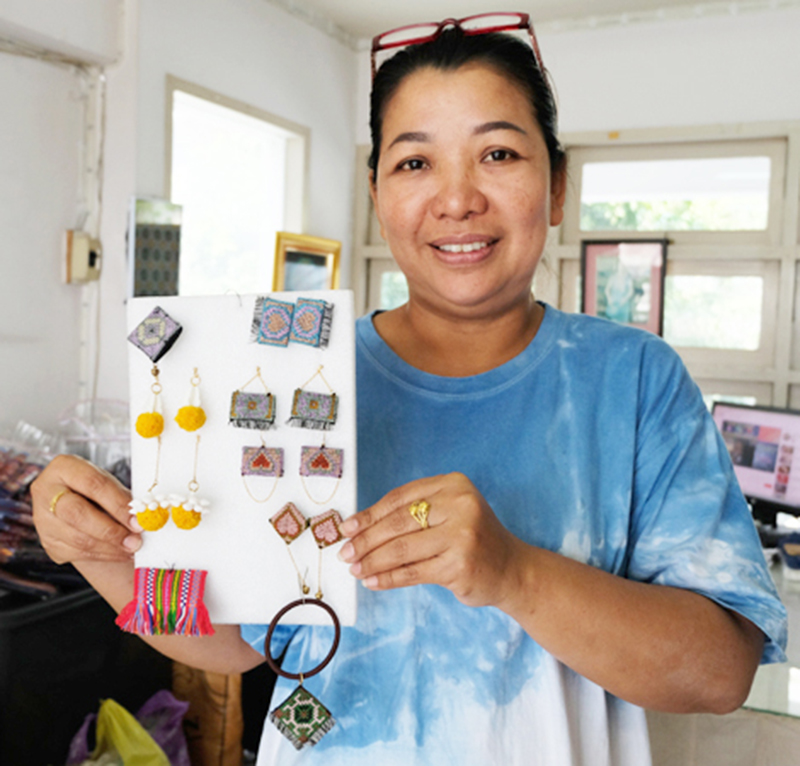
Nalynya Jaroonruangrit displays earrings made by women living in the Khlong Toei slum community for a brand called Feemue. They receive a portion of the sales, most of which are in Japan.
Top: Nalynya Jaroonruangrit displays earrings made by women living in the Khlong Toei slum community for a brand called Feemue. They receive a portion of the sales, most of which are in Japan.
BANGKOK — Once a month, a train creeps slowly between the narrow press of homes. In the days in between, children play between the grassy tracks and skip back home to hot rooms where families gather around small TVs.
Though calls to clear out Bangkok’s sprawling Khlong Toei slum have halted for now, eviction still looms over its residents, who can scrape together enough to survive – but not to leave.
To earn some money, a handful of craftswomen living there have been tying pom-poms into garland-like earrings and cutting plastic rice sacks into see-through bags. In return, they receive part of the proceeds from their sale all the way in Japan.
Nalynya Jaroonruangrit, 30, led a group of expats and tourists, mostly Japanese, through the narrow walkways of what’s designated communities 4, 5 and 6 on a recent Saturday. Along the way, she points out charitable projects, homes and trash dumps on a tour she hopes doesn’t cross the line into exploitation.
Narisara Piluk, handicrafts manager at Sikkha Asia Foundation, holds up Feemue brand earrings.
Nalynya, who completed a graduate degree in international development at Nagoya University and has an interest in hill tribes, works for the Japan-supported Sikkha Asia Foundation. She’s one of the managers of Feemue, the jewelry brand launched to employ community craftswomen. From her ears dangle yellow pom-pom earrings that evoke the woven garlands female residents make and sell for a living.
“Khlong Toei has such a bad image. If you ask a taxi to get you here, half of them won’t even come,” 30-year-old Nalynya said. “By making this brand, we wanted to show that something beautiful can come from here.”
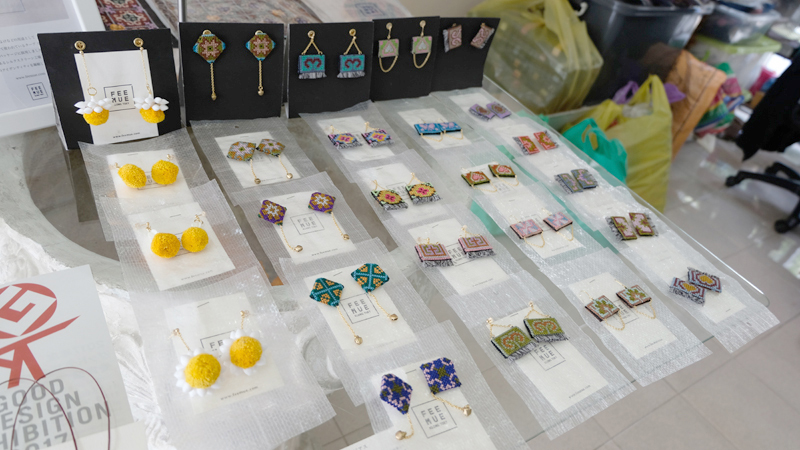
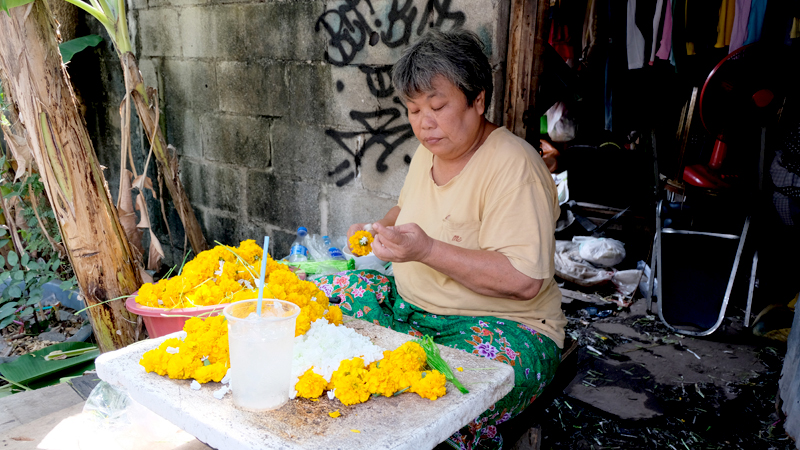
Feemue, which means “skill” in Thai, started in 2017 with the launch of its first collection.Japanese designer Fuji Tate P lived in the area three months to come up with the designs for the items. For example, the Dok Put and Dok Rak earrings (590 baht a pair) were inspired by the local women who weave flower garlands from ervatamia and crown flowers to sell.
Most are sold in Japan.
“The prices are admittedly quite high, but we didn’t hang our hopes on the Thai market,” Nalynya said.
Bringing in a talented designer gave the brand a needed creative boost.
“Before, we did sell some handicrafts, but they were unoriginal, not so different from the things at JJ Market. Fujita-san saw this and felt it was a waste, so he designed for us.”
Now six local women are employed part-time by Feemue to assemble the handicrafts. Last year they shared 20 percent of the profits. Another 10 percent went toward buying books for Miraibrary, a children’s library operated at Sikkha Asia’s Khlong Toei office. Fuji Tate P waived his design fee, resulting in the rest going to the Sikkha Asia Foundation.
Each woman earned about 6,000 baht between April and December last year.
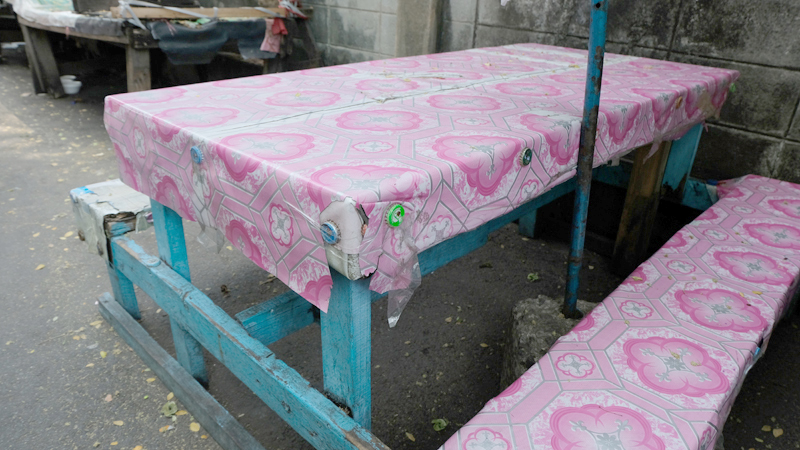
A bag with Hmong embroidery is studded with round metal rivets. It takes cues from the tarps seen everywhere in the shantytown that are often pinned down by bottle caps.
The prices reflect an attempt to upgrade the community’s image while gaining additional income for the foundation. Earrings cost 590 baht to 690 baht, bags made from transparent rice bags cost 590 baht, badges and hairbands run up to 450 baht and fully-embroidered bags cost 2,800 baht.
In Japan – where Feemue is exported for sale – prices are marginally higher: Some earrings sell for JPY3,000 (872 baht). The earrings’ backs and hooks are all imported from Japan.
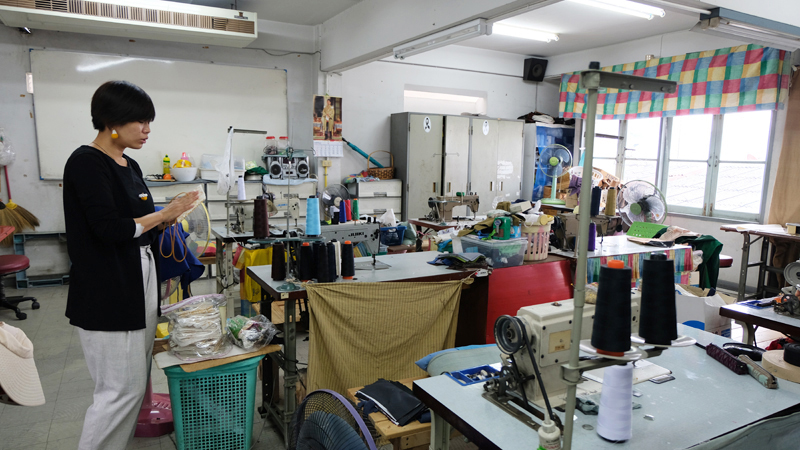
Feemue sources its embroidery and pom-poms from hill tribes including the Hmong, Lahu, Akha and others. It is then made into Fuji Tate P designs by the six woman at the foundation’s sewing center located in the neighborhood.
Narisara Piluk, handicrafts manager at Sikkha Asia Foundation, an Yuki Otsaka, volunteer, hold up Hmong-embroidered bags (2,800 baht).Bottle caps used to pin down cloth coverings inspired the design of Feemue brand bags.Nalynya Jaroonruangrit at the Sikkha Asia Foundation’s sewing center.Earrings from Feemue brand that sell for 590 to 690 baht.Lahu badges from Feemue (450 baht).
Sikkha Asia Foundation
Feemue is part of the Sikkha Asia Foundation, an NGO largely supported by Japanese donors such as labor unions, businesses and temples.
The Sikkha Asia Foundation supports children’s libraries in tenement housing neighborhoods such as Khlong Toei, mobile libraries for children in migrant worker communities and scholarships.
The Miraibrary was made possible by the generosity of Bangkok’s poorest residents.
The foundation collected 40,000 baht in the community to help out after the 2011 Tohoku earthquake and tsunami. After Tokyo businessman Hiroyuki Sugisawa found out the money had come from a Bangkok slum, he decided to return the favor – 10 times over. Half of Sugisawa’s 400,000 baht donation went to the nearby Duang Prateep Foundation.
Students display portraits made through Nikon’s Family Photo Frame project. Photo: Nalynya Jaroonruangrit / Courtesy
The Miraibrary is stocked with children books in various languages translated into Thai, Burmese and Khmer by volunteers. The library always accepts book donations.
On a recent visit, a dozen children were seen crafting, reading and playing inside.
Among the foundation’s supports is camera maker Nikon Corp. One program Nikon sponsors, Family Photo Frame, sends photographers to take professional photos of Karen children’s families Tak province and Hmong families in Phayao province, as well as neighborhoods in Bangkok, since these families cannot afford family portraits.
Nalynya Jaroonruangrit displays a children’s book translated into Burmese at Miraibrary. Migrant worker families from Myanmar, Cambodia and Laos live in the community.Khlong Toei youth.
The Slum Tour
Sikkha Asia began its monthly Slum Tours last year, but it was difficult drawing interest.
“No local media ever gave us any reply,” Nalynya said. “They probably don’t want to come to the Khlong Toei slum. But all the Japanese media already came.”
Most attendees are Japanese expats who want to see the reality of the community and learn about the foundation.
“People here are not extremely poor. They can pay for rent and food, but the problem is they do not have enough to move out,” Nalynya said in Japanese to people on the tour in comments translated by French foundation volunteer Valentin Noble.
People who sign up are picked up from Emporium in a van, taken to Sikkha Asia’s office in Khlong Toei where the walking tour begins.
Nalynya Jaroonruangrit at the Sikkha Asia Foundation’s sewing center.
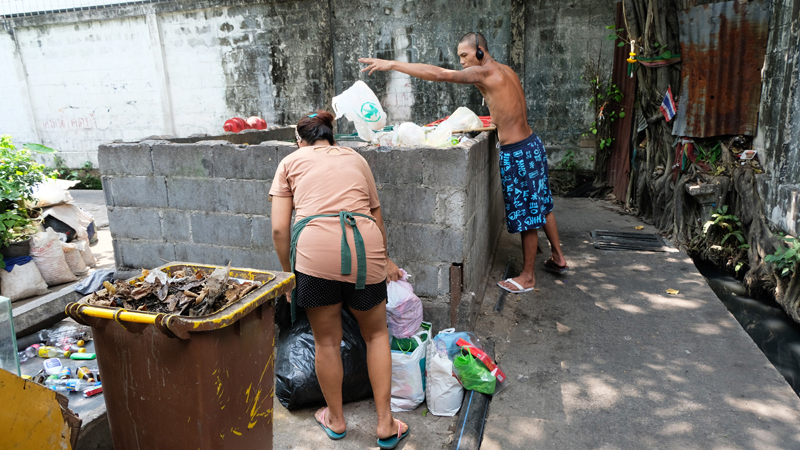
Walking through narrow lanes fouled by water and trash. They peek into the homes of families sitting by small televisions while outgoing inhabitants yell “hello!” at foreigners.
Covering 110 rai (17.6 hectares), Khlong Toei is the largest and oldest slum in Bangkok.
It began in the 1950s, when provincial workers moved in to work at the nearby port. With the opening in 1991 of a deep-sea port in Laem Chabaeng and containerized shipping, the port’s importance declined and its workforce fell into poverty.
Two decades ago the government built flats there to accommodate inhabitants – albeit in smaller rooms. Rent for a household is about 5,000 baht.
The port authority’s land lease has expired since the junta came to power. There are currently no known plans to evict people from the area, which sits between downtown and the riverside in an area that is ripe for gentrification.
But a resumed bid to close the slum is likely inevitable.
“I think the best way out for this is a discussion and a negotiation between the community and the port. But the government only thinks of moving them out,” Nalynya said.
Nalynya said she was concerned a tour would exploit the residents.
“It’s sensitive and impacts the community,” said Nalynya, who graduated from Chulalongkorn University’s Faculty of Arts. “I wondered if I was ‘selling’ them, and taking people to view people who live here like a zoo.”
Still, Nalynya said taking people to see the reality of the neighborhood is important, and offers donors an opportunity to donate or purchase crafts.
“But I wanted to show people what it’s really like in here. I don’t want to just show that it’s all poverty and toil,” she said.
Residents deposit trash in the Khlong Toei shanty community.Feemue brand earrings are inspired by handmade flower garlands.
Feemueproducts can be purchased from the Sikkha Asia Foundation office, Chico shop in Soi Thonglor 53, Voice Hobby Club Thailand in Soi Sukhumvit 49 and Happening Shop branches at the Bangkok Arts and Culture Center. They are also sold at Chang Chui and can also be ordered online.
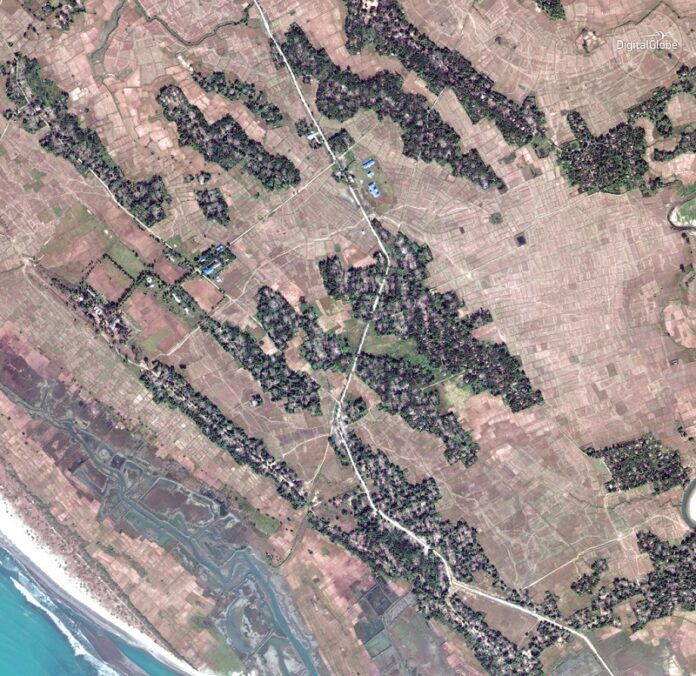
This Dec. 20, 2017, satellite image provided by DigitalGlobe, shows the village of Zone Kar Yar, about 24 kilometers (15 miles) southeast of Maungdaw, Rakhine state, Myanmar. Satellite images of Myanmar’s troubled Rakhine state, released to The Associated Press by Colorado-based DigitalGlobe on Friday, Feb. 23, 2018, show that dozens of empty villages and hamlets have been completely leveled by authorities in recent weeks, far more than previously reported. Photo: Associated Press
BANGKOK — First, their villages were burned to the ground. Now, Myanmar’s government is using bulldozers to literally erase them from the earth – in a vast operation rights groups say is destroying crucial evidence of mass atrocities against the nation’s ethnic Rohingya Muslim minority.
Satellite images of Myanmar’s troubled Rakhine state, released to The Associated Press by Colorado-based DigitalGlobe on Friday, show that dozens of empty villages and hamlets have been completely leveled by authorities in recent weeks – far more than previously reported. The villages were all set ablaze in the wake of violence last August, when a brutal clearance operation by security forces drove hundreds of thousands of Rohingya into exile in Bangladesh.
While Myanmar’s government claims it’s simply trying to rebuild a devastated region, the operation has raised deep concern among human rights advocates, who say the government is destroying what amounts to scores of crime scenes before any credible investigation takes place. The operation has also horrified the Rohingya, who believe the government is intentionally eviscerating the dwindling remnants of their culture to make it nearly impossible for them to return.
One displaced Rohingya woman, whose village was among those razed, said she recently visited her former home in Myin Hlut and was shocked by what she saw. Most houses had been torched last year, but now, “everything is gone, not even the trees are left,” the woman, named Zubairia, told AP by telephone. “They just bulldozed everything … I could hardly recognize it.”
The 18-year-old said other homes in the same area that had been abandoned but not damaged were also flattened. “All the memories that I had there are gone,” she said. “They’ve been erased.”
Myanmar’s armed forces are accused not just of burning Muslim villages with the help of Buddhist mobs, but of carrying out massacres, rapes and widespread looting. The latest crisis in Rakhine state began in August after Rohingya insurgents launched a series of unprecedented attacks on security posts.
Aerial photographs of leveled villages in northern Rakhine State were first made public Feb. 9 when the European Union’s ambassador to Myanmar, Kristian Schmidt, posted images taken from an aircraft of what he described as a “vast bulldozed area” south of the town of Maungdaw.
Satellite imagery from DigitalGlobe indicates at least 28 villages or hamlets were leveled by bulldozers and other machinery in a 30-mile (50-kilometer) radius around Maungdaw between December and February; on some of the cleared areas, construction crews had erected new buildings or housing structures and helipads. A similar analysis by Human Rights Watch on Friday said at least 55 villages have been affected so far.
The images offer an important window into what is effectively a part of Myanmar that is largely sealed off to the outside world. Myanmar bars independent media access to the state.
The government has spoken of plans to rebuild the region for months, and it has been busily expanding roads, repairing bridges, and constructing shelters, including dozens at a large transit camp at Taungpyo, near the Bangladesh border. The camp opened in January to house returning refugees; but none have arrived and Rohingya have continued to flee.
Myint Khine, a government administrator in Maungdaw, said some of the new homes were intended for Muslims. But that does not appear to be the case for the majority of those built or planned so far, and many Rohingya fear authorities are seizing land they’ve lived on for generations.
One list, published by the government in December, indicated 787 houses would be constructed, most of them for Buddhists or Hindus. Only 22 of the houses were slated for “Bengalis” – the word Myanmar nationalists often use to describe the Rohingya, who they say are illegal migrants from Bangladesh.
Myint Khine said the government had no ulterior motive.
“Of course we have been using machines like earth removers and bulldozers because we have to clear the ground first before building new houses,” he said.
Chris Lewa, whose Arakan Project monitors the persecuted Muslim minority’s plight, said the degree to which the villages had been razed would make it even harder for the Rohingya, who have no citizenship and few rights, to ever reclaim their land.
“How will they identify where they lived, if nothing is left, if nothing can be recognized?” Lewa said. “Their culture, their history, their past, their present – it’s all being erased. When you see the pictures, it’s clear that whatever was left – the mosques, the cemeteries, the homes – they’re gone.”
Richard Weir, a Myanmar expert with Human Rights Watch, said on the images he had seen, “there’s no more landmarks, there’s no trees, there’s no vegetation.”
“Everything is wiped away, and this is very concerning, because these are crime scenes,” he said. “There’s been no credible investigation of these crimes. And so, what we’re talking about really is obstruction of justice.”
Both Weir and Lewa said no mass graves were known to have been destroyed. But, Weir added: “We don’t know where all the graves are … because there is no access.”
Zubairia, who asked that only one of her names be used to protect her identify because she feared reprisals, said she did not believe any of the newly constructed homes were intended for Rohingya.
“Even if they give us small houses to live in, it will never be the same for us,” she said. “How can we be happy about our houses being ripped off from our land?”
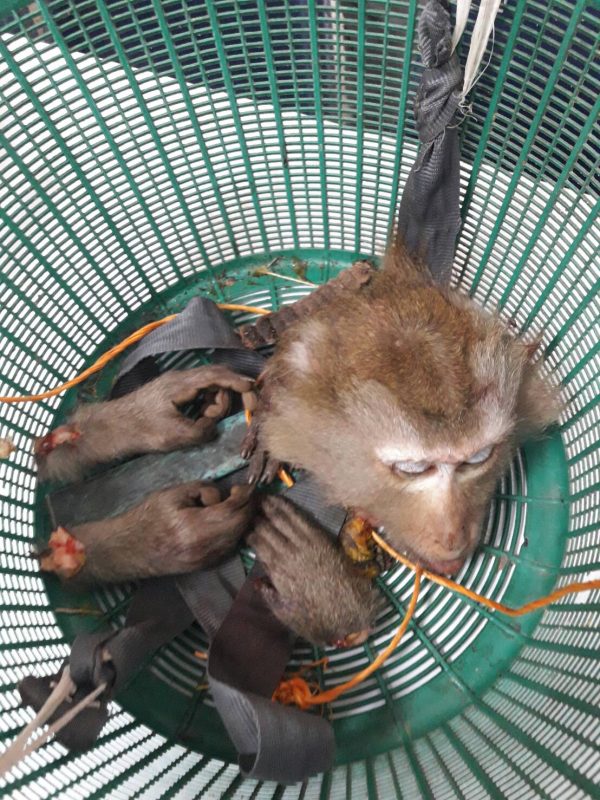
Police and wildlife officials with Nikorn Manpakdee and various macaque remains on Friday in Tak province.
TAK — When police entered Nikorn Manpakdee’s house Friday morning, they found him busy in the kitchen. What was cooking in his kitchen? A severed macaque head, 2 kilograms of skinned macaque meat, and the animal’s legs and arms.
They arrested the 41-year-old Tak man on the spot in Tak’s Nong Bua Naur tambon for allegedly killing the animal on protected forest land.
“The dissected monkey parts are mine. I hunted it in the forest to eat it,” Nikorn told the police of the dismembered, crab-eating macaque.
The severed macaque head hunted by Nikorn Manpakdee, who was arrested Friday morning in Tak.
Lt. Col. Dendiew Dontumpai and wildlife officers confiscated the macaque’s carcass, skinned meat, head, legs and arms. They also took Nikorn’s motorcycle.
Friday morning, locals were putting out a forest fire in the Baan Rai Taa Trakoo Protected Forest when they saw Nikorn ride out of the forest on a motorcycle without license plates. Thinking him suspicious, they called the police who went to Nikorn’s house and found the monkey carcass.
A test of Nikorn’s urine found traces of methamphetamine.
According to Dendiew, Nikorn’s has been in and out of jail repeatedly for theft and drug-related crimes. Nikorn said that this was his first time hunting a monkey.
Police will charge Nikorn with hunting a protected forest animal and possessing a protected animal carcass without a permit.
Under Thai law, crab-eating macaques can be kept in captivity and bred only with an appropriate license.
Junta chairman Prayuth Chan-ocha throws fish food Wednesday at a pond in Nakhon Pathom province. Image: Government House
BANGKOK — About a million people joined the “Thai Niyom” program launched by junta chairman Prayuth Chan-ocha on its first day, according to a government official.
The program, which translates to Thai Way or Thai-ism, will see soldiers dispatched to communities to spread the government’s social principles. Interior affairs minister Anupong Paochinda said soldiers are now being deployed to instruct residents about the initiative, and there is no time frame how long the program will run.
“In each village, about 100 people joined,” Gen. Anupong said. “Excluding Bangkok, the number [of people who joined] is nearly one million.” No data were provided to support the claim.
Touted by the junta leader as a new system to improve the economy, society and even “understanding of Thai-way democracy,” the program officially launched Wednesday with Prayuth touring Nakhon Pathom province.
A day earlier Prayuth summarized his program, which has been criticized as a vague neologism by critics, into 10 points: uniting people through social contracts; not abandoning each other; maintaining happy communities; practicing a self-sufficient Thai way; understanding rights, duties and laws; understanding the bureaucracy; understanding “Thai-way democracy;” raising technology literacy; fighting narcotics; and complying with missions from the state.
The junta chairman said he expects the initiative to reach up to 66 million people – just about the entire Thai population.
Junta critics like former Pheu Thai MP Worachai Hema call it a thinly veiled bid to control the population and campaign for the military government’s ongoing rule.
“This is a sham democracy, because they only tell the people what the government is doing,” Worachai told reporters Saturday. “It’s state officials canvassing for votes while silencing others.”
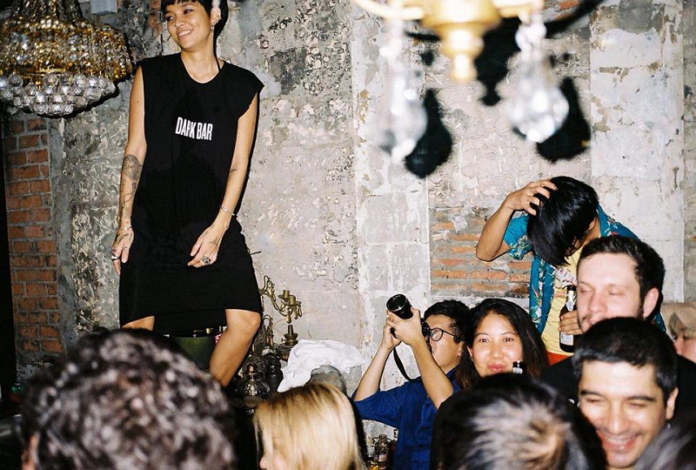
The capital’s underground music scene mourned the loss of a nightlife institution last year after Dark Bar shut its doors once and for all, afflicted by authorities’ progressively tougher measuresto quieten the after-hours party scene in Bangkok.
But its essence endures through events organized by Dark Bar queen, Nodnuanwan “Nod” Tatong, who in December hosted Dark Bar On Tour #1. Next month, fans of the former venue will relive its glory days when the tour makes a second stop at a Silom area club, with the likes of local hero Marmosets supplying techno beats. But before punters go ham, I had a chat with Nod, who told me what she has been up to since the bar’s closure.
During Dark Bar’s heyday, it was impossible not to notice the charismatic and stylish Nod as you walked into the venue. With her signature mop-top hair, lip piercings, tattoos and tribal jewelry, she’d be seen manning the bar on busy nights. On rare occasions she’d enjoy the vibes with punters on the dance floor. “She’s always had her own style. She never followed any trend and never changed her ways,” said Salinee Khemcharas, a longtime fan of the club.
Born and raised in Bangkok, 36-year-old Nod said she was just a normal ‘90s kid growing up who liked to listen to music such as The Cure. She also confessed to being a huge Michael Jackson fan. Nod completed her education in the United Kingdom, where she graduated from the London College of Fashion.
She said her first visit to Berlin in 2012 inspired her to open a venue that could recreate the vibes of that city’s clubs. In 2014, Dark Bar opened for business. Shortly after, it became the place clubbers in the know flocked to every weekend. The hole-in-the-wall venue became famous for its raucous parties and late closing times.
It was this however, that also led to its closure. Nod would soon find out the ways of conservative Thailand would prove to be much different to those of liberal Berlin. Authorities did not welcome late nights and in June last year, Dark Bar closed its doors. Forever.
Never the one to let some authoritarian BS get her down, Nod has done the next best thing and taken the Dark Bar on the road by organizing a series of pop-up events. She took time out of her busy schedule have a chat with me about what’s been going on in her life since the end of Dark Bar.
Mongkorn Timkul: Its been a while since dark bar closed its doors. What have you been up to as of lately?
Nodnuanwan Tatong: I have been studying a lot [at Chanapatana International Design Institute] lately, like interior and product design, meditation, dance and yoga.
MT: Everyone in the underground scene pretty much had an experience at Dark Bar. Can you let our readers know how and why the venue was created?
Nod: I love music, I love partying I love dancing, I have always gone out since I was a teenager. Dark Bar was created after my Berlin trip in 2012. I wanted to create an underground club/bar that remind me of my experiences in Berlin for fulfilling my own passion I guess.
MT: We all know the venue was closed due to pressure from authorities. Do you think things would have remained the same if it was still open?
Nod: Definitely. It would be the same.
MT: What’s your opinion on the current state of Bangkok’s nightlife?
Nod: I feel like when the authorities are getting involved in the scene too much, many people are tired of going out. Anyway, hopefully they will be more supporting in the future. Lately, I hardly go out but if I do will be at Studio Lam, De Commune and Beam.
MT: So dark bar is doing a series of parties. I guess it’s hard to say goodbye to all the music and events after all. What inspires you to keep going?
Nod: The underground scene in Bangkok still inspires me. I want to support and be a small part of it to make this scene better and better.
MT: How did the last party go? And what can Dark Bar fans expect at the next event?
Nod: The last party was great. I enjoyed seeing people having good time. I think the next Dark Bar On Tour will be just like a reunion. The family is back together again just like the old times.
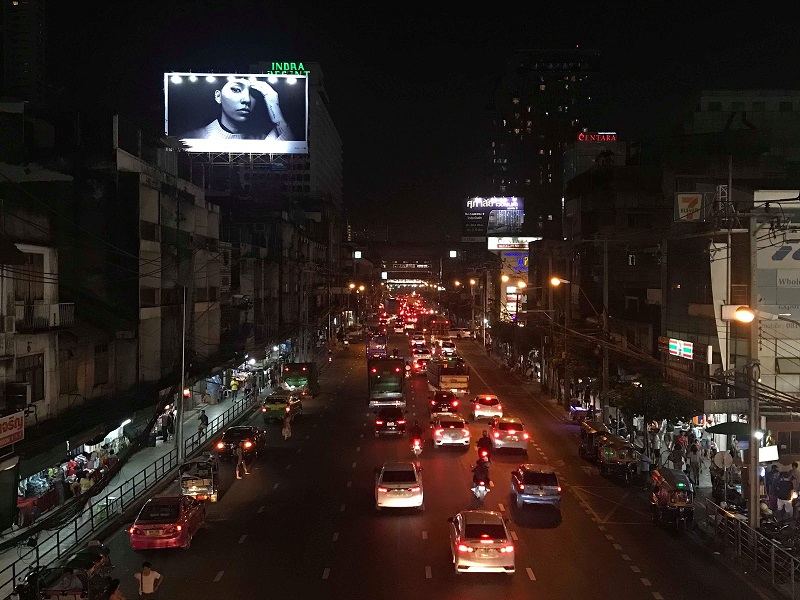
MT: I saw online that there are billboards in Pratunam and in Saint Petersburg, Russia with your picture. What’s that all about?
Nod: I wish I could say, but I can’t ka!
Dark Bar on Tour #2will take place March 2 at Whiteline’s Safe Room in Soi Silom 8. The closest Skytrain stop is BTS Sala Daeng. Entry is 250 baht.
An undated photo of a billboard with Nod’s face in Pratunam.An undated photo of advert showing Nod’s face in a metro station in St. Petersburg, Russia. Photo: Nolens Volens / Courtesy
Election Commission staff demonstrate casting ballots for the August 2016 referendum at a school in Ubon Ratchathani province.
BANGKOK — The junta-appointed National Legislative Assembly on Thursday rejected all seven names nominated to the Election Commission, a move which surprised pundits.
During pre-vote deliberation, some assembly members cited a lack of electoral expertise on the part of nominees, a potential reason for the decision. After Thursday’s results were known, former Election Commissioner Gothom Arya said something wasn’t right and that it appears as if there may have been an “order” for the assembly to vote as it did.
“There must have been an order. The vote was also done in secret so we can’t ask individual [assembly members] why they voted the way they did. This is a headache and I’m at a loss explaining this,” he said.
One month ago, the assembly voted for a procedural measure that threw into doubt the government’s commitment to hold elections in November as promised by junta leader Prayuth Chan-ocha.
A new list of nominees will have to be presented to the assembly within 90 days. All seven received less than half the votes from the 248-member house. Under the organic laws on the Election Commission, once rejected, applicants are barred from re-applying.
Of the nominees, five were selected by a vetting committee while two were picked by the Supreme Court.
Those chosen by the vetting committee were Pracha Tehrat, former deputy permanent secretary of the Interior Ministry, Ruangwit Ketsuwan, former head of Chaiyaphum Rajabhat University, Takorn Tantasith, secretary general of the National Broadcasting and Telecommunication Commission, Issaree Hansacha Rungroj former head of Rattanakosin Rajamangala University of Technology and legal adviser Chomphan Pongcharoen Suthirachat.
Those chosen by the Supreme Court were Chatchai Chanpraisri, a chief judge in the Supreme Court and Pakorn Mahannop, a senior judge.





































 “The prices are admittedly quite high, but we didn’t hang our hopes on the Thai market,” Nalynya said.