BANGKOK — Upon hearing the news, Kiattichai Phongkaew suddenly collapsed on the ground. Crying, he turned to face the Sanam Luang, where smoke lingered in the air above the crematorium, and prostrated.
The cremation of King Bhumibol was already finished, and he had not known until a reporter mentioned it.
“I missed the last chance to send you off, dad,” he said, breaking into tears.
Kiattichai Phongkaew
Like Kiattichai, thousands of mourners waited last night on Ratchadamnoen Avenue to bid farewell to the king they called father. They believed the actual cremation would be broadcast live as it had been done in previous funerals for other royal family members. But that broadcast never came, and no announcement would be made until much later.
In a scene similar to Oct. 13 last year, when well-wishers at Siriraj Hospital were the last to learn the king had died, devout mourners lashed by rain and seared by sun on Ratchadamnoen Avenue had no idea what was going on until they heard from friends watching from home.
The decision not to broadcast the actual cremation seemed to even catch uniformed officials at the event, some of whom said it was merely delayed and still coming, while another simply said he did not know why it wasn’t shown.
By Friday, competing explanations were emerging as to why people were not allowed to witness the cremation of their longest-reigning monarch. But whether it was a last-minute change or just a poorly communicated decision, one fact not in dispute is that it came as a surprise – and disappointment – to the nation.
Mourner sleep early Friday morning on Ratchadamnoen Avenue where they had camped overnight in hope of witnessing King Bhumibol’s actual cremation.
Wanting to Be Close
Those who slept on the sidewalk since Monday nightand tolerated heavy downpours were able to secure places inside the ceremony area starting at 5am on Wednesday.
By Thursday morning, more than 110,000 mourners had filled the royal field, but there were even more people who failed to get access and decided to stay around including on Ratchadamnoen Avenue. They slept on mats and used their bags as pillows. Some were prepared with blankets.
The official televised broadcast schedule did not note the 10pm cremation. It only stated there would be a cremation ceremony at 4:30pm and the next scheduled content was at 8am for the collection of the king’s remains.
Torpong Soonthornvipas vowed to remain until morning with his 7-year-old daughter.
But most people believed they would get to watch the actual cremation because the practice has been done in other royal funerals.
“I don’t know what they all say, but the actual cremation has to happen per tradition,” said Torpong Soonthornvipas, who sat with his 7-year-old daughter and vowed to stay until morning. “It has always been showed every time in the past.”
Reporters were told the live broadcast would run all night, and that public performances marking the end of the mourning period would be suspended during the actual cremation. At 9pm, a Khaosod English reporter at the official press center was told the ceremony would definitely be televised.
Black-clad mourners sit quietly in front of giant screen Thursday night on Ratchadamnoen Avenue awaiting the actual cremation to be televised.
As 10pm was approaching, more people arrived. Fifteen minutes before the scheduled cremation, police allowed more newcomers onto the avenue.
“We can’t get inside Sanam Luang but we will graab the king for the last time together here on the road,” shouted a policeman as he urged people to rush in.
At 10pm, people were still sitting quietly in front of the screen getting ready for a time they never wanted to come. Many meditated. But the screens kept looping a documentary about King Bhumibol’s works. At one point, it cut to show a live orchestra performing in the Sanam Luang.
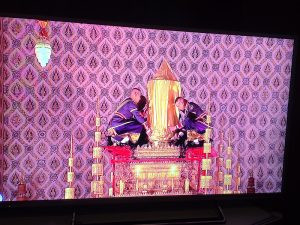
When the time arrived, audience members watching from home saw the coverage cut and replaced with a message: “Royal Cremation of His Majesty King Bhumibol. Everyone is advised to turn toward the Meru Mas and pay their highest respects.”
Those on Ratchadamnoen Avenue saw nothing except the continuing performances and assumed the ritual was delayed.
A Khaosod English reporter at the press center confirmed at 10:38pm that the actual cremation would not be aired. At about 11pm, a royal fire was lit at the replica crematorium on Ratchadamnoen Avenue to burn sandalwood flowers. Next to it, a large screen was still broadcasting an orchestral performance.
By that time, the crowd was confused and reluctant to leave. No official announcement was made. Some decided to leave, while others refused and chose to stay.
Kanokwan Rattanaphoom, 25, broke into tears after hearing the cremation had happened.
Despite looking visibly agitated, Kanokwan Rattanaphoom said she was not disappointed. The 25-year-old broke into tears after hearing the cremation had happened.
“I came from Satun province, arriving in Bangkok last night,” she said wiping tears away. “I slept here in the road last night in the hope of seeing it.”
According to another Khaosod reporter, a palace media liaison informed some reporters at about 10pm, when the cremation was scheduled to begin, that it would not be televised because the king’s successor, His Majesty the King Rama X, had deigned it a “private affair.”
It was at 11:16pm that government spokesman Sansern Kaewkamnerd announced the broadcast and ceremony had ended and coverage would resume in the morning. He did not elaborate on why the actual cremation was not televised.
Ten minutes later, smoke emerged from the top of crematorium, and that was when more people were convinced, despite being so close to where it happened, they had already missed the time they had waited a lifetime to experience.
Smoke lingers in the air above the crematorium.
‘Mai Pen Rai’
Online, some speculated that it might have been for sake of privacy of the king’s wife, Queen Sirikit, who has been ailing and out of the public eye for several years.
Asked why they thought the cremation was done in secret, mourners on the street had different opinions. Most went along with common-sense rationales.
“It’s a private ceremony and should be exclusive for royal family members,” Kiettisak said. “They tried to appear to be strong for the whole day, now we need to give them some private time.”
Mourners sleep on Ratchadamnoen Avenue early Friday morning.
Thai Buddhist traditions regard actual cremation as an exclusive ritual for family members and close friends. Guests are only allowed to attend the symbolic cremation. However, recent royal funerals including those of King Bhumibol’s mother and sister allowed the public to witness by televised video.
“They probably didn’t want mass grieving to happen,” another man said. “It would have been difficult for people to cope if they had seen it.”
The confusion wasn’t limited to Ratchadamnoen Road but was felt nationwide. On the country’s most popular webboard Pantip, many users raised the question of why it was skipped. The common response was the same.
“Don’t expect it based on our familiarity,” wrote member No. 786797 in the top comment. “We revere King Rama IX as father of the nation, somebody regards him as their own father. But in reality, he is only the father of the four royal highnesses. … Even the actual cremations of commoners are done exclusively for their families.”
Some even suggested that expectations to be able to watch it were inappropriate.
“They are very headstrong. I feel sorry for dad,” another comment said.
Ekachai Hongkanwan holds a book on Thai democracy last June. Photo: Ekachai Hongkangwan / Facebook
BANGKOK — A man who was sent on an “excursion” outside Bangkok by soldiers for publicly vowing to wear red during the royal cremation of King Bhumibol will be brought home tomorrow, a civil rights lawyer said Friday.
Eleven soldiers raided Ekachai Hongkangwan’s residence Wednesday after he announced on Facebook that he would don a red shirt and go out to do something “unexpected” the day the late monarch was to be cremated.
Ekachai’s associate Anon Nampha said the 42-year-old former lese majeste convict phoned him Thursday and told him he had been confined to a resort in Kanchanaburi province. Ekachai said he would be brought back to Bangkok on Saturday, according to Anon, who has represented many rights activists.
“He didn’t say who he was staying with,” Anon said by phone. “He only said the soldiers will bring him back on the 28th.”
Ekachai did not answer his phone on Friday. Before his detention on Wednesday he insisted he was merely exercising his rights.
“It’s like those who don’t feel like it have the right to not wear black. Why should everyone have to wear black? I for one don’t want to,” Ekachai said.
It was in November 2015 he was released after nearly three years in prison after being convicted of royal defamation for selling CDs with foreign news reports about the monarchy. He is well known for his provocative stunts and protests aimed to draw attention to controversial issues, such as the disappearance of a historic plaque in April. His activism has often ended in his arrest or detention.
In the run-up to Thursday’s cremation ceremony, the government urged the public to wear black. The mourning dress code is in place until Sunday.
BANGKOK — It’s not too late to put together an outfitthat will win best costume at the city’s nightclubs.
Mourning is just beginning to lift following the cremation of King Bhumibol, and Bangkok only has a few Halloween parties and events on the calendar.
Starting tonight and running through next week at bars and clubs, here are some worth checking out. If revelers are not really into costumes and large crowds, they can also sit in the back row of a private alt-cinema to watch some spooky flicks.
Cinema Winehouse Spooktacular at Cinema Winehouse
‘The Rocky Horror Picture Show’
Starting tonight and running through Halloween night on Tuesday, a bar-restaurant-cinema-lounge will show a double feature as part ofCinema Winehouse Spooktacular. The films range from American horror comedies “Young Frankenstein” and “Ghostbusters” to cult classics such as “The Shining” and “The Rocky Horror Picture Show.”
Barflies who intend to catch a show are advised to sit in the lounge upstairs since the projector is located at the top.
Cinema Winehouse is located near the old quarter in Soi Samsen 1.
Dia de los Muertos: Psy Fest at The Overstay
A hostel-underground music venue will host a thrilling night for the Halloween-adjacent Mexican festival of Dia De Los Muertos, or The Day of the Dead.
A live performance by trance music crew Psyhead Community’s DJ Gummy, John Lee, Pzychobiz and more will work over the deck at The Overstay’s Dia de los Muertos: Psy Fest, starting at 9pm on Tuesday and going “very late.”
Admission is free. The Overstay is located near Soi Charansanitwong 40 and can be reached via motorcycle or taxi from the Phra Pinklao pier.
Dia de los Muertos – Halloween Party at Revolucion Cocktail Bangkok
Come up with a passable sugar skull, floral crown and skeleton outfit and get a free shot.
At Dia de los Muertos – Halloween Party, DJ Paul will be in charge of the dance floor with a live set. Anyone who shows up in a Halloween costume get free shots.
Admission is free. The party runs from 7pm on Tuesday until early Wednesday. Revolucion Cocktail Bangkok sits on Soi Sathorn 10 and can be reached from BTS Chong Nonsi.
Road to Hell at Mixx Discotheque
Slip some fangs in and add some red skin color if you’re into hip-hop, or go green and blue if you’re there for the house music.
Go to that tourist and expat favorite late-night joint that is Mixx for Road to Hell, where Halloween celebrants are dared to dress as devils or “sea demons” (Lovecraft or Jack Sparrow variety unclear) and go wild with hip-hop, R&B, house and trance music.
Those with the most-appreciated costumes will get “prizes.”
Doors open at 10pm Tuesday and stay open until late. Mixx is located in the basement of the Intercontinental Hotel, a short walk from BTS Chit Lom.
Monsters Ball Halloween Party at Koi Lounge Bangkok
Photo: Koi Lounge Bangkok / Facebook
It will be a very special hip-hop Halloween at this restaurant-lounge in Soi Sukhumvit 20.
Koi Lounge invites revelers to dress up and dance to hip-hop and swing some swag at its Monsters Ball Halloween Party.
DJ Birz of Bangkok Invaders will provide the music from 9pm on Tuesday early into Wednesday.
Koi Lounge Bangkok is located in Soi Sukhumvit 22. The nearest transportation is BTS Asoke.
A woman holds a portrait of the late King Bhumibol and a child on Thursday in Bangkok.
The final page turned last night on the 70-year reign of King Bhumibol Adulyadej, who was laid to rest in a grand cremation ceremony. The late king had admirers and detractors, but one thing is certain: His impact on the Thai nation was such that our national identity has become tied to him.
He is dubbed “father of the nation.” We believe this land, this Thailand, belongs to the father, and that we the people are his children. Thailand is a multi-ethnic and multicultural patchwork of former petty kingdoms, fiefdoms and a sultanate. We are taught that it is our common reverence for the late king that defines our collective identity as a single, united people – however fragile that unity has been exposed for during the past decades’ political turmoil.
As the nation celebrates his life and mourns his passing, we should now look to the future. Pertinent to that future is that we, his children, need to grow up and be children no more.
And how childish we have been.
Irresponsibly, as spoiled children, throwing tantrums and committing violence when we don’t get what we want. Disagreements break down in episodes of rage, threats, censorship, bans and punishments. Losing leads to rule-breaking, burning and destroying. Military coup d’etats are applauded because we’ve lost faith in freedom, democracy and the rule of law.
It’s time to grow up. One measure of being responsible grownups is the ability to deal with differences and disagreements through intelligence and understanding.
Good children learn from the wisdom of their father; responsible adults live it. The following quote from the late king spoken on Dec. 4, 2005, are words we should live by:
“If you say that the king cannot be criticized, it suggests that the king is not human. … If someone offers criticisms suggesting that the king is wrong, then I would like to be informed of their opinion. If I am not, that could be problematic. … If we hold that the king cannot be criticized or violated, then the king ends up in a difficult situation.”
Since 1908, Thailand’s lese majeste law, Criminal Code Section 112, has made it illegal to defame, insult or threaten the king, queen, heir-apparent or regent. The punishment is three to 15 years imprisonment per count. The law is meant to protect the sanctity of the institution of the monarchy.
But instead, lese majeste has been misused as a political tool to intimidate, silence and jail political dissidents and ordinary citizens. Those who abuse the letter of the law get away with it because the rest of us breathe the air of mistrust and paranoia.
Defamation, insult and threat aside, we become enraged at the thought anyone could be critical of the late king, or the monarchy. Enraged to the point of justifying locking someone up for 15 years or longer. Enraged to the point of supporting dictatorship over democracy.
Be that as it may, the law is the law, and as responsible citizens we should respect it, even if we disagree with it. But that doesn’t mean we shouldn’t – or can’t – voice disagreement and work toward amending the law.
Today, Thailand is a nation ruled by fear. We dare not speak, write, post, discuss, debate or disagree for fear of a range of punishments – from becoming a victim of a social witch hunt or government detention to suffering those years in prison ourselves.
During the past year, in celebrating the late king’s life, numerous quotes and speeches attributed to him have been published. All of them echo the late king’s character: He was a man of intelligence and compassion, not hate and vengeance. He spent his life uniting the people, not tearing us apart. In his own words, he wanted us to be critical, not cowed in fear.
Why then do we not follow his example?
There will always be those who abuse the law for political or material gain. Those who corrupt the minds of others for personal interest. Those who rob from the land for their own purses. Those who trample on human rights and liberties to steal power.
They only get away with it because the rest of us sit by as unaccountable children. We let them. We remain silent due to fear. At times we even cheer them on, because factionalism blinds our judgement. The abuse of the lese majeste law. The detention cells. The banning and censoring. The hate, rage and witch-hunting. This is not how we honor the father of the nation.
The past is for us to learn from; the future is for us to build upon. Today we live in a society ruled by fear and paranoia; tomorrow we must build a society that is open and free. Pertinent to that future is not only that we need to grow up, but also that we should want better things for our own children.
This should be how we honor the legacy of the late King Bhumibol Adulyadej.
Ed. note: Khaosod English is delighted to welcome Voranai Vanijaka as a regular columnist. Now editor-in-chief of GQ Magazine Thailand, Voranai is a former weekly newspaper columnist famous for his political and cultural commentary.
A mourner puts her head on the ground as the procession carrying Rama IX’s urn passes Friday morning at Sanam Luang.
BANGKOK — Devoted mourners slept overnight around the Sanam Luang after King Rama IX’s cremation to pay their respects to a procession carrying his urn that passed by Friday morning.
In the thousands, they spent the night on litter-strewn sidewalks near the royal field after the king’s cremation to prolong their goodbyes. In the largest sleepover experience many had ever been through, mourners shared collective experiences of adoration of King Rama IX.
Others travelled into the area by foot, with many roads still blocked off. After the actual cremation went untelevised, many who had already camped in the area for days stayed until morning in hope of seeing the urn procession.
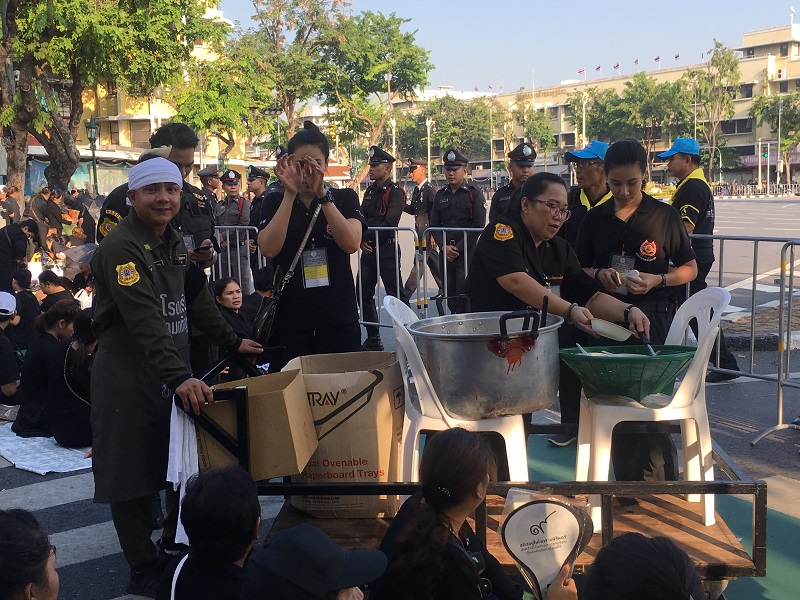
Volunteers handed out food and supplies all night to those who slept over. Some reported seeing a flock of nine white birds take flight near the time of the cremation, symbolizing a supernatural tribute to the king.
Prayoon Bamrungrat, 63 and her husband Udom Bamrungrat, 70 Friday morning.
Prayoon Bamrungrat, 63 of Chumphon, her husband Udom Bamrungrat, 70, were still sitting at 9am on the uncovered street near an offering spot at the Government Lottery Office. There they watched a screen showing the procession transporting King Rama IX’s urn to the Grand Palace.
The pair had come from Chumphon by train with kilos of sticky and mashed rice they had brought to hand out to fellow mourners.
Prayoon Bamrungrat, 63, of Chumphon.
“When we got to Thonburi train station in Bangkok we couldn’t find any transportation at nighttime, so we had to walk. Normally my body is weak, and it hurts to walk so much. But I wanted to see my royal father so I walked here with my husband,” Chumphon said.
The couple had camped out in the Sanam Luang area since Wednesday and knew they wouldn’t be able to witness the actual cremation.
“We tried to walk as close as we could. At least to see the spire of the crematorium would have been good,” Prayoon said. She and her husband slept on the ground after the cremation.
Prayoon and Udom own a 10-rai (1.6-hectare) farm in Chumphon, where they have incorporated King Rama IX’s teachings of sufficiency by keeping a fish pond along with their rambutan, durian and mangosteen crops.
“It increased our income. Everything in our orchard is symbiotic because of him. I will hold onto his teachings forever,” Prayoon said.
The auntie from Kalasin
Chusri Rojanakorn, 68.
“The sky couldn’t hold in her tears, so she cried,” said Chusri Rojanakorn, 68, to account for the rain she said fell after the cremation was concluded.
Chusri had been in the Sanam Luang area since Thursday morning and by 11pm had secured a spot as close to the royal field as she could manage
“During the ritual, I felt that sky was clear and cloudless. But after it finished, heavy rain poured down, like the sky couldn’t hold in her sadness anymore,” Chusri said.
In the heat of the day, Chusri couldn’t eat the food given by volunteers.
“My heart was blocked up. I couldn’t speak. I kept thinking about all he did for Thais, like planting rice, rearing animals and creating jobs,” she said.
“In all my 68 years, I’m so proud to have been born in the reign of Rama IX,” Chusri said. “No matter in which backwater area we lived in, he reached us and never left us.”
The Medical Team
Amornrat Rakraoi, at far right in red backpack, was among volunteer medics.
Anthaporn Rakroi, 35, a volunteer on one of 21 medical teams deployed for the royal funeral, handed out supplies and provided aid throughout the night.
“Some of the people on my team were recovering from colds, but we are proud to serve our fellow citizens who came to say their last goodbye,” Anthaporn said. “Ten, 20 years from now I hope all the volunteers can tell their children that Rama IX was the father who gave everything to us without tiring.”
Anthaporn Rakroi, 35.Mourners at about 7am walk across Somdet Phra Pinklao Bridge.Nurses and volunteers hand out medical supplies by the crematorium Friday morning.
A volunteer fans fellow mourners 9am Friday.Mourners squat at about 9am near Sanam Luang.
Mourners squat and prostrate themselves before the procession carrying Rama IX’s urn passes by.
Officials scatter the ashes of sandalwood flowers in a ceremony in Hua Hin, Prachuap Khiri Khan province
BANGKOK — Within hours after King Bhumibol was cremated, the ashes of offerings made nationwide were scattered Friday morning in canal, river and sea.
Ceremonies that saw mourners leave sandalwood flowers morning through night yesterday concluded with officials taking the ashes to be poured into the kingdom’s waterways.
In Prachuap Khiri Khan, officials poured ashes into the gulf at Hua Hin while those in the northeastern province of Nong Khai performed a ceremony in the Mekong River.
This symbolic act reflects the common cremation tradition of scattering ashes of the deceased into waterways for their historic and cultural significance.
Officials in Nong Khai province poured ashes into the Mekong River.Official scatter flower ashes in the Mae Klong River in Kanchanaburi province.Officials in Phitsanulok province pour ashes into the Nan River.A monk and officials pour flower ashes into the Huai Luang Canal in Udon Thani province.Officials perform an ash scattering ceremony at Surin’s Huai Tab Tan canal.
An overhead view of President John F. Kennedy's car in Dallas motorcade on Nov. 22, 1963, image provided by the Warren Commission as Exhibit No. 698. Special agent Clinton J. Hill is shown riding atop the rear of the limousine. Photo: Warren Commission
WASHINGTON — President Donald Trump blocked the release of hundreds of records on the assassination of President John F. Kennedy, bending to CIA and FBI appeals, while the National Archives came out Thursday night with a hefty cache of others.
“I have no choice,” Trump said in a memo, citing “potentially irreversible harm” to national security if he were to allow all records to come out now. He placed those files under a six-month review while letting 2,800 others come out, racing a deadline to honor a law mandating their release.
The documents approved for release capture the frantic days after the Nov. 22, 1963, assassination, during which federal agents madly chased after tips, however thin, juggled rumors and sifted through leads worldwide.
They include cables, notes and reports stamped “Secret” that reveal the suspicions of the era — around Cubans and Communists. They cast a wide net over varied activities of the Kennedy administration, such as its covert efforts to upend Fidel Castro’s government in Cuba.
For historians, it’s a chance to answer lingering questions, put some unfounded conspiracy theories to rest, perhaps give life to other theories.
Despite having months to prepare for disclosures that have been set on the calendar for 25 years, Trump’s decision came down to a last-minute debate with intelligence agencies — a tussle the president then prolonged by calling for still more review.
The delay sparked a round of finger-pointing among agencies and complaints that Trump should have released all records.
Roger Stone, a sometime Trump adviser who wrote a book about his theories on the assassination, urged Trump to review personally any material that government agencies still want to withhold. Trump should at least “spot check” any extensive redactions to make sure agencies are not “dabbling in acts of criminal insubordination,” Stone said in a statement.
As for the unreleased documents, Trump will impress upon federal agencies that “only in the rarest cases” should JFK files stay secret after the six-month review, officials said.
In the meantime, experts will be poring through a mountain of minutiae and countless loose threads in search of significant revelations.
In the chaotic aftermath of the assassination, followed two days later by the murder of the shooter, Lee Harvey Oswald while in police custody, FBI Director J, Edgar Hoover vented his frustration in a formerly secret report found in the files. It opened: “There is nothing further on the Oswald case except that he is dead.”
But, reflecting on Oswald less than an hour after he died, Hoover already sensed theories would form about a conspiracy broader than the lone assassin.
“The thing I am concerned about, and so is (deputy attorney general) Mr. Katzenbach, is having something issued so we can convince the public that Oswald is the real assassin,” he said.
He also reported: “Last night we received a call from our Dallas office from a man talking in a calm voice and saying he was a member of a committee organized to kill Oswald.”
Hoover said he relayed that warning to Dallas police and was assured Oswald would be sufficiently protected. Oswald was shot dead the next day by Jack Ruby.
A document from 1975 contains a partial deposition by Richard Helms, a deputy CIA director under Kennedy who later became CIA chief, to the Rockefeller Commission, which was studying unauthorized CIA activities in domestic affairs. Commission lawyers appeared to be probing for information on what foreign leaders might have been the subject of assassination attempts by or on behalf of the CIA.
A lawyer asks Helms: “Is there any information involved with the assassination of President Kennedy which in any way shows that Lee Harvey Oswald was in some way a CIA agent or agent” — here the document ends, short of his answer.
Among the files is a more than 400-page document that appeared to describe people being monitored as potential threats to Kennedy and his successor, Lyndon B. Johnson.
Officials described one such person this way: “Subject participated in pickets against JFK in 1961. Allegedly trained in guerrilla tactics & sabotage. Considered very dangerous by those who know him. Has visited USA & Cuba. Considered armed and dangerous.”
Some suspicions missed the mark badly.
One document describes a person who sent a letter to Johnson in December 1963 stating “you’re doomed.” The document says: “Interviewed 1/23/64; friendly. Said letter was a joke. Not dangerous. Attending 5th grade.”
The collection also discloses a Sept. 14, 1962, meeting of a group of Kennedy’s senior aides, including brother Robert, the attorney general, as they discussed a range of options against Castro’s communist government.
The meeting was told the CIA would look into the possibility of sabotaging airplane parts that were to be shipped to Cuba from Canada. McGeorge Bundy, JFK’s national security adviser, cautioned that sensitive ideas like sabotage would have to be considered in more detail on a case-by-case basis.
Much of Thursday passed with nothing from the White House or National Archives except silence, leaving unclear how the government would comply with a law requiring the records to come out by the end of the day — unless Trump was persuaded by intelligence agencies to hold some back.
White House officials said the FBI and CIA made the most requests within the government to withhold some information.
Trump ordered agencies that have proposed withholding material related to the assassination to report to the archivist by next March 12 on which specific information meets the standard for continued secrecy.
That standard includes details that could cause “harm to the military defense, intelligence operations, law enforcement or conduct of foreign relations,” Trump wrote in his order. The archivist will have two weeks to tell Trump whether those recommendations validate keeping the withheld information a secret after April 26.
The full record will still be kept from the public for at least six months — and longer if agencies make a persuasive enough case for continued secrecy.
The collection includes more than 3,100 records — comprising hundreds of thousands of pages — that have never been seen by the public. About 30,000 documents were released previously — with redactions.
Whatever details are released, they’re not expected to give a definitive answer to a question that still lingers for some: Whether anyone other than Oswald was involved in the assassination.
The Warren Commission in 1964 concluded that Oswald had been the lone gunman, and another congressional probe in 1979 found no evidence to support the theory that the CIA had been involved. But other interpretations, some more creative than others, have persisted.
King Maha Vajiralongkorn, or Rama X, participated in a religious ceremony Friday to collect the ashes and relics of his father, King Bhumibol, or Rama IX.
BANGKOK — King Maha Vajiralongkorn, or Rama X, participated in a religious ceremony Friday to collect the ashes and relics of his father to be moved to special locations for further Buddhist rites.
King Bhumibol Adulyadej was cremated in a specially built crematorium in Bankgok’s royal quarter late Thursday as part of an elaborate five-day funeral capping a year of mourning.
As part of Friday morning’s ceremonies, Bhumibol’s relics were to be taken to the Dusit Maha Prasad Throne Hall and his ashes to a shrine in the nearby Temple of the Emerald Buddha.
On the final day of the funeral, the relics will be enshrined in part of a Grand Palace throne hall known as the “Heavenly Abode” and the ashes will be enshrined at two temples, Wat Rajabopidh and Wat Bovoranives, in Bangkok.
Smoke lingers in the air above the crematorium Thursday in Sanam Luang.
By Teeranai Charuvastra, Sasiwan Mokkhasen and Pravit Rojanaphruk
Additional writing and reporting Asaree Thaitrakulpanich Chayanit Itthipongmaetee and Todd Ruiz
BANGKOK — For much of its history, the field in front of the spectacular Grand Palace has sat empty. Commoners mostly use it as a park, flying the kites it has become associated with.
Thais know it by the modern, innocuous-sounding name of Sanam Luang, or Royal Field, but its official English name retains its true meaning: the Royal Cremation Ground. For centuries its grassy expanse has stood as a mortal reminder to the rulers in the palace next door: memento mori.
On Thursday, the Sanam Luang hosted its most-watched funeral ever.King Bhumibol, or Rama IX, the most revered monarch in modern Thai history, who died at 88 in October 2016, was cremated some time between 10pm and 10:30pm in an ancient ritual after nearly a year of preparation.
In Buddhist tradition, the cremation is a final farewell to the dead. Hence, for many Thais, the flames ignited Thursday night symbolized the true end of his reign, which spanned seven decades, and heralded a new era of royal rule under his appointed heir,King Vajiralongkorn, or Rama X.
“I’m here to say farewell to him, to show my love for him,” said Suthida Ketthong, who took time off from her work to volunteer and sleep rough at Sanam Luang for past two days. “This is the last chance in my life to do it, so I’m giving my best.”
On Friday, the palace said 157,000 people were in and around the Sanam Luang for the ceremony.
Despite meticulous planning and stagecraft, the rites fell more than an hour behind schedule and millions of viewers watching the only video stream allowed were denied a final farewell when the actual cremation was unexpectedly cut from the broadcast at the last minute.
With great pomp, Thursday began with a long, slow-moving procession transporting the royal urn to the crematorium in the Sanam Luang, though the king’s remains had apparently been moved Wednesday nightin a secret rite. The head of the ruling junta and military government, Gen. Prayuth Chan-ocha, was among hundreds of uniformed marchers.
By 2:30pm, the urn had been raised by a series of mechanical lifts to its place atop the pyre. King Rama X was observing from a pavilion directly west of the structure before departing by vehicle just before 3pm.
Show of Unity
What was a day of sorrow for the tens of thousands of mourners gathered to bid farewell to to the late king was also a day of pride for those who helped make the massive ceremony happen.
Terms like “once in a life time” and “part of a history” were heard time and again.
“This is the proudest moment of my life,” Sgt. Watcharapong Chumnigul, an army musician who played anthems for today’s funerary rites, said during a break. “I am here to represent my family.”
The Great Victory Chariot bearing the royal urn arrives Thursday at the temporary funerary complex in Bangkok’s Sanam Luang.
The atmosphere has mixed respectful silence during major ceremonial moments – such as the moment arrival of the urn – and casual relaxation. Volunteers and medics took care of spectators by handing out food, water and smelling salts to lessen the effects of the searing heat glaring down on them most of the day.
“I am here to represent my family … it was hot out there, but this is the biggest pride of my life,” said Sgt. Watcharapong Chumnigul, who plays saxophone for the 11th Army Circle, with a smile as he sat with his bandmates during a break.
The ceremony was rigorously choreographed – not just for the troops marching in the funerary procession, but for mourners and the press.
Astrict dress code and ban on any colorful items were imposed. Selfie sticks were banned. The crowds had been warned to refrain from playful behavior or giggling. An army of volunteers and security forces spread around the site to look for any inappropriate behavior.
Great care went into producing a singular image of national unity and discipline through a spectacle that was often visually stunning. The media was not allowed to livestream its own footage within the cordoned-off ceremony area and instead had to run government-supplied footage.
Looming over the Sanam Luang’s field was the 50-meter-high meru, or funeral pyre complex, and its surrounding structures, each decorated inornate traditional craftsmanship and ancient symbolism.
Absent from the public eye throughout the ceremony was King Bhumibol’s wife of 66 years, Queen Sirikit. Her Majesty has been ill and made few public appearances in recent years.
A Day of Silence
Thirteen kilometers away, stillness had fallen on the usually lively streets that are the capital’s beating heart. On Thursday, the real heart of the nation was not at Siam or Thonglor when all roads led to the Sanam Luang.
Rama I Road from Phloen Chit to Chit Lom was a ghost town with all businesses, shopping malls and ubiquitous 7-Eleven stores closed. No workers were toiling at construction sites. At 2:30pm, the road was blocked more than an hour for foreign dignitaries traveling to join the symbolic cremation. Gawking at them from the sides of the road were mostly tourists.
But in part of the Siam area, Rama I Road was far from desolate. From CentralWorld to Siam Paragon, thousands of black-clad mourners queued for hours to pay their last respects to King Bhumibol by offering flowers. Some tourists joined in the line for the experience.
“This is kind of a once-in-a-lifetime experience, so we want to see it from Thailand’s citizens’ point of view,” said American tourist Mary Beth Coleman. “In my lifetime, I don’t think I have ever seen the entire country remember one person in such a unified way.”
Those who could not go to the Sanam Luang had such places nationwide to personally offer sandalwood flowers, which were burned as part of the royal cremation. They resembled daffodils, reportedly the king’s favorite flower when he was in Switzerland. The wood’s fragrance is said to lead the souls of the dead to heaven; the ashes were scattered Friday morning in waterways throughout the realm.
In a symbolic gesture of national unity, the flames that lit the real cremation pyre as well as the replicas nationwide shared the same source. They were all lit by the hand of King Vajiralongkorn one week prior.
In other areas of the town, the atmosphere was gloomy. All outdoor screens, even commercial displays like those at BTS Skytrain stations, showed only the same official live broadcast. People, even most tourists, wore all black. Playing everywhere were songs either composed by King Bhumibol or dedicated to him. Entertainment areas such as Soi Cowboy went dark for three days. In landmark areas such as Victory Monument, volunteers offered free rides to the ceremony area as well as free food and drinks.
King Rama X was tardy returning in the late afternoon from his palace respite as princes, premiers and dignitaries frommore than 40 nations arrived for the mock cremation, which did not occur until nearly an hour and a half after it was scheduled.
Those mourners with eyes on the crematorium were the dedicated – and lucky ones. Most had camped for days, huddling fromrain storms and searing sunshine for coveted spots around the Sanam Luang and a hard-fought, front-row seat to the historic end of a reign.
Mourners sit behind a fence as they await the commencement of funerary rites Thursday at Sanam Luang.
But when the clock struck 10pm – the appointed time of the most-anticipated ritual, the actual cremation of King Bhumibol – state television broadcasts abruptly ended. The coverage was replaced with a message reading “Royal Cremation of His Majesty King Bhumibol. Everyone is advised to turn toward the Meru Mas and pay their highest respects.”
At the same time, the traditional masked Khon dance playing before the funerary complex was suspended for half an hour. At the same time, prayers were heard chanted from the pyre. But no announcement or explanation was made, leaving the crowd of mourners confused.
When rumor spread the cremation would not be broadcast at all, reporters rushed to the Sanam Luang where officials said the flames had already been lit. On three stages erected on the northern part of the field, theatrical performances were staged and other acts of entertainment marked the end of the ceremony.
At 11pm, a palace statement confirmed that King Vajiralongkorn had presided over the cremation of his father half an hour earlier.
Asked why the cremation had not been televised, an official wearing an official ID of His Majesty’s household staff just smiled and said, “I don’t know.”
White Smoke
At about 11:25pm, a plume of white smoke became visible above the Meru Mas, convincing those present the cremation was over. Shouts and gasps went up. Mourners fell to their knees, their hands clasped in prayer. Many were sobbing, but their cries were drowned out by the cacophony of music playing in the background.
For thousands who could not access the Sanam Luang, Ratchadamnoen Avenue was the closest they could get. Many had traveled hundreds of kilometers from across the nation, camping out overnight in hope of witnessing the actual cremation via large video screens while also being physically near to it.
Torpong Soonthornvipas vowed to remain until morning with his 7-year-old daughter.
But an hour after the scheduled time had passed, there was no official announcement on why the screens continued to show an orchestra play instead of the cremation ceremony. The reluctant crowd did not show much sorrow or disappointment, but said they were unsure whether they should leave.
Until a royal fire was lit at the replica crematorium on Ratchadamnoen Avenue at about 11pm to burn sandalwood flowers, some people were convinced the cremation already happened off-camera. Smoke could later been seen around the top of crematorium from there, and a lot of people decided to leave. However, some refused to believe this and remained.
“I don’t know what they all say, but the actual cremation has to happen per tradition,” said Torpong Soonthornvipas, who vowed to remain until morning with his 7-year-old daughter.
‘King of Kings’
Both admirers and critics acknowledge King Bhumibol as one of the most influential leaders in Thailand, if not Southeast Asia. Born in the United States in 1927 as an obscure princeling, Bhumibol would later become a king who transformed not only Thai political ecology but the regional balance of power during the Cold War.
While his elder brother, Ananda, ruled the country as the young King Rama VIII, Bhumibol grew up in Switzerland where he cultivated a love for jazz, skiing and racing. After Rama VIII wasshot dead under mysterious circumstances in the bedroom of his palace in 1946, the throne passed on to Bhumibol, who was later crowned Rama IX.
He also inherited a royal family stripped of much of its former glory in the wake of the 1932 revolution,which ended absolute monarchy. But under Bhumibol, and aided by well-read court advisers and royalist generals, the institution saw a revival in terms of power and popularity.
Military coups in 1947, 1967 and 1968 gradually restored traditional influence to the monarchy. King Bhumibol started touring the country to visit his royal subjects and initiated infrastructure projects to improve their livelihoods, the images of which immortalized the monarch.
Abolished rituals were revived, including the act of groveling with the forehead touching the ground to pay respect to the king.
His charisma helped. One biographer called him the king who never smiled, in reference to the quest of national salvation King Bhumibol believed he was undertaking, which made him come across as a stern leader with rare displays of emotion.
Under military autocrat Sarit Thanarat, a close aide to King Bhumibol, Thailand also sided decisively with the United States and joined its crusade against Communism in the region. In their book “A History of Thailand,” writers Chris Baker and Pasuk Phongpaichit noted a symbiosis among the two sides.
“Sarit and the USA oversaw a revival of the monarchy following its partial eclipse since 1932,” Baker and Pasuk wrote, “Both the generals and their US patrons believed the monarchy would serve as a focus of unity, and a force for stability, while remaining susceptible to their control.”
Since he ascended the throne 70 years ago, King Bhumibol has evolved to bea fatherly and saintly figure whose popularity was undimmed throughout the tumultuous cycles of coups, uprisings and crackdowns.
When Thailand entered an era of democratic parliamentary government, the monarch was seen as “above politics,” meaning he hovers above the bickering and conflicts, only intervening and providing wisdom when the nation needs him.
There were tragedies during his reign, such as a1976 massacre of students by security forces and paramilitaries. A pivotal moment came in May 1992 when the king prevented further bloodshed by summoning leaders of an ongoing political feud – military ruler Suchinda Kraprayoon and opposition leader Chamlong Srimuang – after 52 people were killed soldiers in a crackdown on street protests.
360° Royal Funeral for King Rama IX
Television footage of the meeting shows King Bhumibol asking the two sides to make amends, in the same manner that a father would chide his offspring. Gen. Suchinda later resigned, but not before granting himself amnesty.
“When people act in violence, they forget themselves. In the end, they don’t know why they were fighting in the first place. Then how can they hope to solve any problem?” the king said. “What use is a pride of being a victor when they stand on the ruins of destruction?”
King Bhumibol later receded from the scene in the last decade of his life, beset by a growing number of illnesses. He was largely confined to Siriraj Hospital, at a time of unprecedented political conflict that split the country into two factions of Redshirts and Yellowshirts. Many looked for his guidance in vain.
On Oct. 13, 2016, in the year the country marked the 70th anniversary of his reign, King Bhumibol Adulyadejdied at 88.
To millions of Thais, Bhumibol was the “Father of the Nation,” a tireless ruler who brought tremendous development to the country, and a divine being. He is remembered for 4,000 plus royal projects that helped alleviate hardship in rural areas, and an endless reservoir of royal teachings replayed and repeated on a daily basis on radio.
The admiration for the late monarch is genuine, but it was cultivated before a backdrop of repression. Any act deemed negative to the monarchy is not only taboo, but illegal. A royal defamation law, known aslese majeste, carries a maximum penalty of 15 years in jail, per offense. Trials are generally held in secret.
As the cremation took place Thursday, some were still behind bars awaiting trial or serving sentences for defaming the late king, and will continue to be jailed long after the ceremony is over.
A New Chapter
As a result, those with critical views of the monarchy practice self-censorship, and conversations about what might come after the cremation flame is lit tonight can only take place in private. Just on the eve of Thursday’s ceremony, soldiers took an activist into custody for pledging to wear red in public.
King Vajiralongkorn, 65, is now the de facto monarch, but royal tradition means he had to wait until after the cremation to be coronated. With that now completed, his reign will begin in earnest.
Unlike his predecessor, King Vajiralongkorn is rarely seen in public. In fact, he has spent much of his time abroad for the past year. The media is careful in covering the new monarch, as an official biography of His Majesty is yet to be released by the palace.
Now that the long rites of royal cremation are over, Thailand will begin a new and uncertain chapter in its history.
We’re a wrap now, but to cover Thursday’s massive funerary rites for King Bhumibol, Khaosod English reporters fanned out around the Sanam Luang and elsewhere to bring live coverage from the scene. Teeranai Charuvastra reported from the ceremony area, Chayanit Itthipongmaetee camped outovernight with mourners from out of town at the Thai-Japanese Stadium, Pravit Rojanaphruk and Asaree Thaitrakulpanichlivestreamed reports on Facebook and Sasiwan Mokkhasen traveled to locations throughout the capital. Todd Ruiz and Lobsang Dundup Sherpa Subirana were in the newsroom.
Gallery of 360 images from around the Sanam Luang:
360° Royal Funeral for King Rama IX
1am This concludes today’s live coverage of King Bhumibol’s funeral. Over a year after the world’s longest-reigning monarch died, King Rama IX was cremated at about 10:30pm on Thursday at the Sanam Luang following an elaborate ceremony to mark the occasion. Presiding over the historic moment was his son King Vajiralongkorn, whose coronation ceremony can now take place.
We will continue to bring you all the latest news as it unfolds through our website KhasodEnglish.com and our Facebook and Twitter feeds. For now, that’s a wrap. Thank you for tuning in.
12:45am Sasiwan discusses the confusion among the public about what happened in a livestream from Ratchadamnoen Avenue, where mourners are camped out listening to the performances set to take place until 6am.
12:15am Teeranai reports live from the vicinity of the Sanam Luang, where mourners continue to gather even hours after the cremation of King Bhumibol.
12:10am Chayanit: Though most shelves are half-empty, 7-Eleven stores have begun operating as of midnight.
12:04am Sasiwan: A lady from Samut Prakarn province referred to King Bhumibol as “father” in every sentence she spoke.
Arriving at 2pm in Ratchadamnoen Road with a big old portrait of His Late Majesty in hope of paying her last tribute, Samorn Moonlek admitted she was disappointed.
She only learned the cremation already happened when crowds gathered to look onward to the Sanam Luang where the Royal Crematorium is located.
“I hoped to see it at the Sanam Laung but it was too crowded so I couldn’t get inside. So I thought I would see it on the screen,” she said. “It’s okay, father knew I came here to send him on his departure to heaven.”
11:50pm
Todd: I’m now at the Sanam Luang on the east side by the Rattanakosin Hotel. All faces are turned toward the crematorium still waiting.Though the cremation happened off-camera, these people say they have been watching this, now the last of the smoke, since it appeared at about 10pm.
11:46pm
Sasiwan: Crowds who have been camping on Ratchadamnoen Avenue to watch cremation broadcasted on screens remain reluctant and confused. Up until 11:41pm, there has still been no official announcement over the megaphones.
Some people have started to leave the scene after seeing sandalwood flowers being burned next to the replica crematorium.
“How can they burn the flowers if the cremation hasn’t happened yet?” a man said to me.
The reluctant crowd did not show much sorrow or disappointment. There was no sound of people crying and those who left just walked out calmly.
Some said they understood this was palace ritual and could not be broadcast. Some said the reason was to prevent mass grief among the sea of black-clad mourners.
However, some refuse to believe this and remain waiting. Torpong Soonthornvipas said he and his 7-year-old daughter would wait until the morning.
“I don’t know what they all say, but the actual cremation has to happen per tradition,” he said. “It’s okay if it isn’t broadcast. It’s my duty as a Thai to attend it anyway.”
11:34pm
Teeranai: Government spokesman Lt. Gen. Sansern Kaewkamnerd announced the broadcast of the ceremony is over. No announcement has been made to the public who are facing the crematorium and still waiting.
11:26pm
Teeranai: Smoke now emerges from Meru Mas. The concert meanwhile goes on as the public awaits news regarding the cremation. There has been no announcement for now.
11:25pm
Teeranai: A palace statement released to the media confirmed King Vajiralongkorn presided over the cremation of his late father at about 10:30pm.
11:21pm
Sasiwan: Kanokwan Rattanaphoom said she was not disappointed despite being visibly upset. The 25-year-old broke into tears after learning from a reporter that the cremation already happened without having been broadcasted.
“I came from Satun province, arriving in Bangkok last night,” she said wiping her tears away. “I slept here in the road last night in the hopes of seeing it.”
11:10pm ‘I don’t know.’
Teeranai: When asked why there was no live broadcast, the same official [from the previous update], who wore an ID of His Majesty’s household staff, just smiled and said, “I don’t know.”
Another palace official confirmed the cremation happened the moment Khon started to play. He had no explanation for why the momentous ritual that millions had been awaiting to see was not televised.
By 11:09pm mourners started leaving in droves, but many stayed to see performances at the three stages at the Sanam Luang. Some of those leaving were crying.
11:09pm Some Still Waiting
Sasiwan: A royal fire was lit at the replica crematorium on Ratchadamnoen Avenue to burn sandalwood flowers. Next to it, the screen still broadcasts performances, but much of the public is still unaware the cremation took place an hour ago.
11:00pm
Teeranai: Two palace officials and two police officers told me in separate conversations that the cremation of King Bhumibol took place at 10pm, without a live broadcast.
There was no smoke, as the body was cremated through an electric powered crematorium, one of the four officials said.
10:39pm
Teeranai: Some reporters leave the media center and rush to the Sanam Luang as rumors emerge that the cremation will not be televised.
10:26pm
Chayanit: The television stream now returns as it shows a Khon performance at the Sanam Luang.
10:22pm
Sasiwan: Mourners clad in black continue to sit at Ratchadamnoen Avenue as they await the commencement of the cremations ceremony.
10:12pm
Chayanit: The live stream from the Sanam Luang has stopped temporarily, leaving some confused on social media.
9:50pm
Asaree: Mourners sit quietly on the moist concrete, watching a televised video about Rama IX in Ratchadamnoen Klang Road and Tanao Road intersection.
9:47pm
Pravit: The royal motorcade for the cremation has just driven past Ratchadamnoen Avenue on its way to the Sanam Luang.
9:35pm
Asaree: Mourners corral through checkpoints, guided by volunteers at Chakrabongse Road on the north side of the Sanam Luang.
9:25pm
Asaree: The tourist street Khaosan Road, usually so colorful and boisterous has gone dark for the funeral day.
Daniel and Jill Humphrey from London say they’re happy to be in the city for the historic event. It took them two hours to get to Khaosan from the airport.
“We’ve seen lots of non-Thai people wearing black to show respect, too.
Jill said. “We’re proud that Great Britain sent somebody,” she said, referring to Prince Andrew, theDuke of York’s attendance of the royal funeral.
“There’s no bright lights, it’s very dark, everyone is wearing black whereas before there’d be a lot of tourists and all the lights would be on, and the stalls would be out,” said Daniel, who changed his T-shirt for the occasion.
He says that the contrast is good since he’s witnessing a historical event. Their trip is far from being a disappointment, Jill said.
“We’re not disappointed. This is what’s happening today,” Jill said.
9:22pm
Sasiwan: The deadline to offer sandalwood flowers has been extended until an unspecified time.
9:18pm
Teeranai: Now that the symbolic “mock cremation” is over, people must be asking when the actual cremation of King Bhumibol will take place.
According to an official schedule, the flame was set to light up at 10pm, but given that the faux ceremony only just finished, it is unlikely that the actual cremation will be on time.
None of the officials I asked could give a definite answer on what time it would take place. Two members of King Vajiralongkorn’s bodyguard corps only told me there would be a “delay.”
To give the audience back home an indication on how long that delay might be, at about 8:50pm a palace media liaison informed photographers at the media center they had to register and hand over their cameras to be inspected now if they want a spot on the stands to photograph the real cremation.” sted “for inspection now if they wanted to be on a stand and photograph the real cremation
The official acknowledged the schedule had been pushed back. This camera inspection routine was supposed to have happened nearly an hour and a half ago, at 7:30pm.
9:04pm
Asaree interviews Britons Daniel and Jill Humphrey who had booked their tickets without knowing the Royal Funeral was taking place during the time they would spend in Thailand.
8:56pm
Sasiwan: The traditional masked drama or Khon performance in front of the crematorium has begun. It signifies the ending of the mourning period and manifests the greatness of the king. Other public performances have also commenced at three stages at the Sanam Luang.
8:50pm
Sasiwan: One and a half hours before the cremation takes place, mourners are no longer allowed to pay their last respects as they line up to enter Wat Pathum Wanaram. The queue stretches along the length of Siam Paragon. Their last chance to offer sandalwood flowers will last until 10pm before the cremation of King Bhumibol begins.
8:32pm
Sasiwan: The first performance of the evening will start in a matter of minutes. It will feature a scene from Manohra, a Thai-style ballet composed by King Bhumibol.
7:49pm
Sasiwan: To facilitate the public’s access to the rituals and performances, which are scheduled to take place until 6am on Friday, police will allow more mourners to gather inside the Sanam Luang. The performances will mark the end of the mourning period and will be carried out in three open-air stages.
7:35pm
Teeranai: Police say they plan to let more people into the Sanam Luang.
7:07pm
Asaree: As the symbolic cremation continues, jeeps filled with yellow-clad royal guards pass long queues of mourners waiting to place sandalwood flowers in Santi Chai Prakarn Park. Police march past on patrol. (Todd: Check 360 gallery above for image)
6:50pm
Asaree: As night falls and mourners stream in and out of the Sanam Luang area across the Somdet Phra Pinklao Bridge, Kiatpairote Imsomphot, 41, pours hot water from a thermos for his wheelchair-bound mother, Penpak Kaenpanich, 82, who clutches a portrait of Rama IX.
“Don’t you all remember how much the king loved his mother? He always had meals with her,” said Kiatpairote, who has been wheeling his mother through the area through the day’s heat since early afternoon. The pair appeared to be staying past their planned departure time of 6:30pm. “We’ll stay until we’re satisfied. This doesn’t happen often,” Kiatpairote said.
6:45pm
Chayanit: I’m over at the Thai-Japanese Stadium. Mourners fill the bleachers of Stadium 1, the Bangkok Youth Center, as they wait to participate in a flower-leaving ceremony.
6:40pm
Todd: It appears the first batch of people are ascending by stair to leave offerings at the urn for the mock cremation. Thai royals will be followed by visiting dignitaries.
The symbolic cremation is happening over an hour later than scheduled. Will this push back the planned 10pm cremation or will it stay on schedule? Seems unlikely it would be delayed given the importance of its timing.
6:36pm
Pravit: A fresh fusillade of cannon fire signals the beginning of the faux cremation.
6:30pm
Teeranai: I caught sight of this interesting piece of equipment earlier.
To enforce a drone no-fly zone over the ceremony, the military deployed anti-drone units equipped with jamming devices.
The air force officer who possessed the one I saw was happy to explain how it works – on condition of anonymity. The technology is still regarded as sensitive info, he said.
The jammers work in pairs. One operator carries the bulky equipment, the other scans the horizon with binoculars for drones not operated by the palace.
Each portable device has an effective range of 200 meters to 300 meters. It looks like a Ghostbusters unit: A big box strapped to shoulder and a fork-like “gun.” I tried to lift it but couldn’t. Larger variations posted on rooftops have a range of up to 1 kilometer, the officer said.
If one is spotted, jammers will radio a palace liaison to confirm it’s a hostile. Once confirmation is given, the jammers will point the “gun” at the drone, causing it to lose connection and most likely causing it to fly back to where it took off from.
“Police then can give chase and arrest the pilots,” the officer said. He added that no strays had been spotted so far.
“The penalty is too high for anyone to try,” his partner, the spotter, put in.
He said the military also has another bigger device that can instantly “kill” any drone and send them plummeting to the ground, but they didn’t bring it today because a falling drone could seriously injure mourners.
6:25pm
Todd: Dusk is giving way to night and the first images of the crematorium lit up are being broadcast. The camera spent many minutes lingering on a wide establishing shot, and the desired effect – a golden heaven – is stunning indeed.
6:10pm
Pravit: Over on the Phra Pin-klao Bridge, no cars pass. But mourners stream both ways on foot, many on their way home.
5:46pm
Teeranai: Here’s the kind of view mourners outside the crematorium complex have. The Meru Mas glitters just before dusk after the rain. The mock cremation will soon begin.
5:18pm
Todd: King Rama X has just returned and walked from his vehicle into the hall.
5:10pm
Sasiwan: It was again an unusual night for Bangkok’s usually raging nightlife, even on Soi Cowboy. All go-go bars on the narrow street were closed since Wednesday and will remain close until tomorrow by police order.
4:54pm
Lobsang: VIP foreign guests, including heads of state and other royals, have taken their seats inside the designated pavilion.
4:43pm
Teeranai: A major part of today’s event is the music. Not the wailing notes from traditional instruments that can easily slip into white noise, but the jaunty tunes played by the army marching band stationed next to the Meru Mas complex.
Sgt. Watcharapong Chumnigul
Most of the time they played “March Ratcha Wallop,” a royal bodyguard anthem written by King Bhumibol. It’s the song heard during the intro to daily royal news and many important events related to the monarchy. Today, the theme lends timing to the goose steps of fully uniformed troops marching in the Sanam Luang.
Whenever the king makes appearance or leaves the stage, the band strikes up the royal anthem, prompting mourners to either stand at attention or grovel in respect, depending on how close they are to the crematorium.
One musician is Sgt. Watcharapong Chumnigul, who’s been playing saxophone for the 11th Army Circle for over seven years. He’s participated in countless events in those years but all paled to today.
“My family phoned me to show their support,” Watcharapong said with a smile as he sat with his bandmates during a break. “I am here to represent my family … it was hot out there, but this is the biggest pride of my life.”
The band spent three months rehearsing for Thursday’s performance, he added.
4:30pm
Chayanit: Twenty-four hours ago, I arrived with a backpack to the Bangkok Youth Center, or Thai-Japanese Stadium, to spend the night with people who had traveled from outlying provinces.
I wasn’t sure to expect. Would I be napping uncomfortably in my bag on a hard wooden gym floor? Socializing with royalists from far-away provinces? What I experienced in 24 hours at the temporary campsite in Bangkok’s Din Daeng area gave me more than one surprise.
At 4:30pm on Wednesday, I was greeted by officials who offered me a camouflage army sleeping bag in exchange for my ID. There were 88 other campers, and it wasn’t long after I’d marched onto the basketball court to find a spot to place my bedding.
Surrounding me were nearly 30 women from Songkhla who lied down on the floor, mat or sleeping sacks. Some had their eyes shut while some others were chatting quietly. I couldn’t understand them very well. They were speaking to each other quickly using unfamiliar southern terms to my central Thai ears.
Wan Tongyoo, 55, said she and other 28 rode a bus on Monday from Songkhla, a southern province of the country, before arriving in Bangkok on Tuesday. They were the first group who checked in at the campsite. Wan just finished cleaning herself from what I’d call “bucket shower,” which basically scooping water from a bucket to pour it over one’s self. She was talking to me while changing into a comfortable black clothes under her colorful sarong.
“I would do anything to be a part of the ceremony. It’s the last time for dad,” Wan said.
4:10pm
Teeranai: Today’s massive ceremony might not have gone this smoothly without the help of the volunteer corps. Hailing from all backgrounds, genders and ages, they came to offer their labor.
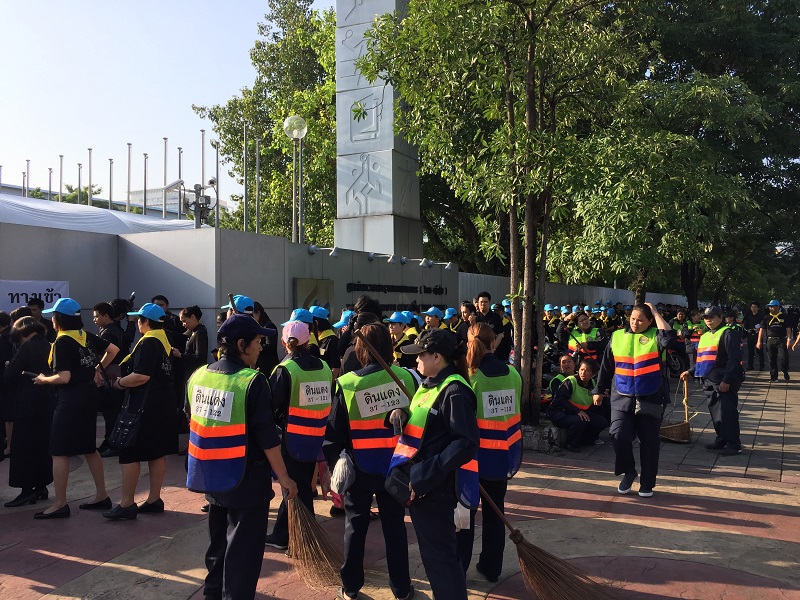
These unsung heroes are assigned to a variety of menial tasks, from handing out food and water to picking up garbage and making sure no one stands up when royal motorcades go past. They are easily identified by the yellow scarves and volunteer ID cards they wear.
They went through nearly the same ordeal as the determined mourners who camped out to witness the cremation. They worked under the heat and the rain. Many slept in the open, on the very ground of the Sanam Luang, so they could get up and resume working in the morning. They lined up to use portable toilets alongside the mourners.
There was no reward other than the pride that they help make possible the funeral for their beloved monarch, His Majesty the Late King Bhumibol.
By my own estimate, they probably outnumber police and military officers stationed in the vicinity of the cremation grounds.
Suthasinee Nuankim is a police officer by trade. Officers were told they could volunteer at the Sanam Luang, so Suthasinee and 60 others in her department took up the offer. She has been working at the royal cremation ground since Monday and she pledged to only leave on Sunday, when the ceremony is entirely finished.
“I’m very touched to have the chance to participate in history,” Suthasinee said as the sun was beating down on her and thousands of others gathered here.
When I approached her, Suthida Ketthong was sitting in the shade of a table where she handed out bottled water. After insisting on giving me wet wipes for my own sweaty face, Suthida said she hasn’t slept. The previous night was spent on handing out goods and collecting trashes.
Suthida, who’s self employed, said she arrived two days ago, and she already had what she came for: at one point she was stationed next to the fence separating the crowd from the gilded structure of Meru Mas, where King Bhumibol will be cremated tonight.
“I happened to be where I could see the stairs leading up to the crematorium,” Suthida said. “I was so overwhelmed with feeling.”
Suthida said she came for the bond she feels with the monarch. She often camped outside Siriraj Hospital when he was admitted there for his illnesses over the years.
“So I’m here to say farewell to him, to show my love for him,” she said. “This is the last chance in my life to do it, so I’m giving my best.”
Saleswoman Siriporn Klangsuwan was supposed to enjoy her day off today, but instead she came to the Sanam Luang with her friends and younger sister last night to help hand out supplies. She hasn’t slept a wink.
“I’m happy to participate in the event,” she said, adding that she would only go home after the actual cremation takes place at 10pm.
Surayuth Phummalai is native of Chiang Mai who lives in Bangkok. He saw on TV that the authorities are recruiting volunteers to help, and he immediately decided to go. He’s been running errands – providing food and water and other tasks – since Oct. 12.
He said he volunteered largely because he wanted to be close to King Bhumibol for once.
“I told [my mom] it’s once in a lifetime experience to be close to His Majesty,” Surayuth said. “When I was in Chiang Mai, I didn’t visit any royal funeral. The king’s mother, the king’s sister. I could only watch from TV at home.”
3:50pm
Asaree: DOWNPOUR! Forecasts said today would see a break from the heavy rain that has belted Thailand for weeks as the rainy season drew to a close. However a big downpour just hit and mourners are scrambling.
3:44pm
Sasiwan: At 2:30pm, 7-Eleven, Watsons and many other of the convenience stores which are a big part of everyone’s lives closed to let their employees pay tribute to King Bhumibol. It was so unusual that some people couldn’t help but stop for selfies as the shops that are always open, 24 hours every day, were closed for the first time.
3:40pm
Todd: The royal urn is in place. The elaborate ceremonies which began this morning to transport it from the Grand Palace, where the king’s remains had been kept for the past year, are complete. The optics of this event are crucially important for the present military leadership. Given the magnificent spectacle created by meticulously planned camera angles and pre-composed shots, it makes sense they banned the media from filming their own footage. This is an ordered, humble and united Thailand for the world to see.
Elsewhere, offerings are being made at replica crematoriums and memorial sites nationwide. Otherwise the main event will continue when King Rama X returns to the crematorium at 5pm for the “faux” cremation of his late father. This is customarily when people file past through the crematorium to leave offerings, and precedes the real cremation at 10pm.
3:35pm
Todd: A lot of people sharing these “instant paintings” of the ceremonials.
Asaree: A good perspective on the sea of black-clad mourners as Pravit and I saddled up on some motorcycle taxis to relocate.
3:25pm
Teeranai: Members of Pa’O tribe from northern Thailand sit in line to offer funerary sandalwood offerings at a replica cremation pyre close to Dusit Palace in Bangkok.
3:15pm
Sasiwan films streets normally bustling with life now at a standstill as traffic has been cut off to accommodate passing motorcades.
3:10pm
Pravit interviews volunteers at a sandalwood flower-laying spot near the Sanam Luang.
3:03pm
Lobsang: Overwhelmed, mourners cry as funerary proceedings continue to take place at the Sanam Luang.
2.56pm
Pravit: I met Watchara Chuaraman, a teacher at Wimol Business Administrative College who was supervising 50 student crowd-control volunteers. They helped maintain order among mourners offering sandalwood flowers at a stage in the Saman Luang. Wimol said they drilled for 5 days before arriving at 7am today. They will remain until everyone gets a chance to lay flowers at the site. Some wearing jeans have been turned away, however.
2:50pm
Todd: King Rama X has just departed the Sanam Luang by vehicle. He will retire to rest at the palace and return at 4:30pm.
2:35pm
Asaree: Walking around the western side of the Democracy Monument, I see mourners steaming under black clothes and black umbrellas on black-hot pavement covered only by heat-conducting, reflective tarps. The afternoon sun is blinding and unbearable, but people stare unflinching at the large screen televising the cremation procession with little to cool them but their devotion.
Anyone walking too fast or making too much noise is given side-eyes. A child playing too loudly at the McDonald’s flanking the monument was given a stern talking-to by a nearby auntie. “It’s improper to make this much noise, krup. Stop disturbing others!” she scolded the child.
2:32pm
Asaree: As noted below, I spoke to a group of missionary volunteers who conducted themselves exactly like mourning Thais, wearing modest black clothing and speaking reverantly of the late monarch.
“I want to pay respects to the late king because I’ve been staying here for a year, and I feel like a Thai person right now,” said Itumeleng Naha, 26 of Lesotho. “I heard he made so many things for the Thai people, and accepts foreigners as Thai people so I feel like he did great things for me also.”
“Now I understand why Thai people love and respect him so much. I haven’t seen anything like this in Ukraine before,” Andrew Nepyivoda, 22 of Ukraine, said.
2:28pm
Sasiwan: Rama I Road in front of Amarin Plaza is now closed as foreign dignitaries are traveling to the Sanam Luang.
2:26pm
Todd: The royal urn has been raised by a series of small lifts to its place atop the pyre.
2:22pm
Sasiwan: At Siam, I walked past thousands of black-clad mourners waiting in line for hours just to put sandalwood flowers and say their last goodbye to the man they called father. The line to enter Wat Pathum Wanaram runs past the Siam Paragon shopping mall, while the line to leave flowers at CentralWorld runs from the Ratchadamri Road side through Rama I Road and goes to the opposite side of the mall. It is hard to tell how many thousands people have gathered here.
Once inside CentralWorld, I’ve got goosebumps. All eyes were on the screen where the cremation procession was broadcast live. It appeared that people just came to watch it together. No one was talking to each other. The atmosphere was calm, and even though most of shops stayed opened, no one cares to shop. The cinema was closed but restaurants were doing well.
2:18pm
Teeranai: Sure, there are checkpoints and a dress code being enforced, but the strict rules not entirely so. There are at least three women with dyed hair (a no-no), people are freely taking photos (but they can be heard reminding each not to take smiling selfies). They can walk away from their mats to get food and water and cross the road to use toilets at Thammasat. Police only close the roads when the are processions are on the move.
Media restrictions also less draconian than expected. We were told reporters would be cordoned off at the media center. But I and several others managed to enter the Sanam Luang by showing government-issued press cards. We were told only photographers would be allowed in the Sanam Luang area, but I was able to mill about in this staging area. We were discouraged from interviewing mourners but no one interfered when we did so.
2:16pm
Pravit: At the Democracy Monument, mourners are seated and watching the telecast on a large screen.
2:05pm
Lobsang: Foreign dignitaries have begun to arrive at the Sanam Luang to pay their respects. A total of 42 are expected to attend the ceremony.
Teeranai: One of the most recognizable elements of royal cremation has played its part and made its exit: the royal carriage. In fact, some people rushed out to the Sanam Luang fence to catch last glimpse and take pictures with it. They wont see it in use again until the next monarch dies.
It will reside in the carriage hall – where a wall there will have to rebuilt because tradition requires it to be torn down each time the carriage is needed. The tradition underlines a hope that a permanent gate is not necessary because a monarch’s death is rare.
The carriage seen as it leaves the Sanam Luang.
1:45pm
Lobsang: Mourners from around the globe have gathered at the Sanam Luang to pay respects to the late king, Asaree interviews missionary volunteers from seven different countries who describe Rama IX as a “hero of the Thai people.”
1:34pm
Teeranai: The procession has reached the pyre, and the kot, or royal urn, is now being taken counter-clockwise around the pyre. A marching band is playing and prayers can be heard chanting. Despite the heat, many people are not shielding themselves from the sun with fans. They instead choose to wai, and keep their faces fixed on the kot while it is being moved.
Barely anyone speaks here. It’s so quiet despite the sheer mass of people assembled. The silence is only broken by shouts of “Two lines! Two lines ka!” from the entrance and exit, and, again, the ear-piercing cannon fire.
Asaree: I filmed some 360 footage from under Bangkok’s Great Swing, near where a replica crematorium has been erected.
1:23pm
Pravit: I’m now on Din Sor Road near the Democracy Monument and though the crowd is not huge, many volunteers are busy handing out free drinks, food and medicinal balms.
The heat is picking up, but the general feeling is one of calm.
Volleys from ceremonial canon can be heard in the distance, about 600 meters from here.
1:15pm
Teeranai: Here’s the audience view of the procession. Right now, I’m as close to the king as a commoner can get. I just saw a parade trooper in traditional red brought out. I cannot stress enough the power of the heat and reports of cannon fire. I think those will be two things people remember clearly, apart from what’s unfolding in front of them.
1:01pm
Teeranai: I’m over by the ceremony area. Fainting appears to be a common affliction for the people in the afternoon heat where many mourners have been sleeping rough the past two days and nights.
“Someone fainted in front of Lottery Office. Send help,” came the voice from radio carried by rescue workers posted in front of Thammasat University.
Pongpan Panthuchat, a rescue worker with Ruam Katanyu Foundation, said it’s the most common problem he has to deal with so far today.
“I helped about 15 people since my shift started,” said Pongpan, who’s been working since 5am.
When someone faints, a team is sent in with a folded wheelchair. The patient is brought out to rest at first aid stations, like the one at Thammasat University. Other predicaments include diarrhea and wounds from tripping over, he added.
Pongpan said 2,000 Ruam Katanyu workers are deployed in the Sanam Luang vicinity today. He urged those not accompanied by family or friends and people with medical conditions not to come to Sanam Luang.
12:58pm
Sasiwan: I’m passing through CentralWorld, where mourners clad in black have gathered to watch a live broadcast of the cremation ceremony.
Teeranai: A police officer in charge of security in northern portion of Sanam Luang said everything is going smoothly so far.
“There has been no report of any incident,” Col. Adisak Sunthrarak said as he was watching over a crowd of mourners. “Overall, everything is in good order.”
He said a rigorous search for weapons has been imposed in all checkpoints.
Asked whether police will be exhausted by their all-day duty, Adisak said they are trained to be on alert at all times.
12:34pm
Wirat, left, and his crew at 5am on Thursday cook pad see ew as breakfast for mourners at the Bangkok Youth Centre.
Chayanit: Wirat Kianduangchan, 42, traveled from Nakhon Ratchasima’s Wang Nam Keaw district and arrived Thursday to camp at the Bangkok Youth Center. Wirat, manager of Baan Rai Plai Tawan Almshouse back home, led more than 30 people to cook meals for mourners in Bangkok.
The menu includes pad see ew and, of course, pad mhee Korat, a typical Nakhon Ratchasima dish.
12:25pm
Sasiwan: Among hundreds of people lining up to enter Wat Pathum Wanaram to offer sandalwood flowers to King Bhumibol were two Americans who landed in Thailand last night. Sam Sears said he just bought black trousers this morning before joining the queue.
“I think I’ve only seen one man wearing a pink shirt, everybody else were pretty much wearing black,” he said as he gave his first impression of the city. “It’s kind of impressive because in America if President [Donald] Trump died, I think you wouldn’t see people wearing black.”
From left, Sam Sears and Mary Beth Coleman.
Finding their Thailand vacation turned out to be an important occasion for the country, the two from California decided to skip tourist attractions and follow the large crowd to do what local resident were doing.
“This is kind of a once-in-a-lifetime experience so we want to see it from Thailand’s citizens’ point of view,” said Mary Beth Coleman. “In my lifetime I don’t think I have ever seen the entire country remember one person in such a unified way.”
After half an hour in the line, they admit to not knowing what is to be expected inside the temple but say that was part of their travel plan.
“It’s very interesting to see how people react to things and to understand the custom and culture and I think that’s why we like to travel,” said Coleman. “Not to see the basic touristy things, but to understand people really really well.”
12:05pm
Chayanit: The nearly 8,000 mourners gathered in front of the Bangkok Youth Centre are now divided into five lines.
11:55am
Teeranai: Marching bands play, their music intertwined with the pitching noise of traditional flute that marks an ancient ritual in progress.
These processions are the highlight thousands brave through storm and blistering heat to see: a tradition dating back centuries relived before their eyes.
Hindu priests hold the royal urn steady, their distinctive white robes and towering headgear visible to the crowd.
11:49am
Teeranai: The colorful procession is now slowly edging toward the Meru Mas. The ornate carriage that carries the symbolic Royal Urn is drawn by troops dressed in traditional red garment, while soldiers in full marching regalia shuffle forward between the processions.
11:37am
Pravit interviews mourners and volunteers who have gathered since yesterday both to pay their respects and help the procession.
11:10am
Lobsang: King Rama X and Prince Dipangkorn Rasmijoti march alongside the royal parade as funerary rites continue to take place.
Chayanit: A fruit seller is giving away his fruit for free in front of a Bangkok Youth Center’s gate. Watermelon is the most-popular seller, as its high water content can help relieve the heat.
Approached by a man who asked for some yam for his pregnant wife, the fruit vendor acceded immediately.
10:50am
Chayanit: “Where are you going? Free motorbikes here!” motorbike taxi drivers say from their station in front of the Bangkok Youth Centre.
10:38am
Sasiwan: Volunteers hold banners reading “free rides” as they offer free transportation for mourners from Victory Monument to the Sanam Luang and its vicinity.
10:34am
Teeranai: The procession transporting the royal urn to the crematorium paused for the playing of the royal anthem. Junta leader Prayuth Chan-ocha is expected to take his place in the parade.
Pravit: Julaluck Nuankratoke’s eyes were brimming with tears after hearing the cannon fire salute marking the procession of the royal urn to the crematorium. She sat 600 meters from the scene and could not see anything but hear the repeated sound of cannons firing.
10:10am
Asaree filmed this 360 video clip for a look around the people waiting at the Democracy Monument:
10am
Chayanit: The funeral coincides with the annual Vegetarian Festival. Volunteers were handing out vegan, or jae, sandwiches to mourners and participants.
Natee Yingwongwiwat on Thursday at the Bangkok Youth Centre.
Chayanit: Natee Yingwongwiwat, 74, traveled by train alone Tuesday night from Hat Yai in Songkhla. She arrived in Bangkok at noon on Wednesday and camped out overnight at the Bangkok Youth Center. Today she wants to visit Pak Khlong Talad’s Flowers For Dad event,which runs through Friday.
9:45am
Todd: The procession that began for the royal urn is passing outside the Grand Palace on its way to the crematorium at the Sanam Luang.
Sasiwan: A long line of cars queue to enter a Bangchak gas station as the company has lowered gas prices by 1.5 baht today to facilitate travel to the royal funeral.
9am
Teeranai: More than 100,000 people are estimated to be here in the vicinity of Sanam Luang. Providing security, food and sanitation to the mass of crowd who would spend days camping out is the biggest logistical challenge for the authorities in years.
As far as I could see, at least, there’s a ready supply of food and water. Bakery and bottled water were handed out this morning. Rows of portable toilets are everywhere, but the line is long, as expected. Medics are visibly on standby.
Many mourners come here with their family members and friends, so they take turn leaving their spot to toilet or shower. They get blue stamps on their forearms, like passport entry stamps, so they could be allowed back in through the security checkpoint.
“The ink wears out too quickly. I had to be careful when I shower!” one man joked.
Security is tight. Apart from soldiers and police, there is an army of volunteers distinct in their yellow scarves. As I took a quick break and typed on my phone inside the security cordon, where photographers must be corralled in their stands, one elderly volunteer quickly spotted I had a camera with me and radioed his supervisor.
“He’s not supposed to be loitering around. Get him moving!” came the crackling voice on his radio as he shyly approached me and gestured me to leave.
8:50am
Asaree interviews Chalaem Ponpanom, 41 from the Don Mueang area and Julaluck Nuankratoke, 39 from Bangkok’s Ratchada area.
8:26am
The royal urn.
Chayanit: Thousands of mourners, volunteers, soldiers and bureaucrats arrive at the Bangkok Youth Centre for the commencement of the flower-placing ceremony scheduled to start at 9am. Among them was Koranit Buachan, director of the center.
8:12am
Teeranai: The media center next door to Sanam Luang shakes at the vibration of cannons being fired. The gun salute marks the moment the in which the outer decoration of the Royal Urn is being taken apart.
8:07am
Chayanit: Hundreds of people pour inside the Bangkok Youth Centre and place flowers to mourn the late King Bhumibol.
Mourners queue outside the Bangkok Youth Centre as they look to place flowers inside in memory of King Bhumibol.
8am
Teeranai: Heavy fog blanketed Bangkok in the early hours of Thursday, Oct. 26, 2017, the day Thais from across the country are gathering about the field of Sanam Luang to bid farewell to His Majesty the Late King Bhumibol.
For many here, most of whom have been camping out for at least two days, the mist holds a special meaning. They will remember the night when King Bhumibol died on Oct. 13, 2016. A heavy fog also descended on the capital that night, adding a gloomy element to the memory.
At about 6am, by the time I passed security checkpoints and stood at the epicenter of what would be the cremation of King Bhumibol, the fog has dissipated, replaced by a blazing sunrise. The day promised to be clear, a break from torrent of rains that has battered the city for a week.
Mourners clad in black are sitting on their mats here. Before them looms the Meru Mas, the ornate crematorium where King Bhumibol will be laid to rest.
There’s a flurry of activities wherever you look. Troops dressed in traditional red outfits marched about the funeral pyre complex. A carriage was drawn to its ready position. Mourners come and go about their spots. Photographers rush to the stands set in the middle of Sanam Luang. Volunteers, distinguished by their yellow scarves, move about to hand out food and collect trashes.
Despite the sense of sorrow associated with the cremation ritual, the atmosphere here is relaxed, joyous even. Families and friends take selfies together. Mourners laughed and teased with police officers who patrol the area.
All of mourners I interviewed said they went through rain and sunshine since they started camping out two days ago (they were only let onto the field of Sanam Luang yesterday morning), but they dismissed it as trivial hassle.
“Our father suffered so much,” Chalinee Heawjapok told me, using a common endearing term for King Bhumibol. “What we went through is not a slice of what he suffered.”
Prapan Meemangkang still remembers receiving King Bhumibol’s visits to the northeast when she was young. Her father is a chicken vendor who travels around, seeking out crowds that gathered whenever the royal visit was taking place.
“We were surprised he came all the way there,” Prapan recalled, saying she saw the king in Maha Sarakham, Nakhon Phanom and Khon Kaen. “There was no road … And Isaan was in the thick of Communist [insurgency]. We were asking each other, how could he dare come there?”
Her fondest memory was the king kneeling down to greet a group of little children, herself included.
“He was very casual. He was kneeling down, talking to us like you are now,” Prapan said.
7:43am
‘All the Thai people are so narak today,’ said Nathaya Somboonrat, 30 at left, with Nuttawut Seeampai, 36.
Asaree: Mourners at the Democracy Monument clad in black sit on plastic tarps and factory rolls of packaging material while volunteers give out everything from baked goods and sweet green tea to cotton balls soaked in eucalyptus. The roundabout is fenced off and a subdued carnival-like atmosphere can be felt along the sidewalk where people have been allowed to sit.
Nuttawut Seeampai, 36
Nathaya Somboonrat,30
Both from Bangkok
“I came here since 2am. I probably won’t get any closer to Sanam Luang but I’m so happy to be able to participate with everyone and see some procession pass,” Nuttawut said.
Describing the atmosphere, Nathaya said “All the Thai people are so narak today.”
Mourners stand behind a fence Thursday near the Democracy Monument.
7:25am
Teeranai: His Majesty the King Vajiralongkorn arrives at the Grand Palace, accompanied by his children. His arrival marks the start of the funerary rites today.


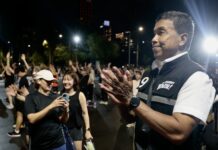























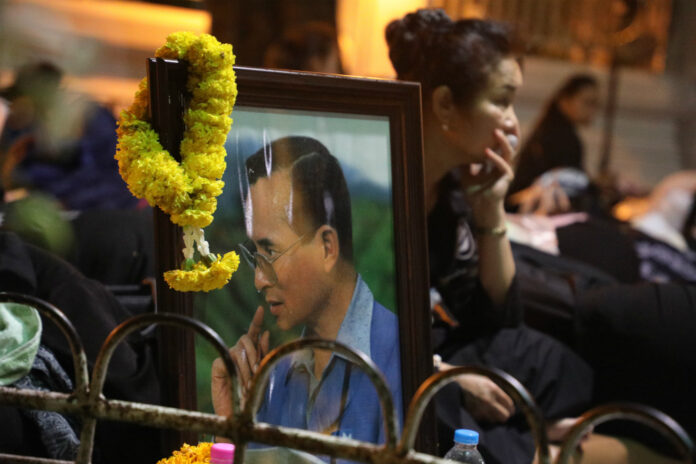
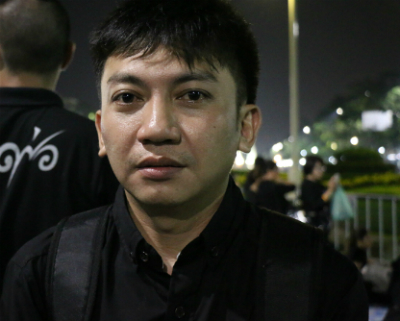
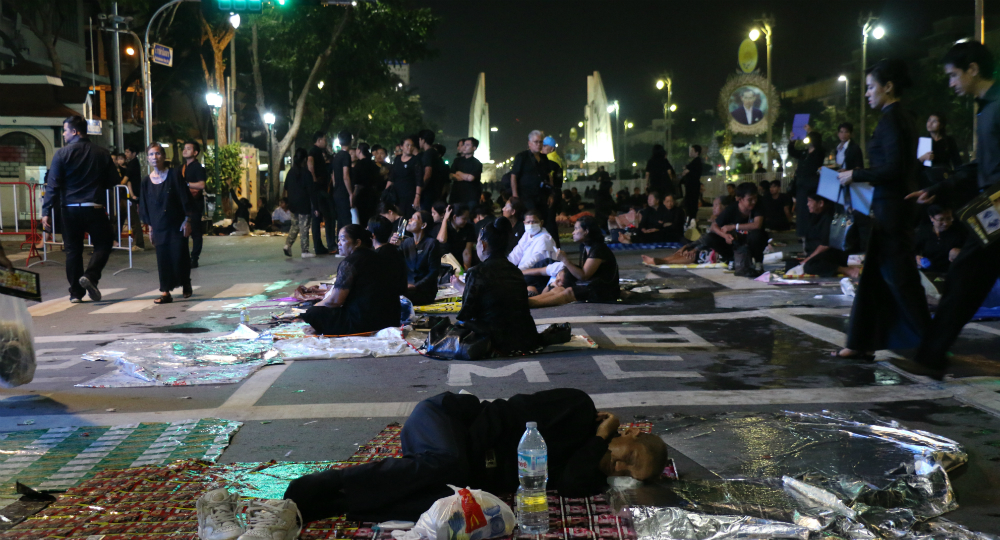
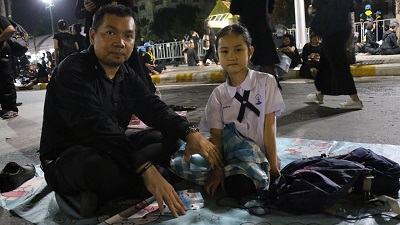
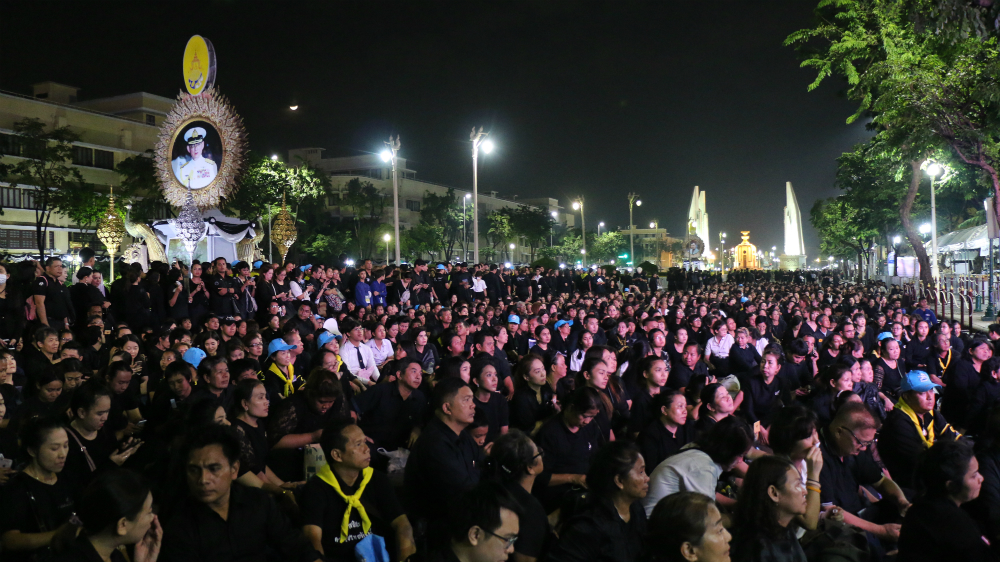
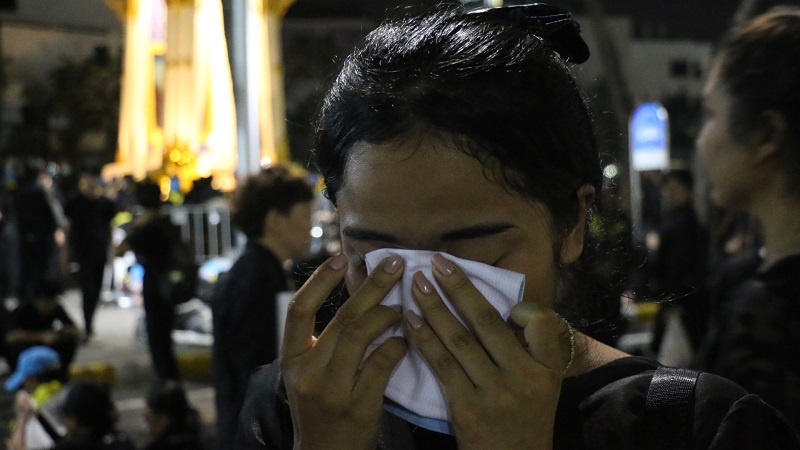
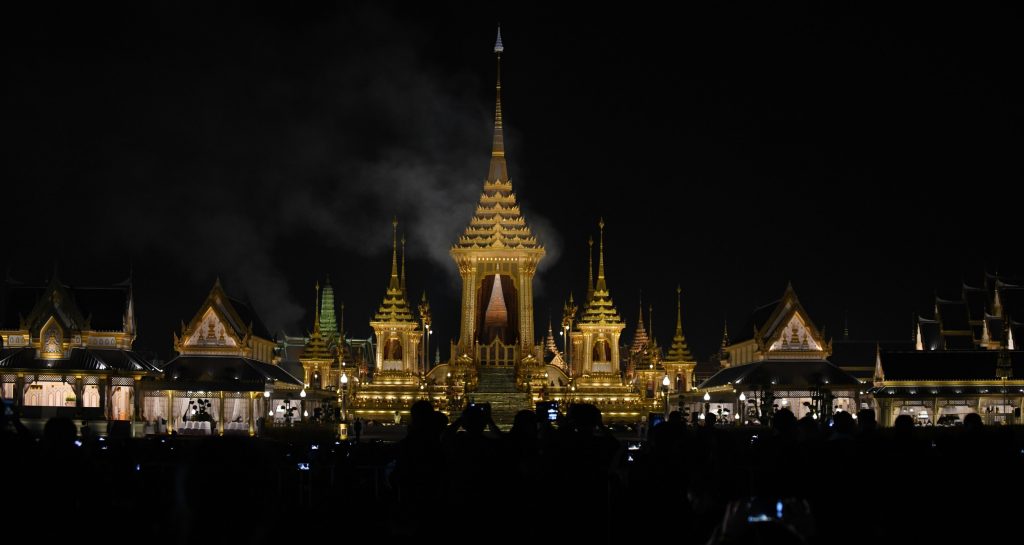
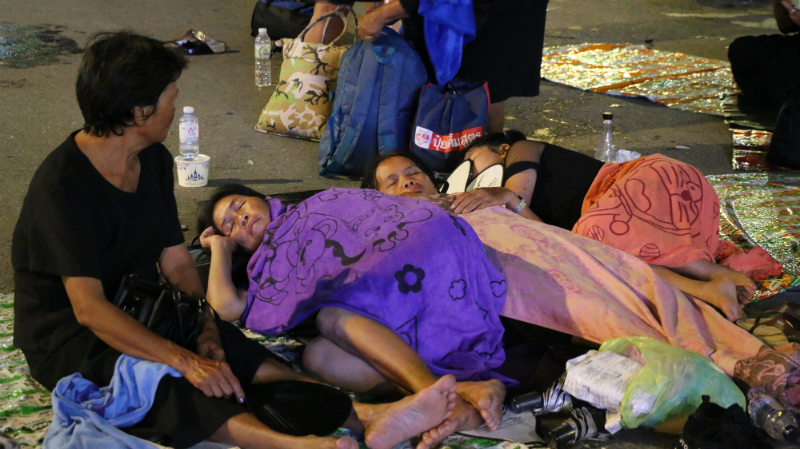
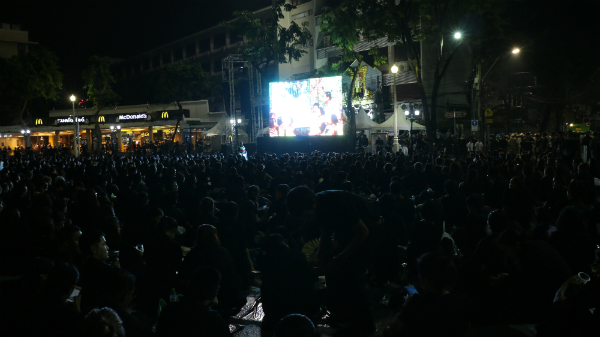
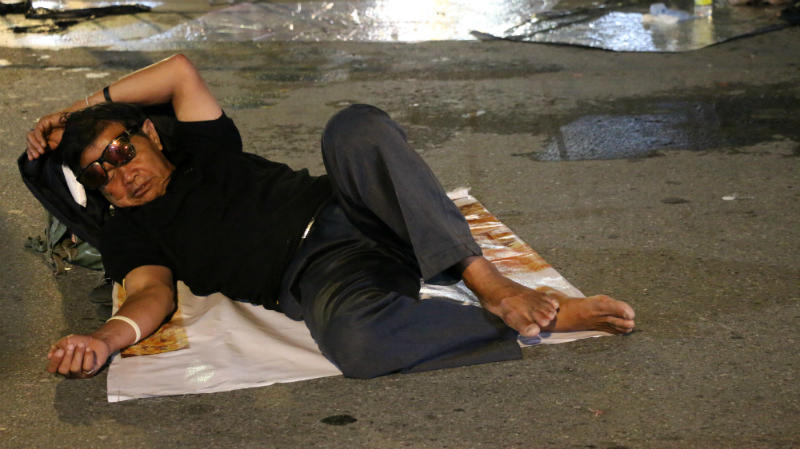
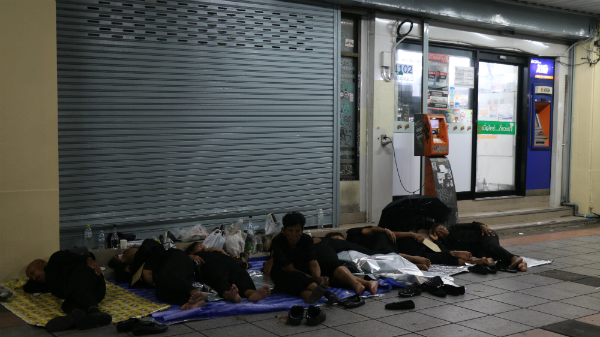
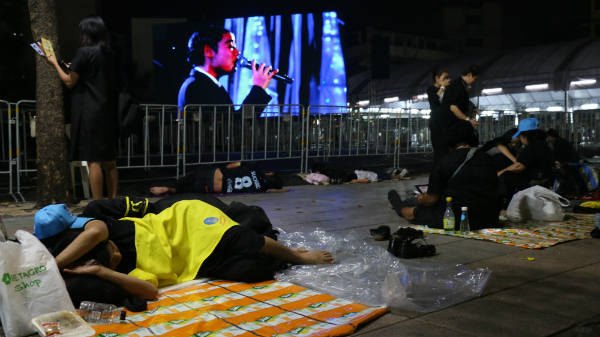
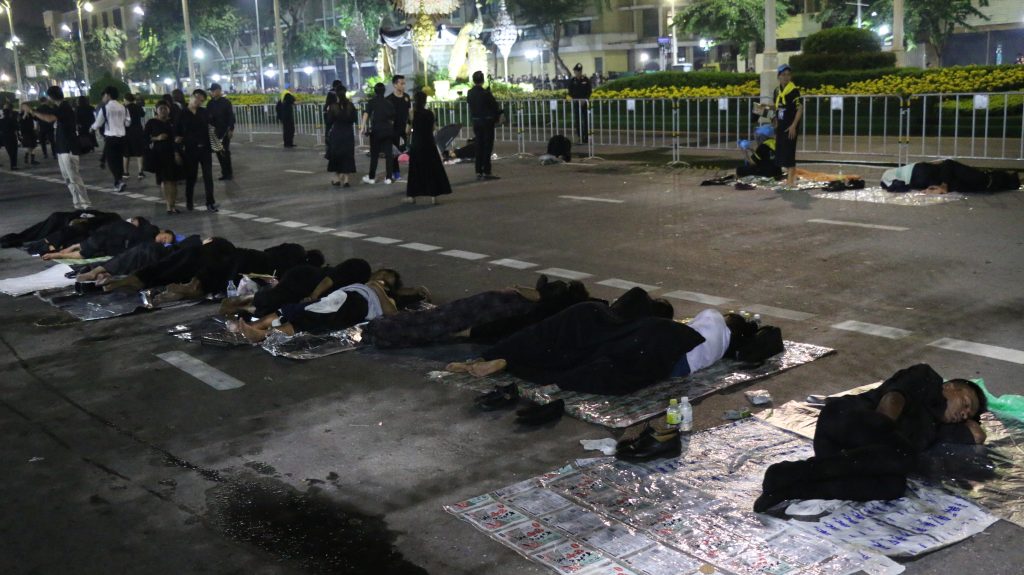
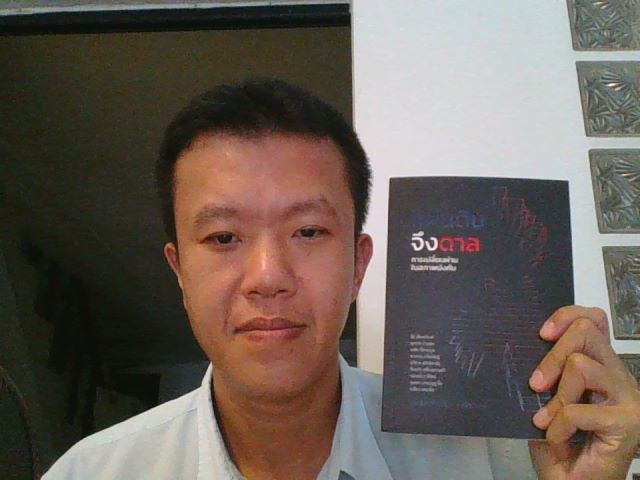

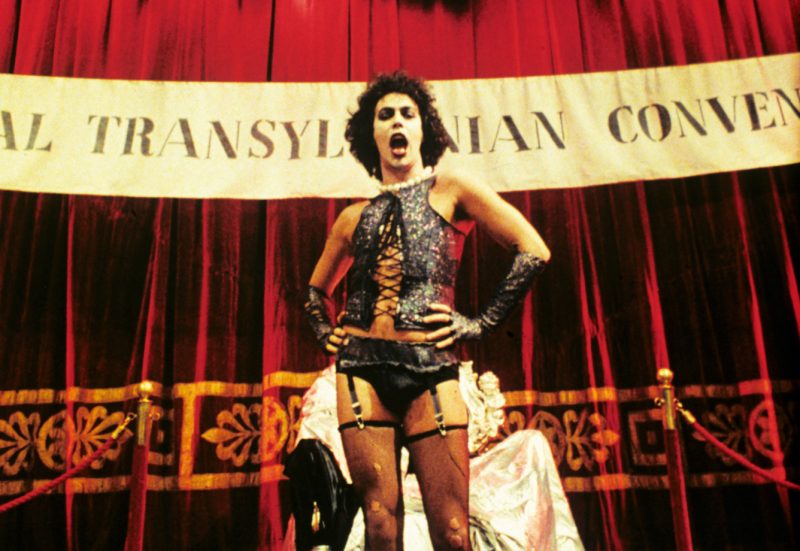



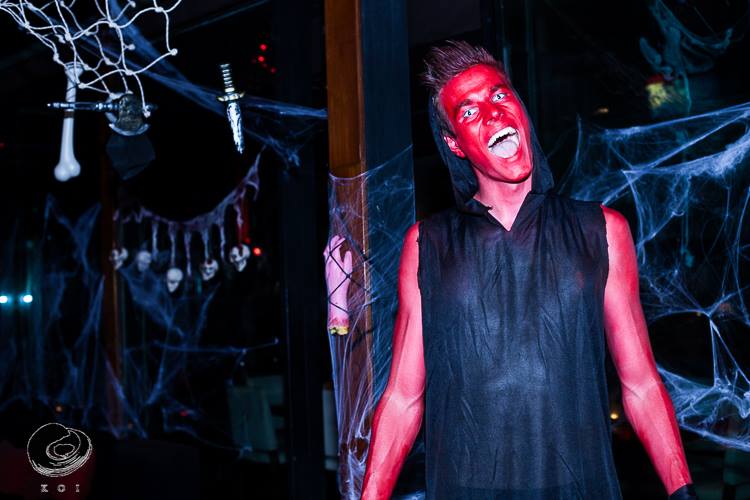
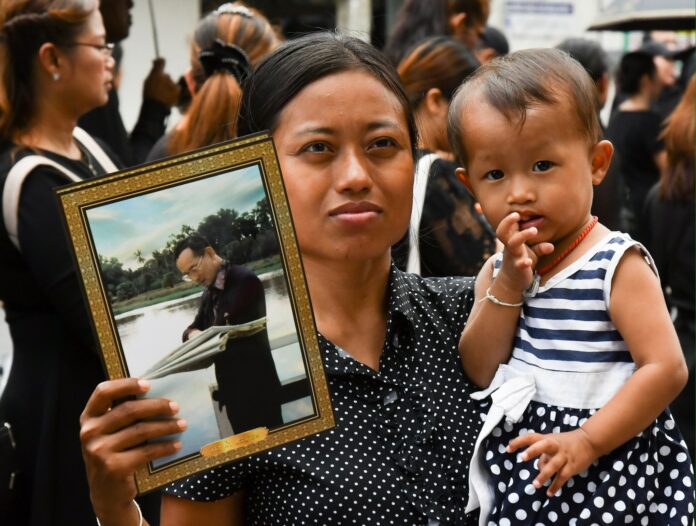
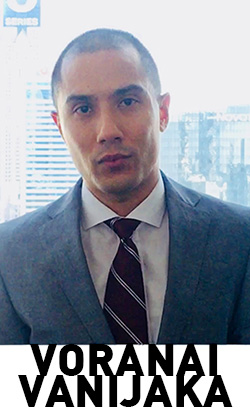
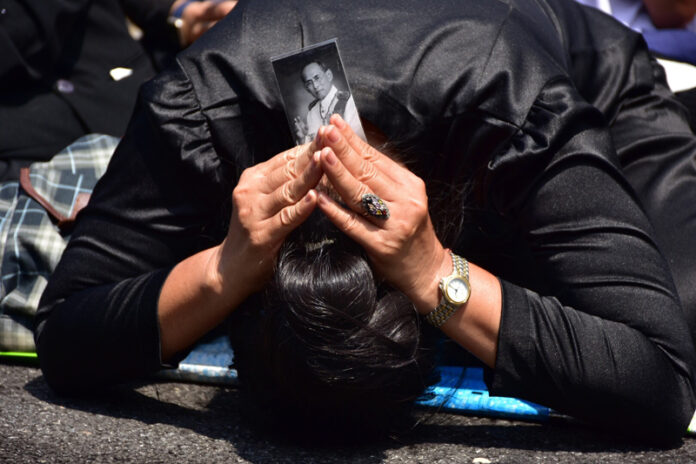
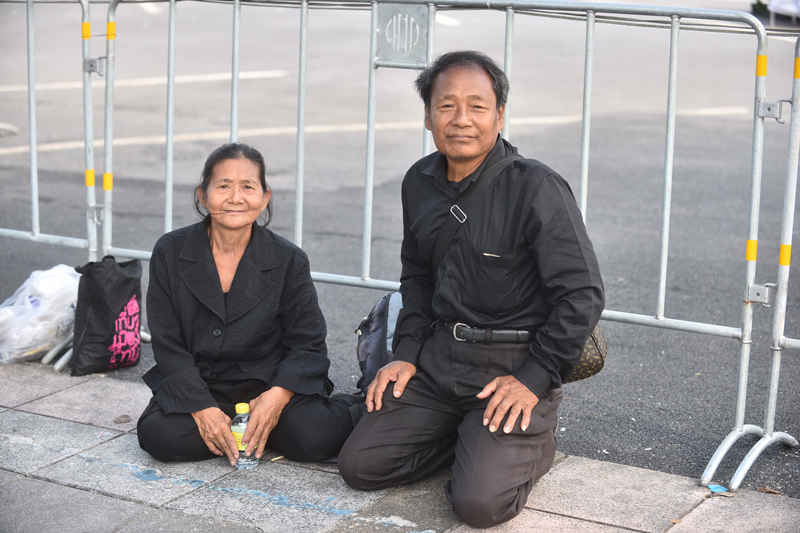
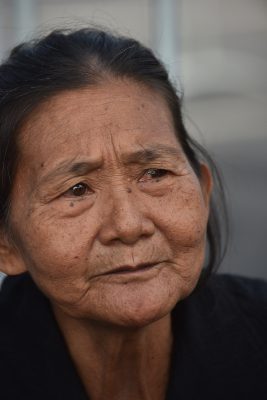
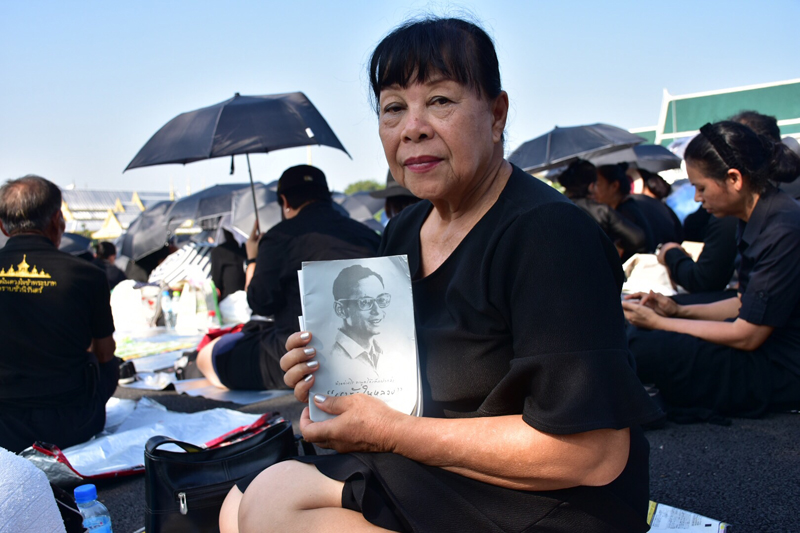
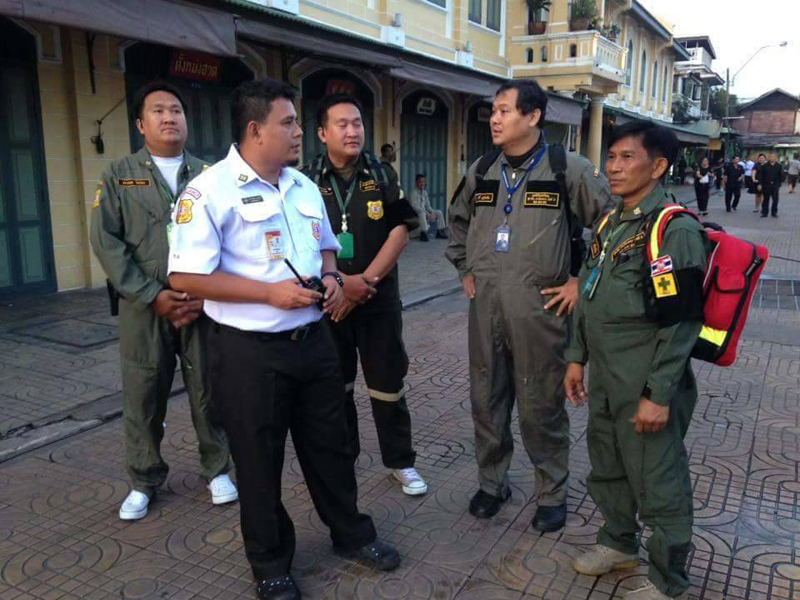
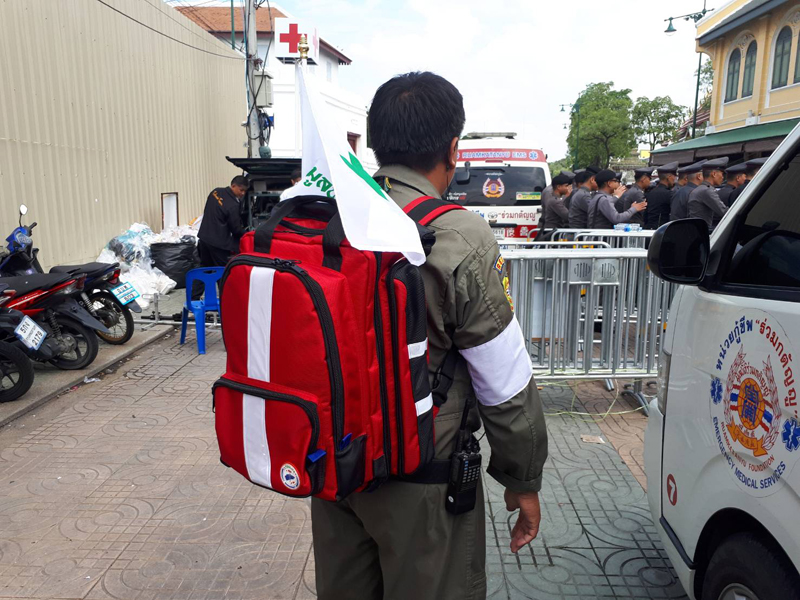
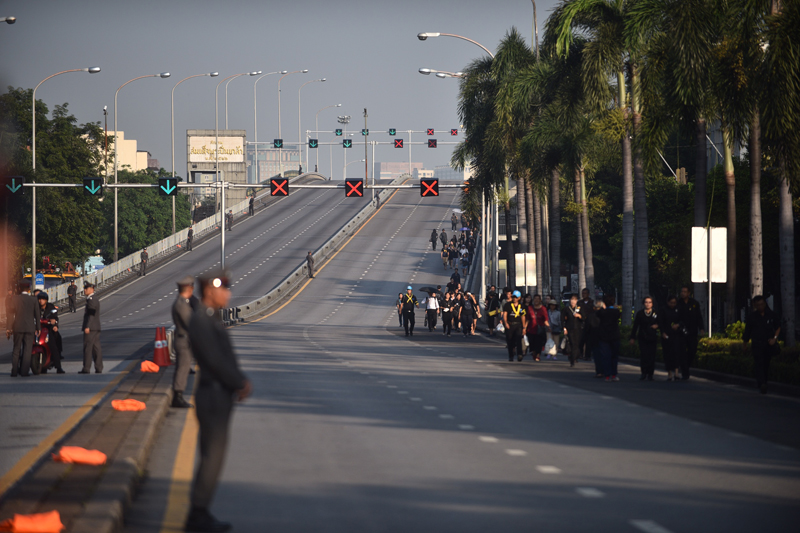
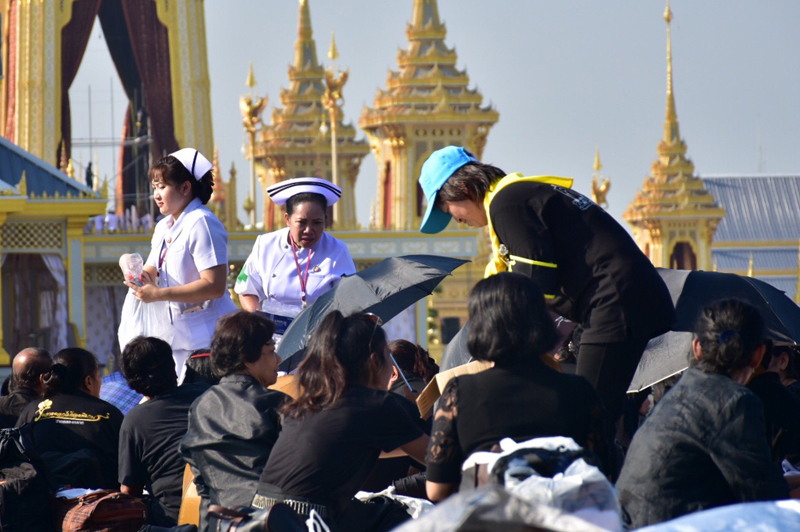
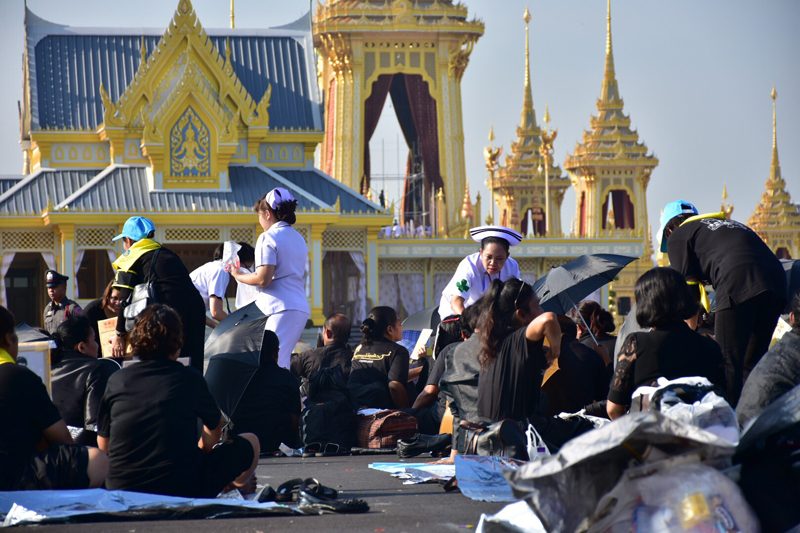
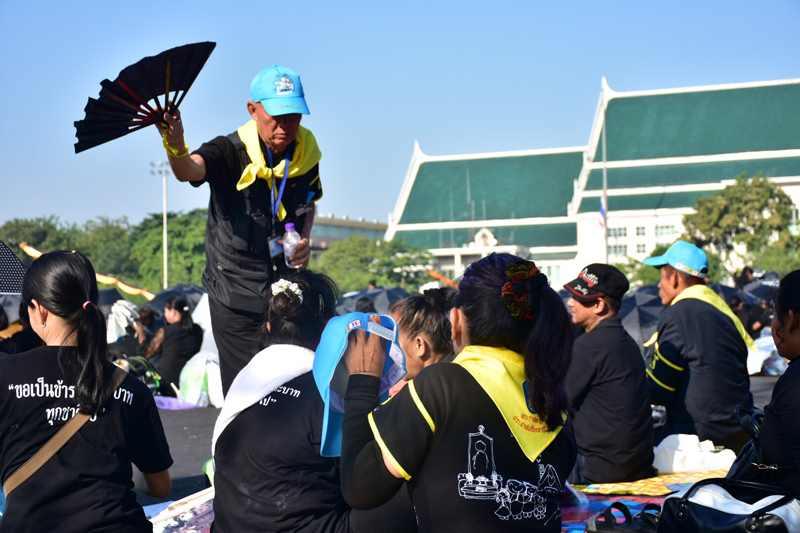
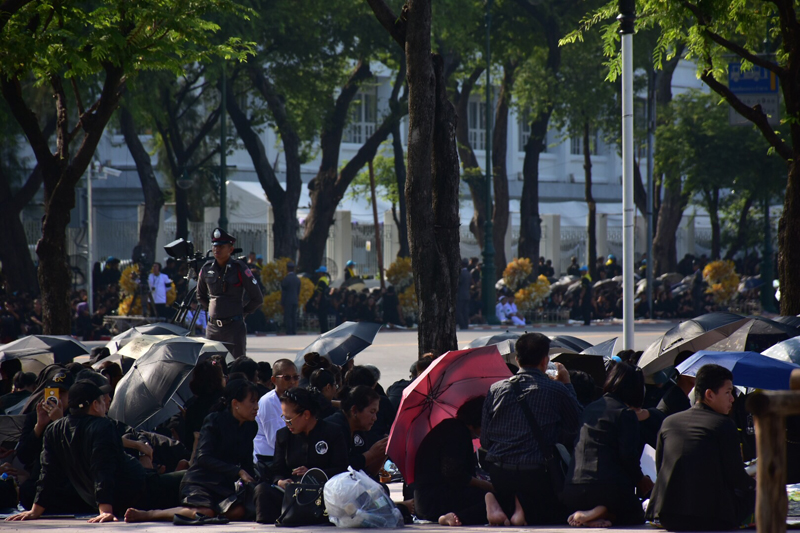
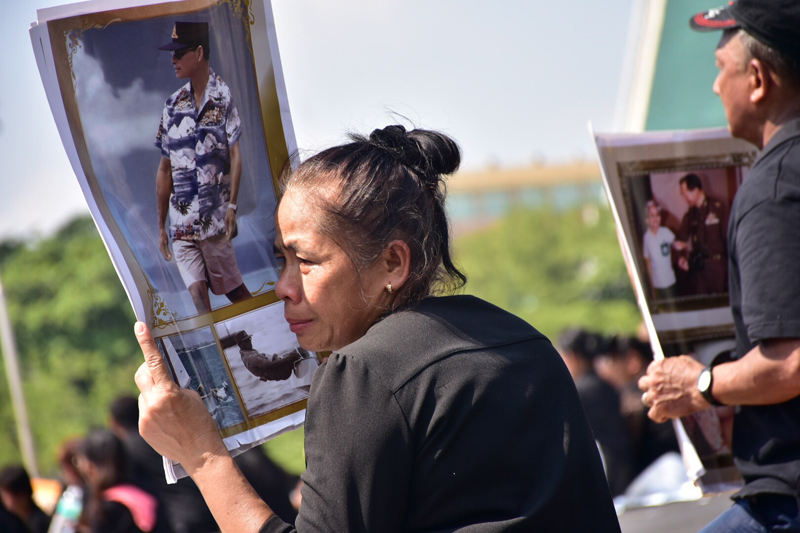
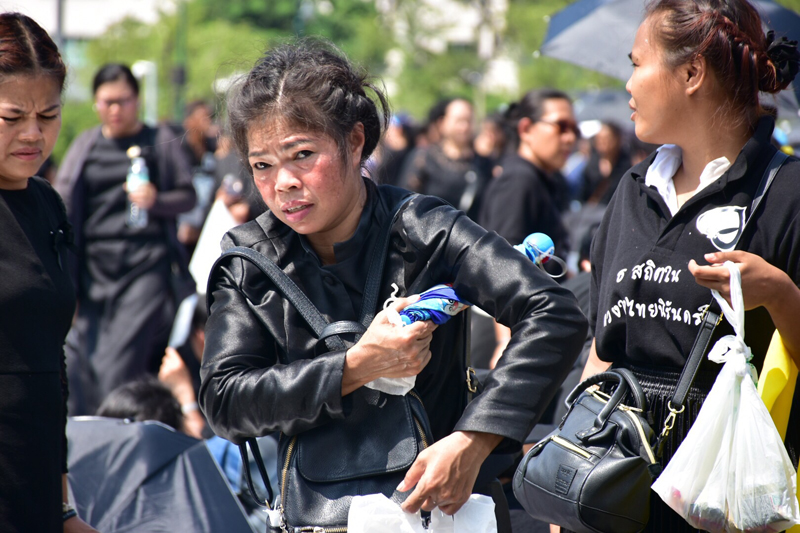
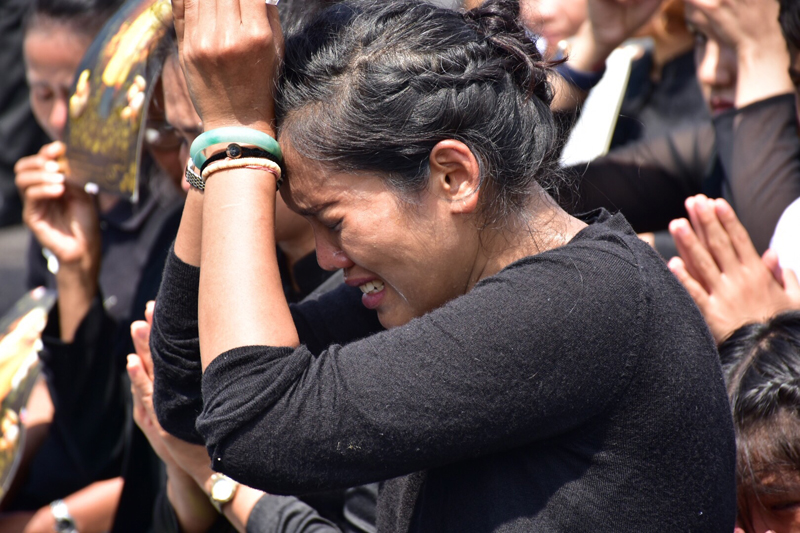
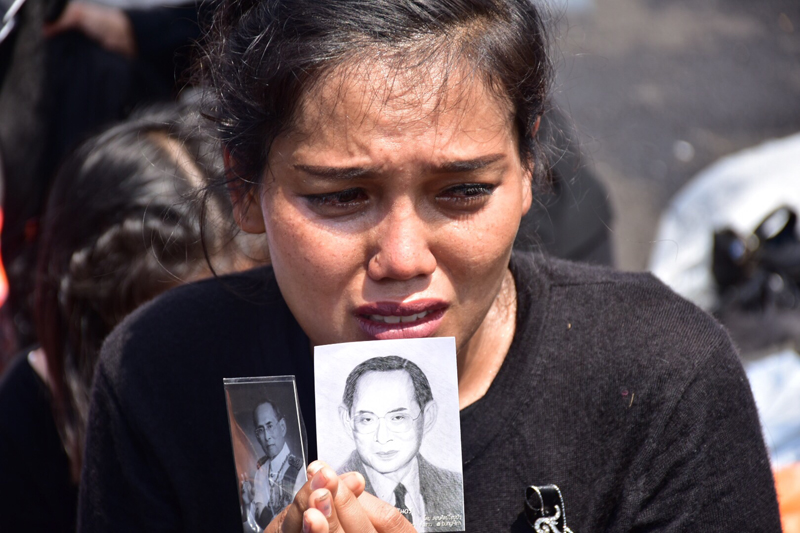
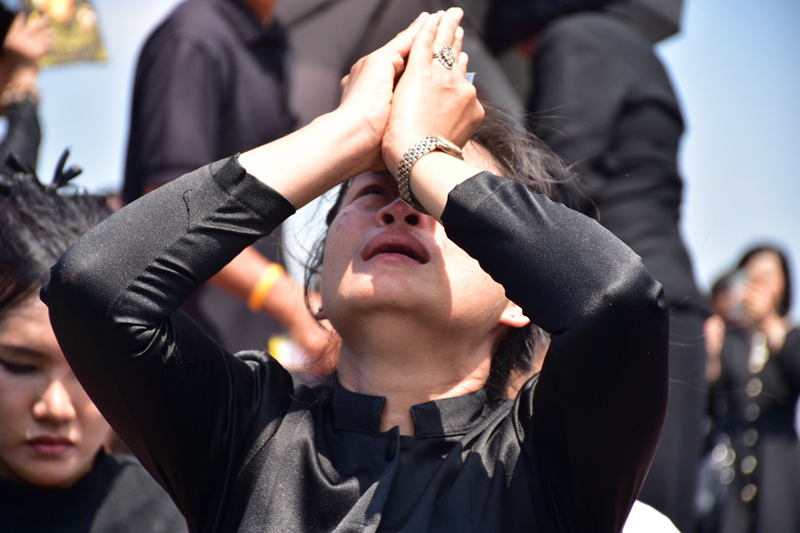
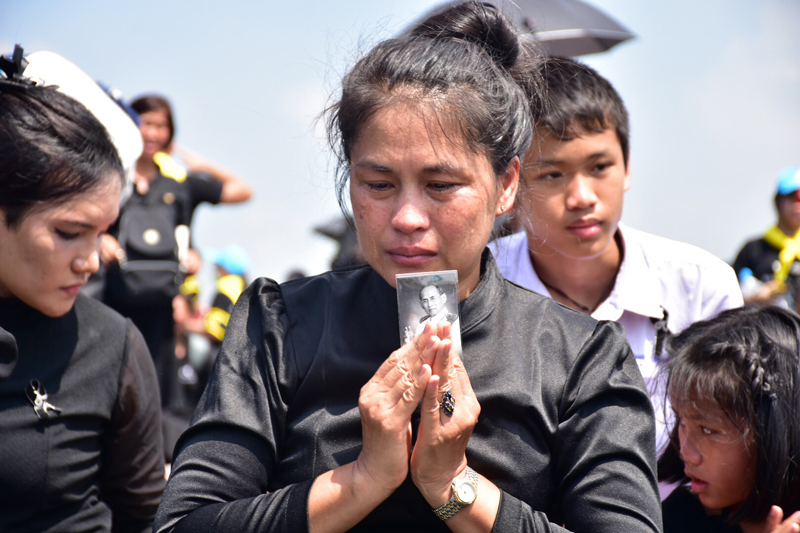
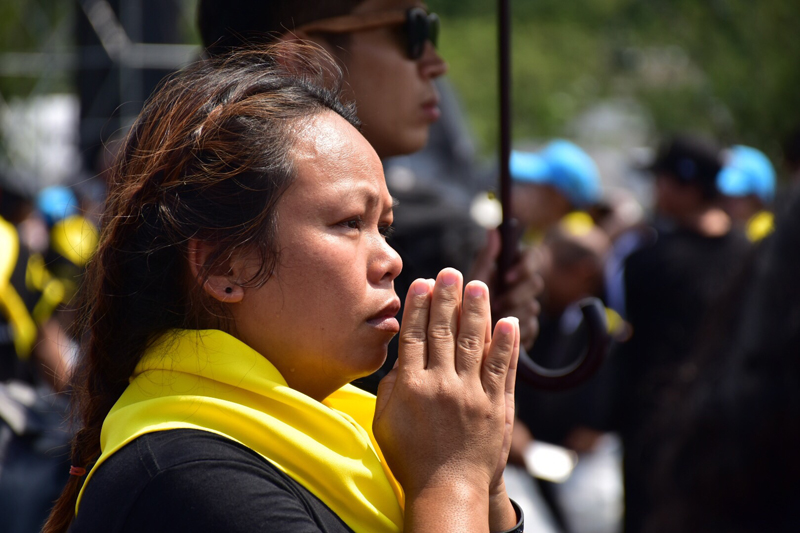
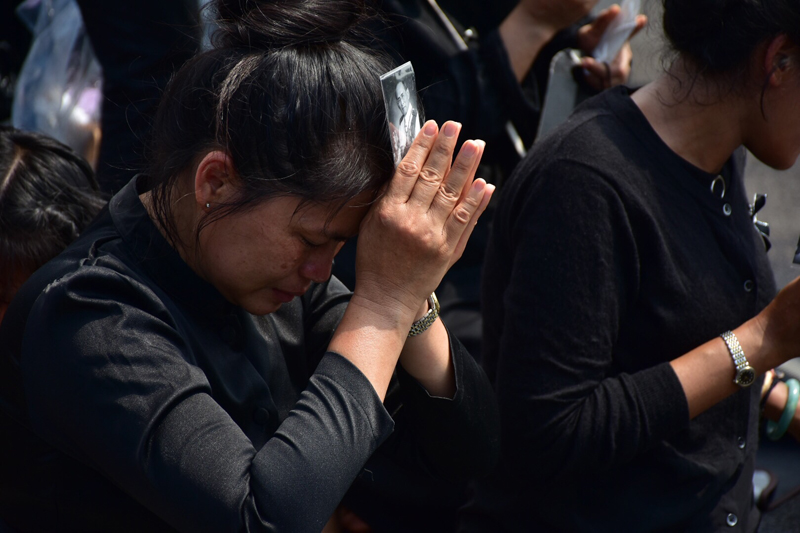
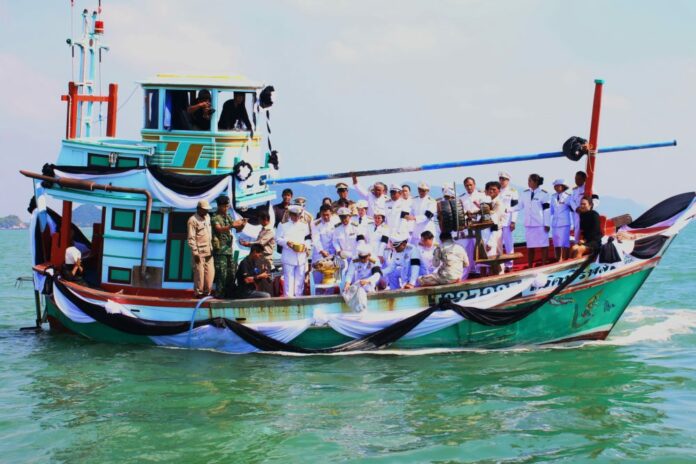
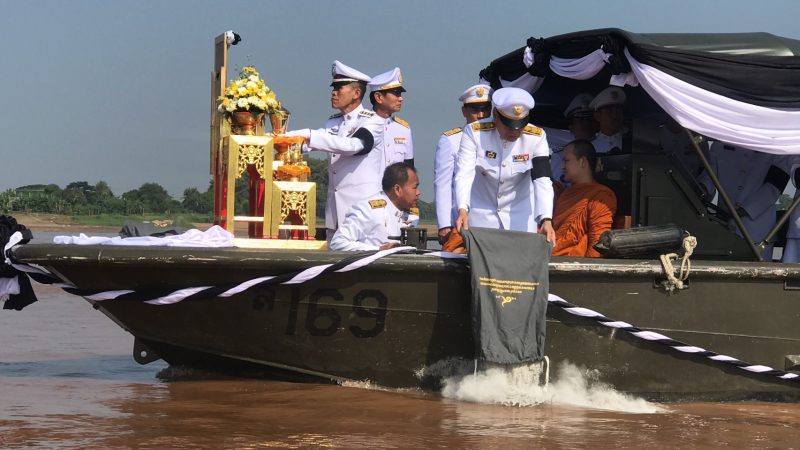
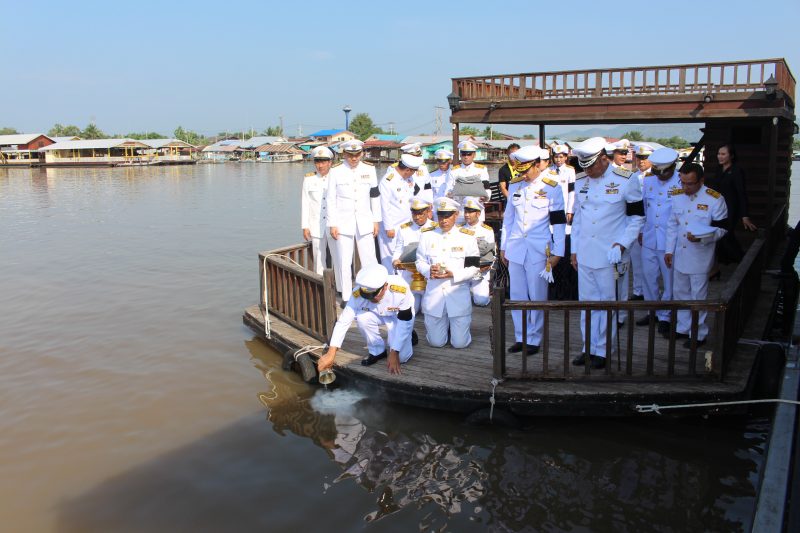
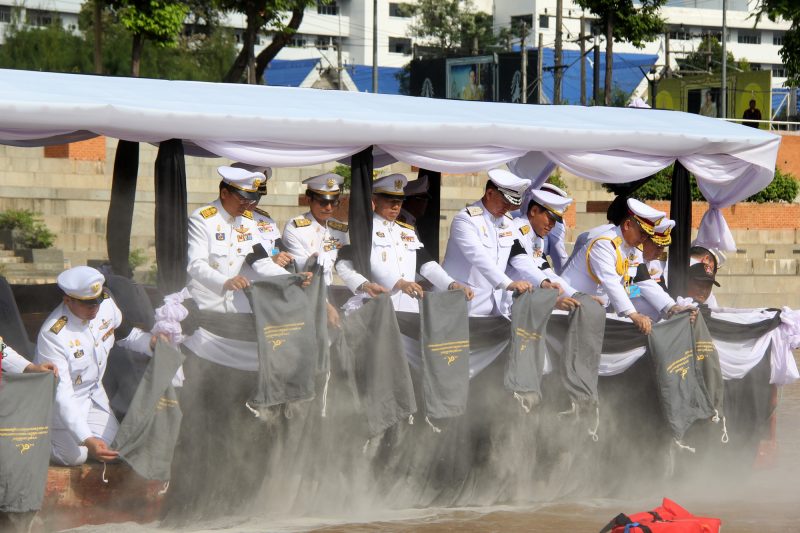
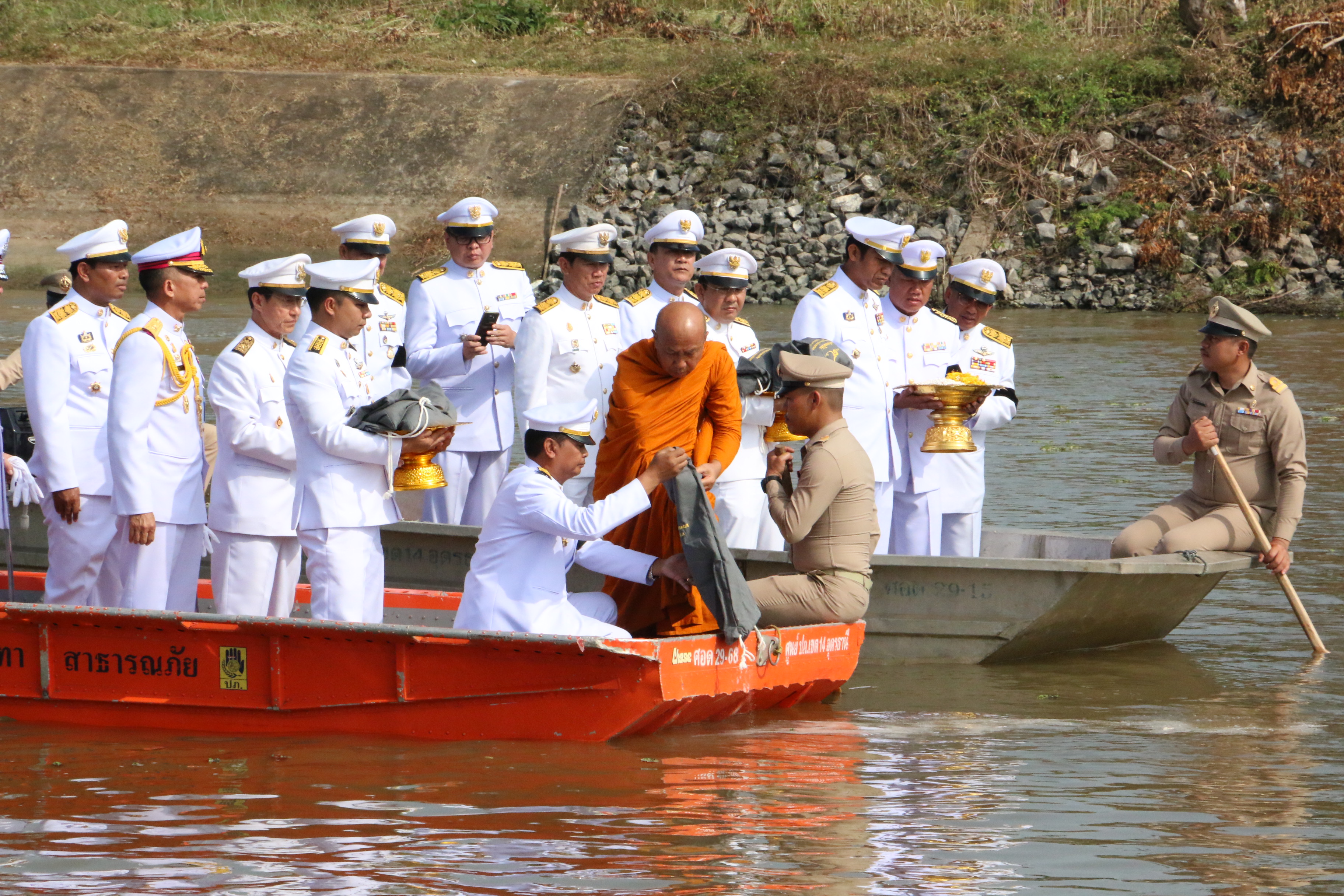
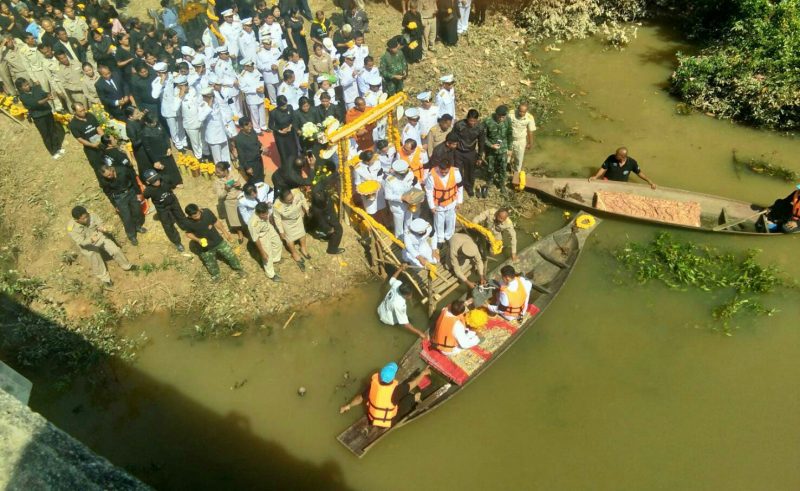
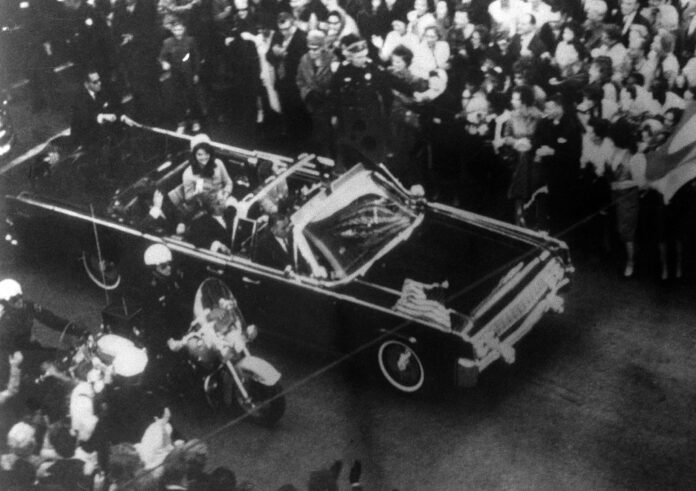
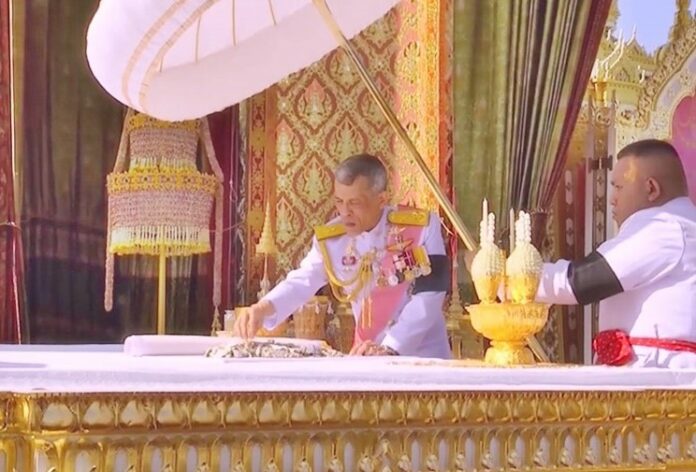
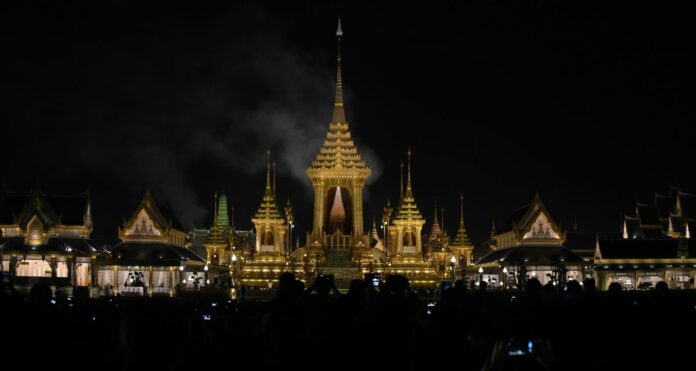
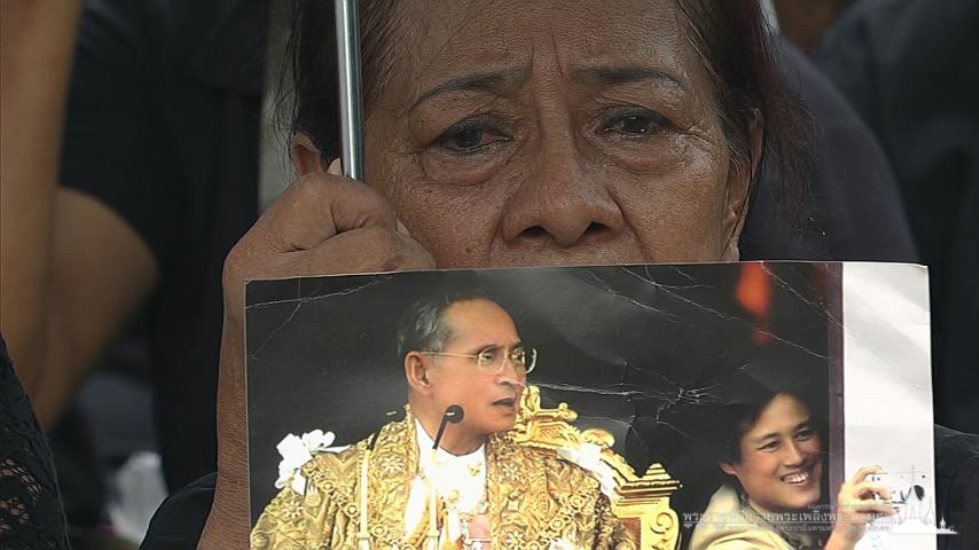
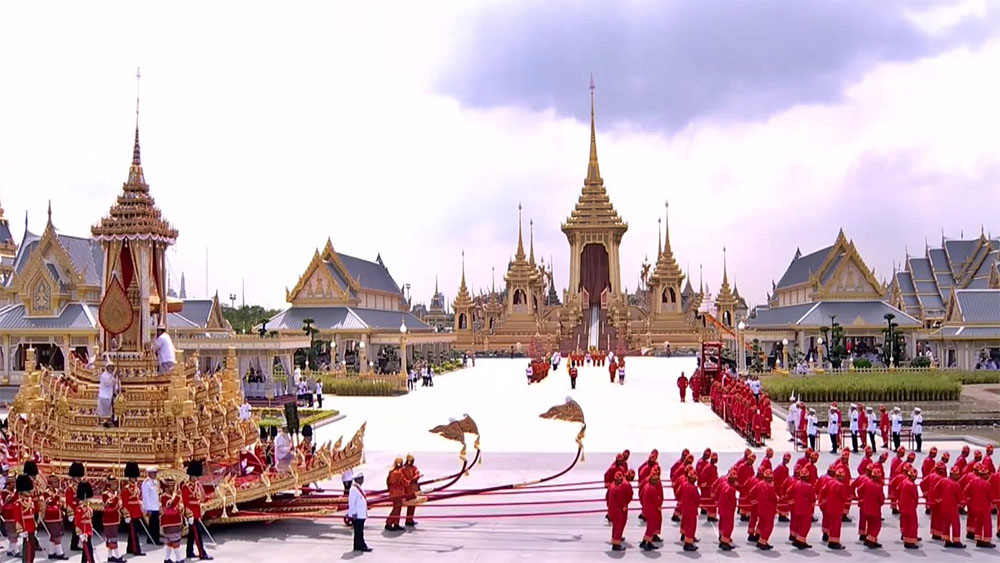
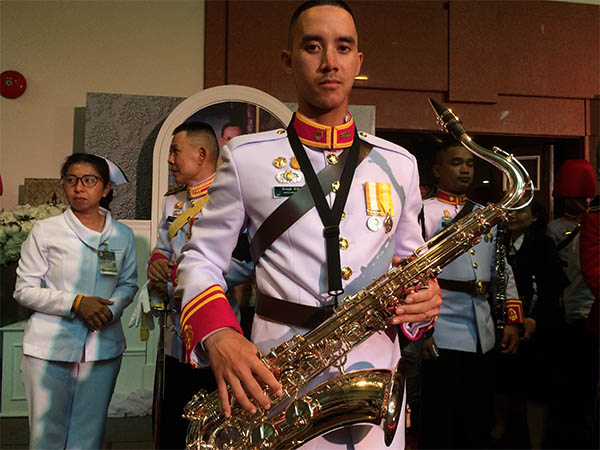
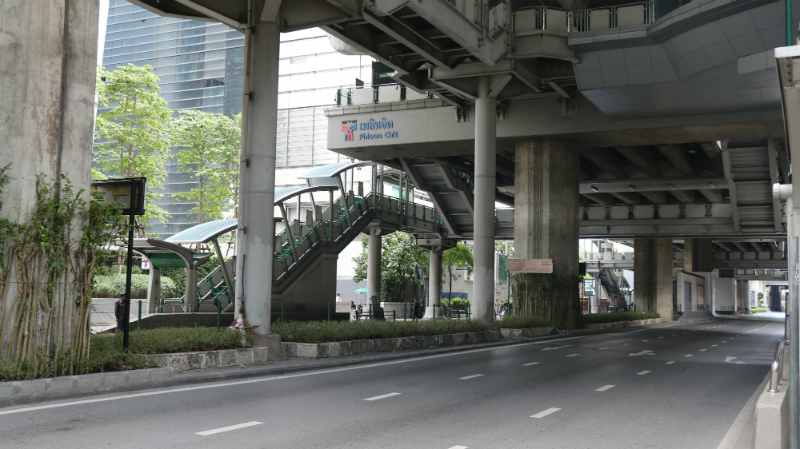
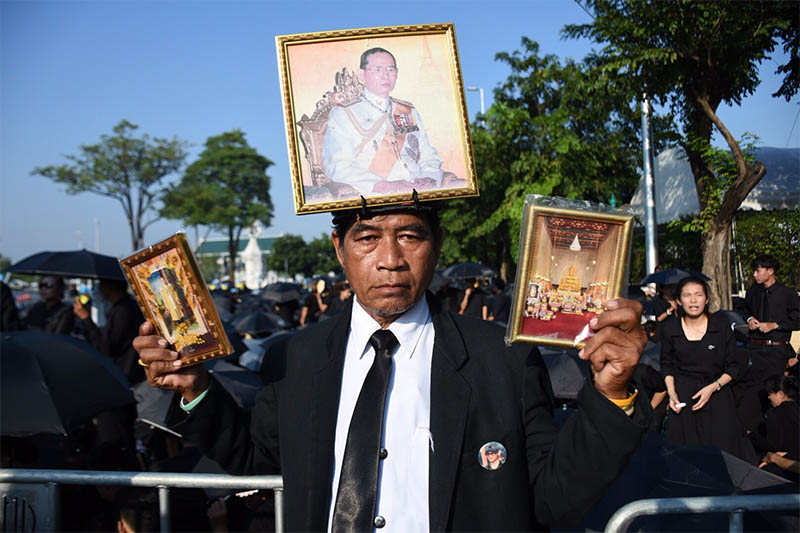 “This is kind of a once-in-a-lifetime experience, so we want to see it from Thailand’s citizens’ point of view,” said American tourist Mary Beth Coleman. “In my lifetime, I don’t think I have ever seen the entire country remember one person in such a unified way.”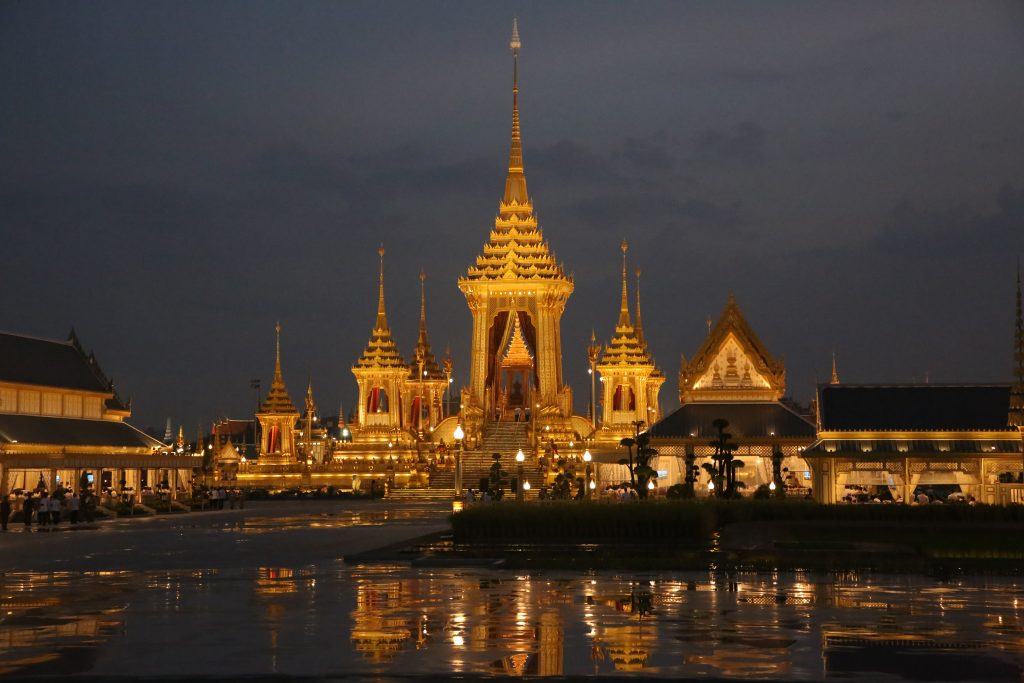
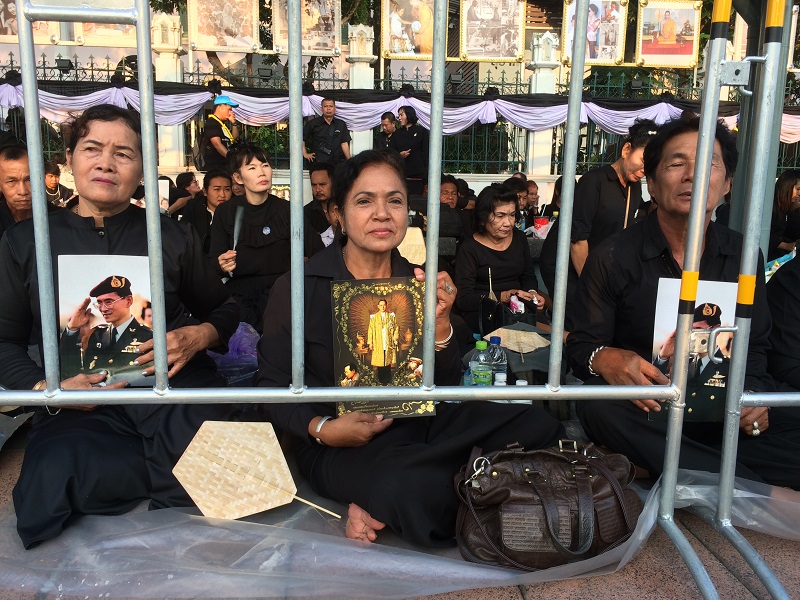
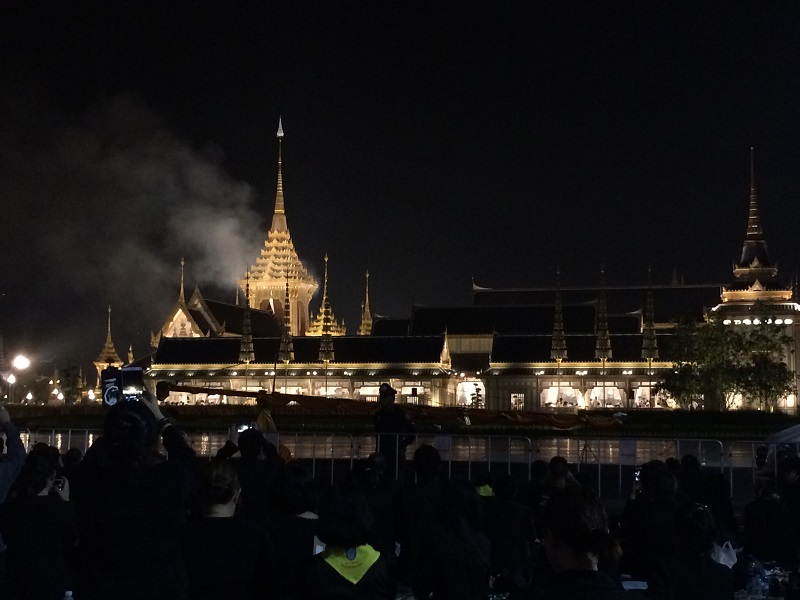
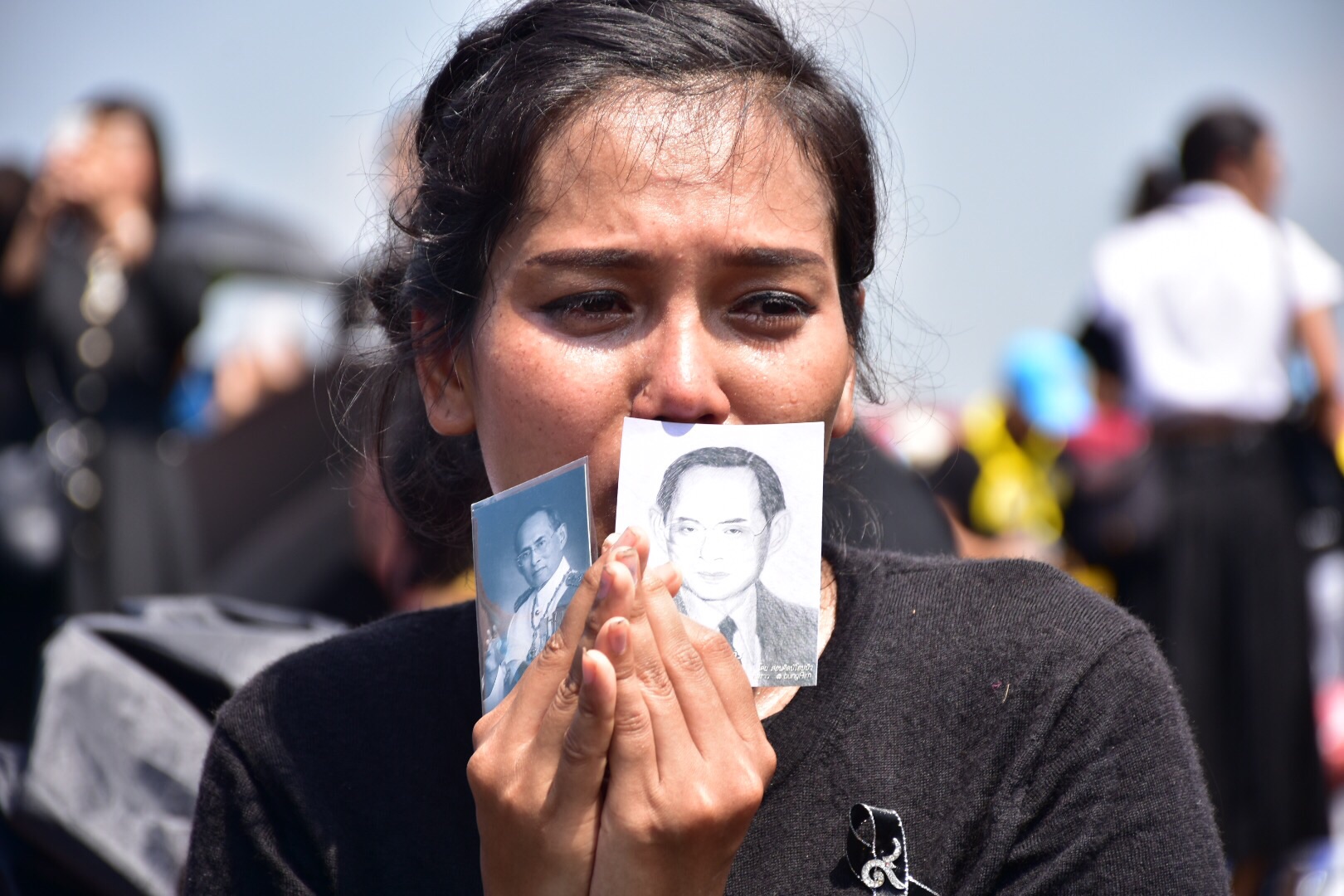 Both admirers and critics acknowledge King Bhumibol as one of the most influential leaders in Thailand, if not Southeast Asia. Born in the United States in 1927 as an obscure princeling, Bhumibol would later become a king who transformed not only Thai political ecology but the regional balance of power during the Cold War.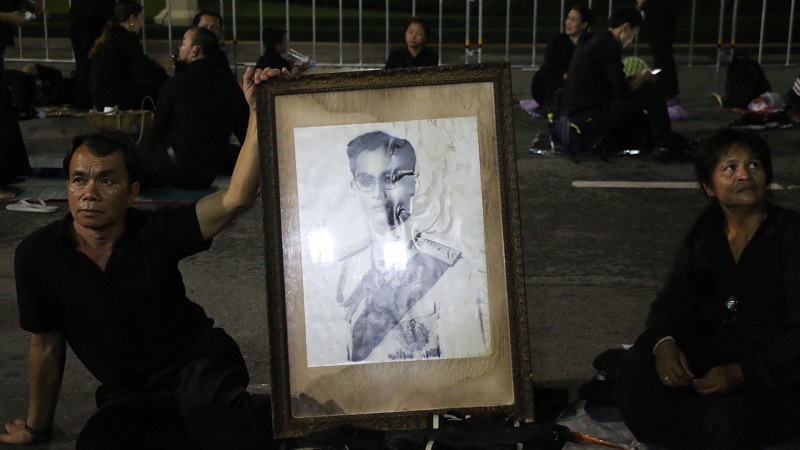

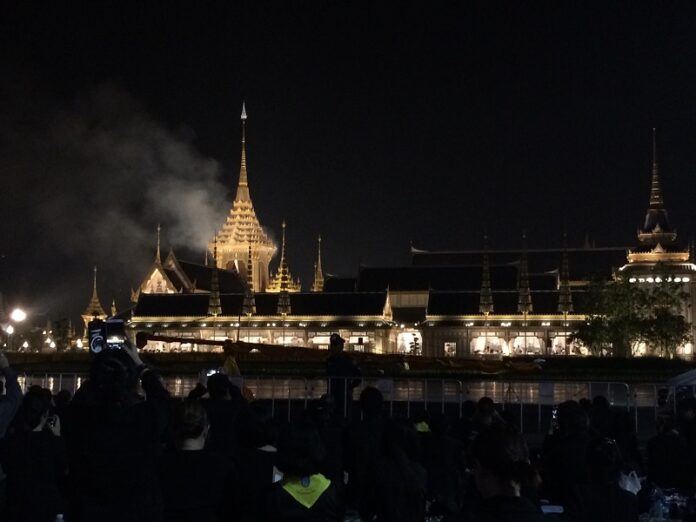
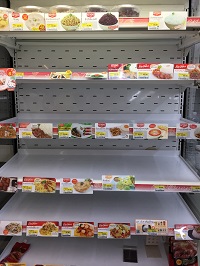
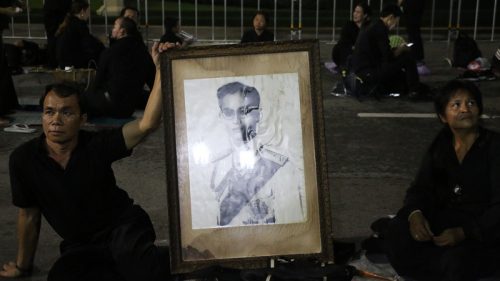
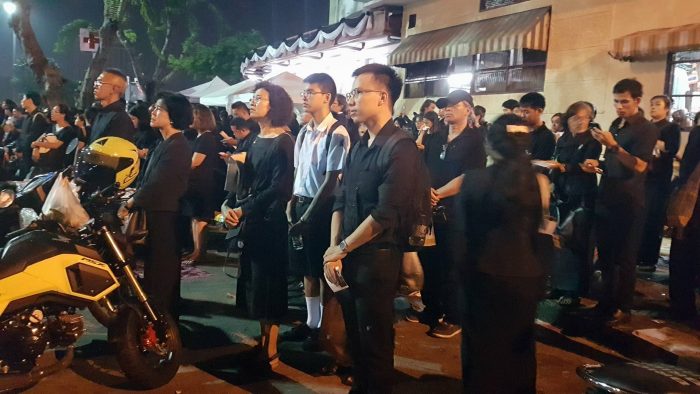
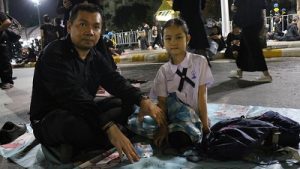
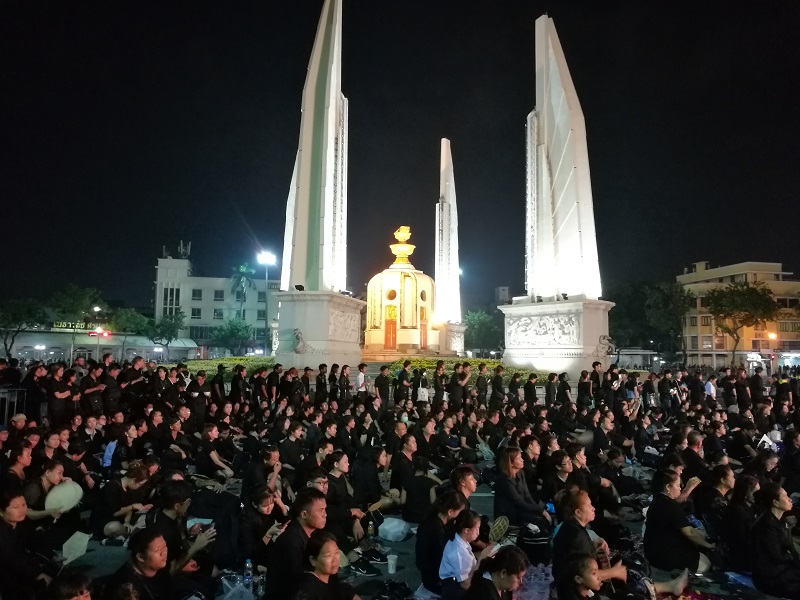
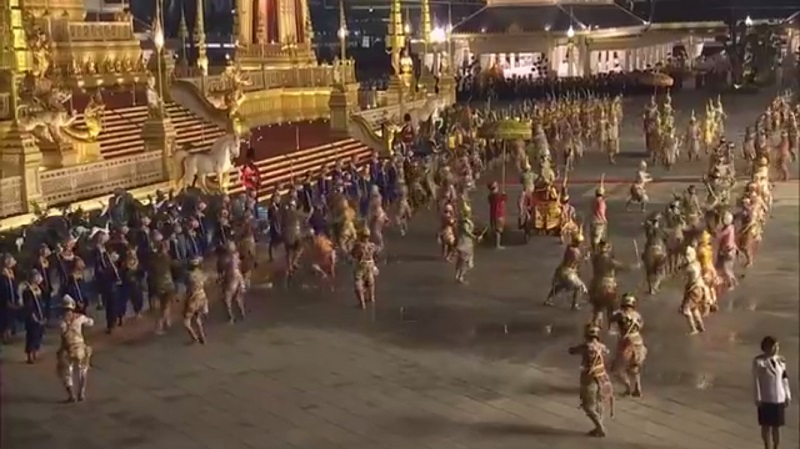
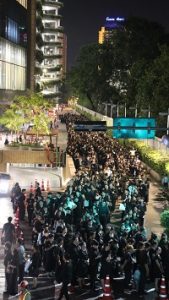
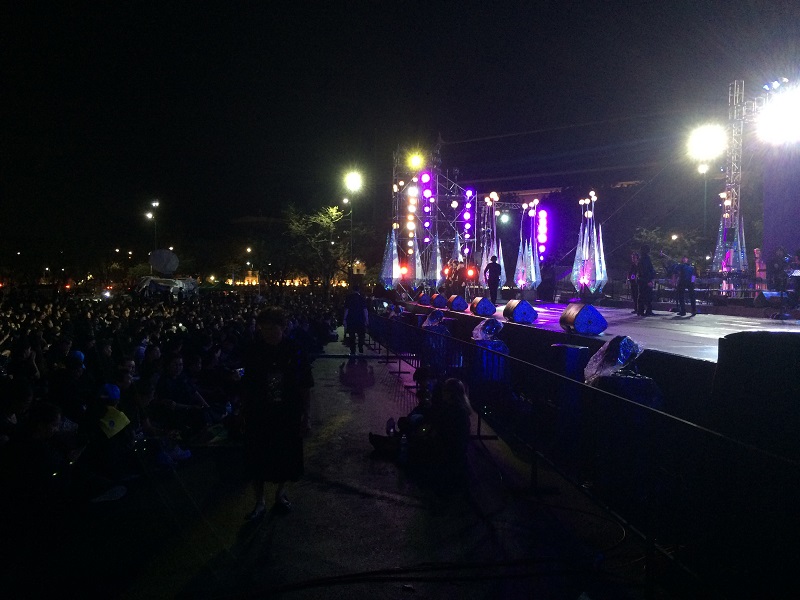
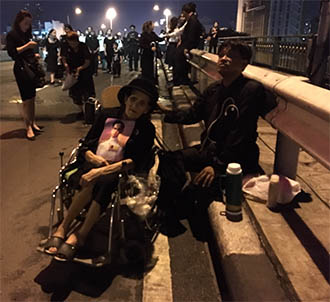
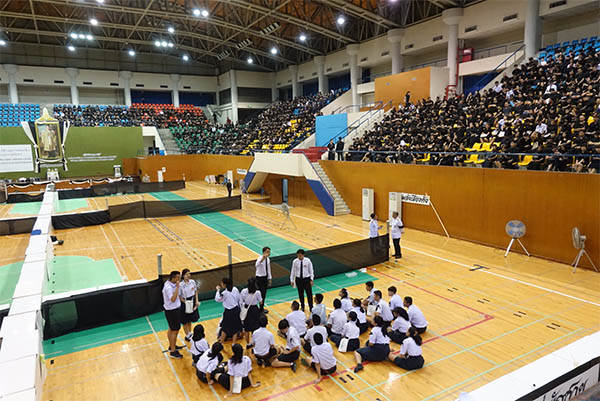
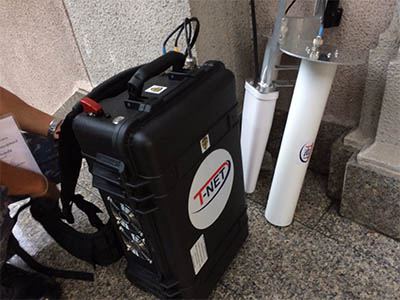
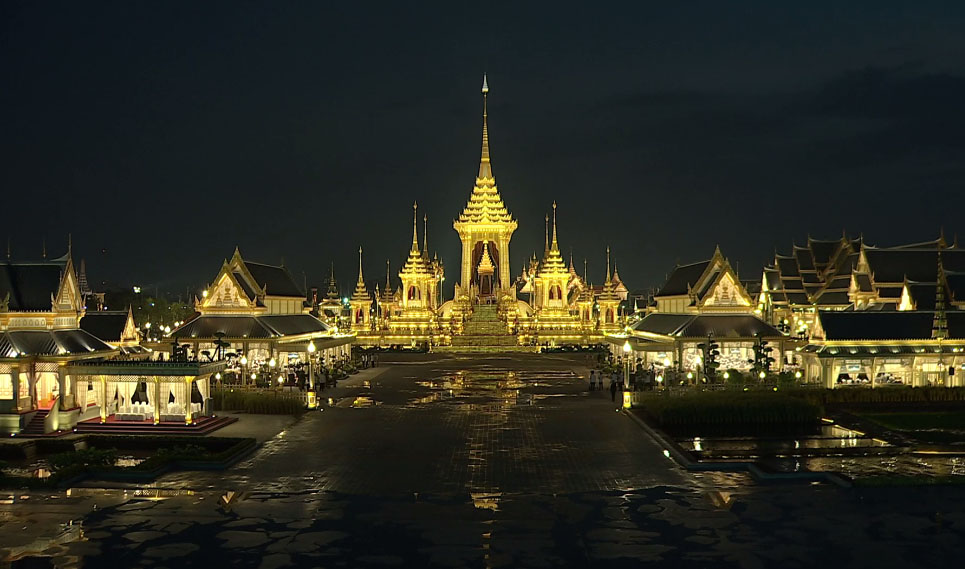
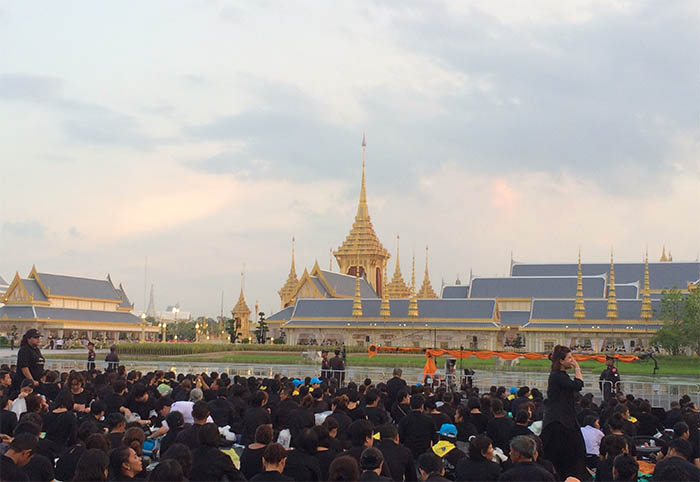
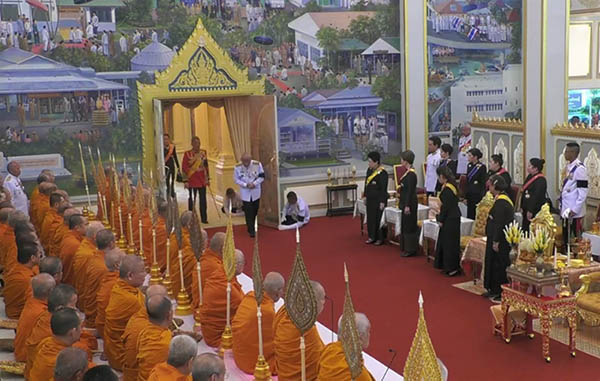
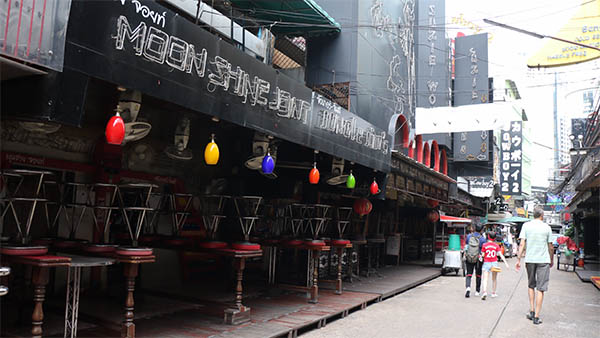
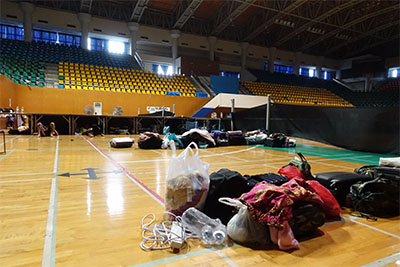 Chayanit: Twenty-four hours ago, I arrived with a backpack to the Bangkok Youth Center, or Thai-Japanese Stadium, to spend the night with people who had traveled from outlying provinces.
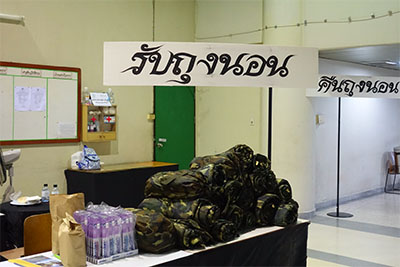 Surrounding me were nearly 30 women from Songkhla who lied down on the floor, mat or sleeping sacks. Some had their eyes shut while some others were chatting quietly. I couldn’t understand them very well. They were speaking to each other quickly using unfamiliar southern terms to my central Thai ears.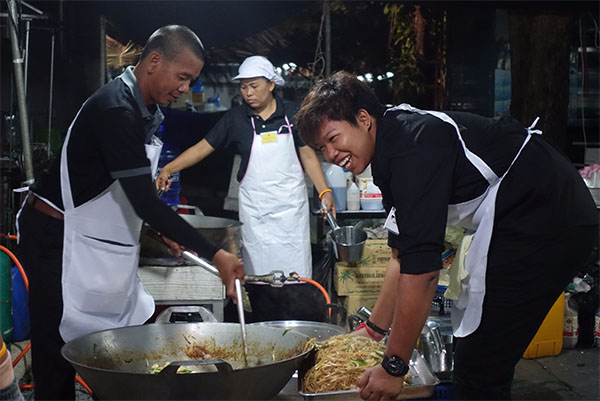
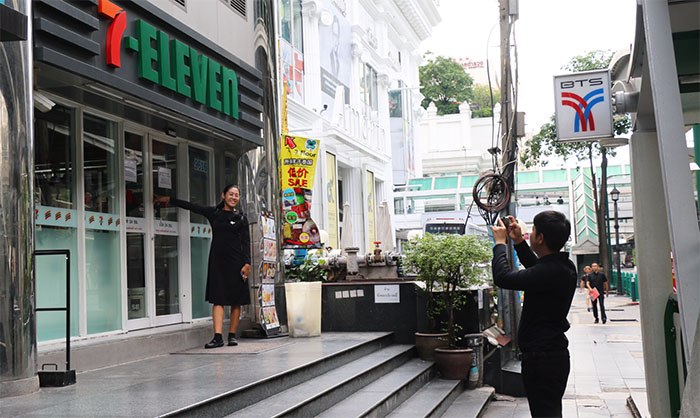
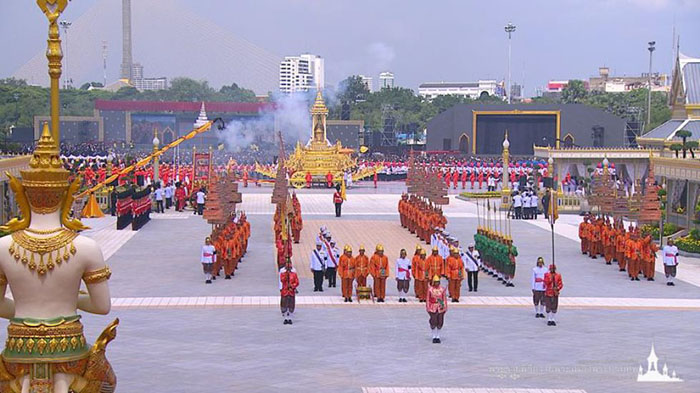
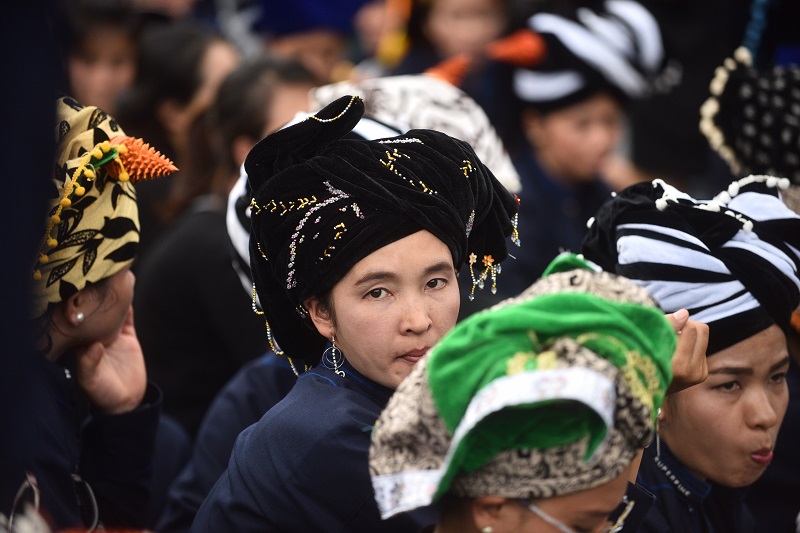
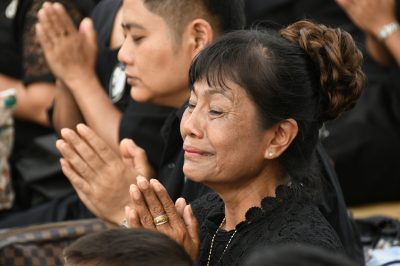
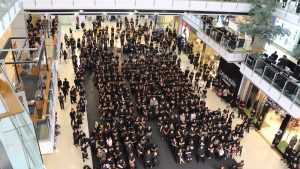
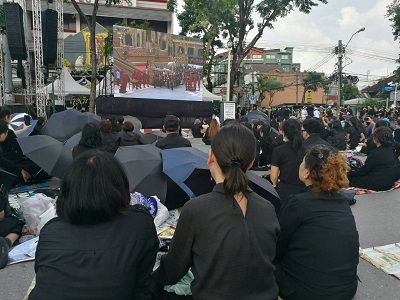
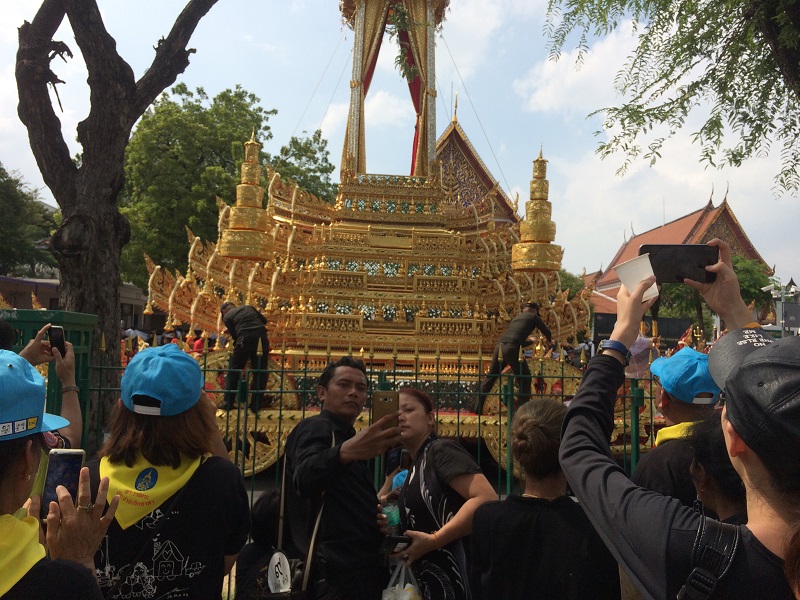
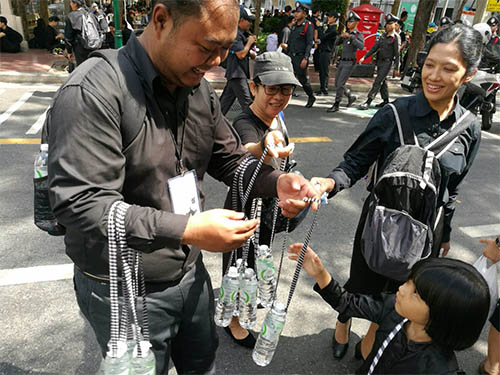 Pravit: I’m now on Din Sor Road near the Democracy Monument and though the crowd is not huge, many volunteers are busy handing out free drinks, food and medicinal balms.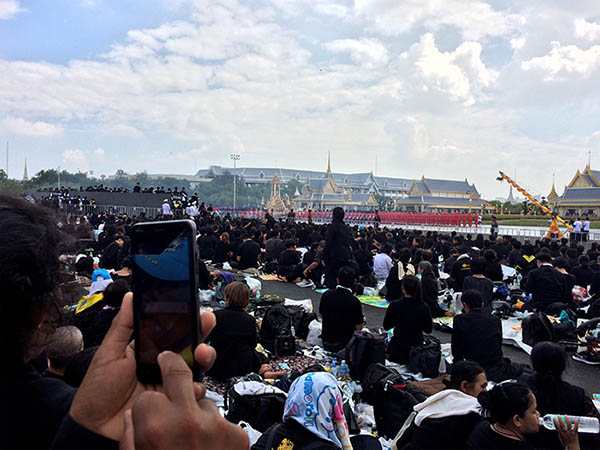
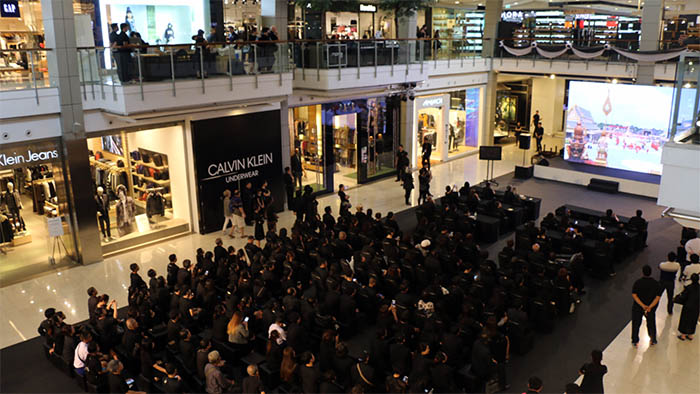
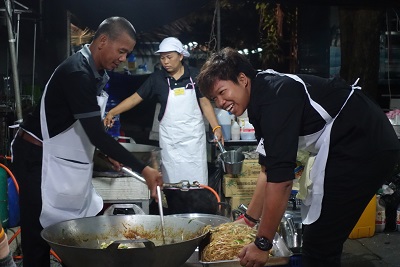
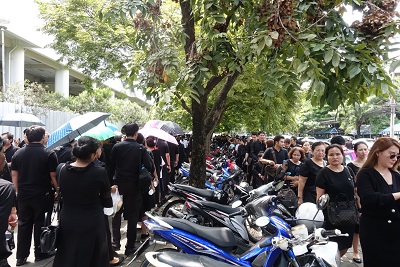
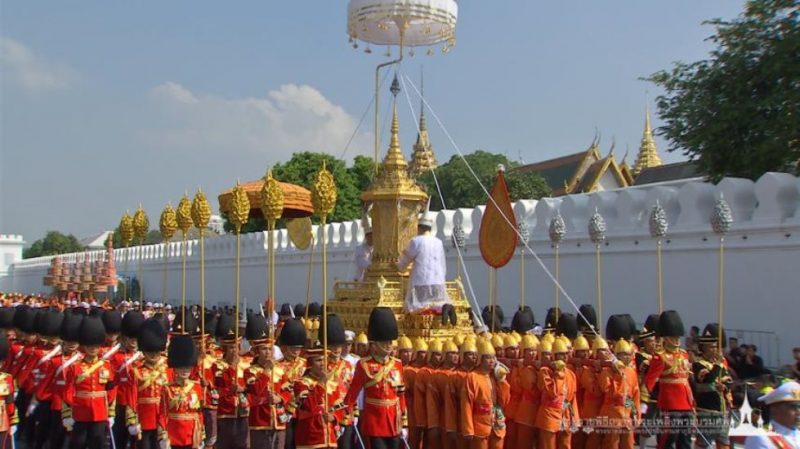
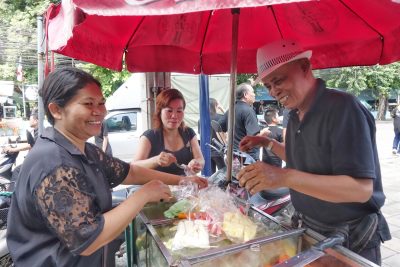
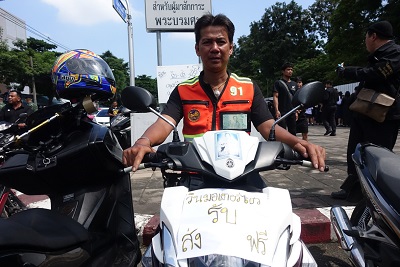
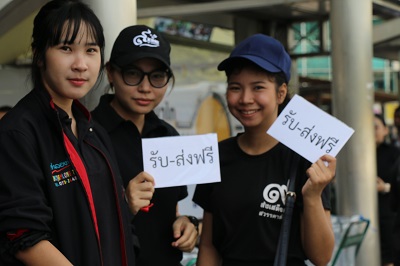
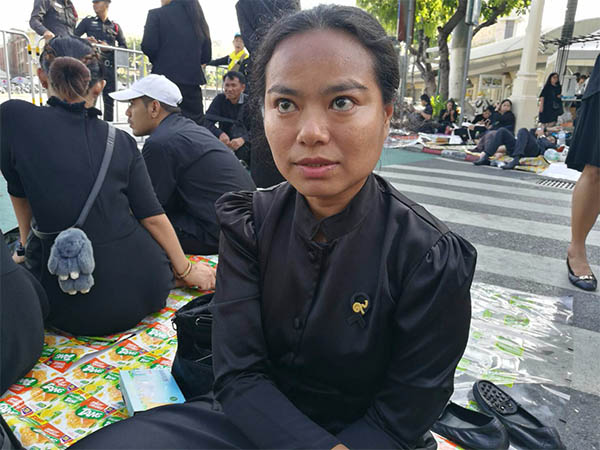
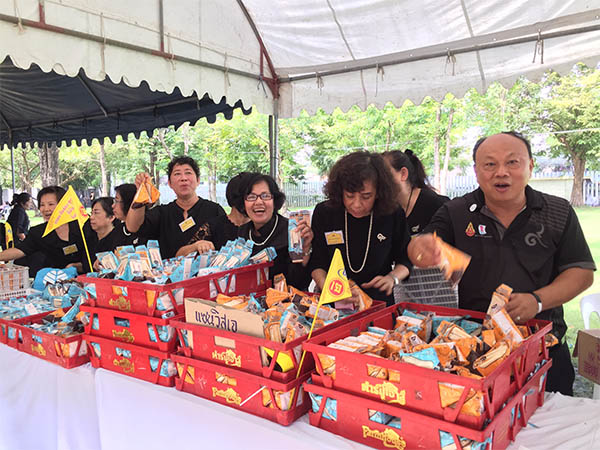
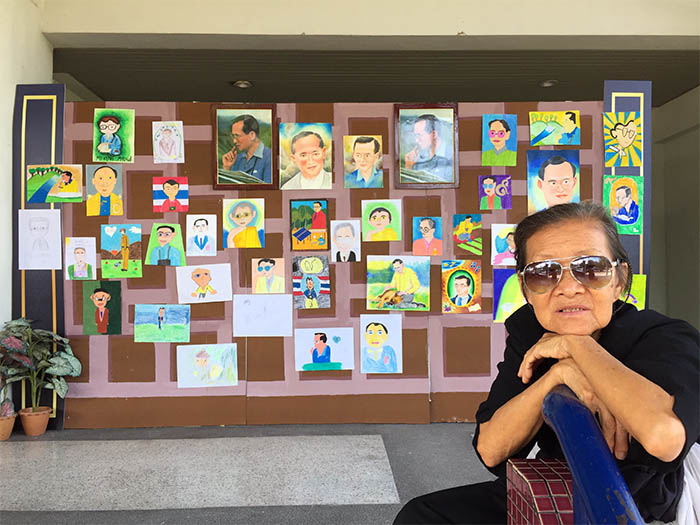
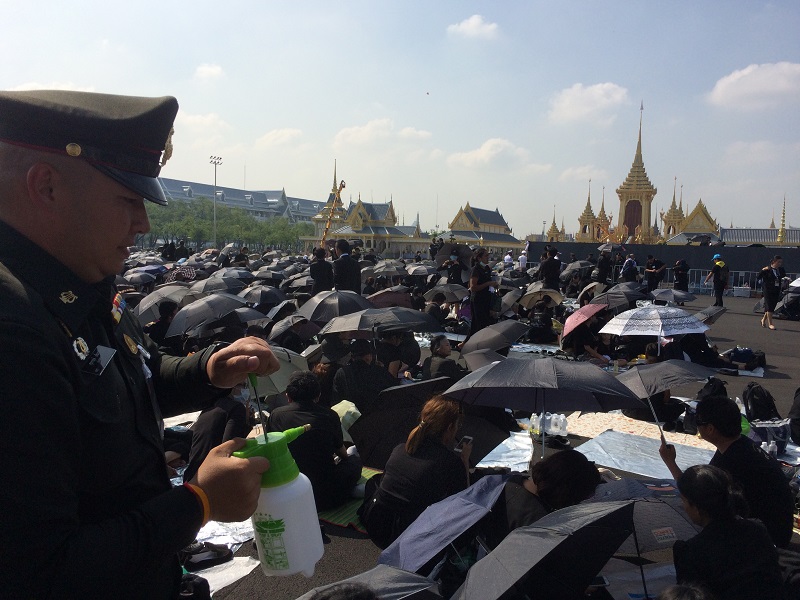
 Sasiwan: Passengers can receive free BTS Skytrain rides all day either by using their cash cards or pressing any button on the ticket machine.
 Teeranai: More than 100,000 people are estimated to be here in the vicinity of Sanam Luang. Providing security, food and sanitation to the mass of crowd who would spend days camping out is the biggest logistical challenge for the authorities in years.