Narathiwat residents scoop water from a ‘magical black spring’ Saturday, after health officials said the spring, hailed for its magical healing properties, was safe to bathe in – but not drink from – due to a high concentration of e-coli.
NARATHIWAT — Health officials on Saturday cleared a blackwater spring hailed for its alleged magical healing properties as safe to bathe in – but not to drink out of – due to its high concentration of e-coli bacteria.
The inky black spring of supposedly curative waters in a rubber farm in Si Sakhon district, Narathiwat – a popular pilgrimage destination for Southern locals and Malaysians – was found to be polluted with e-coli bacteria Thursday. After visiting and testing the waters, public health officials said Saturday the springwater was safe to bathe in, but not drink.
“Some components of the water have properties that may heal diseases, but drinking the tainted water can lead to diarrhea,” Sommhai Boonkliang, a Narathiwat public health official said Friday. “The three southern provinces has beliefs about sacrality, so we don’t want to affect that. We just want to add quality to these beliefs to maximize citizens’ benefit.”
On Saturday, residents set up tents near the spring as a makeshift shower stall to bathe. Others scooped up cups of the magical water to take home. According to them, the spring – consisting of a 3 meter pond and a 2 meter pond – has been a place of local hearsay and healing for over 30 years.
Sommhai recommended the water be used externally and be boiled to 100C before drinking.
“The levels of e-coli found here are above standard, and should not be released into public khlongs,” he said.
On Saturday, Sommhai said that after tests of the pond water found components of sulfur, which can be used to cure skin diseases and is found in a lotion used to treat dermatitis.
Narathiwat residents scooping water from the “magical” black spring Saturday.
A woman holds a rose and a French flag during a demonstration in what was described as a march of support for all French security forces Saturday in Paris. Photo: Emilio Morenatti / Associated Press
PARIS — Early voting began overseas Saturday in France’s most nail-biting election in generations, and the 11 candidates seeking to become the country’s next president silenced their campaigns as required to give voters a period of reflection.
Opinion polls pointed to a tight race among the four top contenders vying to get into the May 7 presidential runoff that will decide who becomes France’s next head of state. But the polls also said that decision was largely in the hands of the one-in-three French voters who were still undecided.
Polls opened in France’s far-flung overseas territories but voting wouldn’t start until Sunday on the French mainland. France’s 10 percent unemployment, its lackluster economy and security issues topped voters’ concerns.
Political campaigning was banned from midnight Friday until the polls close at 8 p.m. Sunday.
Polls suggested that far-right nationalist Marine Le Pen and Emmanuel Macron, an independent centrist and former economy minister, were in the lead.
However, conservative Francois Fillon, a former prime minister whose campaign was initially derailed by corruption allegations that his wife was paid for no-show work as his aide, appeared to be closing the gap, as was far-leftist candidate Jean-Luc Melenchon.
Security was tight – the government mobilized more than 50,000 police and gendarmes to protect 70,000 polling stations, with an additional 7,000 soldiers on patrol.
Security was a prominent issue after a wave of extremist attacks on French soil, including a gunman who killed a Paris police officer Thursday night before being shot dead by security forces. The gunman carried a note praising the Islamic State group.
Voters made their choices in the Atlantic Ocean territories of Saint Pierre and Miquelon as well as in French Guiana in South America, the Caribbean’s Guadeloupe and elsewhere. Voters abroad could also cast ballots in French embassies Saturday.
The mad-dash campaigning of the last few weeks came to an abrupt halt after the Champs-Elysees gun attack by 39-year-old Karim Cheurfi. Three suspects close to the attacker remain in custody, Agnes Thibault-Lecuivre of the Paris prosecutor’s office said Saturday.
Le Pen and Fillon canceled their last campaign events Friday over security concerns. Macron did too, but also accused his rivals of trying to capitalize on the attack with their anti-immigration, tough-on-security messages.
In a sign of how tense the country is, a man holding a knife caused widespread panic Saturday at Paris’ Gare du Nord train station. He was arrested and no one was hurt.
Well-wishers paid their respects Saturday at the site of the shooting, which was adorned with flowers, candles and messages of solidarity for the slain police officer, Xavier Jugele. Across from the Eiffel Tower, women from the group Angry Wives of Law Enforcement demonstrated against violence aimed at police.
Some believed French stoicism would prevent a lurch to the right in the presidential vote, even though the attack dominated French headlines.
“These 48 hours are not going to change everything … terrorism is now an everyday occurrence. It’s permanent, 24 hours a day. So we’re not afraid. If we’re believers in freedom, we must live with it,” said Marise Moron, a retired doctor.
“I’m not going to let myself be influenced by people who are trying to frighten us,” Paris resident Anne-Marie Redouin said near the heavily-guarded Eiffel Tower.
Others, fearful that Le Pen has been strengthened by the instability, said they would shift their votes from fringe candidates to make sure to keep the far-right out of power.
“With an attack such as this one, I think the National Front will get a good result. Therefore I’ll change my intention and cast a useful vote – either Melenchon or Macron,” said physics teacher Omar Ilys, 44.
The French presidential choice will resonate far beyond France’s borders, from Syrian battlefields to Hong Kong trading floors and the halls of the U.N. Security Council.
The election is also widely being viewed as a ballot on the future of the 28-nation European Union. The far-right Le Pen and the far-left Melenchon could pull France out of the bloc and its shared euro currency – a so-called “Frexit.”
A French exit could ignite a death spiral for the EU, the euro and the whole idea of European unity that was borne out of the bloodshed of World War II. France is a founding member of the EU and its main driver, along with former rival Germany.
Financial markets are already jittery over a possible Frexit, fearing capital flight, defaults or lawsuits on bonds and contracts. Le Pen’s team is downplaying possible apocalyptic scenarios and arguing that the euro – which is now used by 19 nations – is headed for a breakup eventually anyway.
If Le Pen or Melenchon win a spot in the runoff, it will be seen as a victory for the populist wave reflected by the votes for Donald Trump and Brexit – the British departure from the EU. Many French workers who have lost out by globalization are similarly fed up with establishment parties and attracted by promises of ditching the status quo.
Alternatively, if neither candidate makes it past Sunday’s first round into the runoff, that’s a clear message that populist nationalism is receding.
Macron and Fillon are committed to European unity and would reform labor rules. Macron has framed himself as a bulwark against Trump’s protectionism.
Le Pen and Melenchon blame free trade pacts for killing French jobs and want to renegotiate them.
A Clamont time trial in 2013 in New South Wales, Australia. Photo: Conollyb / Wikimedia Commons
SAN JUAN, Puerto Rico — It wasn’t a 10-speed, but a bank robber in Puerto Rico was still able to elude police Friday by fleeing on a bicycle.
Authorities said the unidentified suspect stole some USD $3,000 from Banco Popular after handing a teller a note that suggested he was carrying a weapon.
The incident occurred in the Rio Piedras suburb of the capital of San Juan.
Police said they believe the suspect is the same man who robbed another bank last week, although he did not flee on a bicycle that time.
Actresses Erin Moran, left, and Marion Ross pose together in 2009 at the Academy of Television Arts and Sciences' "A Father's Day Salute to TV Dads" in the North Hollywood section of Los Angeles. Photo: Matt Sayles / Associated Press
NEW YORK — Erin Moran, the former child star who played Joanie Cunningham in the sitcoms “Happy Days” and “Joanie Loves Chachi,” has died.
Police in Harrison County, Indiana, said that she had been found unresponsive Saturday after authorities received a 911 call. She was 56, and the cause of death has not been determined. Moran had endured numerous struggles in recent years.
Moran was already a veteran actress when in 1974 she was cast in “Happy Days” as Joanie, the kid sister to Ron Howard’s Richie Cunningham in the sitcom set in the 1950s. She would later appear with Scott Baio in the “Happy Days” spinoff “Joanie Loves Chachi.”
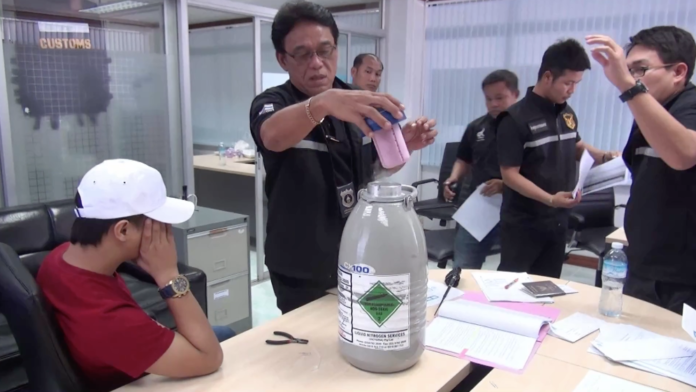
Nithinon Srithaniyanant, at far left, covers his face as customs officers examine his nitrogen-cooled tank of semen Thursday in Nong Khai province.
BANGKOK — Two of six bottles of semen found on a would-be smuggler at the border with Laos came from a Bangkok fertility clinic, Nong Khai border customs officials said Friday.
After Nithinon Srithaniyanant was arrested at a customs checkpoint in Nong Khai city with the six bottles in a nitrogen-cooled tank, authorities discovered Friday that two of the bottles had come from a fertility clinic in Bangkok. That clinic – Superior ART – denied having knowledge it might be illicitly exported.
“After the clinic gives out the semen, the transaction is completed on our end. The clinic was unaware and completely uninvolved with the semen smuggling,” Srayuth Assamkorn, the clinic’s managing director said Friday. “We always tell our patients that exporting semen is against the law.”
Commercial reproductive services became controversial after a string of incidents in recent years, including an Australian couple accused of abandoning a Down syndrome baby born to a Thai surrogate, a Japanese “super dad” who fathered at least 16 babies and a legal battle between a gay couple and their Thai surrogate. Commercial surrogacy was later banned, while fertility clinics are widespread.
The two bottles from Superior ART contained semen from Chinese and Vietnamese men, and was withdrawn from the sperm bank April 17 and 19 by a patient who had come in for counseling. The clinic did not disclose the name of the patient.
Nithinon said Thursday he had made several trips smuggling materials from Thailand to fertility clinics in Laos and Cambodia. On those trips, he would obtain semen, eggs or embryos from four fertility clinics in Bangkok: the Jetanin Institute for Assisted Reproduction, First Fertility PGS Center Limited, iBaby Fertility & Genetic Center and Superior ART.
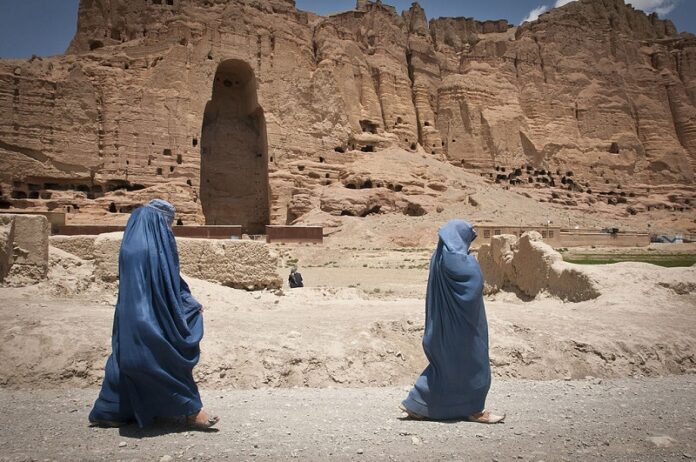
Two women walk in 2012 past the huge cavity where one of the ancient Buddhas of Bamiyan, known to locals as the "Father Buddha," used to stand in Afghanistan. Photo: Ken Scar / Wikimedia Commons
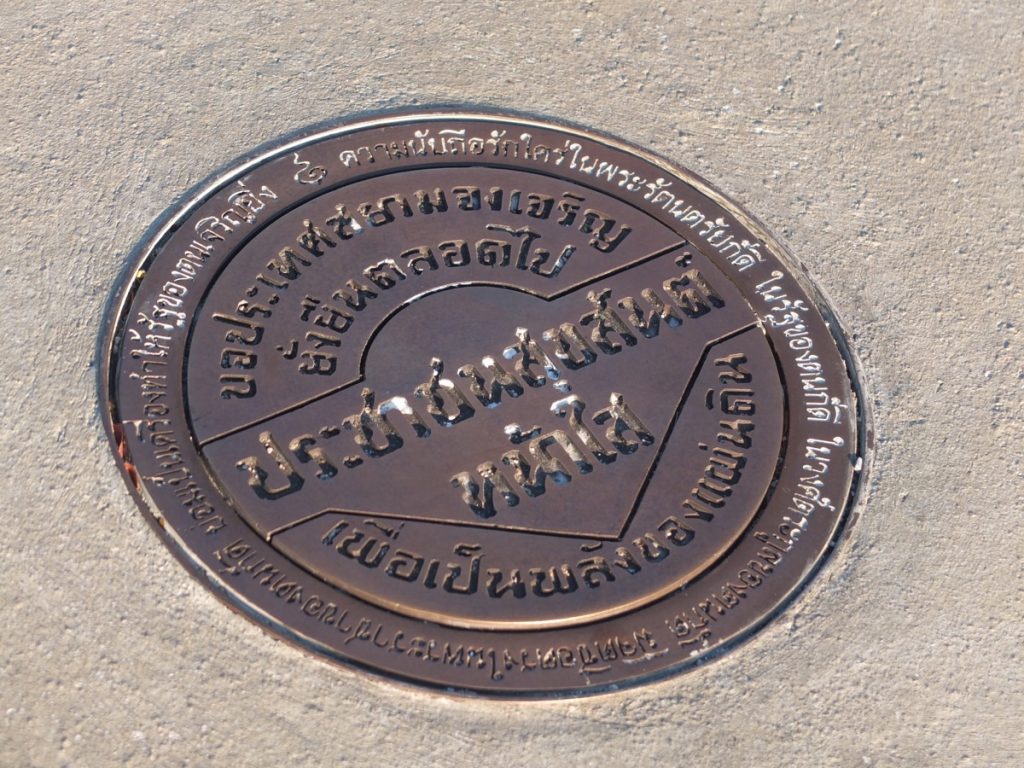
The mysterious removal of 1932 Revolution Plaque has opened up a Pandora’s box. The news about the removal of the brass plaque – marking the spot where the revolt which ended absolute monarchy in 1932 began with a declaration – led to debate. Not just over the merit of the historical object itself but over a re-assessment and rediscovery – particularly among younger Thais – of the Promoters, also known as People’s Party, or Khana Ratsadon, which overthrew absolute monarchy 85 years ago.
While many social media users were angered by loss of the historic plaque and concluded it’s an attempt to literally remove the past, some ultra-royalists jubilantly greeted its disappearance and replacement with a similar plaque extolling the virtues of loyalty to the throne.
Both sides have their reasons to be disturbed or delighted. While it’s normal for people to have differing political ideologies, and we should debate about our past, Thai society should not Talibanize its historical relics – lest we learn or remember nothing from our past. If we continue to allow our past to be removed or deleted, we risk not knowing who we are. The same applies to society and our collective memory.
The fact that a number ultra-royalists are jubilant about the disappearance of an important historical relic is a disturbing sign. It points to a vision for a society that desires amnesia about its unpleasant or inconvenient collective past.
We should not try to be selective in remembering our past because there’s a lot we can learn, even from its bitter chapters. (Think Germany’s preservation of the Buchenwald Concentration Camp as a reminder of Nazi atrocities, for example.)
The past is distant, and we need all the jigsaw pieces possible to properly and fairly comprehend it.
If people keep destroying historical artifacts that don’t suit their ideology, sooner or later they won’t have any old material culture left to study or remember. This leads to a rootless, and literally ruthless society.
The other unintended repercussion of the plaque’s removal is revisiting the Promoters’ legacy. Prior to last Friday, some younger Thais didn’t even know there existed such a commemorative plaque, which was in fact embedded on Royal Plaza ground in 1936, four years after the revolt.
Those overtly gratified by the plaque’s removal soon found themselves confronted by debate about the merits of the Promoters.
Some said what had happened was nothing compared to the nationalization of the Pathumwan palace, which belonged to the first crown prince appointed by King Rama V, destroyed and turned into what today is the National Stadium. A Twitter user reacted to this, asking about the palace of Chiang Mai’s royalty now turned into Chiang Mai prison.
It was also met with remarks referencing Field Marshal Plaek Pibulsongkram, also known as Pibul, who ordered the land which belonged to the Crown Property Bureau be given over in perpetuity to Chulalongkorn University, enabling the university to maintain considerable resources for its development.
Some pointed out that another leader of the Promoters, Pridi Banomyong, founded Thammasat University, the other leading Thai University. So should Thammasat also be demolished to remove the memory of the 1932 revolt?
Not all of the legacies of the Promoters were positive. Pibul eventually succumbed to the temptations of strongman rule. The motto, “Believe in The Leader and the Nation Shall be Safe” led to creation of a personality cult subsequent dictators tried to emulate.
I personally dislike that most Thais automatically freeze to the sound of the National Anthem played at 8am and 6pm in public areas, even if they were just walking past an elevated pedestrian bridge over or resting on a grass lawn in a public park. This is a waste of time, an attempt to control people’s bodies, and a legacy originated from Pibul’s time. I try to resist or ignore it as much as possible.
“[People] were to stand to attention when the national flag was hoisted up the pole at eight in the morning…,” wrote scholar Kobkua Suwannathat-Pian, in the book “Thailand’s Durable Premier: Phibun through Three Decades 1932-1957.”
Like it or hate it, society’s past contains various aspects and objects that we may not all like. Removing or destroying it will only impoverish our past and present, as a society however. The Taliban blew up the giant Bamiyan Buddha statues in 2001 in Afghanistan because they wanted to erase the Buddhist past from the now-Muslim land. That only made them barbaric and the place barren.
BANGKOK — Along with two apparel shops, that which is also gone from Soi Sukhumvit 55, aka Thonglor, is its street food scene after a ban on sidewalk stalls went into effect Monday.
As expected, there are no longer som tam restaurant tables intruding onto the footpaths. But after the ban, some small push carts selling grab-and-go food had also disappeared.
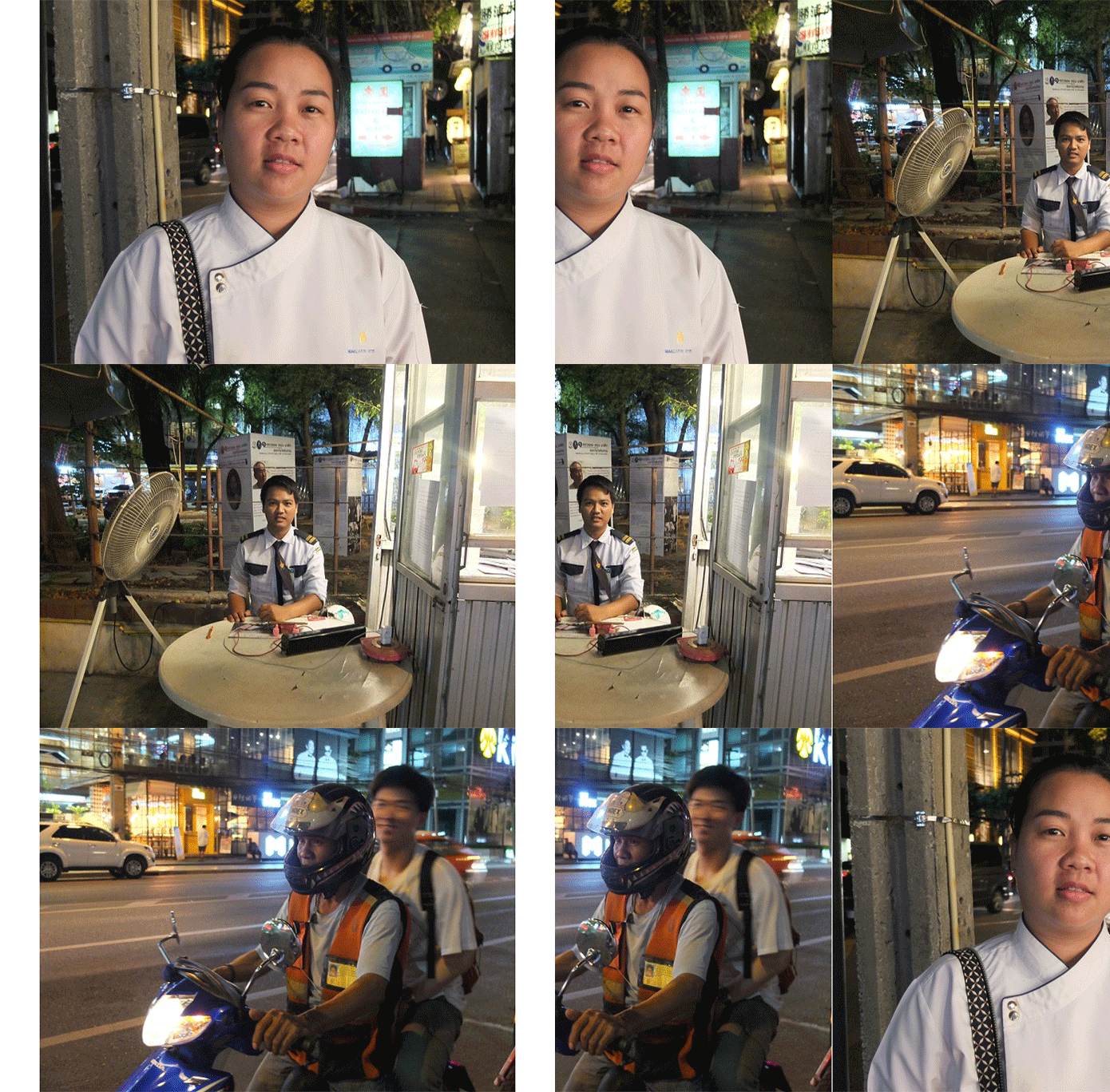
So we wondered how the folks there to work – not play – are holding up, or more precisely: What are they eating? We went out and asked some Tuesday night. Here are their answers.
“7-Eleven only. Normally I sometimes have Look Chin Ping (grilled pork balls), but it’s also gone. If I have time, I cook from home and bring it to work,” – Na, masseuse at right
“This grilled chicken cart is the only food cart left around here at night. The vendor made a deal to park it under the roof of the hair salon. I’ll just eat here. The ready-to-eat food cart that used to park in front of 7-Eleven? I heard they moved to Rama II. They can sell there,” – Bunthom Pittana, a motorcycle taxi driver despairing of the ban when we spoke to him last month.
“I ate at the street food place inside the next soi. It’s a private lane, so the place can still sell. It costs around 35-40 baht. But today it’s even more packed because there is no other place to go, so everyone went there. It’s good for me; I can go any time. But for those who have a specific time for their one-hour break, it must be difficult. I don’t get it. They want us to pack our lunch from home?” – Mek, security guard
“MaxValu. Some of their food is a little bit cheaper than 7-Eleven, by like 3 baht. Or sometimes I go back to eat at home. My home? It’s in Bang Na,” – motorcycle taxi driver who declined to give his name.
“I don’t have any problem. My workplace offers meals – breakfast, lunch and dinner,” – Ja, employee at the Grande Centre Point Sukhumvit 55 Hotel
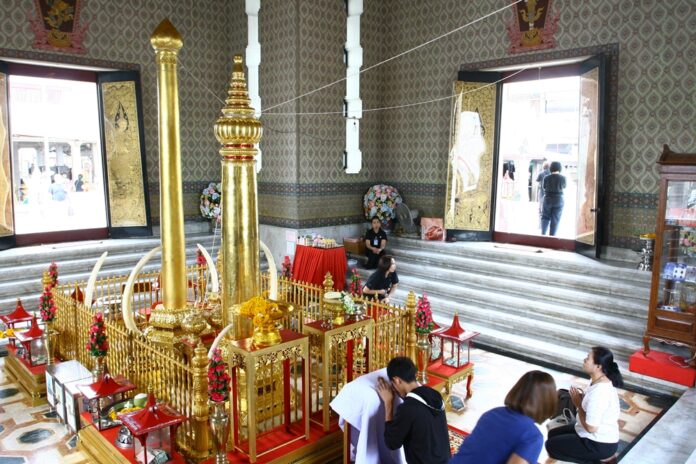
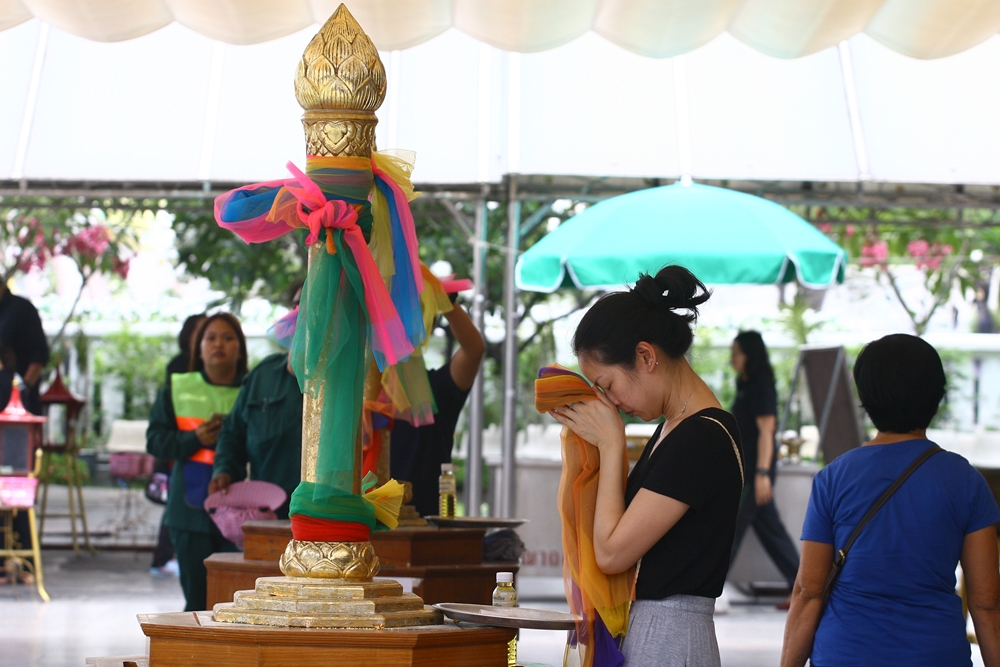
Worshipers pray at the Bangkok city pillar shrine. Decades after the first city pillar was laid there, the royal court had to place a new one because the former is believed to have been marred by a curse.
Much has been said about what prompted a group of Western-educated military officers and technocrats to seize power from the royal government 85 years ago and pave way for democratic rule in Thailand, then known as Siam.
Historians generally cite the failure by the king’s government to fix the social and economic malaise, others point to the wave of constitutionalism sweeping the globe at the time, while the more conservative thinkers believe it was an attempt by “hot-headed” liberals to waylay the king, who was ready to grant a constitution when Siam was ready.
For many among the royal circles back then, the revolution was not about politics, but also about supernatural cause. For them, what happened on the morning of June 24, 1932, was a 150-year-old prophecy coming true – despite their efforts to avert it.
The prophecy was part of a curse that reportedly befell Bangkok the moment the city was founded in 1782. It predicted that the Chakri Dynasty would only rule the country for a century and a half before coming to an end.
While the curse may sound ludicrous today, it was no laughing matter for a country known for deep-seated superstitions. Generations of noblemen and royal family members lived under fearful conviction that their reign will end once the time runs out. And they did all they could to ward off the doom.
Because of the curse and the subsequent attempts to remedy it, Bangkok has a bridge across the river, two city pillars, an invented deity all Thais supposed to worship, a folk song all children know by heart and a Red Cross building. According to one historian, even the 1932 coup plotters made use of the curse by spreading rumors about an imminent downfall as prophesied to demoralize the royal establishment.
Sacrifices for a Newborn City
For four days and four nights in April 1782, royal astrologers and an entourage of the newly crowned King Ramathibodi converged on a patch of ground close to Chao Phraya River.
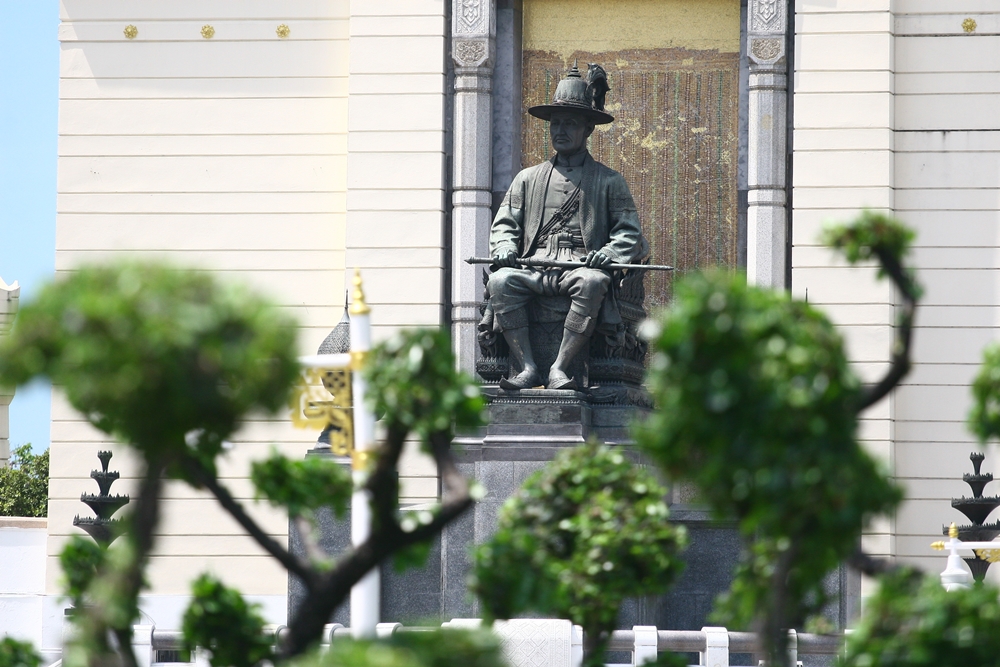
After seizing power from a previous monarch and beheading him mere weeks earlier, King Ramathibodi, who later became known as Rama I, chose this spot to be the city pillar, the divine foundation of his reign.
A statue of King Rama I in Bangkok.
The minute and hour the pillar, actually a large Javanese cassia log, would be put up was meticulously calculated by the royal soothsayers for the most felicitous alignment in the stars. It was to be the moment Bangkok, the new capital city of the Siamese kingdom, would be born.
Those minutes and hours are important because they would establish the Duang Mueang, or a “City’s Fortune.” Every city has its Duang Mueang, but Bangkok’s was to be the most important because it not only affected the capital city – but the entire kingdom.
“Everyone in the country is bound to it,” Fongsanan Chamornchan, an astrologer and author who’s written about Duang Mueang, said in a recent interview.
For maximum benefit to Bangkok’s Duang Mueang, the team of royal astrologers calculated the best time to lay down the city pillar to be the the 9th baht (also an archaic unit of time) after dawn of the 10th day of the waxing moon of the sixth month of the Year of the Tiger. By Gregorian reckoning, that was 6:54am on April 21, 1782.
As recorded by the royal astrologers and recently retold in vivid details in “Miraculous and Mysterious Dimensions” by historian Rome Bunnag, the hole for the city pillar was dug on the night before the auspicious day. When dawn arrived, a sense of apprehension must have swept through the ranks of noblemen, priests, soothsayers and mages gathered there.
The chief astrologer, Phra Hora Thibodi, laid four stones into the hole, symbolizing the four spirits that guarded the four cardinal directions, followed by a parchment bearing magical incantation.
6:54 AM
Time for the pillar to be erected. A gong was sounded to herald the sacred minute. The priests made ready about the log.
Just then, the royal chronicle noted, four snakes appeared from nowhere and slithered into the hole meant for the log. There was nothing the holy men could do; the hour and minute of Duang Mueang had to be respected. They had no choice but to slam the pillar home, smothering the four snakes.
The serpents thus became unwitting sacrifices to the newborn city.
The Curse of Bangkok
It doesn’t take a degree in divination to deduce that unintentional animal sacrifice was bad mojo for Duang Mueang.
Immediately after the incident, Rama I gathered his astrologers and asked them what the snakes portended. The consensus, as the king feared, was awamongkol, an ill fortune. But what doom was to descend on Bangkok? The astrologers had no answer.
The news could not have been well received by King Rama I and his infant kingdom. But for the next seven years and seven months, no significant disaster took place, and the royal court likely sighed in relief.
A worshiper prays to a replica of the city pillar.
That changed on a Sunday afternoon in May 1789, when lightning struck a throne hall in the Grand Palace and set it ablaze. The incident forced Rama I to consult his astrologers again to see the meaning of the botched ritual seven years earlier.
His conclusion, as famously chronicled by his sister Her Royal Highness Gu Narindaradevi, was that the snakes doomed the Chakri dynasty to fall, but the deities took mercy because the king had recently ordered a new translation edition of the Tripitaka, the Buddhist scripture. The angels, Rama I reportedly said, agreed to delay the inevitable 150 years.
“[Thus] His Majesty proclaimed, I have restored the Tripitaka, and the gods granted me a chance,” Gu Narindaradevi quoted her brother as saying. “My line of kings will last for 150 years.”
Averting Doom
Instead of resigning to the prophesied downfall, the royal court spent the next 150 years trying to thwart it.
Much of these attempts were recorded and retold in the tradition of mukha patha (oral history) passed down through generations of astrologers, said Pakasit Tipjorn, a professional necromancer, who also studies astrology.
The first major effort was undertaken by King Mongkut, or Rama IV. While the monarch is generally described as the champion of science and Westernization, King Mongkut was also enthusiastic about astrology and clairvoyance.
“He didn’t rely on astrologers. He was the astrologer,” Pakasit, who specializes in animist black magic, said in a recent interview.
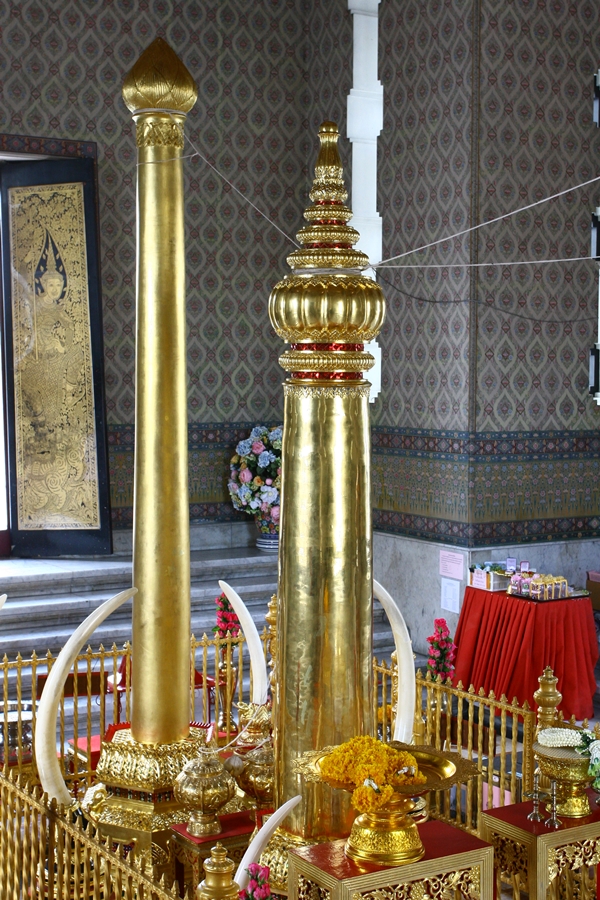
In December 1852, the king decided to solve the problem at its root. He ordered the city pillar shrine torn down and rebuilt. A new teak log was erected next to the original one.
The old and new city pillars.
King Mongkut also ordered his artisans to construct a figurine of Phra Siam Dheva Thirat, a small deity he believed embodied an invisible angel that protected Siam from disasters and colonization. According to the oral histories, the king hoped Phra Siam Dheva Thirat would spare the country from the evil fortune portended by his grandfather.
Despite its relatively recent history, Phra Siam Dheva Thirat is now worshiped by Thais as one of the most sacred of deities.
Astrologer Fongsanan said such gestures are futile because the fate of Duang Mueang cannot be changed.
“It’s a destiny that cannot be altered,” said Fongsana, who’s worked as a soothsayer for 15 years. “It’s like a person. You only have one fate once you’re born. Everything that you do is simply the colors of life.”
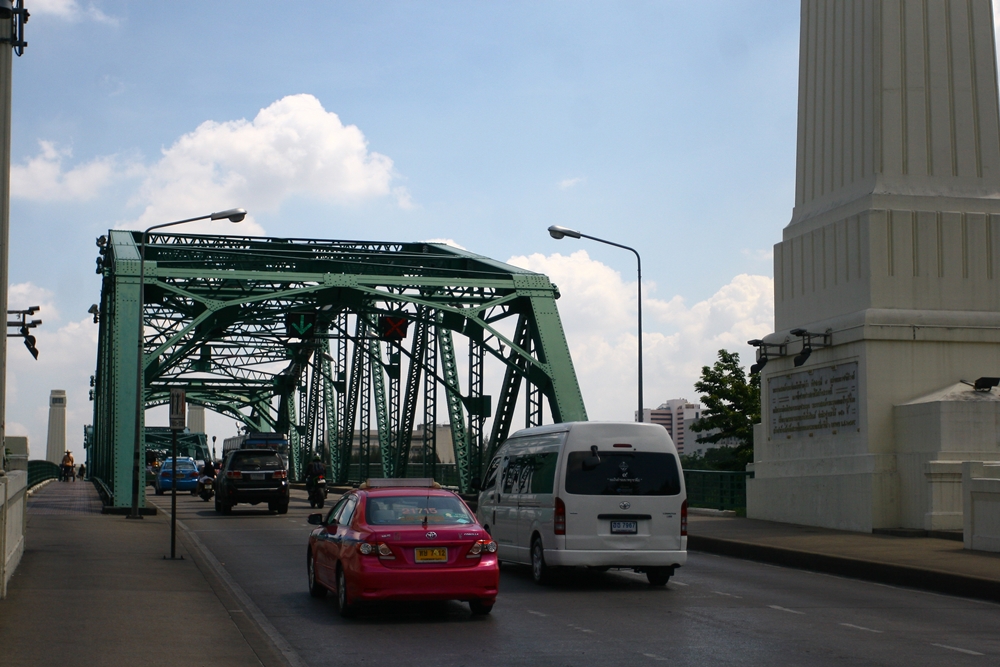
But the aristocrats did not think so. In 1932, the year the reign of kings was supposed to end, drew closer, the palace intensified its efforts. The largest project was undertaken by King Rama VII’s royal court in 1927: The construction of a bridge connecting Bangkok and Thonburi over the Chao Phraya River.
While the bridge obviously had its practical use, there was also a cosmological meaning as well, Pakasit said. Rama IV is said to have come up with the idea of the bridge, as he believed that uniting the spirits of the two capital cities, old and new, could bring a divine harmony to eclipse the curse.
The project did not take off in his time, but it would be realized by Rama VII.
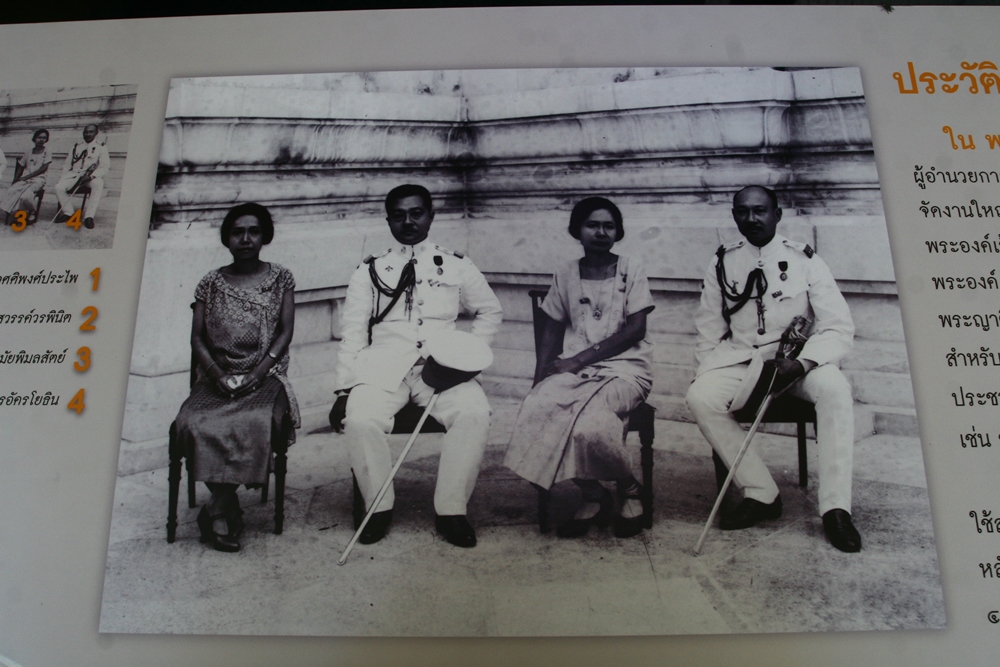
The ‘four serpents’ royals in a photo hung at the Queen Saovabha Memorial Institute.
Return of the Serpents
The beginning of 1932 must have invited dread for King Rama VII, aka Prajadhipok. He knew the prophecy would arrive on his watch. The curse of the four snakes also held a special, personal meaning for Rama VII: He was born in 1893 – the Year of Serpent, in the traditional zodiac.
By freakish coincidence, four of his close aides in the royal court – Sasibongse Prabai, Paribatra Sukhumbhand (grandfather of former Bangkok Gov. Sukhumbhand Paribatra), Bismai Bimalasataya and Purachatra Jayakara – were also born under the serpent – 1881.
Rumors began spreading that the four royals were the four snakes reincarnated to deliver vengeance. As a gesture to ward off the purported jinx, the four pooled donations for the Red Cross to construct a new building named “Si Maseng,” or “Four Serpents,” in memory of the four unwitting martyrs of Bangkok.
The building, near Chulalongkorn University, today is a snake farm for researching snakebite serum at the Thai Red Cross on Henri Dunant Road.
Around this time, a new folk game was invented to placate the serpentine spirits, Pakasit said. Children in communities around the country were soon taught to play it, and the game is still observed in schoolyards and traditional celebrations today. The game involves a song all Thais know by heart:
“Mother snake, which well are you drinking from? I’m drinking from a stone well, and I’m moving about. Mother snake, which will are you drinking from? I’m drinking from a sand well, and I’m moving about.”
Rumors of Revolt
New Year’s Day of 1932, which at the time was observed on April 1, arrived under an oppressive sense of disapprobation. It was time for the Chakri Dynasty to meet its end, so it was believed, and according to capital gossip, some were conspiring to ensure the prophecy came true.
King Rama I Memorial Bridge
On April 6, Chakri Day, the king was set to christen the newly built bridge across the Chao Phraya, which he named Rama I Bridge. Rumors claimed that a group of republican military officers would crash the inauguration, arrest King Rama VII and declare Siam a republic.
The plan wasn’t far-fetched. In 1912, a group of progressive army officers, displeased with the absolutist rule of the royal family, plotted to surround the Grand Palace while King Rama VI made merit within and force him to abdicate by the barrel of a gun. The insurrection fell apart, and the plotters were arrested after one exposed the plot.
But in the end, the the bridge was inaugurated without incident. Any relief over the outcome was likely tempered with annoyance, then as now, that such nonsensical rumors could generate so much attention in the capital.
Two months later, without any warning, the real revolt happened.
‘On the Backs of the People’
A coalition of Western-educated military officers, bureaucrats and civilians, called the People’s Party, seized power at dawn on June 24, 1932, as the king and his entourage were holidaying in Hua Hin.
In a declaration printed and distributed to crowds of excited onlookers on the streets, the People’s Party demanded a constitution be implemented, which the monarchy must abide. Siam would no longer be ruled directly by the king, but via an elected parliament and government.
“The People’s Party will govern and implement projects based on knowledge, not act like a blind man as the government of the king above the law has done,” part of the proclamation read. “Everyone will have equal rights and freedom from being serfs, servants and slaves of royalty. The time has ended when those of royal blood can plant rice on the backs of the people.”
Suthachai Yimprasert, a political historian at Chulalongkorn University, said the plotters took advantage of the cycles of rumors that preceded the actual revolution.
“The authorities were lulled into relief,” Suthachai, who’s written extensively about the 1932 revolution, said in a recent interview.
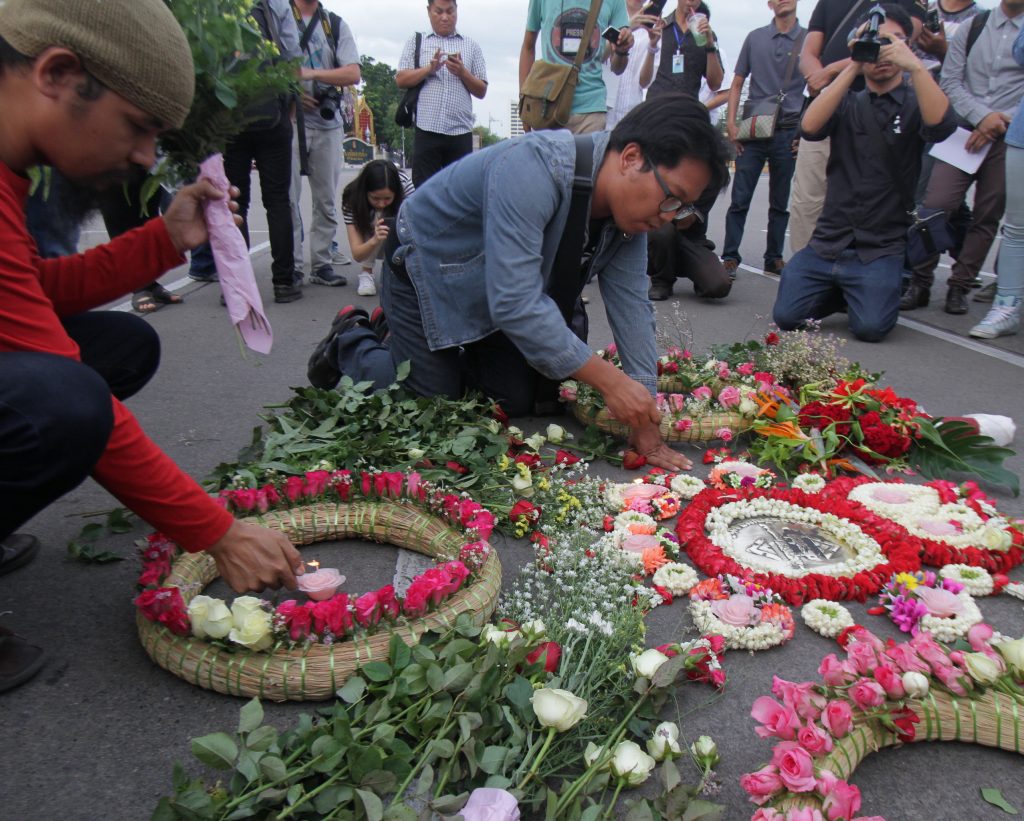
Activists place flowers and garlands around a small plaque memorializing the 1932 Revolution on June 24, 2015 in Bangkok.
Suthachai believes it was one of the People’s Party leaders who spread the rumors about a conspiracy to detain King Rama VII to demoralize and confuse the royal government. The rumors also served as a safety mechanism: with police overwhelmed by so many tips, they were likely to disregard or miss actual intelligence on the real coup.
The tactic was the hallmark of a People’s Party leader named Phraya Song Suradet, according to Suthachai. The army officer was tasked with strategic planning and intelligence gathering for the day of action.
“Phraya Song definitely had a hand in it,” the historian said.
By the time dusk fell on June 24, 1932, the plotters had taken over a palace in Bangkok as their headquarters and awaited the king’s answer.
Although some of his closest advisers pressed him to fight, King Rama VII believed resistance would only lead to bloodshed and perhaps come to nothing, as the rebels had already occupied the capital and detained nearly all key members of the government.
That night, he telegraphed his reply to Bangkok. He agreed to the coup leaders’ demands. Thailand would become a constitutional monarchy.
Seven centuries of royal rule was over, exactly 150 years after the founding of Bangkok, as prophesied by Rama I.
The Curse, The Plaque and Today
Few people in Thailand, then as now, were immune from beliefs in horoscopes, prophecies and auguries. Was it possible that the People’s Party saw themselves as the supernatural instrument that would make the curse come true, and therefore rendering Rama I’s prophecy a self-fulfilling one?
Suthachai, the Chulalongkorn historian, believes the opposite is true. The People’s Party, he said, was strictly secular in nature.
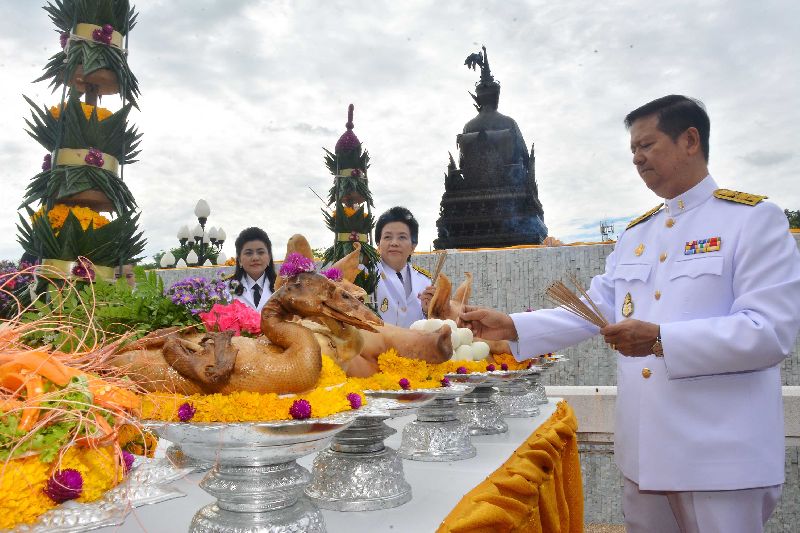
Government officials at Parliament House organize a ritual honoring King Rama VII’s spirit on the 83rd anniversary of the 1932 revolution on June 28, 2015.
“They were probably the least superstitious of all coup-makers,”said Suthachai, laughing.
He said the People’s Party did not consult any horoscopes when they planned the revolution, unlike the leaders of other coups and revolts (even the plotters of the failed uprising of 1912 included one astrologer). The date, June 24, was chosen not because of any astral alignment, but because Rama VII happened to be outside Bangkok that day.
It is now 2017, and the curse, like legacies of the People’s Party, is a thing of the past.
The Chakri Dynasty did not come to an end; in fact, Thailand saw a new king, the tenth Chakri, just this year. Although absolute monarchy has not been fully restored, much of the government system envisioned by the 1932 revolution has been rolled back, as most evident in the lack of mechanisms that effectively limit the monarchy’s influence in state affairs.
Even the historic plaque marking the very spot the People’s Party announced the end of absolute monarchy vanished earlier this very month, offering a tantalizing coda to this centuries-spanning tale: Has the curse been broken?
So, did King Rama I get it wrong? Or did only a “lite” version of the curse manifest?
Pakasit believes the curse would have unfolded differently if the Chakri Dynasty hadn’t undertaken so much effort to undo it.
“The curse could not be avoided, but it was not fatal,” he said.
The new plaque that replaced the 1932 revolution marker, which went missing in April.
Fongsanan, on the other hand, insisted that the curse played out exactly as Rama I foresaw, even though it was not as literal as thought by many at the time.
“It shows that King Rama I was very talented in astrology,” she said. “Probably even more so than his own chief astrologer.”
Nevertheless, both Fongsanan and Pakasit agreed the first monarch of the Chakri Dynasty made a permanent mark on the mystical structure of Bangkok and the nation-kingdom. The most exalted spot in the Duang Mueang was reserved for King Rama I and his bloodline.
Of the existing Duang Mueang, Fongsanan said:
“It means that no matter what happens, or what destiny holds for Thailand, we will forever be ruled by Chakri kings, the descendants of King Rama I.”
A look at the founding of Bangkok and its subsequent curse by Matichon’s Art & Culture Magazine
BANGKOK — A Spanish man was sentenced to death Friday morning at the Ratchada Criminal Court for the savage 2016 murder of a fellow Spaniard.
BANGKOK — A Spanish man was sentenced to death Friday morning at the Ratchada Criminal Court for the savage 2016 murder of a fellow Spaniard.
Artur Segarra Princep, 38, was sentenced to die for the January 2016 abduction, torture, murder and dismemberment of David Bernat, parts of whom were discovered floating in various locations along the Chao Phraya River.
Segarra has been jailed at the Bangkok Remand Prison since February 2016 after he was arrested in Sihanoukville province, Cambodia, and extradited back to Thailand.
Segarra made large ATM cash withdrawals before fleeing across the border after gaining access to Bernat’s account, which held about 37 million baht.
The court handed down a death sentence for the count of premeditated murder. He was also convicted of theft and ordered to return nearly 750,000 baht of the stolen funds to Bernat’s family.
Segarra maintains his innocence and his lawyer Worasit Piriyapiboon said they’ll appeal his conviction within 30 days.
Whether Segarra is ultimately executed or has his sentence reduced is up to the courts.
Capital punishment is enshrined in the law but its use effectively ended 14 years ago. The last execution took place in 2009, when two drug traffickers were killed by lethal injection. Before that, the previous execution was carried out in 2003.








































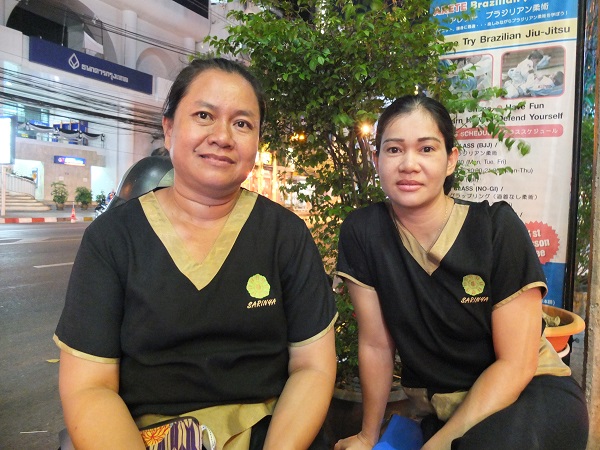 “7-Eleven only. Normally I sometimes have Look Chin Ping (grilled pork balls), but it’s also gone. If I have time, I cook from home and bring it to work,” – Na, masseuse at right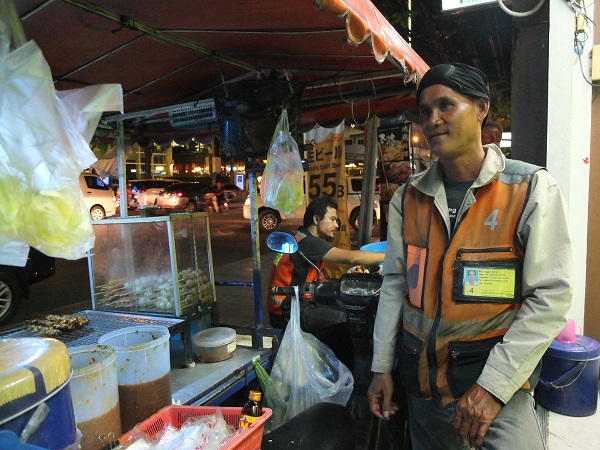
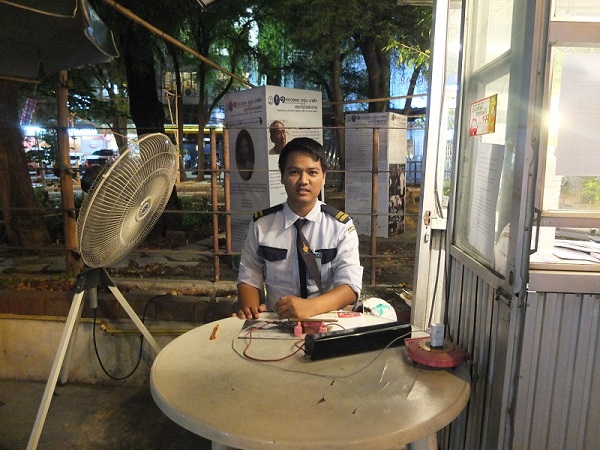 “I ate at the street food place inside the next soi. It’s a private lane, so the place can still sell. It costs around 35-40 baht. But today it’s even more packed because there is no other place to go, so everyone went there. It’s good for me; I can go any time. But for those who have a specific time for their one-hour break, it must be difficult. I don’t get it. They want us to pack our lunch from home?” – Mek, security guard
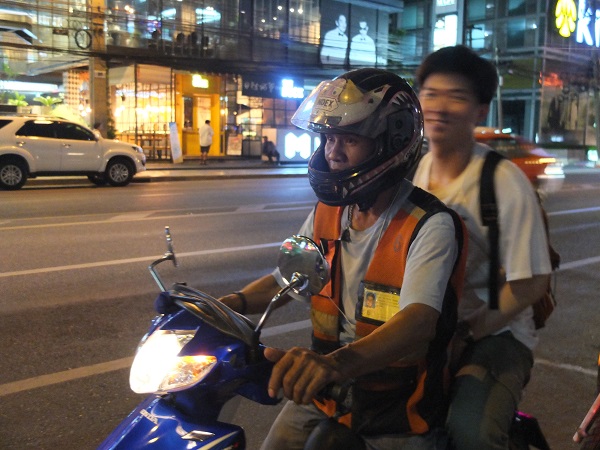 “MaxValu. Some of their food is a little bit cheaper than 7-Eleven, by like 3 baht. Or sometimes I go back to eat at home. My home? It’s in Bang Na,” – motorcycle taxi driver who declined to give his name.
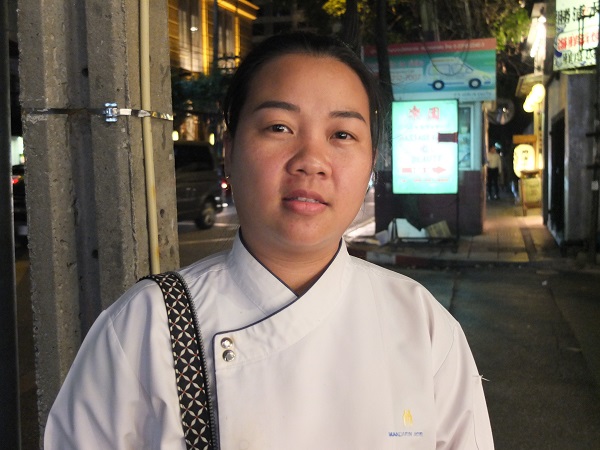 “I don’t have any problem. My workplace offers meals – breakfast, lunch and dinner,” – Ja, employee at the Grande Centre Point Sukhumvit 55 Hotel