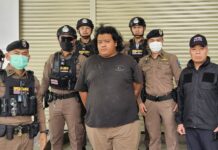
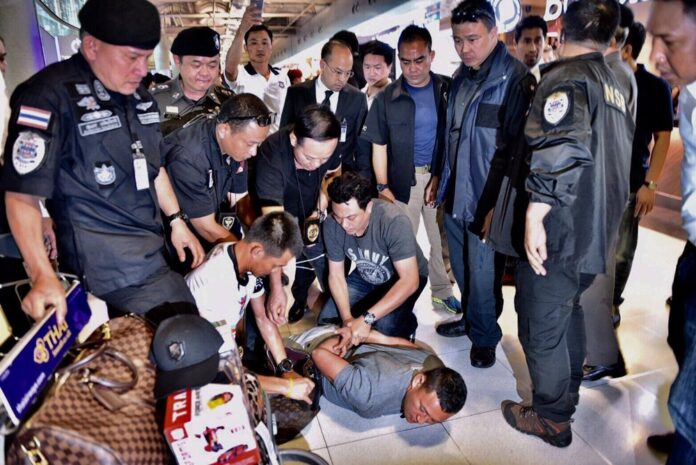
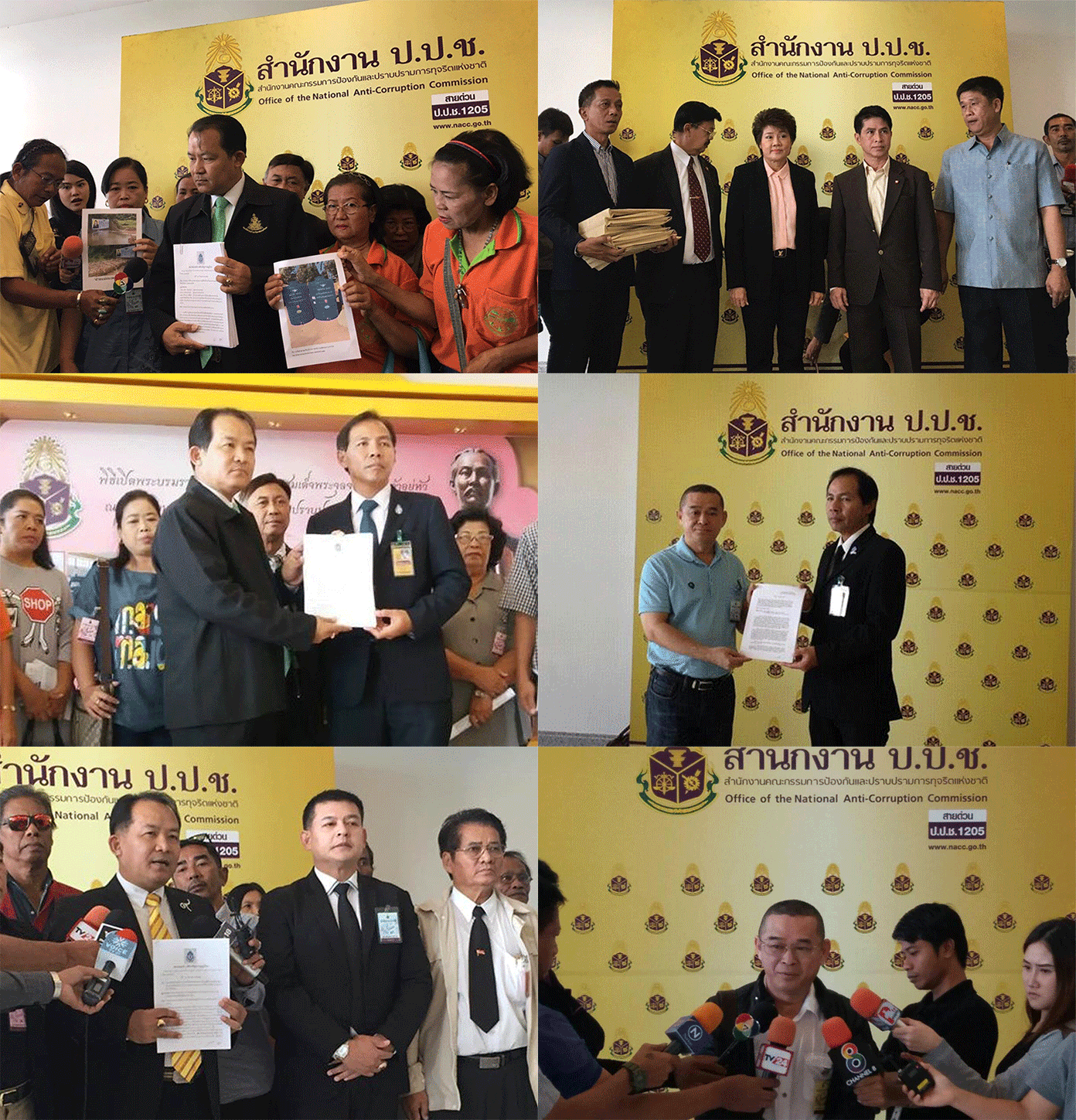
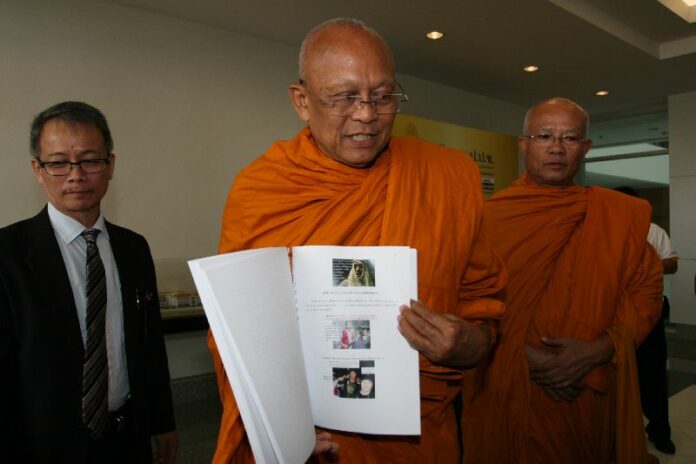
Police on Jan. 19 arrest alleged Laotian druglord Xayasana Keopimpha shortly after landing at Suvarnabhumi Airport
BANGKOK — Police said on Thursday that they are not considering any plan to extradite alleged drug kingpin Xaysana Keopimpha back to Laos.
Police spokesman Krissana Pattanacharoen said the force wants to prosecute Xaysana in Thailand and dismissed speculation Thai authorities want to use the Laotian suspect as a bargaining chip in exchange for political dissidents seeking refuge in Laos.
“It’s not related at all. This is a different matter,” Col. Krissana said. “We want to prosecute him on the Thai side, because his wrongdoing took place in Thailand, and in this case, we were tracking him for over five years, and it’s leading us to smash the rest of his drug network.”
Deputy national police commissioner Rungroj Sangkram also told reporters Wednesday that there is no plan of extradition at this time.
Xaysana, whom police identified as the most influential drug lord in northeastern Thailand, was arrested at Suvarnabhumi Airport last month, and police have been naming suspects in connection with his network since. Those named as Xaysana’s accomplices include celebrities and police officers.
Xaysana’s arrest also sparked suspicion among some Redshirt activists that the Thai government may use him to negotiate with Laotian authorities for the extradition of Redshirt fugitives and those charged with royal defamation who are living in exile in Laos.
The Laotian was arrested ten days before the Thai spy chief flew on a trip to Laos on Jan. 31. Officials said National Security Council sec-gen Thaweep Netrniyom was in Vientiane to jump-start another round of extradition talks, an effort that has yielded no result so far.
Historian and monarchy critic Somsak Jeamteerasakul wrote online that he wondered whether an exchange will be considered by both countries.
“I think it is possible that the [junta] will mount another attempt to pressure Laos to stop giving refuge to the exiles,” said Somsak, who’s an exile living in France himself. “Is this matter related to Xaysana who’s on the news right now? I don’t have other information than what is reported in the news, but I can’t help wondering, are Thai authorities expecting something in return from cooperating with the Laotians to wipe out Xaysana’s network?”
Krissana, the police spokesman, said such speculation is far-fetched.
“Here’s what it is: we haven’t even reached that issue yet,” the colonel said. “We are not touching any dimension about international issue yet. This is totally different matter. We are now focusing on investigation on Xaysana’s network in our country.”
He added that Laotian authorities do have the rights to make a request for the extradition of Xaysana, but the decision will ultimately rest with Thailand. Krissana also said Laos has not made such request.
PRACHUAP KHIRI KHAN — A two-time Grammy award winner will jazz-up a weekend next month in a new Hua Hin venue accompanied by some funk, pop and mor lam sounds.
Piano and organ prodigy Cory Henry will tag along with the Funk Apostles to bring melodious jazz to the Hua Hin seaside at an upcoming Jazz Festival.
Jazz artists to join include saxophone artist Benny Golson, American jazz fusion quartet The Yellowjackets and guitarist Al Mckay’s Earth, Wind and Fire Experience. Thanachia “Pod” Ujjin from Modern Dog will perform along with leading jazz musicians united in the Thailand All-Stars Jazz Orchestra.
To breaking some boundaries, Thai soul band Soul After Six will weigh in on the jazz vibe, as will mor lam sounds by the internationally renowned Paradise Bangkok Molam International Band.
One-day tickets are 2,000 baht, and two-day tickets are 3,500 baht. Early birds can purchase two-day tickets online for 2,500 baht until Feb. 19.
Jazz up the weekend 6pm to midnight, March 24 and 25, at True Arena Hua Hin.
Four men from the Public Health Ministry promote the “Red-Cheeked Thai Women Bear Children For the Nation with Wonderful Vitamins” program Wednesday.
BANGKOK — Thailand has a baby problem – there just aren’t enough of them.
Amid the wacky campaigns launched in the run-up to Valentine’s Day each year, public health officials this year want to give newlyweds free vitamins and a license to procreate under a program announced Wednesday.
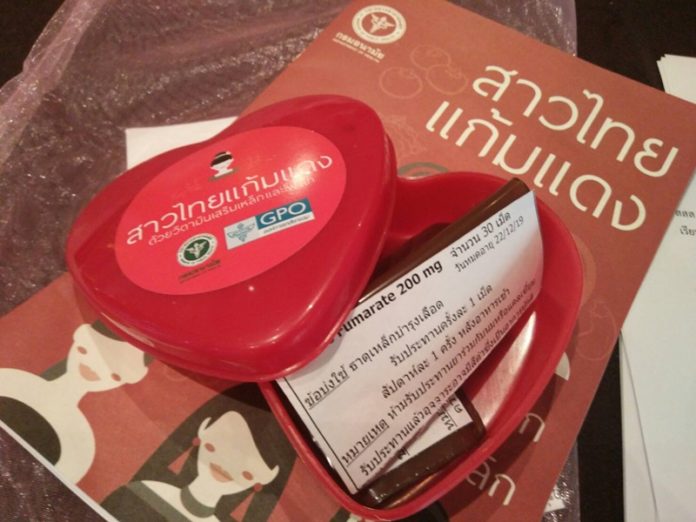
Under the Red-Cheeked Thai Women Bear Children For the Nation with Wonderful Vitamins campaign, officials will give free heart-shaped boxes of iron and folic acid supplements to combat birth defects starting Tuesday, Valentine’s Day.
The hope is to encourage more ready-and-willing women 20 to 34 to have babies due to collapsing birth rates, according to Health Minister Piyasakol Sakolsatyadorn.
“Fewer Thai women are getting married, are marrying later or instead staying single because of higher education,” he said.
A box of prenatal vitamins that will be distributed by the Public Health Ministry starting Tuesday on Valentine’s Day.
The birth rate in 1970 was 2.7, falling to 0.4 in 2015 and projected to reach 0, meaning equilibrium with the death rate, by 2027. Adult women will have to step it up, as the ministry also made its latest seasonal call for a reduction in teen pregnancies.
The initiative is the first part of an ongoing health ministry program to increase birth rates under a plan approved by the cabinet in October.
Free pills will be given out at starting 8am on Tuesday at the Bang Rak District Office between Silom and Surawong roads. After that they will be available for prospective parents and pregnant women from then on at public hospitals.
One million baht has been budgeted for the vitamins, Nopphon Chuenklin, the ministry’s pharmaceutical director said.
“Doctors recommend women take one dose at least three months before pregnancy to decrease the risk of birth defects. On Feb. 14, 2017, or Valentine’s Day, a large number of couples will come and register their marriage licenses, so we will distribute a box of the vitamins along with an informational pamphlet,” Wachira Pengjun, health ministry director-general said.
Bang Rak district, or “Place of Much Love,” is a popular place to get marriage licenses, especially on Valentine’s Day.
Time and again, petitioners make a splash and garner public attention holding news conferences to file complaints with the National Anti-Corruption Commission. Most languish or get dropped.
BANGKOK — When someone found documents online showing officials bought Government House microphones for 140,000 baht each, he took his complaint to the National Anti-Corruption Commission, or NACC.
When a Democrat MP believed he found evidence of massive graft in the rice subsidy program overseen by the government at the time, he also took it to the commission.
Most recently, when Rolls-Royce admitted to a British court it paid Thai officials more than 1 billion baht in bribes, the same agency was brought in to find which state employees received those bribes.
In fact, search for news about “corruption” and “abuse of power” in Thailand and find many headlines declaring the NACC, an anti-graft watchdog set up by a popular constitution nearly two decades ago, was set to investigate this case or look into that complaint.
However a review of the NACC’s track record by Khaosod English found that, out of thousands of cases processed by the committee, only 105 led to convictions. As for why it has little to show for the investment – the commission’s 2016 budget was 1.8 billion baht – corruption crusaders and legal experts said the agency is bogged down by its bureaucracy and biased in its judgment.
Since its inception in 1999, the NACC has accepted 3,383 cases for investigation. Of those, it said investigators found evidence of corruption or malfeasance in about a third – 1,191 cases.
Fewer than one-in-10 of those secured a conviction in a court of law that was not overturned on appeal. And those convictions have not been for the marquee cases involving rich and powerful defendants: All but one involve infractions by mid- and low-level administrators such as mayors, school directors, policemen, clerks and registrars.
The NACC, however, said that they were reviewing all cases they receive, with any cases not reviewed in a year were carried over to next year. Junta laws were also being used to move along cases in a more convenient way, said an NACC official.
Justice Delayed
The commission has 2,192 “ongoing” cases, according to its records.
Some of those date back to 1999 – the year the agency was founded – such as a fraud case against a school teacher in Chiang Mai who only learned of the charge Thursday.
Jiamjit Boonyarak, a teacher with the Education Ministry’s PE department, was accused of embezzling students’ dorm fees and stealing from other projects in 1998. An investigation wasn’t launched until July 2011. On Thursday, the committee for the first time formally informed Jiamjit of the allegations, so she could prepare her defense.
Emblem of the NACC proclaims its commitment to the constitution, justice and swift combat of corruption, as signified in the lightning bolt striking an arrow.
In another unresolved case filed with the NACC in 1999, three officials from the Land Department were accused of amending land deeds without permission. A committee to look into the trio was only convened in 2011, and there’s no record of any progress in the case since.
Pairote Phromrat, head of the NACC’s information analytics center, said that even if cases seem to drop off the public’s radar, the commission is still working on them.
“We’re doing the cases we received, such as the Rolls-Royce one,” he said. “We don’t forget cases, because still gathering information on them.”
Interview requests sent a week ago to NACC chairman Watcharapol Prasarnratchakij went unanswered.
It’s possible there are more convictions than the 105 found in the NACC database. Although Pairote insisted the records contain all updated case information, there appears to be some missing data.
For example, the archive doesn’t include a major conviction against former assistant minister Wattana Asawahem in 2011 on corruption charges related to sales of public land in Samut Prakan province. Wattana fled the country before the verdict was handed down.
And Watana appeared to be the only high-profile politician to ever be convicted in recent years. Other convictions brought about by the NACC’s investigation were mostly for officials in administrative duties, and none in the ministerial positions.
Friends in High Places
Describing the NACC’s post-coup efforts, Pairote said the agency has operated more smoothly under the junta.
“We found that we have more power to enforce the law. We can work with more efficiency and convenience and have more thorough investigations,” Pairote said. “For example, we can use Article 44 to tell the accused to prove their innocence later. It’s handy and works well.”
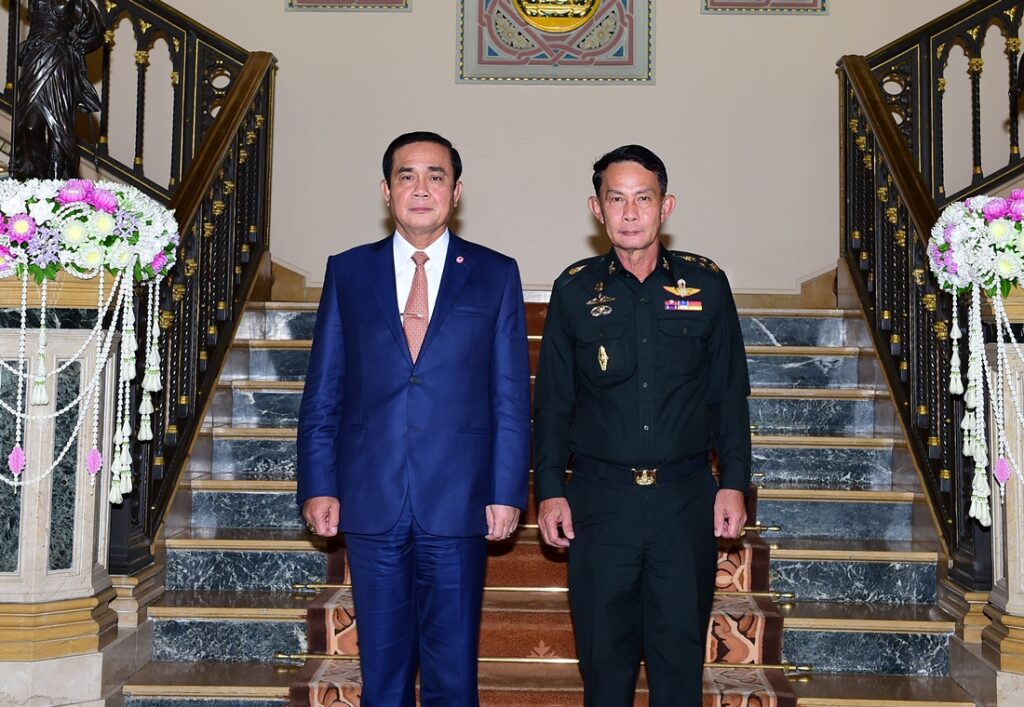
Prayuth Chan-ocha poses for photo with his brother Preecha Chan-ocha on Sept. 28, 2016, at Government House. The NACC has repeatedly dismissed complaints of corruption against both figures.
Critics say that coziness comes at the price of independence.
Srisuwan Janya, a government transparency activist who’s gone after politicians from across the political spectrum, said the nine current NACC commissioners have conflicts of interest with the ruling junta.
“Many of the commissioners in this set are questionable. For example, the president used to be a police officer and served administrators in the current government directly,” Srisuwan said. “Therefore, whenever there’s cries about corruption relating to powerful people in the government, there’s a direct conflict of interest.”
He said the NACC is reluctant to use its power to investigate members of the junta and its allies, decreasing its credibility as a watchdog.
Srisuwan gave the example of Preecha Chan-ocha, brother of junta chief Prayuth Chan-ocha, appointing his son to the military in September 2016. Srisuwan urged the NACC to investigate whether it was nepotism. Soon after, Prayuth declared there was nothing wrong with the appointment, and the NACC dropped the case a month after Srisuwan complained.
“That case clearly showed a conflict of interest, a reluctance to investigate a general in the Ministry of Defense. They’re too close to power, so the NACC says that any complaints against the government are baseless,” Srisuwan said.
Selective Prosecution
Not all cases are equal in the eyes of the NACC, according to Srisuwan and a university law professor.
Somchai Preechasilpakul, a law lecturer at Chiang Mai University, said the NACC shows selective enthusiasm by moving forward cases against the political opposition while ignoring those brought against the powers that be.
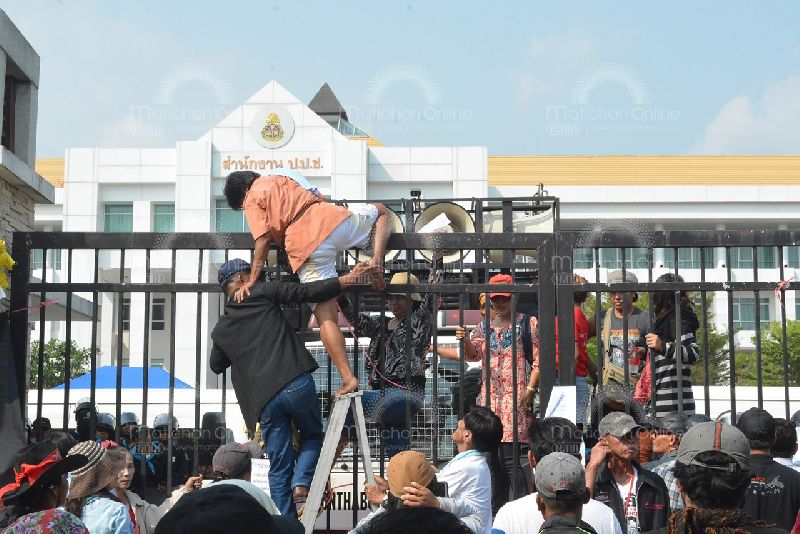
Enraged at the commission’s alleged favoritism, Redshirt activists on Feb. 28, 2014, attempt to break into the NACC headquarters in Bangkok.
“Usually, the high-profile cases involving those against state power, especially involving elected officials from the Pheu Thai Party, go extremely fast, as we can factually see from the past 10 years,” Somchai said. “Yingluck and Abhisit both have NACC cases, but Yingluck’s proceeded much faster, while stalled cases are never given a substantial explanation for being stopped.”
Srisuwan said its justice should be exercised blindly.
“The NACC should have standards they adhere to when dealing with cases big or small,” said Srisuwan, who has petitioned the NACC to investigate everything from taxpayer-funded Line stickers and charges of nepotism.
The NACC’s track record of letting cases stall indefinitely – especially when they involve the powerful – is an unchecked problem, the professor said.
“These cases go extremely slow, even when the public can clearly see that they’re wrong, such as the case involving Preecha’s son or Rajabhakti Park,” Somchai said.
An ‘Ongoing’ Problem
A group that advocates for government transparency said the NACC is a necessary, albeit sluggish organization.
“The NACC’s big problem is their process of working that’s in place. Their system requires time in order to investigate cases, taking seven-and-a-half years on average, per case,” said Mana Nimitmongkol of the Anti-Corruption Organization of Thailand.
With time spent on some cases stretching up to 12 years, long periods of inactivity make it seem like cases have halted while complicating the investigative process, Mana said.
“They do work during those seven-and-a-half years, but when the process takes that much time, witnesses and evidence become harder to find or are damaged,” Mana said.
The slow handling of cases is a red flag to critics.
Tens of thousands of cases, some decades-old, appear stalled, while others receive selective attention and proceed much faster – with no explanation offered to the public, professor Somchai said.
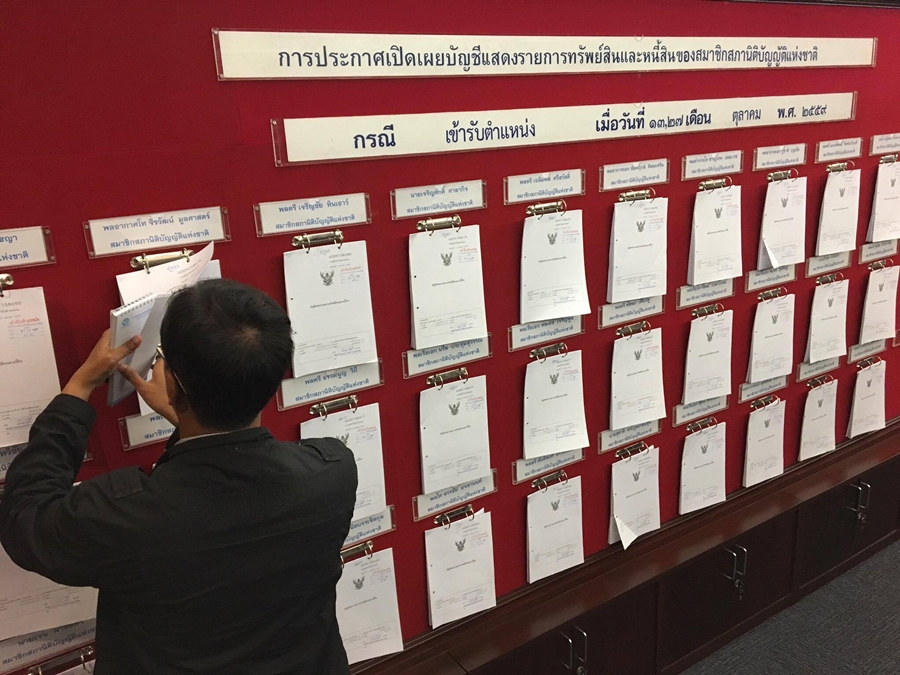
In a bid to increase transparency, the NACC requires all legislators to declare their assets, like these financial statements of members of the interim parliament posted at the commission’s office on Dec. 8, 2016.
“People can’t check up on the steps of the NACC’s process. A stalled case is just labeled as being ‘in progress’ without saying what step they’re on,” Somchai said. “Sometimes they even make excuses like, ‘oh the office flooded, we can’t find the papers,’ for stalled cases, or they’re just dropped and ruled not guilty.”
What to Do?
The three differ in their outlook for the organization going forward.
Mana the anti-corruption advocate said the commission, despite its flaws, fulfills an important function.
“The NACC is a necessary organization for Thailand, as the main organization for fighting corruption,” he said. “The people may support them or criticize them, but don’t just hate them.”
Chiang Mai University’s Somchai, on the other hand, said it has ongoing problems with transparency and focusing on its mission.
“The NACC has too much freedom and money – they get billions of baht a year, but in return have no accountability,” Somchai said. The professor also called out the commission for using taxpayer money for things like feel-good campaigns that are unrelated to its mission.
Transparency activist Srisuwan, however, takes the dimmest view, saying the organization investigates like “waves breaking on the shore. “After a big splash,” he said, “they soon recede.”
It “has yet to produce any substantial investigative victories to build public trust,” he said. If they have, I cannot see any trace of them whatsoever, because they have not decided to communicate openly with the public.”
Additional writing and reporting Teeranai Charuvastra
Prime Minister Suthep Thaugsuban formally reported to the National Anti-Corruption Commission (NACC) to contest charges related his role in the deadly crackdown on Redshirt protesters in 2010, 26 March 2015.
The first test for new anti-corruption mechanisms in the 1997 constitution came when tycoon-turned-premier Thaksin Shinawatra himself was subject of investigation by the National Anti-Corruption Commission, or NACC.
The commission accused Thaksin, who just recently won the first landslide electoral victory in Thai history, of funneling billions of baht worth of stocks to his family members and housekeepers to avoid disclosing them as assets in mandatory reports. The case was eventually dropped by the court by a narrow 8-7 ruling.
In 2008 the NACC accused then-Foreign Affairs Minister Noppadol Pattama of malfeasance for supporting Cambodia’s claim to register the disputed Preah Vihear temple as a UNESCO World Heritage Site, as the ancient site was also claimed by Thailand. The court later dismissed the case.
A Cambodian security officer guards the Preah Vihear temple in Preah Vihear province, Cambodia, on July 18, 2012. Photo: Mak Remissa / EPA
Former Prime Minister Somchai Wongsawat was also accused of abuse of power by the NACC for ordering police to crack down on anti-Thaksin protesters in October 2008. The case remains unresolved.
But after the NACC was assigned by a court to prosecute former Prime Minister Abhisit Vejjajiva and his deputy Suthep Thaugsuban on the same charge for ordering a crackdown on pro-Thaksin protests in 2010 which left 90 people dead, the commission dismissed the case against him in 2015.
A rare high-profile court conviction won by the NACC was that of former assistant Minister of Interior Affairs Wattana Assawahem, who was found guilty of corruption in 2011. However, Wattana fled the country before the verdict was handed down.
The NACC’s also made a bribery case against former Tourism Authority of Thailand Gov. Juthamas Siriwan. It’s taken awhile – she was indicted in 2015, a dozen years after she allegedly received bribes from organizers of the Bangkok International Film Festival she ran from 2003 to 2006. Her case is ongoing; meanwhile, the American couple who reportedly bribed Juthamas were convicted in a U.S. court seven years ago.
Thirteen years after the Thai military spent millions of baht on bogus GT200 “bomb detectors,” the NACC investigation is “ongoing.”
Redshirts mock the army with an imitation of the GT200 device in an anti-government protest in 2010.
Since the junta came to power in 2014, activists have accused the military regime of nepotism and misconduct, but the NACC has dismissed all, citing a lack of evidence. Cases dismissed by the NACC include allegations that the billion-baht Rajabhakti Park complex was ripe with corruption and unusually expensive materials.
Yet its most high-profile investigation in recent years came from a 2013 corruption complaint against former Prime Minister Yingluck Shinawatra over her government’s loss-heavy rice subsidy program. Within months the commission announced it had enough evidence to try Yingluck for failing to stop widespread corruption in the program. Her trial is ongoing.
Former PM Yingluck Shinawatra on Jan. 15 receives a bundle of rice from her supporters outside court just before her trial on charges of negligence commences.
A municipal guard aims his weapon as two men are searched Tuesday in Vitoria, Espirito Santo state, Brazil. Photo: Diego Herculano / Associated Press
SAO PAULO — A Brazilian governor said Wednesday that he needs more soldiers to help cope with a police crisis that has led to a wave of violence and at least 80 deaths in his southeastern state.
Cesar Colnago, acting governor of Espirito Santo, told reporters that he would ask the federal government for more troops, saying the 1,000 soldiers already sent were not enough to stem the tide of violence.
The killings in the state capital of Vitoria and other cities erupted as friends and family of military police officers blocked their barracks over the weekend to demand higher pay for the officers, preventing patrols from cruising the streets. Brazil’s military police patrol the nation’s cities and are barred by law from going on strike.
Andre Garcia, head of Espirito Santo’s Public Safety Department, told reporters Wednesday that violence has diminished since the arrival of the first troops this week, but said he would still like to see an additional 1,000 soldiers sent to the state.
The union representing civil police officers has said that 87 people have been murdered since police stopped patrolling the streets Friday night. The state government has not released an official death toll.
At least two buses have been burned over the past five days in Vitoria and several stores have been looted, leading six shopping malls to close their doors.
Buses that had resumed circulating Tuesday were again off the streets Wednesday. Schools were shut and medical services at public hospitals were interrupted.
BEIJING — When the smog descends over northern China, turning blue skies gray and thickening the air, Cai Fujian can feel his lungs tightening and he begins to cough.
The 65-year-old retiree says he’s too old to take steps to combat the heavy pollution like wearing a mask, but he does watch television news reports about the particles in the air that damage lung tissue and kill thousands of people each year.
For weeks at a time, China’s smog transforms cities across the industrial north into quiet, gray shells of their normal selves.
The Associated Press visited several spots in Beijing during and after a December “red alert,” the highest level in China’s four-tiered smog warning system. The AP used a 360-degree camera to record the difference the smog makes at each location.
AP journalists first took video when levels of PM2.5 – the microscopic particles that clog and destroy lung tissue – were more than 15 times the level considered safe by the World Health Organization. Nearly half a billion people were affected during the December red alert, according to Greenpeace East Asia.
Outside Beijing’s Forbidden City, the sprawling home of ancient emperors, streets normally bustling with vendors were largely empty.
Inside the Temple of Heaven to the south, only a few tourists were standing atop its marble altar, and wide views of the city had been obliterated.
And along the city’s busiest roads, traffic was thin and the tops of nearby skyscrapers were all but lost in the encircling miasma.
Then the AP visited the same spots days later, after the smog had dispersed.
At the Temple of Heaven, couples were dancing to Chinese tunes blaring from a portable loudspeaker, looping and circling around a plaza. Cai, the retiree, sat with friends nearby, engaged in a card game.
As he walked through the park, Cai related his experience with smog, describing lines of coal-burning factories along the massive highways circling Beijing, belching out flames and smoke like “dragons of fire.”
The heavy reliance on coal to power those factories and the surfeit of older, inefficient cars on the roads are widely acknowledged as the main reasons for China’s problems with pollution.
Beijing has made robust efforts to retire aged vehicles and move heavily polluting industries to outlying provinces, yet the problem persists. The sheer size of the city’s population, now at almost 22 million, and geographic conditions that surround it on three sides with smog-trapping mountains seem to require that further measures are needed.
While many residents install expensive air filtration machines and wear masks, Cai doesn’t do that.
“We don’t take many protective measures because we are old,” he said.
He blamed businesses and factories for flouting anti-pollution regulations. He also said government officials need to better promote electric cars and bicycles, as well as other conservation measures.
“Developed countries such as Germany, France and the UK are doing fine, and we should learn from them,” Cai said. “It takes time to deal with smog.”
Attorney General-designate, Sen. Jeff Sessions, R-Ala. testifies in January on Capitol Hill in Washington at his confirmation hearing before the Senate Judiciary Committee. Photo: Andrew Harnik / Associated Press
WASHINGTON — The Senate on Wednesday confirmed Sen. Jeff Sessions to be attorney general in the Trump administration despite fierce Democratic opposition to the Alabama Republican over his record on civil rights and immigration.
The 52-47 nearly party-line vote capped weeks of divisive battles over Sessions, an early supporter of President Donald Trump and one of the Senate’s most conservative lawmakers. After the vote was announced, Sessions’ Republican colleagues applauded the outcome while barely a handful of Democrats did the same.
In a post-vote valedictory speech, Sessions alluded to the bitter partisanship and wished for more collegiality.
“Denigrating people who disagree with us, I think, is not a healthy trend for our body,” he said.
Since Trump tapped Sessions, Democrats have laced into the lawmaker, casting him as too cozy with Trump and too harsh on immigrants. They asserted he wouldn’t do enough to protect voting rights of minorities, protections for gays and the legal right of women to obtain an abortion. They fear immigrants in the country illegally won’t receive due process with Sessions as the top law enforcement officer.
“His record raises doubts about whether he can be a champion for those who need this office most and it also raises doubts about whether he can curb unlawful overreach” by Trump, said Sen. Tim Kaine, D-Va.
Republicans say Sessions has demonstrated over a long career in public service – and two decades in the Senate – that he possesses integrity and honesty and is committed to justice.
“He’s honest. He’s fair. He’s been a friend to many of us, on both sides of the aisle,” Majority Leader Mitch McConnell, R-Ky., said. “It’s been tough to watch all this good man has been put through in recent weeks. This is a well-qualified colleague with a deep reverence for the law. He believes strongly in the equal application of it to everyone.”
Sessions won unanimous backing from Senate Republicans but picked up the support of just one Democrat, Joe Manchin of West Virginia.
Alabama Gov. Robert Bentley is expected to name a replacement for Sessions as early as Thursday. Bentley has named six finalists for the Senate appointment, including state Attorney General Luther Strange and GOP Rep. Robert Aderholt.
Strange is considered a leading candidate for the job since Bentley interviewed potential replacements for state attorney general, according to people close to the process. However, Bentley’s office has said he has not made a decision.
Wednesday’s vote came amid rising tension between Republicans controlling the chamber over delaying tactics by minority Democratic that have left fewer of Trump’s picks in place than President Barack Obama had eight years ago. Democrats no longer have filibuster power over Cabinet picks, however, after changing Senate rules when they controlled the chamber in 2013.
Next up for the Senate is Rep. Tom Price, R-Ga., Trump’s pick for health secretary. A final vote on Price could come late Thursday and success seemed certain.
Democrats have solidly opposed Price, a staunch advocate of repealing Obama’s health care overhaul and reshaping and scaling back the Medicare and Medicaid programs that provide health care to older and low-income people.
But they’ve mostly accused Price, a wealthy former orthopedic surgeon, of conflicts of interest by acquiring stocks in health care companies and pushing legislation that could help those firms.
They’ve especially targeted his acquisition of shares in Innate Immunotherapeutics, an Australian biotech firm that’s said Price got a special insider’s deal. Price, who has said he learned of the opportunity from a fellow lawmaker, Rep. Chris Collins, R-N.Y., had testified to Congress that the shares were available to all investors.
“If I were a prosecutor, I’d say this case has real potential,” Senate Minority Leader Chuck Schumer, D-N.Y., said Wednesday.
This week has featured overnight, round-the-clock Senate sessions as GOP leaders are grinding through a thicket of controversial picks.
Epitomizing the sharp-edged partisanship surrounding confirmation of Trump’s Cabinet nominees, Sen. Elizabeth Warren was given a rare rebuke Tuesday evening for quoting Coretta Scott King, widow of the late civil rights leader Martin Luther King Jr., in her 1986 criticism of Sessions.
King wrote that as an acting federal prosecutor in Alabama, Sessions used his power to “chill the free exercise of the vote by black citizens.”
McConnell held that the Massachusetts Democrat had run afoul of rules about impugning a fellow senator.
Sessions’ nomination to a federal judgeship was rejected three decades ago by the Senate Judiciary Committee after it was alleged that as a federal prosecutor he had called a black attorney “boy” and had said organizations like the NAACP and the American Civil Liberties Union were un-American.
At his hearing last month, Sessions said he had never harbored racial animus.
Copulating desert locusts photographed in 2007 near the Red Sea, Sudan. Photo: Christiaan Kooyman / Associated Press
LA PAZ, Bolivia — Bolivian President Evo Morales is declaring a state of emergency to fight a plague of locusts that is decimating crops in the country’s agricultural heartland.
Morales announced the decision Wednesday as part of a contingency plan. It includes USD $700,000 in additional funds for fumigation.
Officials say the swarm of locusts first appeared two weeks ago about 60 miles (100 kilometers) south of the eastern city of Santa Cruz. It has spread fast and is now about 18 miles (30 kilometers) from Bolivia’s largest city.
Bolivia’s Eastern Agriculture Chamber estimates more than 2,700 acres (1,100 hectares) of corn, sorghum and beans have already been destroyed by the locusts. Authorities fear the locusts will reach the breadbasket region that supplies more than 80 percent of Bolivia’s food unless there is extensive fumigation.
Vhils’ mural on the wall of the Embassy of Portugal in Soi Charoen Krung 30. Photo: Kritz Ktz / Instagram
BANGKOK — A Portuguese street artist will unveil Friday the riverside mural he’s spent much of the past week creating.
Vhils, a London-based artist who’s been hailed for murals that look carved into the urban environment, is in Bangkok for the first time as part of his ongoing Scratching the Surface project.
Taking five days to create, the mural will play off the antique European environment of the Portuguese embassy hidden in the riverside “Creative District” of Charoen Krung.
Vhils, aka Alexandre Farto, will show off the final product at 6:30pm on Friday at the Embassy of Portugal near the Chao Phraya River on Soi Charoen Krung 30. The embassy is a three-minute walk from the Si Phraya express boat pier.