25 C
Bangkok
Friday, June 19, 2026
Home Blog Page 2628

Actress’ Sister Jumps to Death at Major Ratchayothin

Rescue workers at the scene on Thursday where Korbboon Thongmee reportedly jumped to death.

BANGKOK — The sister of actress and TV personality “VJ Ja” jumped to her death from the parking structure of Major Ratchayothin shopping mall Thursday afternoon, police said.

Korbboon Thongmee was seen by a witness jumping from the 10th-floor parking lot at around 3pm. Police ruled her death a suicide.

According to Maj. Pairat Thongdonnoi of Phahonyothin Police Station, Korbboon left a suicide note at the scene, in which she described personal troubles. Korbboon is the younger sister of Natthaweeranuch Thongmee, aka VJ Ja, a celebrity actress, model and TV host.

Advertisement

Pakistan’s Joyful Jazz Warriors Resist Cultural Annihilation in ‘Song of Lahore’

BANGKOK — To Pakistanis who grew up considering jazz and orchestral sounds as much their culture as anyone’s, the religious and social upheaval threatening to take it away was an attack.

One group of talented musicians in Lahore went a step further by recreating the music they loved in traditional Punjabi instrumentation. Their exciting journey to bring it to the Big Apple with Wynton Marsalis is chronicled in “Song of Lahore,” a documentary being screened and discussed Wednesday at the Bangkok Art and Culture Centre.

The film, which premiered at the Tribeca Film Festival, was directed by Pakistani woman filmmaker Sharmeen Obaid-Chinoy, a two-time Academy Award winner, and shot by cinematographer Andy Schocken.

Before a gloomy backdrop of social strife, the musicians raise their voices through jazz and classical sounds from the Lahore, the cultural capital of Pakistan and the Punjab, where music is increasingly considered haram by fundamentalists.

Their melodious journey to revitalize their musical culture by taking it to the world peaked in 2014 when trumpet guru Marsalis invited them to perform with him at the Lincoln Center in New York City.

Before the film will be a special change to hear renowned Thai-Muslim band Baby Arabia perform at 4pm. Panu Aree, the co-director of a documentary about the band will lead a discussion in Thai on music and politics in Pakistan and Thailand at 6pm.

Admission is 100 baht and seats are limited to only 200 people. Advanced tickets can be booked by depositing the ticket price to Thida Plitpholkarnpim, Kasikorn Thai Bank No. 799-2-21364-3 and sending proof of payment to [email protected] for ticket collection at the reception desk at 3pm on the day of the event.

The film will show in English with Thai subtitles at 4:15pm at the center’s fifth floor auditorium, which can be reached via BTS National Stadium skywalk.


Advertisement

Guide Fined 500 For Arranging Sea Creature Photo Shoots

Unidentified tourists pose with a giant clam Tuesday in the sea off Koh Chang in an image circulated on social media.

TRAT — A tour guide was fined Thursday for allegedly urged tourists to take photos with rare sea creatures in the sea off Koh Chang.

Komsan Charoensilpa was accused of bringing up a sea urchin and giant clam from the seafloor during a Tuesday diving trip which he then handed out for tourists to photograph. His actions violated a law forbidding the disturbance of animals in national parks, which includes the maritime park around Koh Chang, officials said.

“The tourists were Thais, and it was the fault of the [guide] on the boat,” Kamthorn Wehon, chief of Koh Chang District, told reporters. “From now on, there should be more strict measures to prevent this kind of incident from happening again. Tourists and tour operators must be mindful of this.”

Komsan was fined 500 baht.

National park officials on Koh Chang, a popular tourist destination in eastern Thailand, investigated the case after photos of tourists holding up the sea creatures surfaced on social media.

Tourists have run afoul of animal protection laws for interfering with marine life in Thai seas before.

In May, a Chinese tourist was fined with a hefty sum of 100,000 baht after he was caught feeding corn to fish on a beach in Phang Nga province. Feeding coastal fish is banned because it can indirectly harm coral, as the fish will seek handouts rather than play their usual role in the ecosystem.

An unidentified tourist poses with asea urchin Tuesday in the sea off Koh Chang in an image circulated on social media.

Related stories:

Tourists Fined for Instagramming Starfish

Tourists’ Big Catch Gets Yacht Banned from Similans

Advertisement

No Peace in Deep South Without Justice, Legal Activist Says

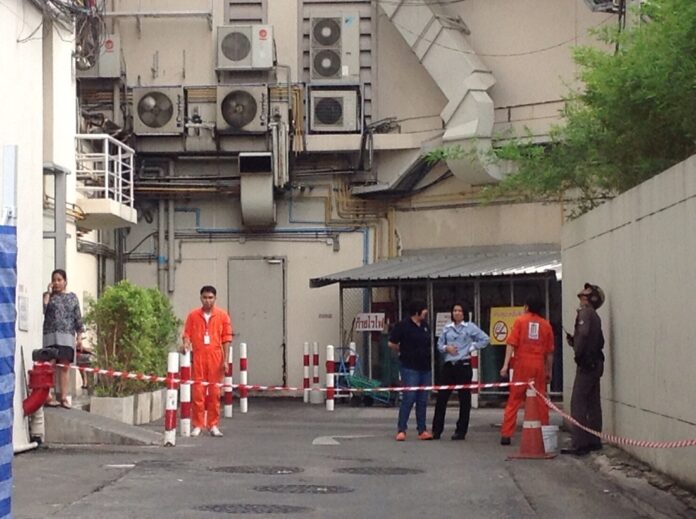
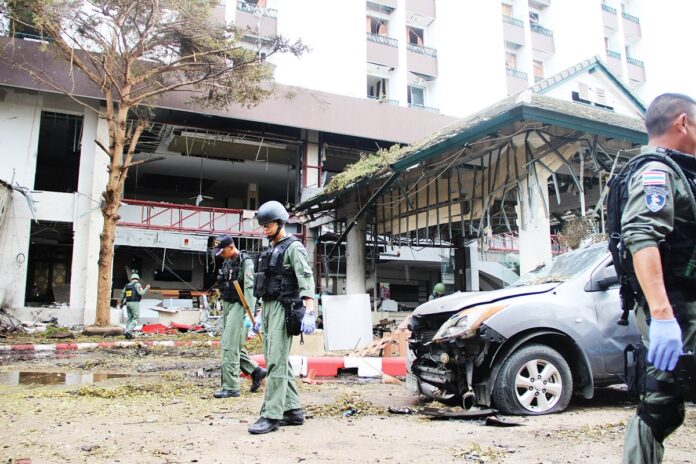
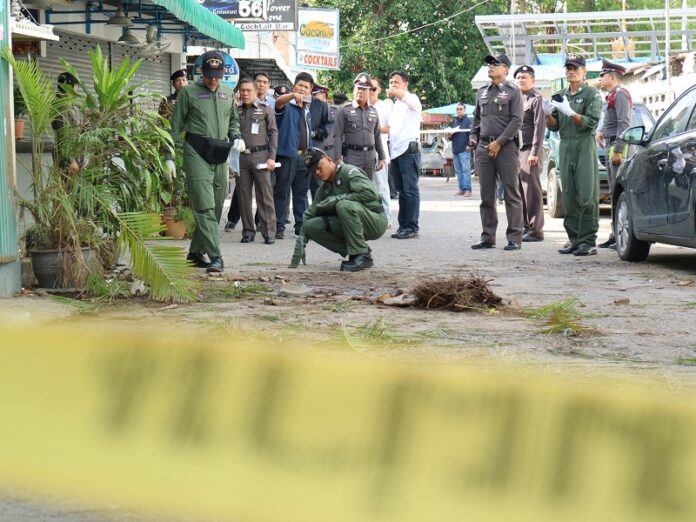
Police officers on Wedneday morning inspect the site of the deadly twin car bomb that struck a hotel in Pattani province.

BANGKOK — Respect for human rights is necessary to achieve peace in the Deep South, said a human rights lawyer charged with defamation for publishing a report on the alleged use of torture by security forces there.

Somchai Hom-laor, a legal adviser to the foundation whose report drew criminal complaints of defamation and computer crimes, said Wednesday night that ending abuses is necessary to ending the long-running conflict in a panel discussion at the Foreign Correspondents Club of Thailand.

Army Suspends Colonel Filmed Threatening to Abduct Woman

“We believe that the conflicts in the south cannot be solved without respect for human rights,” Somchai said.

On July 26, the military unit which heads southern counterinsurgency efforts and answers to the prime minister accused Somchai and two of his colleagues at the Cross Cultural Foundation of criminal defamation and violating the Computer Crime Act in response to the February report.

At the time it and others like it were published, the Internal Security Operations Command, or ISOC, dismissed them as works of fiction intended to damage its credibility.

The report by the foundation, along with Pattani-based Network of Human Rights Organizations and Dua Jai Group, detailed first-hand accounts of torture ranging from waterboarding and strangulation to threats of violence and sexual assault by the army and police to force confessions from suspected insurgents.

More than the monetary compensation sometimes offered to them, victims of torture need true justice, Somchai said, including prosecution of the perpetrators.

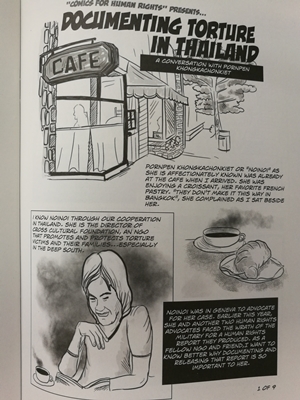
Story of Pornpen's investigation into torture practices in the Deep South is told in cartoons in this booklet released by the Asian Legal Resource Center (ALRC).
Story of Pornpen’s investigation into torture practices in the Deep South is told in cartoons in this booklet released by the Asian Legal Resource Center (ALRC).

“It’s not good for peacebuilding. It’s not good in the long term … [the] victims need justice,” Somchai said. Even an apology from the state, he added, would be helpful.

While there seem few legal consequences for those who carry out abuses, reporting about them has been met with a stern response, Somchai and colleagues Pornpen Khongkhachonkiet and Anchana Heemmima have learned.

They face up to seven years in prison for simply releasing the report, which included testimony going back to 2014 alleging 54 instances of torture.

“They should not be angry because we speak the truth,” Somchai said to the audience at the club.

Pornpen, director of the foundation and chairwoman of Amnesty International Thailand, said fear of torture in the Deep South is such that many family members of separatist suspects beg human rights activists to do what they can to get their loved ones transferred off army bases and into prison. Those detained on military bases can be held for seven days without charge or legal representation.

The practice of pretrial detention, or even pre-charge detention, is not uncommon in southernmost provinces, Pornpen said, but soldiers insist such people were merely “invited” for “talks.”

“[They say] it’s not an arrest. It’s an invitation. I always have to adjust my language when speaking with them,” said Pornpen. “They don’t want to hear that these people were arrested.”

Pornpen said the detailed nature of the 120-page report may have prompted the authorities to file charges. The cases is still under investigation by police, while the three are receiving legal aid from the Pattani-based Muslim Attorney Center Foundation.

A similar case of defamation brought by the military against civilians for disseminating information ended late last year when a court acquitted two journalists of charges brought by the navy over a report on human trafficking in the south of Thailand.

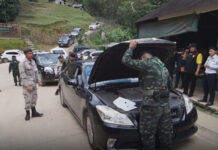
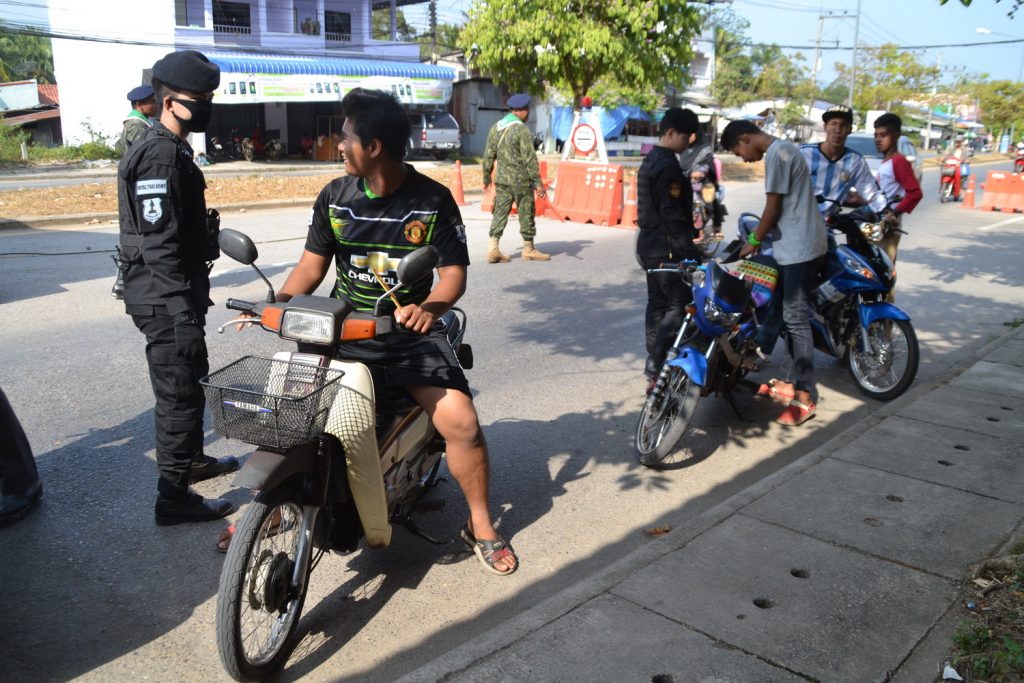
Security officers on Wednesday stop and search vehicles on a road in Yala province.

Pornpen said there was a compelling public need to produce the report, as the situation has not improved for over 12 years now, during which time more people have become willing to speak out.

“We won’t stop what we’re doing,” Pornpen said.

Kingsley Abbott, legal advisor to the International Commission of Jurists and the last to speak Wednesday, said Thailand is obligated to investigate allegations of torture and prosecute any perpetrators. The government, Abbott said, should strengthen measures to prevent torture from taking place.

Instead, Abbott said, the opposite happened in this case, with those behind the report being charged.

“This case should never have been brought in the first place and should be dropped immediately,” he said.

Related stories:

Human Rights Activists Refuse to Hand Over Names of Alleged Torture Victims

Army Denounces Deep South Torture Report as Product of ‘Imagination’

Torture in Deep South Systematic and Spreading Elsewhere, Rights Groups Allege

Advertisement

Italy Toll Rises to 247 As Anguish Mounts Over Quake Past

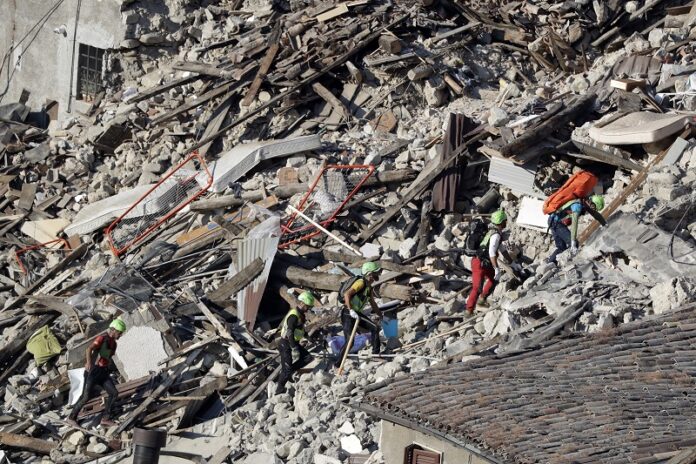
Rescuers make their way through destroyed houses following an earthquake on Thursday in Pescara Del Tronto, central Italy. Photo: Gregorio Borgia / Associated Press

AMATRICE, Italy — Rescue crews raced against time Thursday looking for survivors from the earthquake that leveled three towns in central Italy, but the death toll rose to 247 and Italy once again anguished over trying to secure its medieval communities built on seismic lands.

Dawn broke over the rolling hills of central Lazio and Le Marche regions after a night of uninterrupted search efforts. Aided by sniffer dogs and audio equipment, firefighters and rescue crews using their bare hands pulled chunks of cement, rock and metal apart from mounds of rubble where homes once stood searching for signs of life.

One area of focus was the Hotel Roma in Amatrice, famous for the Amatriciana bacon and tomato pasta sauce that brings food lovers to this medieval hilltop town each August for its food festival.

Amatrice’s mayor had initially said 70 guests were in the crumbled hotel ahead of this weekend’s festival, but rescue workers later halved that estimate after the owner said most guests managed to escape.

Firefighters’ spokesman Luca Cari said that one body had been pulled out of the hotel rubble just before dawn but that the search continued there and elsewhere, even as 460 aftershocks rattled the area after the magnitude 6 temblor struck at 3:36 a.m. on Wednesday.

“We’re still in a phase that allows us to hope we’ll find people alive,” Cari said, noting that in the 2009 earthquake in nearby L’Aquila a survivor was pulled out after 72 hours.

Worst affected by the quake were the tiny towns of Amatrice and Accumoli near Rieti, 100 kilometers (60 miles) northeast of Rome, and Pescara del Tronto, 25 kilometers (15 miles) further east.

Italy’s civil protection agency reported the death toll had risen to 247 early Thursday with at least 264 others hospitalized. Most of the dead — 190 — were in Amatrice and Accumuli and their nearby hamlets.

“From here everyone survived,” said Sister Mariana, one of three nuns and an elderly woman who survived the quake that pancaked half of her Amatrice convent.

“They saved each other, they took their hands even while it was falling apart, and they ran, and they survived.”

She said that others from another part of the convent apparently didn’t make it: Three other nuns and four elderly women.

The civil protection agency set up tent cities around the affected towns to accommodate the homeless, 1,200 of whom took advantage of the offer to spend the night, civil protection officials said Thursday. In Amatrice, some 50 elderly and children spent the night inside a local sports facility.

“It’s not easy for them,” said civil protection volunteer Tiziano De Carolis, helping to care for about 350 homeless in Amatrice.

“They have lost everything, the work of an entire life, like those who have a business, a shop, a pharmacy, a grocery store and from one day to another they discovered everything they had was destroyed.”

As the search effort continued, the soul-searching began once again as Italy confronted the effects of having the highest seismic hazard in Western Europe, some of its most picturesque medieval villages, and anti-seismic building codes that aren’t applied to old buildings and often aren’t respected when new ones are built.

“In a country where in the past 40 years there have been at least eight devastating earthquakes … the only lesson we have learned is to save lives after the fact,” columnist Sergio Rizzo wrote in Thursday’s Corriere della Sera. “We are far behind in the other lessons.”

Experts estimate that 70 percent of Italy’s buildings aren’t built to anti-seismic standards. After every major quake, proposals are made to improve, but they often languish in Italy’s thick bureaucracy, funding shortages and the huge scope of trying to secure thousands of ancient towns and newer structures built before codes were passed or after the codes were in effect but in violation of them.

In recent quakes, some of these more modern buildings have been the deadliest: the university dormitory that collapsed in the 2009 L’Aquila quake, killing 11 students; the elementary school that crumbled in San Giuliano di Puglia in 2002, killing 26 children — the town’s entire first-grade class. In some cases, the anti-seismic building standards have been part of the problem, including using reinforced cement for roofs that are then too heavy for weak walls when quakes strike.

Premier Matteo Renzi, visiting the quake-affected zone Wednesday, promised to rebuild “and guarantee a reconstruction that will allow residents to live in these communities, to relaunch these beautiful towns that have a wonderful past that will never end.”

While the government is already looking ahead to reconstruction, rescue workers on the ground still had days and weeks of work ahead of them. In hard-hit Pescara del Tronto, firefighter Franco Mantovan said early Thursday that crews knew of three residents still under the rubble, but in a hard-to-reach area.

In the evening there, about 17 hours after the quake struck, firefighters pulled a 10-year-old girl alive from a crumbled home.

“You can hear something under here. Quiet, quiet,” one rescue worker said, before soon urging her on: “Come on, Giulia, come on, Giulia.”

Cheers broke out when she was pulled out.

But there were wails when bodies emerged.

“Unfortunately, 90 percent we pull out are dead, but some make it, that’s why we are here,” said Christian Bianchetti, a volunteer from Rieti who was working in devastated Amatrice.

Story: Frances D’Emilio and Nicole Winfield 

Advertisement

You Just Got 44’d : Prayuth Suspends Bangkok Governor

Junta chairman Prayuth Chan-ocha on March 31, 2015, takes Governor Sukhumbhand Paribatra, second from the left, on a canal boat trip near Government House in Bangkok.

BANGKOK — Invoking his emergency powers, junta chairman Prayuth Chan-ocha on Thursday suspended the governor of Bangkok indefinitely without pay, citing an ongoing graft case against him.

Gov. Sukhumbhand Paribatra, who’s implicated in a 39 million baht corruption scandal, previously said he would only step down if the national anti-graft agency found him guilty.


Read: Bangkok Governor Refuses to Step Down Despite Corruption Allegations

But Prayuth cut short his defiance by issuing an order under Section 44 of the interim charter, which grants him authority to take any action for the sake of “national security.” In the order, Prayuth said it was necessary to suspend bureaucrats accused of corruption while their inquiries were underway.

“Although investigation results or fact-finding efforts at the moment cannot yet conclude their wrongdoing, it is considered an important matter, which is in the public interest,” said a part of the order published on a government website Thursday afternoon.

Sukhumbhand will not receive his salary during his suspension, the order said, adding that Gen. Prayuth will “consider” restoring the twice-elected governor to his position he is cleared of any wrongdoing.

Wasan Meewong, a spokesman for Sukhumbhand, said it was too soon for his office to make any comment.

Sukhumbhand is currently on a government trip to South Korea and is due to return on Sunday.

The Auditor-General in May accused the governor and eight other Bangkok officials of colluding to embezzle state funds as part of a New Year’s light show auditors said should have cost 10 million baht less than the 39 million baht cost paid by city hall. Sukhumbhand denied the allegations and soon sued the auditor for libel.

Prayuth has suspended other officials accused of corruption with the absolute power granted to himself through Section 44, but his aides previously said the junta chairman would not take it up against Sukhumbhand.

Advertisement

BRN Implicated in ‘Unprecedented’ Ambulance Car Bomb

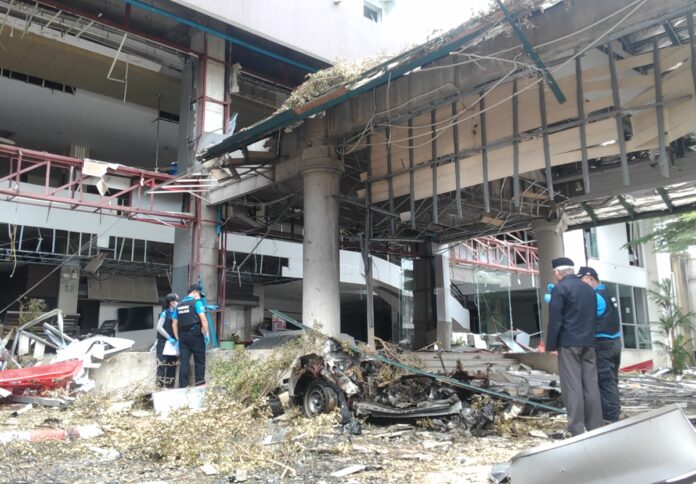
Police officers on Wedneday morning inspect the site of the deadly twin car bomb that struck a hotel in Pattani province.

PATTANI — A radical separatist cell called BRN is thought by police to be responsible for pulling off Tuesday’s twin car bomb in front of a hotel in Pattani.

One person was killed and 30 others were wounded in the attack, which observers said marked the first time in the bloody history of Deep South insurgency that the militants used a stolen ambulance as an instrument of destruction.

Govt Condemns ‘Barbaric’ Bomb Attack on Deep South Hotel

“The perpetrators are either PULO or BRN, but recently, it’s mostly BRN who staged attacks,” said Maj. Gen. Thanongsak Wangsupa, commander of Pattani police force.

Both PULO and BRN were among the groups that fight for the independence of Patani, a historic kingdom that was broken up to become the provinces of Pattani, Yala and Narathiwat after Bangkok annexed it over a hundred years ago.

But in recent years the PULO, or Patani United Liberation Organization, is thought to have declined in influence. Authorities often describe the BRN, or the Revolutionary National Front, as a better-armed and more active militant group. Some experts also believe the group was behind the multiple bomb attacks that rocked southern Thailand during the recent Mother’s Day vacation.

According to Thanongsak, the perpetrators set off the first car bomb in the car park behind Southern View Hotel in Pattani on Tuesday night to prompt the crowds to flee to the other side of the building. Just half an hour after the first blast, an ambulance packed with explosives that was parked in front of the hotel went off, killing one person and injuring at least 30 others.

“They drove the ambulance into the area and pretended to be aid workers, helping people,” Maj. Gen. Thanongsak said.

Ruthless Tactic
The Tuesday’s car bomb was condemned by both government and civil right groups as a violation of international laws on medical equipment and personnel.

The government’s counter-insurgency agency called the attack “barbaric,” while the US-based Human Rights Watch suggests that the militants committed “crime against humanity” by using an ambulance to blow up civilians.

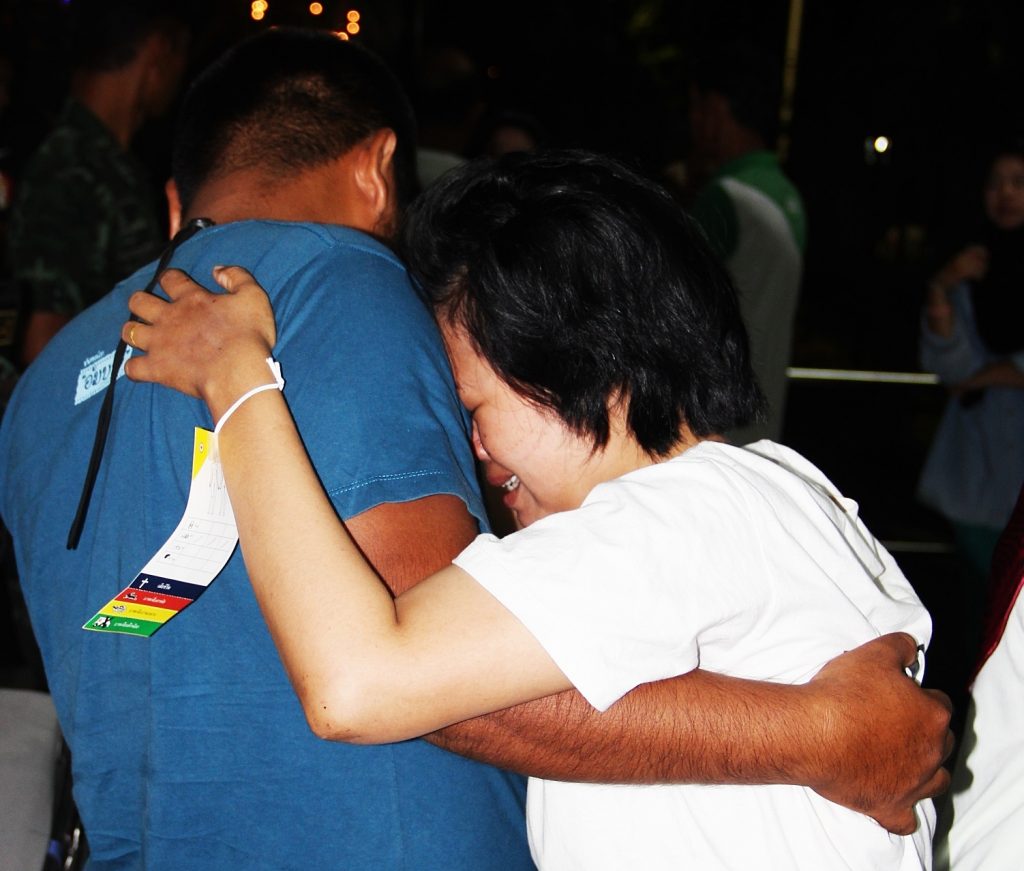
A woman injured in Tuesday's car bomb cries at a hospital in Pattani.
A woman injured in Tuesday’s car bomb cries at a hospital in Pattani.

Pornpen Khongkachonkiet, director of Cross Cultural Foundation, another rights monitoring group based in the south, said it’s the first time she knew of militants turning an ambulance into a car bomb.

“This kind of issue should be an ethics adopted by everyone, even the perpetrators,” said Pornpen, whose organization has also condemned the incident. “They should be aware of that.”

She said she fears that the militants are stepping up their attacks without regard for rules of war concerning medical personnel or facilities.

In March, the insurgents also launched an unprecedented raid on a hospital in Narathiwat province, where they tied the staff down and fired assault rifles at a nearby military base.

Thanongsak, the Pattani police chief, said he believes the militants chose to use an ambulance in Tuesday’s car bomb because no one would think to search such vehicles headed to a crime scene.

“It was very hard to detect, because no one checked the ambulance when it entered the area,” Thanongsak said. “They [local officials] also didn’t make a report to police when the ambulance was stolen. We only found out about it later.”

Pornpen said the government should do more to defuse the tension by getting serious about peace negotiations and relying less on military pacification campaign.

“Those methods did not convince the perpetrators of violence to use any other method than violence,” she said.

But the military junta also ruled out any meaningful peace dialogue in the near future, saying that such talks can only take place after the separatists stopped their campaign of terror attacks first.

“If bombs still go off like this, we can’t sign any [agreement] with them,” deputy junta chief Prawit Wongsuwan said Wednesday. “We have to wait for the situation to be calm first.”

Related stories:

Separatists ‘Crossed Rubicon’ With Attacks, May Escalate: Expert

Deep South Banners Denounce Thailand’s ‘Lies to International Community’

Advertisement

Myanmar Quake Wrecks Bagan Heritage Sites

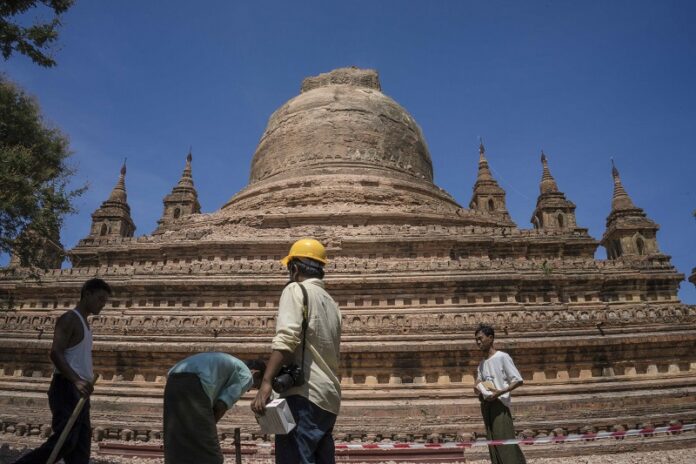
Workers set the security line around the earthquake-damaged Sitanagyi Pagoda on Thursday in Bagan, Myanmar. Photo: Hkun Lat

BAGAN, Myanmar – It was a time of conquest and conversions. Above all, it was a time of construction, on a scale never seen before. Over 250 years, from the 11th century onwards, the rulers of Bagan built more than 10,000 magnificent religious monuments.

The stupas, temples and monasteries became the defining emblems of Bagan, the capital of the Pagan (pronounced PUH’-gahn) empire that ruled Myanmar from roughly 1044 to 1287.

On Wednesday, scores of the monuments – of which only about 2,200 remain – were damaged in a powerful 6.8 magnitude earthquake. Yet much of what fell was modern material, sanctioned by Myanmar’s former army rulers who had put top priority on restoring the temples with little regard for the original architectural styles.

King Anawratha, who unified the country formerly known as Burma, and his successors built the temples in a frenzy, believing they would gain spiritual merit. Still, piety didn’t stop them from making war or killing to gain power.

One king, Narathu, slew his father, elder brother, and one of his wives. He also killed the architect of the magnificent Dhammayangi temple so he couldn’t repeat the feat, and chopped off the hands of sloppy workmen.

As more and more monuments rose in the dusty plains of central Myanmar, Bagan became the political, economic and cultural center of the empire, promoting religious as well as secular studies, including philosophy, astrology, medicine, law and Pali, the language of Buddhist scriptures. The city became an educational destination for monks from as far away as India, Sri Lanka and Cambodia.

But Bagan declined as rapidly as it rose.

It was abandoned around 1287 for reasons not entirely clear, and the city – once home to up to 200,000 people – was reduced to the status of a small town. Some historical accounts cite Mongol invasions but others dispute that, saying the Mongol armies may not have reached the city.

But the dead city left a legacy that future generations are benefiting from.

Bagan covers more than 80 square kilometers (32 square miles) of a flat plain. It is the country’s biggest tourist attraction, and along with Cambodia’s Angkor Wat and Indonesia’s Borobudur temple, the temples of Bagan are considered one of Southeast Asia’s major historical landmarks.

Yet unlike those Southeast Asian archaeological cousins, Bagan is not listed as a World Heritage Site by UNESCO due to a tangled modern tale of neglect followed by a fervid if misguided effort at renovation in the 1990s, partly to restore damage from a 1975 earthquake.

As the ground shook on Wednesday, the tremors dislodged spires, loosened bricks and cracked the mortar, revealing modern material that was the result of haphazard restoration by the former military regime.

These efforts drew widespread international condemnation and forced UNESCO to deny Bagan the World Heritage Site stamp, even though it acknowledged that “these monuments represent the outstanding artistic and technical achievement of an original and innovative Buddhist school of art.”

Much of the blame lies with the junta that took power in 1988, after crushing a pro-democracy movement. By 1995, restoration was in full swing to complete the work before the Visit Myanmar Year in 1996, which the generals of this once-pariah nation hoped would bring in much-needed tourist income.

The plan was a limited success, due to still underdeveloped infrastructure and a boycott call by human rights groups against the military regime, which had placed pro-democracy leader Aung San Suu Kyi under house arrest. The country emerged from military rule this year after Suu Kyi’s party won to become the country’s de facto leader.

Pierre Pichard, a UNESCO consultant who had long been associated with Bagan, said impressing visiting generals rather than cultural priorities dictated restoration while military-ordered excavation has been done “hastily, without proper preparation and without the requested scientific methodology and records.”

UNESCO was even more disturbed when a 60-meter (198-feet) -high viewing tower opened in 2005, saying it’s out of scale and detracts visually from the historical monuments.

State tourism authorities responded that the tower would prevent tourists from climbing on fragile pagodas and stupas and damaging them.

Story: Min Kyi Thein and Grant Peck

Advertisement

Court Approves Second Warrant for Southern Bomber Suspect

Officials inspect the scene where a bomb exploded in Hua Hin's bar area Friday morning.

PHETCHABURI — A military court on Wednesday approved an arrest warrant for a man believed to be linked to the bombings at the resort town of Hua Hin two weeks ago, while rejecting two other warrant requests from police.

Police named the suspect as Ruslan Baima, a 35-year-old Songkla native. He’s charged with possessing explosive and attempted arson. He is the second suspect to have been issued with an arrest warrant in the investigation into the series of explosions and arson attacks that struck seven southern province during the Mother’s Day holidays.

The attacks, which left four people dead, include four bombings in Hua Hin on Aug. 11 and Aug. 12.

Ruslan was previously named as a suspect in the 2012 bomb attack at a hotel in Hat Yai which killed 5 people, but police later retracted the claim.

Police Gen. Srivara Ransibrahmanakul, who heads the ongoing investigation, said he believed Ruslan is still in the country.

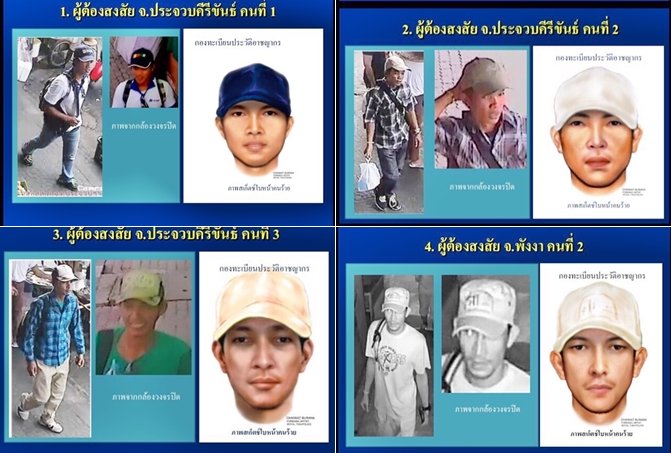
Ruslan was one of the three men police believed carried out the explosions in Hua Hin.Their sketches, which were based on witness’ descriptions, were released by police on Wednesday.

Read: Police Release Bombers’ Sketches, Will Seek Warrants

However, the military court declined to grant arrest warrants for those two alleged accomplices of Ruslan. Srivara said he will gather more evidence and re-apply for the warrants soon.

A collection of sketches of alleged bombers behind the Aug. 11-12 terror attacks released by police on Wednesday.

Police on Wednesday also released a sketched drawing of an unnamed man said to have carried out the bomb attack at Bang Niang Market in Phang Nga province on Aug. 12. Police have not said when they would request a warrant for the man.

Wednesday’s warrant for Ruslan was the second warrant issued in connection with the bombing spree. The other warrant was a Narathiwat man named Ahama Lengha who, like Ruslan, remains at large.

Advertisement

Federal Judge Puts Starbucks Lawsuit on Ice in California

Photo: Rob Pongsajapan / Flickr

LOS ANGELES – A federal judge has thrown cold water on a lawsuit that claimed Starbucks defrauded customers by adding ice to its cold beverages.

Judge Percy Anderson tossed out the potential class-action lawsuit because a reasonable customer would know that a portion of iced coffee or tea would include ice and they’d be able to see it through the clear plastic cups the beverages are served in. In fact, he said, even a child would get it.

“As young children learn, they can increase the amount of beverage they receive if they order ‘no ice,'” Anderson said in a ruling issued Friday in U.S. District Court. “If children have figured out that including ice in a cold beverage decreases the amount of liquid they will receive, the court has no difficulty concluding that a reasonable consumer would not be deceived into thinking … some portion of the drink will be ice rather than whatever liquid beverage the consumer ordered.”

Alexander Forouzesh sued Starbucks Corp. in May for fraud, breach of warranty and false advertising, among other claims.

The Los Angeles man said the chain was cheating customers out of iced coffee and tea by filling cups as much as halfway with ice.

Forouzesh said Wednesday that he plans to appeal and was insulted by the judge’s remarks about children.

“Any child can figure out that they’re being deceived by Starbucks, as well,” he said. “It’s not right. The whole point is that we’re being deceived.”

A Starbucks spokeswoman said the company was pleased with the decision and the judge’s remarks.

A similar case is still percolating in Chicago’s federal court. The coffee company is due to file its defense in that case Thursday.

Story: Brian Melley 

Advertisement

Hot News

LATEST NEWS

Bangkok
light rain
25 ° C
27.2 °
25 °
92 %
8.2kmh
100 %
Fri
25 °
Sat
32 °
Sun
35 °
Mon
36 °
Tue
37 °