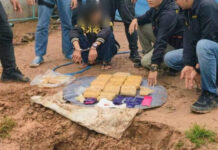
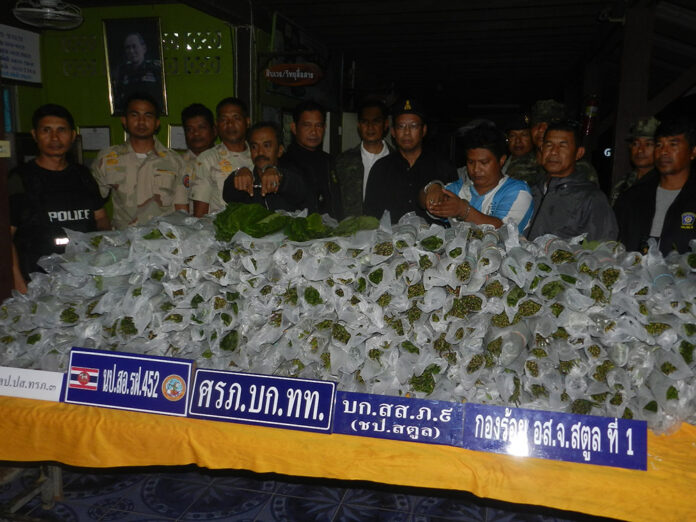
BANGKOK — The government should introduce more effective approaches including supporting local communities in the deep south to play a role in eradicating drugs problems, a newly established party said Friday.
Prachachart Party, which has its stronghold in the deep south, said more than half the inmates in prisons there are being detained for drugs-related charges, adding that there was a needed to introduce more diverse strategies to reduce that number.
It called for the state to support the construction of more sports centers at sub-district level and the establishment of youth councils to lure young people away from drugs.
The party, which published the proposal on its official Facebook page, said drug addiction had been widespread in the three southernmost provinces of Yala, Pattani and Narathiwat for nearly two decades, adding that it was “complex” and deeply related to the area’s separatist violence.
It said bai kratom – a chewed drug which though illegal is widely grown in the south – is particularly widespread.
Suppression must also be carried out along with effective prevention, treatment rehabilitation and appropriate measures for each locality, the party added.
In this March 14, 2018, file photo, former South Korean President Lee Myung-bak arrives for questioning over bribery allegations at the Seoul Central District Prosecutors' Office in Seoul, South Korea. Photo: Kim Hong-Ji / Associated Press
SEOUL — South Korea’s former President Lee Myung-bak was convicted and sentenced to 15 years in prison Friday in a corruption case badly tainting his status as the country’s first leader with a business background who once symbolized the country’s economic rise.
Lee’s conviction came six months after his successor and fellow conservative Park Geun-hye was convicted in a separate corruption scandal that triggered the country’s biggest political turmoil in decades. She is serving 33 years in prison. The back-to-back scandals badly wounded conservatives in South Korea and deepened a national divide.
Few past South Korean leaders are free from corruption scandals. Before Lee and Park, former liberal President Roh Moo-hyun jumped to his death in 2009 amid a high-profile corruption investigation on his family. His liberal predecessor and Nobel Peace Prize winner Kim Dae-jung was forced to apologize at the close of his term after all three of his sons were arrested or embroiled in scandals.
On Friday, the Seoul Central District Court convicted Lee of embezzling 24.6 billion won ($21.7 million) from a company he owned; taking bribes from Samsung, one of his spy chiefs and a former lawmaker; causing a loss to state coffer; and committing other crimes. The court fined Lee 13 billion won ($11.5 million). It said Lee committed those crimes before and during his presidency, from 2008 to 2013.
Lee “has bitterly disappointed not only citizens who trusted and supported him but also our entire country,” the court said in a televised verdict.
Lee, who has denied most of the allegations, didn’t attend the court session, reportedly citing his health and in protest of a court decision to allow a live broadcast of Friday’s trial. His lawyer said the live broadcast would hurt South Korea’s international image and undermine national unity, according to Yonhap news agency.
Lee and prosecutors have one week to appeal, according to the Seoul court.
Before serving as president, Lee, 76, was one of the most famous businessmen in South Korea and had been a Seoul mayor.
He started at Hyundai Group in the mid-1960s and led the company’s rapid rise at a time when South Korea’s economy grew explosively from the rubble of the 1950-53 Korean War. Lee, who once peddled cheap snacks and ice cream on the streets as a poor teenager, started at Hyundai with an entry-level job and rose to various top company posts. He was dubbed a “salaryman legend” or a “bulldozer,” and his success story was chronicled in popular TV dramas.
While serving as Seoul mayor from 2002 to 2006, Lee further built up his can-do image by pushing through an ambitious yet tough project to demolish an inter-city highway and open up a long-paved-over stream to create a new landmark in central Seoul.
Lee won the 2007 election by the widest margin in South Korean history owing to public hopes that he could revitalize the faltering economy. But his five-year term was eventually marred by a global financial meltdown, massive street protests over the resumption of U.S. beef imports and rising military animosities with North Korea.
Before his arrest, Lee accused the current liberal government of President Moon Jae-in of retaliating over the 2009 death of Roh, whose corruption investigation occurred when Lee was in office. Moon, who was Roh’s friend and his presidential chief of staff, responded with fury, calling his accusation a challenge to South Korea’s judiciary order. Previously, Moon called the Roh investigation politically motivated by the Lee government.
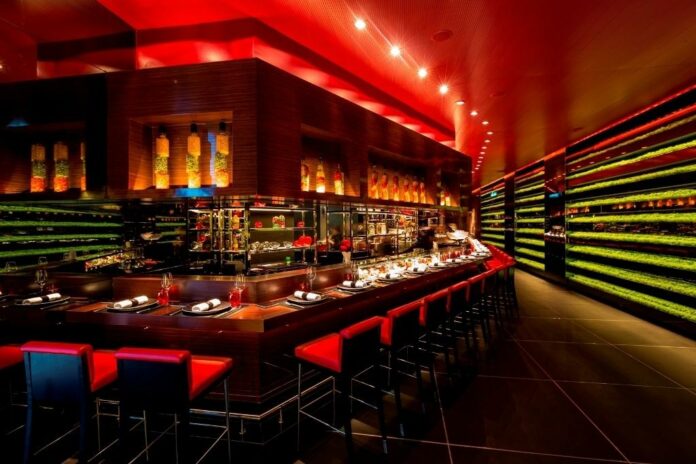
After a significant change in policy on dining enjoyment, L’Atelier de Joël Robuchon Bangkok now offers more opportunities for wining and dining. For the first time, L’Atelier de Joël Robuchon has introduced a hassle-free BYO policy. Diners can bring their own wine for a corkage fee of Bt1,500.
The restaurant has a select wine list featuring great tasting new- and old-world vintages. Bottles come with different price points, from Bt1,000 to Bt680,000 per bottle.
The restaurant offers a choice of premium wine by the glass under Bt1,000.
Some of the premium wines to pair with dinner include 2002 R.D Extra Brut, Maison Bollinger (Bt26,500), 2005 Mersault 1er Cru Les Caillerets, Domaine Jean-Francois Coche Dury (Bt61,000) and 1996 Clos-Vougeot Grand Cru, Chateau de La Tour (Bt34,000).
True to its core values of quality, conviviality and friendliness, L’Atelier provides the best fine dining experiences at all price points in a cheerful, laid-back atmosphere unlike any other classic French eatery.
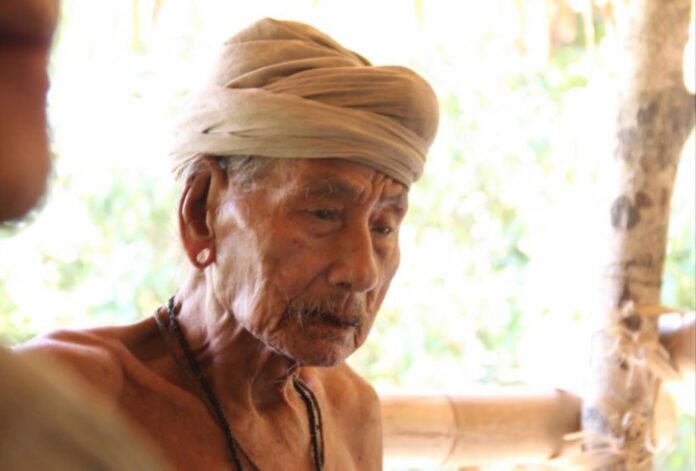
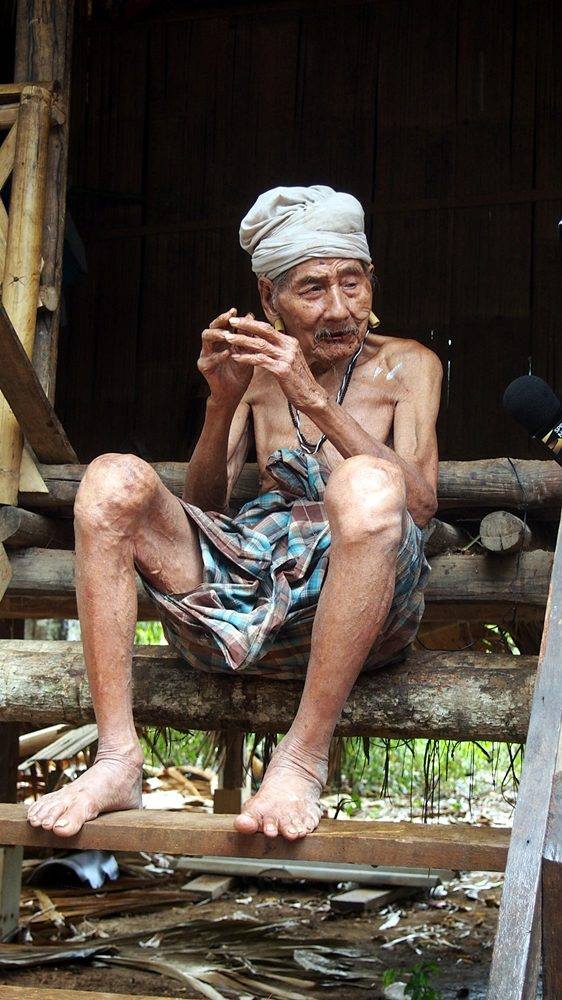
PHETCHABURI — Having failed to fulfil his last wish of returning to his birthplace, Karen community’s spiritual leader Ko-ee “Grandpa Ko-ee” Mimee died early Friday. He was 107.
Ko-ee died from complications to his pneumonia at 4am on Friday at the King Mongkut Memorial Hospital (Phra Chom Klao Hospital) in Phetchaburi province, announced the hospital. He had been in hospital since Sunday.
Ko-ee was born in 1911 as an ethnic Karen in a jungle on the border between Ratchaburi and Phetchaburi province. He was known as a skillful huntsman in the Kaeng Krachan jungle and made a living from selling animals and guiding tourists from Bangkok to hunt, before a wildlife preservation and protection act came into force.
Following the formation of Kaeng Krachan National Park in 1981, Ko-ee was among the Karen minority group who was threatened to leave and find a new home.
In May 2011, National Park officers evicted the Karen villagers and set about 100 of their houses on fire.
Ko-ee’s house was one of them.
In 2012, Ko-ee and another five Karen filed a case against the Department of National Parks to the Central Administrative Court.
The court in 2014 ordered the National Park Department to pay 10,000 baht in compensation to the six Karen plaintiffs. However, the court also rejected the Karen’s request to return to the national park as they did not possess legal document proving their rights to live in the forest.
In September 2018, the Supreme Administrative Court ruled the national park department pay about 50,000 baht to each of the six Karen in compensation of their destroyed houses and rice barns. Five of them traveled to Bangkok to receive the money, except Ko-ee who was unable to travel.
Ko-ee’s wish was to return to his hometown in Ban Bangkloi village, located in the Kaeng Krachan National Park.
“I want to die at my birthplace,” Ko-ee often said in many media interviews.
Suwaroj Chawanunthanaphokin, at right, speaks to reporters at the City Pillar Shrine on Thursday.
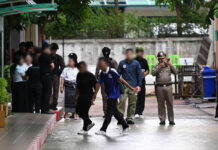
BANGKOK — The military on Friday said five people arrested for attempting to file a royal petition at the Grand Palace had been released.
The five, led by businessman Suwaroj Chawanunthanaphokin, were apprehended Thursday at the City Pillar Shrine just before they made way to the palace to submit their petition, which urged His Majesty the King to replace the junta with a national government.
Prior to their arrest, Suwaroj told reporters a summary of his royal petition had already been sent to the palace for the king’s consideration, and his group was to submit a full draft Thursday.
The group was taken to an army base for questioning before they were freed without charges at 5pm on the same day, military sources told the media.
Security officers accused Suwaroj and his group of violating the junta’s ban on political gatherings.
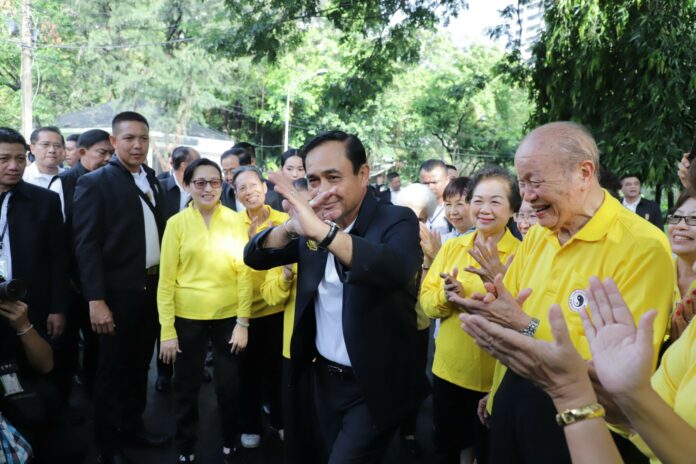
Junta leader Gen. Prayuth Chan-ocha exercises Friday at Lumphini Park in Bangkok.
BANGKOK — Junta leader Gen. Prayuth Chan-ocha made a surprise Friday morning appearance to exercise in the capital’s Lumpini Park.
Appearing at 7:30am, Prayuth did some light jogging and even briefly joined a taichi exercise before some people stopped him to take selfies.
The move came as Prayuth contemplates a future as prime minister after elections. The promised general elections are slated for Feb. 24.
Prayuth has been criticised for allegedly campaigning for elections while the junta’s ban on political activities is enforced. Prayuth has repeatedly denied he is campaigning.
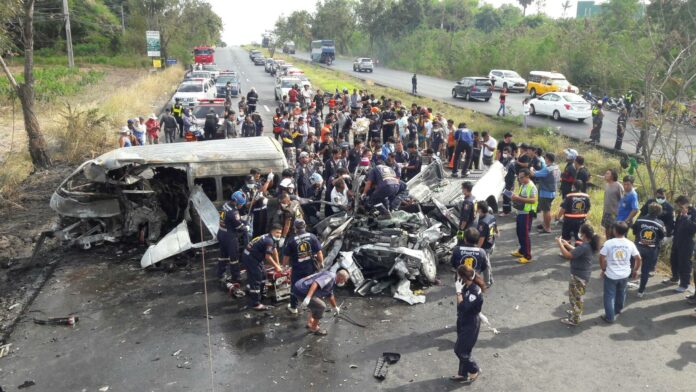
On Jan. 2, 2017, Policemen and rescue officials at the scene of a collision in Chonburi where 25 people died.
CHANTHABURI — A state-owned transport regulator and the heir of a van driver were ordered to pay millions of baht in compensation to the families of a traffic accident that killed dozens last year.
Chanthaburi Court ruled Thursday that The Transport Co., Ltd. company and a son of deceased van driver Sumon Eiamsombat had to pay 26 million baht in compensation to the families of the 25 victims killed during the New Year holiday crash in 2017.
A Bangkok-bound van slipped across a road divider and slammed head-on into a pickup truck on Jan. 2, 2017 in Chonburi’s Ban Bueng’s district. Both vehicles burst into flames.
The court acquitted Sumon’s van operator as the 64-year-old driver was not officially registered as the driver.
A forensic examination of Sumon’s bodyfound he was sober at the time of the incident, according to Maj. Gen. Pornchai Suteerakun of the Forensic Science Institute.
Police said fatigue was the likely cause of the accident. Sumon had reportedly driven five back-to-back trips between Bangkok and Chanthaburi for more than 31 hours.
The 25 who died at the sceneinclude a Chulalongkorn University medical student, members from two families who were returning from a new year trip and both drivers.
Only two survived the crash.
Correction: An earlier version of this article stated that the bus operator was ordered to pay in compensation. In fact, it is the transport regulator. We regret the error.
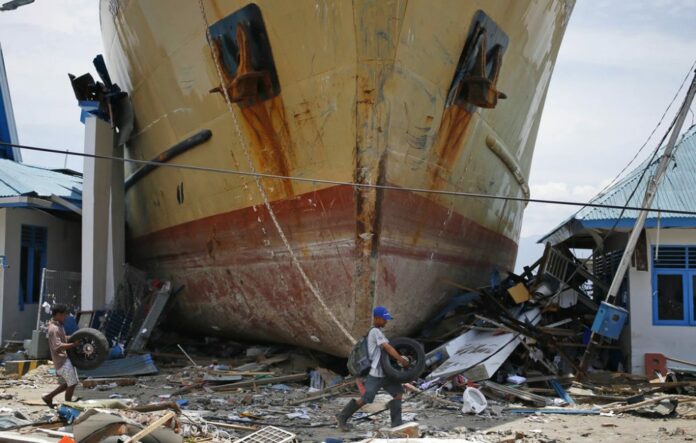
On Thursday, an Indonesian men carry car tires past Sabuk Nusantara 39 which was swept ashore by the tsunami in Wani village on the outskirt of Palu, Central Sulawesi, Indonesia. Photo: Dita Alangkara / Associated Press
WANI, Indonesia — The captain and crew sailing the Sabuk Nusantara ferry to new owners on the Indonesian island of Sulawesi got the task done and then some.
The hulking red and yellow ship was bounced like a basketball as a massive earthquake rocked the region and it landed in front of a row of houses in the village of Wani, dumped by tsunami waves that the crew say were a towering 15 meters (50 feet) or higher.
A week after the magnitude 7.5 quake and tsunami hit central Sulawesi, the captain and 20 crew of the ferry remain on board, waiting for an assessment team to arrive and decide if the ship, its propeller jutting over the waterfront, can be put back to sea.
In interviews on the bridge, the captain, second-in-command and petty officer recounted minutes of chaos and sheer panic as at least 10 other vessels twisted and collided and the rapidly retreating tide — a sure sign a tsunami is coming — sucked the Sabuk Nusantara away from the pier.
“It was just sudden,” said the vessel’s second-in-command, Jona Johanes. “We felt the ship was like a basketball being bounced” as the quake rocked the region.
The double disaster that struck the city of Palu and other settlements killed more than 1,550 people, left about 70,000 homeless and wiped away buildings along Sulawesi’s coastline. The city of 380,000 people has experienced days of lost power and water, dry gasoline stations and a slow dribble of aid.
The ferry, built in 2014, was docked outside Wani because the state-owned company that owns it was delivering it to a new owner. That was also serendipitous because there were no passengers on the 63-meter (208-foot) -long vessel.
Captain Edy Junaidi said the tide retreated about 7 meters (23 feet) immediately after the quake and he thought the tsunami wave was 10-15 meters (33-50 feet) high. Petty officer Imat, who uses one name, said 20 meters (66 feet) and Johanes estimated it at 15-20 meters (50-66 feet).
Their accounts exceed the highest estimates of disaster officials, who said the wave could have been 6 meters (20 feet) or higher based on a man who survived by climbing a tree. A tsunami warning issued after the quake predicted waves of up to 3 meters (10 feet).
Johanes was in his cabin turning on the TV when the quake hit just after 6 p.m. on Sept. 28. There was “extreme shaking” and the light bulb fell out and the air conditioning unit plunged to the floor, he said.
By the time he reached the deck, a huge wave was approaching and the pier had collapsed.
In the preceding one to two minutes, the panicked crew had donned lifejackets and released all of the ship’s mooring lines except one — the head line at the front of the ship — which was stretched incredibly tight as the tide rushed out, forcing Imat, the petty officer, to let it go.
“There is no doubt as a human being of course I’m panicking,” said Imat. “But we have to realize that this is a natural phenomenon. It’s the will of God and we are chanting God is Great. But without forgetting our position, our duty,” he said.
To the crew, the sudden drop in water level was bewildering and it seemed like the Earth was rising.
“I saw the ground getting higher and higher. It was so high. Then I saw the pier had collapsed. It was chaotic. I could see a wave, a dark high wave. I cannot imagine that,” said Imat.
“The ship was driven all the way back and only then did I realize that it was the water that had gone down,” he said.
Johanes, at the bridge when the wave hit, was bracing for a collision with the broken pier.
“I was holding on. I thought we were going to be thrown when we hit the pier. Then I just realized we weren’t thrown. We were flying,” he said.
The time that elapsed between the tide retreating and the tsunami hitting was “just a matter of minutes,” Imat said. “Maybe it was 3-5 minutes. It was really fast.”
At first the crew didn’t realize they’d been dropped on land because the ship remained surrounded by water after being lifted and pushed forward by the surging sea.
In retrospect, it was a “smooth” landing and the ship appeared completely undamaged, Imat said. The captain, Junaidi, estimated the ferry now lies about 50 meters (yards) from its original position at the dock.
“We all panicked,” said Johanes. “We have a plan to abandon the ship but we are waiting for the captain’s instruction. The captain managed to calm us down,” he said.
“If it is necessary we will abandon the ship but at the end the ship didn’t go anywhere. After 30 minutes we saw solid ground around us. We realized it’s not ocean around us. It’s solid ground,” he said, days later still absorbing the ordeal the crew endured.
They cracked dark jokes about their experience and seemed content to wait on a vessel that has none of the deprivations of the nearby villages.
“We can go down from the ship but where can we go? There’s no market around. The shops are still closed,” said Johanes. “And a few days ago there was looting around this area. So we don’t know where to go if we go to the ground.”
Finding an unpretentious yet stylish restaurant serving homey portion sizes at reasonable prices in Asok is rare. For it to serve authentic southern Thai food is even rarer. In that tiny interval of probability, there’s Klangsuan.
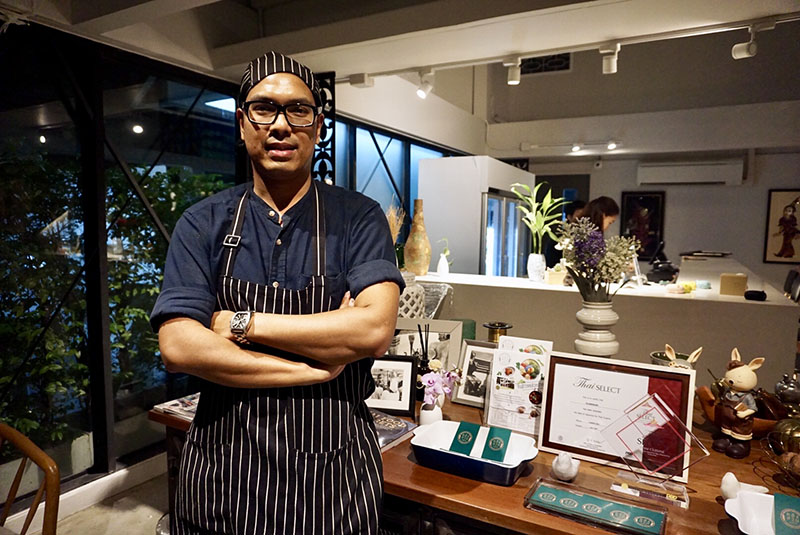
A low-key restaurant serving Chumphon province food and passed around by word of mouth, Klangsuan opened July 2017 deep in Soi Sukhumvit 22. In an interview with Khaosod English, owner Nuttavut “Tum” Mandrananda, 39, talked about growing up to the sound of chili dip being pounded, the sharp scent of turmeric curry being boiled and how the restaurant is an ode to his family.
“I know people are having fun with fusion food right now, but I want to bring back childhood nostalgia,” Tum said. “I’m cooking like my grandma did, staying faithful to the things she made for me growing up.”
For Tum, and many diners, Klangsuan spells nostalgia and childhood, a homecoming to filling and delicious homestyle food.
Nuttavut “Tum” Mandrananda.
From Grandma, to Mom, to Son
Tum grew up averse to everything related to cooking. Growing up, he saw his grandmother struggle as she hawked food and ran a small eatery with his mother in their native Lang Suan district in Chumphon.
“Cooking was always something I tried to run away from. I wanted to be an artist, so I became a freelance photographer and went to Australia to work. I was searching for myself. All the while I didn’t go close to Thai food,” Tum said of his three-year stint from 2007 to 2009.
Unlike many Thais who work overseas in the food business, the closest Tum went to touching food was waiting tables in a bar and delivering catering. But it was one night in a pub, chatting to farangs, that he decided it was time to stop running.
“They were asking about what I had back home, so I talked about my grandma’s shop. Then, they said, ‘if I were you, I wouldn’t come here to struggle. I’d go back home, help the family out and pass on the tradition,’” Tum said. “Farangs really give credit to chefs and people that can feed others. So that changed my perspective.”
Tum came back home to reconnect with his mother, Ngam-nit Mandrananda, 65, – and memories of dishes by granny Cha-leaw Mee-sombut, who died in 2001 at 75, came rushing back.
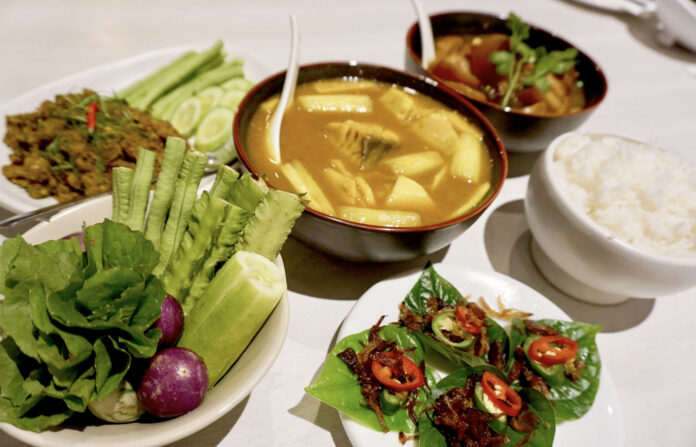
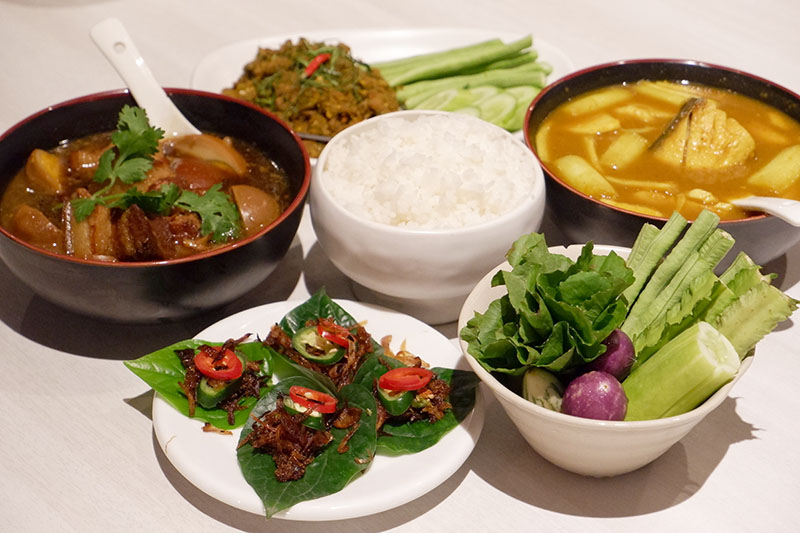
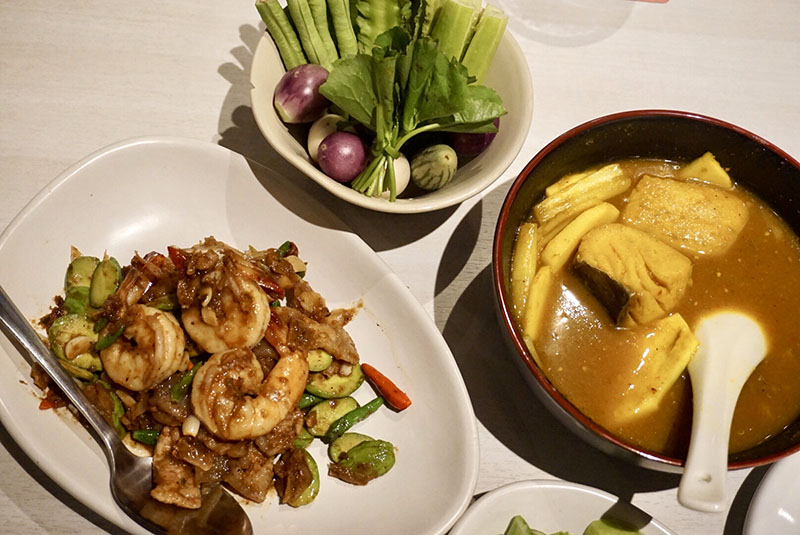
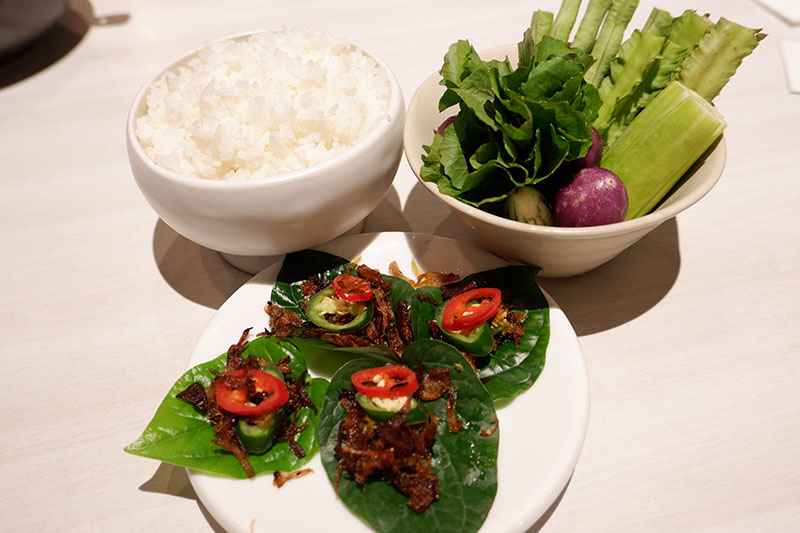
Clockwise from top: khua kling moo (฿150), kaeng som Klangsuan (฿350), a bowl of vegetables, half of an order of miang pla kraben waan (฿120) and khai palo koo rak (฿200) around a bowl of rice.
“There was something surreal linking me to cooking old tin and wood house. It’s like how the kid is an artist when their parents were, because they’re used to seeing wrists flicking brushes,” Nuttavut said. “I remembered the little tips my mom said to herself while cooking, like not putting liang [melinjo] leaves while boiling coconut milk.”
He saw his childhood in a new light as his mom taught him her trade.
“My mom never told me to go into cooking. She said it was a hard job with many problems. You have to chop things repetitively every day until your hands crack,” Tum said. “I realized then that I had been selfish. I experienced the difficulties my mom went through in running her shop to raise me, like going to the market at 3:30am. It got emotional.”
Tum then decided to open Klangsuan, (a dialectal name for a house garden) to pass on his grandmother’s dishes.
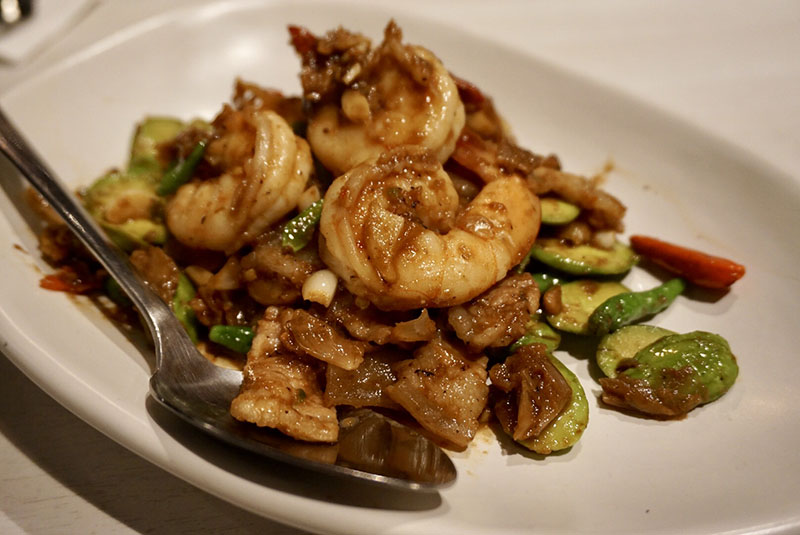
Sataw kao pad kapi (฿180 with prawns) and kaeng som Klangsuan (฿350).
The Food
The attention is in the details: 80 percent of the ingredients are Chumphon-sourced. Nuttavut insists the lemongrass from his hometown is softer and more fragrant than those in Bangkok. Mackerel must be fished from the Gulf of Thailand, not the Andaman Sea, for firmness. Cumin is only from Lang Suan district and he uses coconut sugar, not white sugar. Coconut milk must be fresh, not boxed. All curry pastes are made in-house and some of the veggies are grown in the garden by the restaurant.
“If I run out of chili, I say so and have to tell the customers that I can make them something else. It won’t taste the same if I run out and get chili here,” Nuttawut said.
I’m cooking like my grandma did, staying faithful to the things she made for me growing up
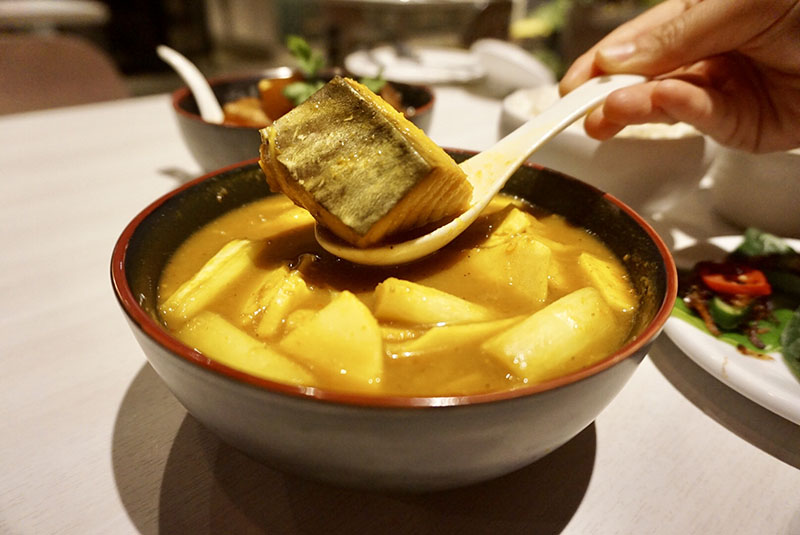
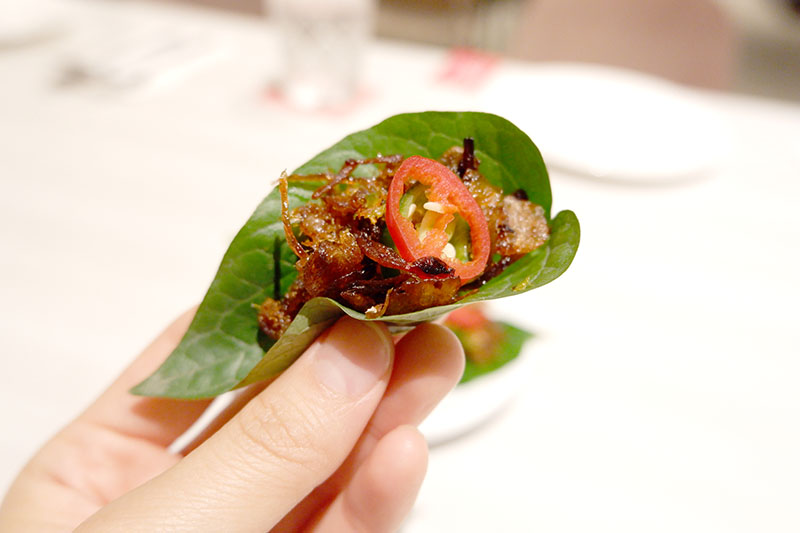
It’s near impossible to miss when ordering at Klangsuan, unless you dislike southern food. The miang pla kraben waan (฿120) are 12 betel leaves with shredded rays and lemongrass, a sweet opening to the wild spiciness of the khua kling moo (฿150) of roasted spicy pork and kaeng som Klangsuan sour yellow curry (฿350), generous in its mackerel and crunchy bamboo shoots.
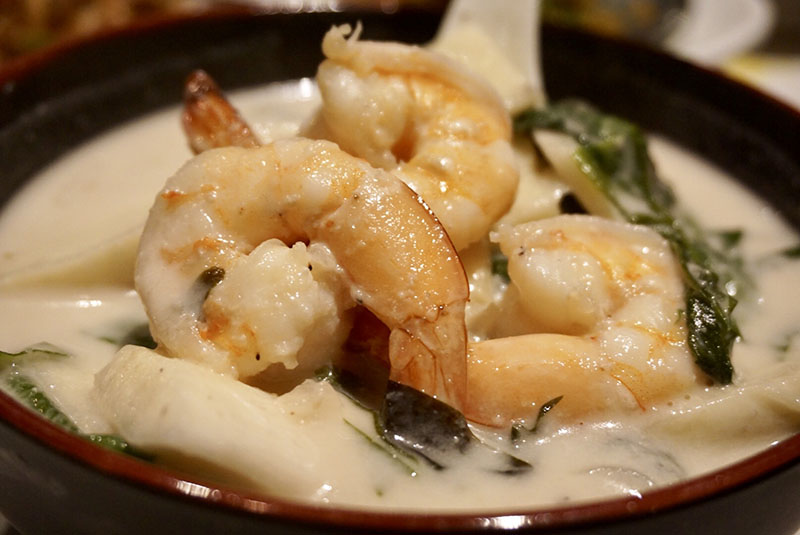
The spiciness builds up until cloaked by the coconut milk soup with prawns (tom kati hua maprao, ฿180). The sparks of heat in the mouth is extinguished in one go with the sweetness, like how a gust of wind blows out all the lights in a candle-lined Tibetan cave.
Kaeng som Klangsuan (฿350).
When things are getting too sweet, turn to the dish of sataw khao phad kapi (฿160 with pork belly, ฿180 with prawns.) It brings to mind better versions of hot seaside summers, with crunchy, fresh, stir fried stink beans. The kapi paste used is sharper and fishier than usual shrimp paste since it’s made of krill.
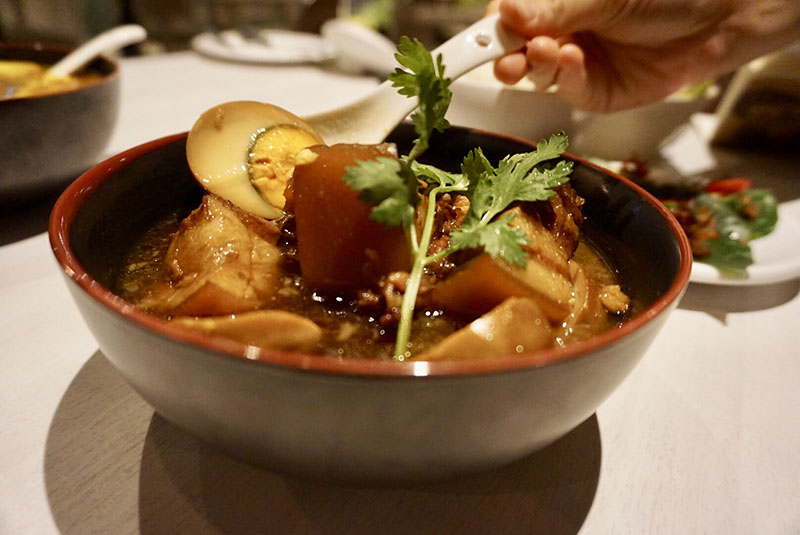
Again, extinguish excess spice with the Southern-style five-spice Chinese soup, khai palo koo rak, sweeter than usual egg-and-pork palo dishes (฿200.) Take a palate-cleansing, crunchy break with the complementary vegetables of Asiatic pennyworth and spherical green and purple eggplants.
In a world of fad foods and calorie counting, it’s nice to simply slurp down sweet and spicy without a care.
Khai palo koo rak (฿200).
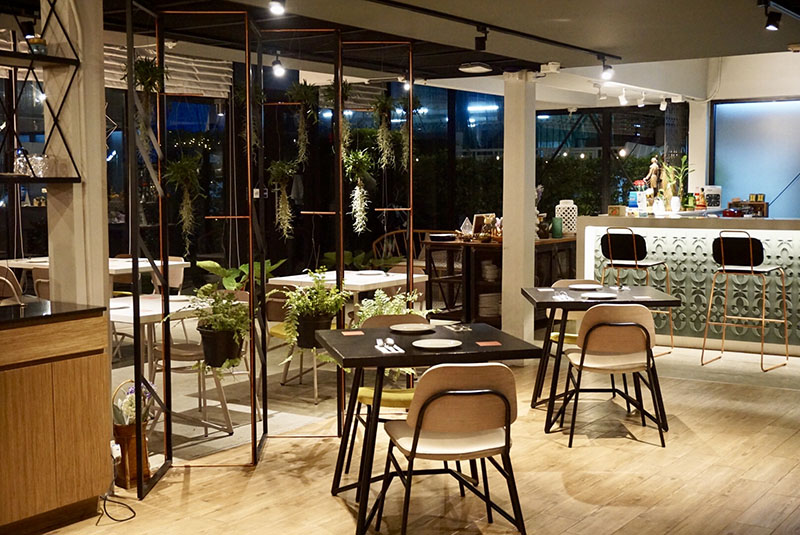
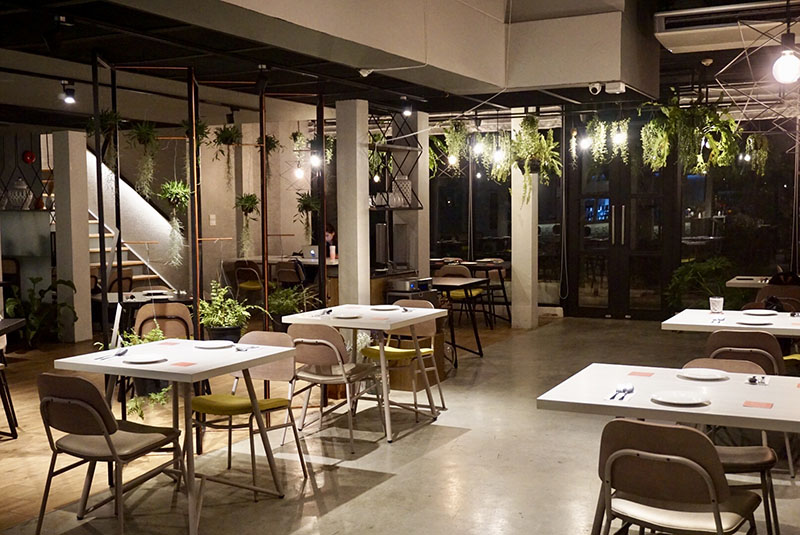
Other than the lunch office crowd in the fern-and-polished concrete space, the clientele is largely family-oriented, like the restaurant’s story.
“Actually, there’s a lot of elderly. They’re past the point of eating fusion food with fancy plating in small portions,” Tum said. “This 70-year-old granny who came to eat khao yum [rice salad] said it immediately made her think of cracking wild tamarind seed pods for her mom as a child.”
One can tell that the food at Klangsuan isn’t meant to trick, show off or even impress one with showmanship. It’s food to nourish you, making you reach for different flavors, and switching them up if things get too hot or too sweet. The food tastes what a southern granny, if you had one, would have made for you to eat until you’re stuffed. The food tastes like love.
Tom kati hua maprao (฿180).
Photos by Jintamas Saksornchai
Klangsuanis open 11am to 2pm and 6pm to 10pm on Tuesday to Friday. It opens 11am to 10pm on weekends. The restaurant is closed on Monday. It’s reachable by a short taxi or motorcycle ride into Soi Sai Namthip 2 in Soi Sukhumvit 22 from BTS Phrom Phrong, BTS Asok, MRT Sukhumvit or MRT Queen Sirikit National Convention Centre.
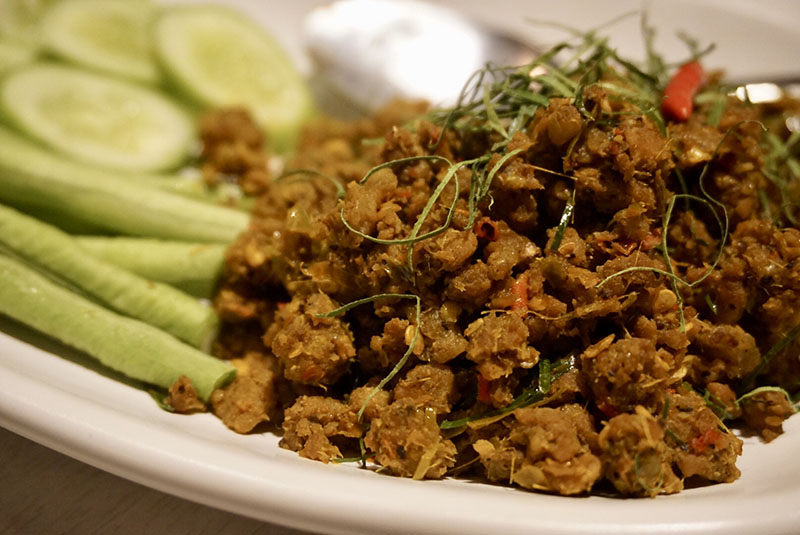
Sataw kao pad kapi (฿180 with prawns).Khua kling moo (฿150).
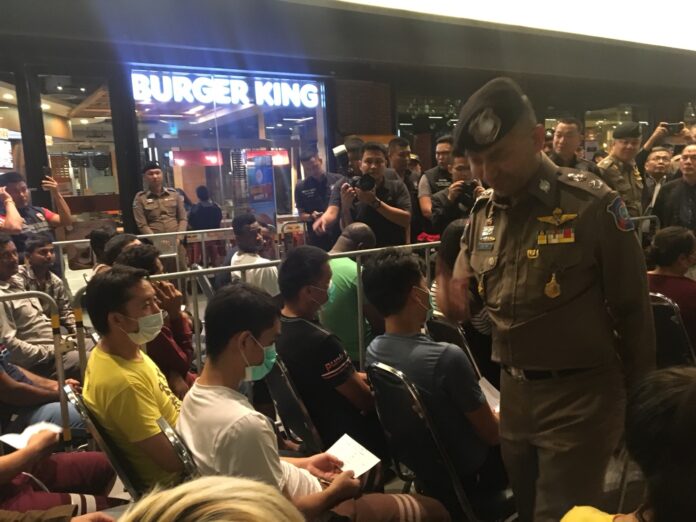
Maj. Gen. Surachet Hakpan, right, at a Friday press briefing with foreigners arrested from across country.
BANGKOK — Police on Friday said hundreds of foreigners were arrested in another round of national raids targeting schools, hotels and restaurants.
A record 369 foreign nationals were arrested Thursday night from 337 locations, including in the capital’s Huai Khwang district, in an operation the immigration chief said was a joint effort between various law enforcement sectors. Maj. Gen. Surachet Hakpan began leading the campaign when he was deputy commander of the tourist police.
He said 96 were captured for overstaying their visas, 131 for illegally entering the country and 142 for petty crimes.
More than 70 Chinese, Indians and Ghanaian were rounded up from Ratchada and Sutthisan areas for selling goods, as foreigners are not allowed to work in retail.
Surachet said the ongoing operation has seen almost 2,300 foreigners arrested and banned from entering Thailand in 35 raids.