27 C
Bangkok
Thursday, September 17, 2026
Home Blog Page 1966

Malaysian PM Says Public Caning of Lesbians Tarnishes Islam

KUALA LUMPUR — Malaysian Prime Minister Mahathir Mohamad on Thursday criticized the public caning of two Muslim women for attempting to have sex, saying it tarnished Islam’s reputation as a merciful and compassionate religion.

Mahathir made the comment after the rare caning of the two women in an Islamic court on Monday, which was witnessed by more than 100 people. Lawmakers and rights groups criticized the punishment as a form of torture.

Mahathir said the Cabinet in a meeting Thursday felt the caning “did not reflect the justice or compassion of Islam.” He said the women could have been given a lighter sentence and counseling since it was their first offense.

“It gives a bad image to Islam,” Mahathir said in a video posted on social media. “It is important for us to show that Islam is not a vicious religion that likes to punish and humiliate people.”

Mahathir, who won a stunning election victory in May, said Muslims greet each other “in the name of Allah who is most merciful and compassionate” but the caning gave a message that there was no mercy in Islam.

The women, aged 22 and 32, were arrested in April and pleaded guilty in an Islamic court. They were given six strokes by a light rattan cane on their covered backs by female prison officers in a Shariah court in northeast Terengganu, a state ruled by a conservative Islamic party.

Human rights groups slammed the punishment as a setback for human rights and said it could worsen discrimination against people in Malaysia’s lesbian, bisexual, gay and transgender community.

Homosexual activity is illegal under both Islamic and Malaysian secular laws, which are seldom enforced. Women cannot be whipped under civil laws. Islamic officials defended the caning, saying it wasn’t painful, unlike caning under civil laws, and was meant to educate the women so they would repent, not to hurt them.

Malaysia follows a dual-track justice system. Nearly two-thirds of Malaysia’s 31 million people are Muslims who are governed by Islamic courts in family, marriage and personal issues.

Malaysia is seen as a moderate and stable Muslim-majority country, but Islamic conservatism is on the rise.

The caning occurred amid a climate of fear and discrimination against Malaysia’s LGBT community. A few weeks ago, authorities removed the portraits of two LGBT rights activists from a public exhibition. Malaysia religious minister Mujahid Yusuf later said the government doesn’t support the promotion of LGBT culture.

A transgender woman was also beaten up by a group of people in a southern state this month.

Advertisement

Thailand’s Politicians Will Have About 2 Months to Campaign. Will They Be Ready?

Pirom Polwiset and other members of the so-called, pro-junta Three Friends Group were criticized this week after they were spotted campaigning in Chaiyaphum province while other politicians face prosecution for violating the junta's ban on politicking.

BANGKOK — Politicians gave mixed reactions Thursday to the idea that they will get about two months to campaign for next year’s promised elections once the ban on politicking is lifted mid-December.

A day after a top official said campaigning is likely be allowed starting mid-December, pols from the Pheu Thai and Future Forward parties said that time is inadequate so long as the ban prevents them from making preparations, making for an election that will be neither fair nor free. A senior Democrat Party member said the given time will be enough, depending on how each party prepares.

“It sounds good when you listen to it … but as long as the political ban continues, old political parties are frozen,” Weng Tojirakarn, a former Pheu Thai MP, said Thursday, adding that it will take time for parties to come up with policies or choose new leadership.

Pheu Thai Party caretaker secretary general Phoomtham Vejchayachai said the party will try to name new leaders within 10 days of the ban being lifted.

Future Forward spokeswoman Pannika Wanich said Thursday it is unfair to keep the political ban until mid-December as having 60 to 70 days for campaigning – a period longer than some past elections – won’t compensate for the losses suffered by political parties and the general public.

Pannika said a number of political parties, including Future Forward, have called for the military junta to immediately lift the four-year-old ban.

“Moving toward free and fair elections requires that political parties have the opportunity to declare their stances and ideologies as widely as possible, so people have full information to make informed election decisions. The longer the ban persists, the less free and fair elections will become. This is not only adverse to political parties but will affect the legitimacy of the election results,” Pannika said.

On Wednesday, Deputy Prime Minister Wissanu Krea-ngam said campaigning will be allowed sometime in mid-December, and that the 60 to 70 days would be more than some past polls, when snap elections left politicians as few as 45 days.

“There is more than enough time to prepare party policies and run an election campaign… There are about 70 days between mid-December and Feb. 24,” Wissanu said Wednesday, referring to a date that has been floated for Election Day. “It’s more than enough compared to other [elections].”

Chorisak said the idea that 60 days or even 70 days would suffice is an outdated way of looking at elections. The way things are now, she said the stress is on voters remembering a candidate’s number in order to vote for them.

“If you want people to have greater participation and understand the policies of each party and think clearly before they vote, 60 days won’t be enough,” she added.

But one of the leaders of Thailand’s oldest party said the alloted time will be enough. He said it depends on how each party prepares prior to the lifting of the ban.

“For the Democrat Party, we will call for a general assembly as soon as possible after the ban is lifted, no more than 10 days after,” said deputy Democrat Party leader Nipit Intarasombat.

He still reserves doubt that a vote will happen in February, as most recently promised by the ruling junta.

“There could be another legal miracle,” he said, referring to previous pretexts for forestalling elections in recent years.

Correction: A previous version of this story had the Future Forward Party spokeswoman’s first name as Chorika. It is in fact, Pannika.

Advertisement

In ‘The Nun,’ What Evil Lurks Beneath a Habit

As frightening as the “The Nun” is, it doesn’t hold a candle to today’s real-life horrors in the Catholic Church.

But while a new generation of filmmakers has breathed new life into horror by embedding it with frightful and salient social commentary, the “The Conjuring” franchise – of which “The Nun” is a spinoff and the fifth installment – isn’t about anything so real. It’s about exhuming classic horror archetypes – creaky old houses and creepy old dolls – with (mostly) old-school effects. And what’s more old school than a mean ol’ nun?

Set in 1952, “The Nun” is the origin story of Valak (Bonnie Aarons), a demonic nun who first turned up in “Conjuring 2,” as the pursuit of Vera Farmiga’s paranormal expert. This time, our protagonist is Sister Irene (played by Vera’s younger sister Taissa Farmiga), a novitiate who, just before her vows, is dispatched by the Vatican, along with Father Burke (Demian Bichir), an expert in unexplained phenomena (or as he says, “miracle hunting”), to a remote Romanian abbey where a young nun has just hung herself.

The decaying, overgrown abbey and its adjoining covenant are suitably eerie. The place, handsomely crafted by production designer Jennifer Spence, has the feel of a horror-movie set, complete with a foggy cemetery, and the action that follows has the almost comforting pattern of surprises and scares that’s to be expected. Entering the gothic world of “The Nun,” built so sturdily on horror movie clichés, is to slide into a darkly fantastical realm that’s practically cozy it’s so familiar.

Crypts will turn into traps, apparitions will flicker in the mirrors and ancient Christian dogma will be used for all its sinister power. Certainly, anyone who goes anywhere at any time clutching a lantern will run into trouble.

But what distinguishes “The Nun” is its silky, sumptuous shadows. Directed by British filmmaker Corin Hardy (“The Hallows”) and shot by Maxime Alexander (who was also cinematographer on the “Conjuring” spinoff “Annabelle: Creation,” ”The Nun” shrouds itself so much in darkness that it at times verges on becoming a nightmarish abstraction. You almost lose sense of what exactly is going on, as Sister Irene falls into a labyrinthine abyss.

The spell, of course, gets broken as the demands of plot and franchise return. And “The Nun” has little to offer beyond: Beware of spooky Romanian abbeys. But for a moment or two, it hangs suspended in a luxurious gloom, the kind that these days passes for a welcome escape.

“The Nun,” a Warner Bros. release, is rated R by the Motion Picture Association of America for terror, violence, and disturbing/bloody images. Running time: 96 minutes. Three stars out of four.

Story: Jake Coyle

Advertisement

Unswayed by Protest, City Hall Vows to Evict More Street Sellers

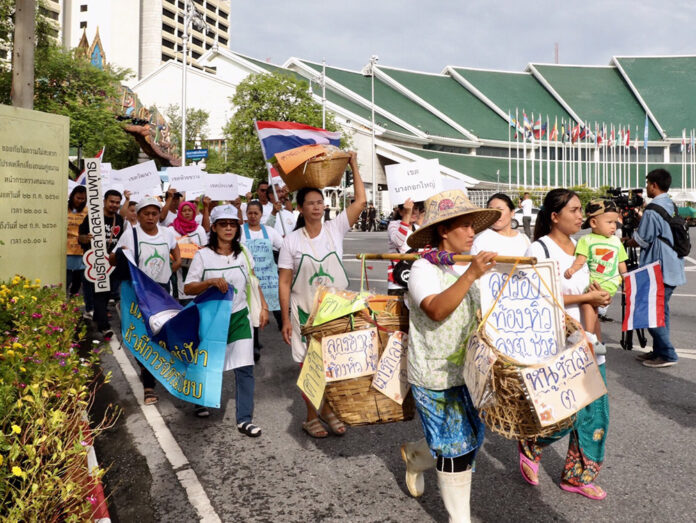
Sellers take to the streets to take back the streets for vending Tuesday at the Government House in Bangkok.

BANGKOK — Top city officials said they will continue to clear vendors from the capital’s sidewalks despite a groundswell of opposition from Bangkok vendors.

After frustrated sellers marched to demand the policy be rolled back and closed areas allowed to reopen, the provincial governor and his deputy said they will advance the campaign to new areas, including Chinatown.

Read: Street Wars: Bangkok Vendors Strike Back

“City Hall’s policy has made clear that vendors can not come back to areas that have already been regulated,” said Deputy Gov. Sakoltee Phattiyakul, who’s been tasked with leading the effort.

Marching on the Government House, vendors Tuesday complained that the city destroyed livelihoods with a heavy-handed approach that offered no satisfactory compensation. Sakoltee said efforts have been made to find new spots for those evicted, especially from the Asok and Memorial Bridge areas, with possible results by next week.

Over the years, as the city forced vendors from places they had long hawked their wares, it typically offered alternative spaces the vendors said were impractical and distant.

Gov. Aswin Kwanmuang also backed the policy, saying that though he felt sorry for thousands of impacted vendors, he also felt bad for millions of pedestrians unable to use space intended for them.

Vendors from throughout the city rose up this week after those on Khaosan Road recently won concessions by fighting the changes.

As for the ongoing dispute over selling there, Sakoltee said district administrators have already designated spaces for selling on the sidewalks and is registering those who would like to sell. He said those violating the rules will be banned and prosecuted.

His confidence doesn’t match the description of vendor representative Yada Pornpetrumpa. A day before Sakoltee’s comments, she said the zoning attempt had failed as there was not enough space for all vendors. A top local administrator on Thursday confirmed that the issue hasn’t been resolved.

“It’s a dispute between vendors and building owners,” said Apichart Saenmanot, head of the Phra Nakorn district’s code compliance officers. “If we just have vendors put their stalls up [on the sidewalks], it also wouldn’t be fair to the owners. They don’t want their shops blocked.”

“We’re trying to negotiate and find a way to compromise to make progress, but now both vendors and building owners won’t back down and only care about their own interests,” he added.

Apichart said the new ban on daytime sales will still be enforced. Yada, who has been questioning the rationale behind this rule, said Tuesday that she might tell the vendors to ignore it next week and erect their stalls during the day.

On Wednesday, Sakoltee also said City Hall is examining ways to regulate vendors in Chinatown, another busy marketplace which was exempted from the policy a year ago.

Meanwhile, Bangkok compliance officials say they are searching to regulate more areas where vendors have troubled traffic, blocked pedestrians or made things “messy and unsanitary.”

Related stories:

Khaosan Future Remains in Limbo

Defeated, City Hall Again Agrees to Exempt Khaosan

Deal Struck For Khaosan Vendors to Submit Alternate Rules

Khaosan Goes Quiet After Police Ignore New City Rules

Khaosan Vendors to Defy City Hall’s New Rules

Feeling Spurned, Khaosan Sellers to March on City Hall

Police the Cops Before ‘Choking Us,’ Khaosan Vendors Say

In Reversal, City Won’t Spare Khaosan, Chinatown Vendors

Advertisement

2018 Won’t be 2011 For Bangkok Flooding: Experts

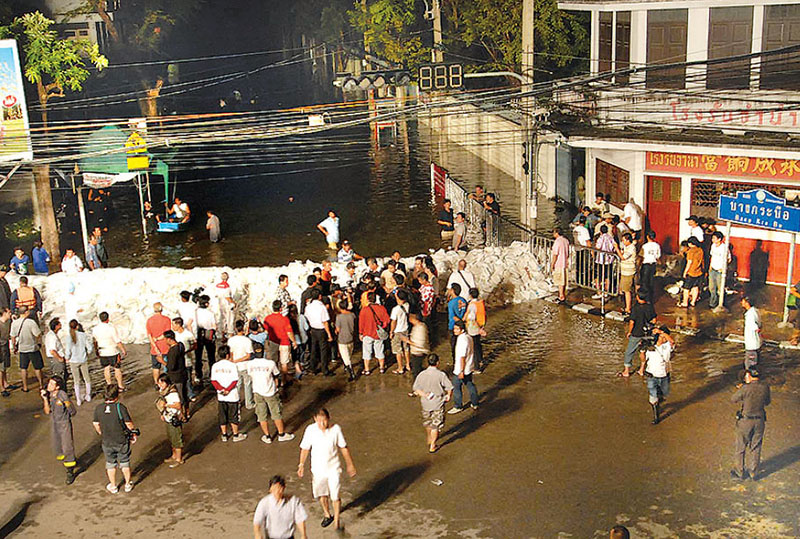
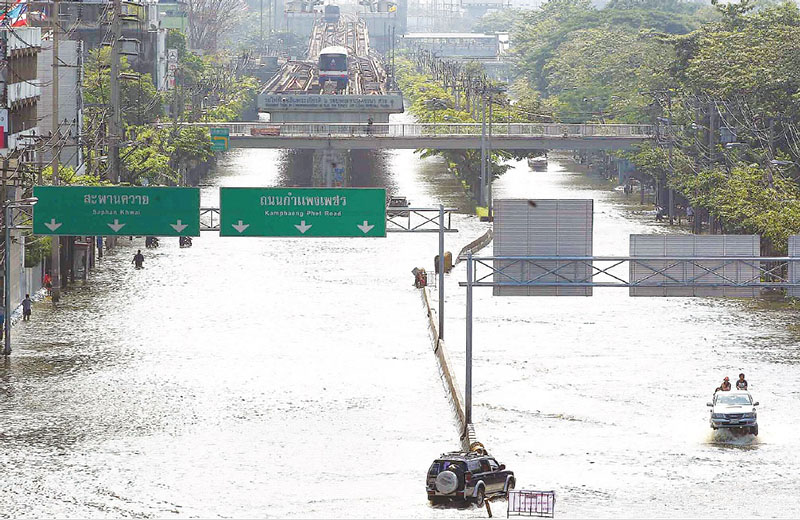
Flooding Oct. 23, 2011 at Thupatemi Stadium in Pathum Thani.

Top: Flooding Oct. 23, 2011 at Thupatemi Stadium in Pathum Thani.

BANGKOK — A woman drowned to death in the capital last night, but although seasonal flooding is approaching the capital, experts said Thursday the death was unrelated and Bangkok will likely be spared from the deluge.

Phanumas Sae-tae, 41, drowned Wednesday night in the eastern Bangkok district of Prawet after becoming trapped in her vehicle in a depressed roadway submerged by a flash flood. Her vehicle stalled out in rising waters after she drove into the street near Airport Rail Link Ban Thap Chang. It took seven hours for rescue workers to recover her body.

The wider flooding crisis that has killed dozens since it hit the northern and central regions in July, today reached Prachinburi city, about a two-hour drive east of the capital. Despite rising waters and reports that the nation’s network of dams are filling to capacity, a state engineer and environmental expert said the capital is not under threat.

3793866
A man and two children raft Thursday through Prachinburi city.

Flooding in seasonally prone areas is actually happening at statistically lower levels than in previous years, according to Urin Soteyonem, a hydrologist with the Royal Irrigation Department. He said that means a slimmer chance of floodwaters reaching Bangkok.

When people are talking about flooding, we’re already looking ahead to the dry season

“If you check back at flooding in Phetchaburi in 2015 to 2017 and ask around with locals, the flooding this year is less than in previous years. It’s about 30 [centimeters] to 40 centimeters now, and only in low areas by the sea, compared to meter-high floods of before,” Urin said.

Read: Flooding Hits Phetchaburi City as Crisis Continues

Elsewhere in Prachinburi’s Kabin Buri district, flooding is only a third of its usual level for this time of year, he added.

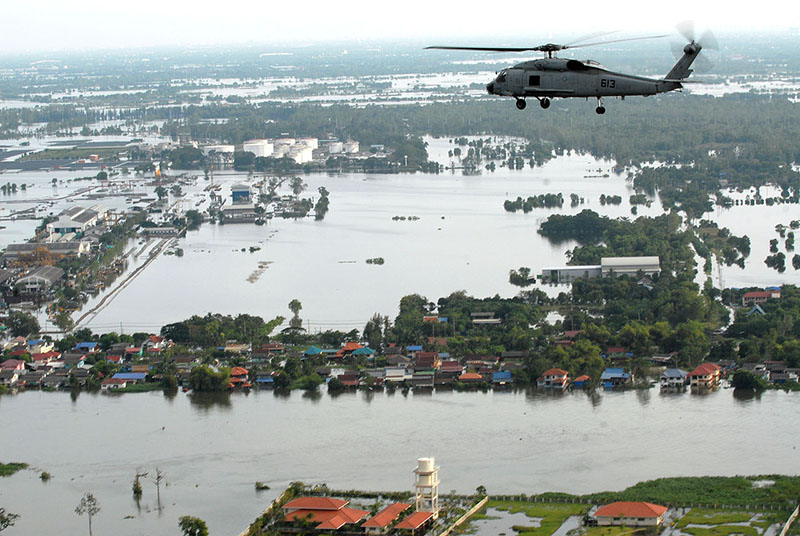
1280px US Navy 111022 N WW409 445 An SH 60F Sea Hawk helicopter assigned to Helicopter Anti Submarine Squadron HS 14 flies around the Bangkok area with
A US Navy helicopter flies over flooded Bangkok in October 2011. Photo: Mass Communication Specialist 1st Class Jennifer A. Villalovos

Urin maintained that Thailand’s extensive waterworks system – 35 large dams, 400 smaller ones – is enough to contain flooding. He said the fixation on dam capacities should not be a cause for alarm, as it is routine to retain water for agricultural use during the dry months.

“We already did mathematical calculations about how much water will be needed, which is why sometimes the capacity can be as high as 80 percent,” the engineer said. “We have to balance the water between the seasons’ dynamics, both rainy and dry season. When people are talking about flooding, we’re already looking ahead to the dry season.”

dusit
Flooding at Kheaw Khai Ka Pier in the Dusit area on Oct. 23, 2011.

The director of Greenpeace Thailand agreed flooding will likely be limited to the outlying provinces and their reservoirs. If anything, Tara Buakamsri said, drought poses a bigger threat.

“We have heavy rain now, but it will taper off later this year and into next year because of the El Nino phenomenon. We will probably have less rainfall compared to other years,” Tara said, referring to a cyclical weather phenomenon of warmer ocean currents in the East Pacific.

Though Bangkok is like the spigot at the bottom of the national floodplain, there are other paths for water to release into the gulf.

donmuanng
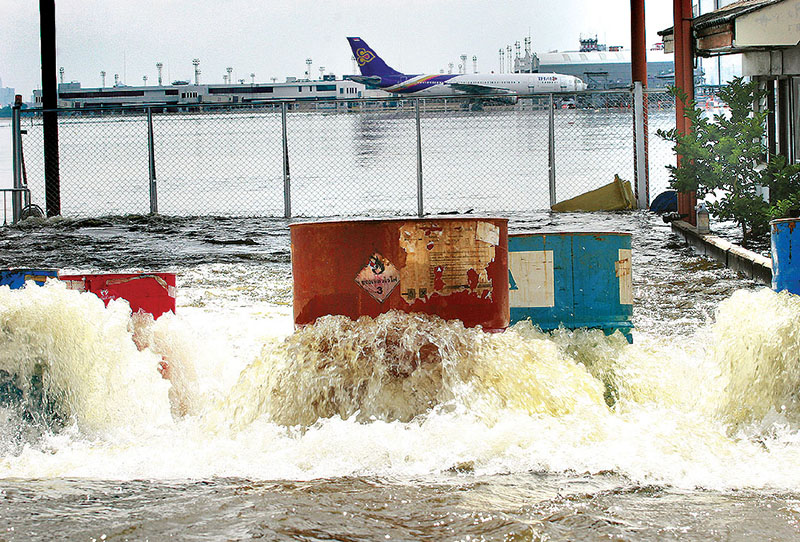
The flooded runway at Don Mueang Airport on Oct 27, 2011.

“Floodwaters in Prachinburi will drain out toward Chachoengsao and then into the gulf,” Tara said. “Of course dams in the provinces have to release water, but as long as water management is good and kept in the kaem ling [water-retention pockets] there’s a very small chance Bangkok flooding.”

The last time severe national flooding reached the capital was in 2011, when much of Bangkok save for the central business district were inundated by meters of water. Damages were estimated in the billions of baht.

6Nov2011Flood
Flooding in the Chatuchak area on Nov. 6, 2011.

Then, dams reached capacity as a tropical storm dropped heavy rain months earlier in May, earlier than normal. Conditions were compounded by La Nina, the opposite current pattern from El Nino which delivers colder water and wetter weather. By October, the system was overwhelmed by the sheer amount of water draining from the highlands and flood plain.

“If everyone goes as expected and there are no extreme weather conditions, then 2011 won’t happen again. The water will be even lower than last year,” Urin said.

The environmentalist echoed the engineer.

“Bangkok has adequate dykes and high enough flood walls and will withstand the worst-case scenario, unless we’re hit with 10 crazy storms or something,” Tara said.

Related stories:

Flooding Hits Phetchaburi City as Crisis Continues

Tropical Storm ‘Bebinca’ to Pound the Provinces

Warning: Be Alert For Flash Floods, Landslides Nationwide

Why Was Bangkok Not Warned of Flooding?

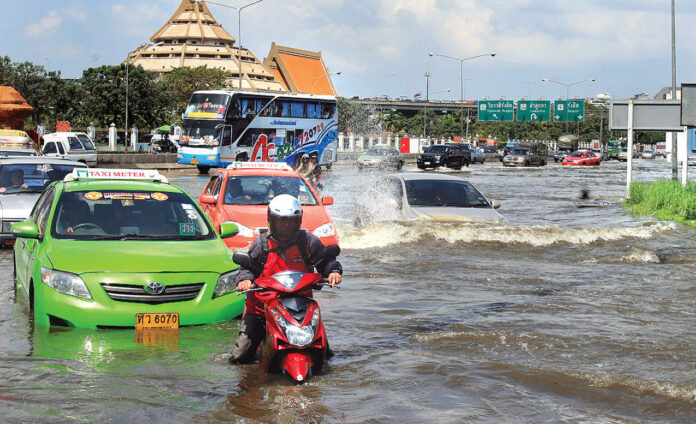
Heavy Rains Leave Bangkok Swimming in Floods

Advertisement

India’s Top Court Decriminalizes Homosexual Acts

Indian actor Nakshatra Bagwe, center, with his mother Swati, left, and sister Samiksh Mirashi at an LGBT Pride march in 2015 in Mumbai, India. Photo: IndianGlamor / Wikimedia Commons

NEW DELHI — India’s top court has struck down a colonial-era law that makes homosexual acts punishable by up to 10 years in prison.

The court gave its ruling Thursday on a petition filed by five people who challenged the law, saying they are living in fear of being harassed and prosecuted by police.

In 2009, a New Delhi High Court declared unconstitutional Section 377 of the law, which says intercourse between members of the same sex is against the order of nature. But the judgment was overturned by the Supreme Court, which says amending or repealing the law should be left to Parliament.

But the government left it to the court to decide the validity of the law dealing with consensual sexual acts between two adults.

Advertisement

Lawyer Says He Can’t Reach Men Held For Sharing Koh Tao Rape Claims

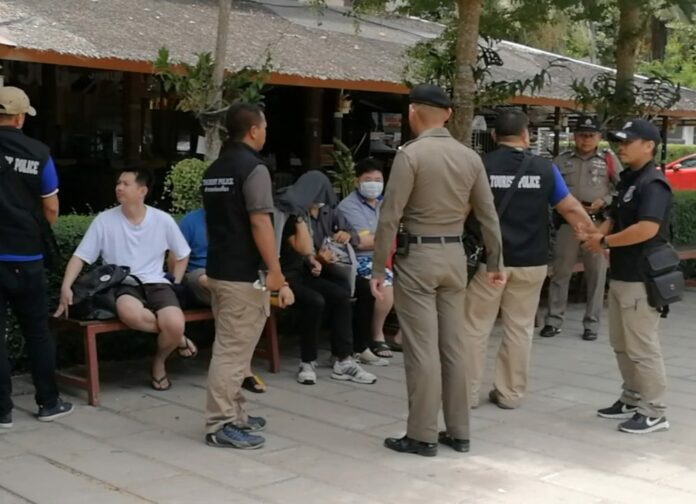
Police and the suspects waited to board a ferry to Koh Tao police station Wednesday on Koh Samui.

Update: All suspects were released on bail Thursday night. 

KOH TAO — Eleven men arrested for sharing Facebook posts about an alleged rape on the tourist island of Koh Tao were questioned without legal counsel and held incommunicado, an attorney said Thursday.

The men, who were taken into custody Tuesday and Wednesday, were charged with violating the Computer Crime Act by spreading news about the alleged assault of a British tourist the dismiss as false. Their head lawyer, Winyat Chartmontree, said he has yet to meet with any of his clients.

“They cannot do that. They have no lawyer there right now,” Winyat said by phone from a pier on Koh Samui, where he was waiting for a 12.30pm ferry to Koh Tao. “They can do it now, but it won’t be considered legal.”

Read: 10 Arrested For Sharing Koh Tao News, Lawyer Says

Winyat added that police confiscated the suspects’ phones once they reached Koh Tao, so his team could not communicate with them.

Koh Tao police chief Piyapong Boonkaew confirmed that questioning had already started, but he denied any wrongdoing. The suspects had a choice to decline the interviews, and they could also choose to give new statements once their lawyers arrive from the mainland, he said.

“It’s our duty to question the suspects,” Piyapong said.

Twelve people were slapped with arrest warrants after they reportedly shared posts from CSI LA, a self-styled investigative Facebook page that has published reports about the alleged rape.

The last suspect who remains at large has contacted police to turn himself in later today, Winyat said.

Advertisement

6 Years Gone: Myanmar Woman Escapes Brutal China Captivity

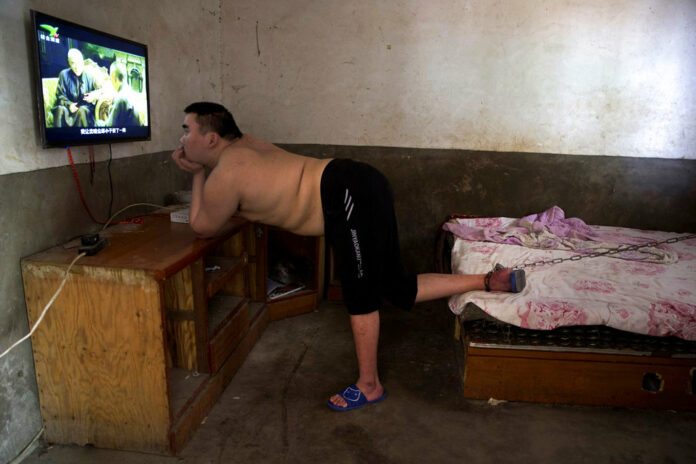
In this July 12, 2018, photo, Li Mingming, whose foot is chained to a bed, a practice sometimes employed by families in rural China to keep mentally disabled relatives from wandering away, watches television in this home in Gucheng village in central China's Henan province. Photo: Ng Han Guan / Associated Press

GUCHENG, China — They were the first photos Marip Lu had ever taken of her son, and it broke her heart to think they might be the last.

The 3-year-old was standing in their living room in rural China, brown eyes beaming as he watched cartoons on TV. He had no idea she was facing a heart-wrenching choice: stay with him and the family that was holding her hostage, or leave him behind and be free.

Six years earlier, Marip Lu said, she had been drugged, kidnapped and trafficked to this place far from her native Myanmar. She had been beaten, forced to “marry” a mentally disabled man, and repeatedly raped, she said – allegations her captors staunchly deny.

Marip Lu is among dozens of women from her state alone in Myanmar to be trafficked to China. The Myu Shayi women’s group says the average number of known victims from Kachin state has jumped from about 35 annually to 50 last year. Myanmar’s government has reported over 1,100 cases in the country since 2010.

Human rights workers say the phenomenon, known as “bride-trafficking,” is a direct consequence of the country’s former one-child policy, which skewed the nation’s gender balance for decades. Today, there are over 30 million more men than women.

The Associated Press pieced together Marip Lu’s story through interviews with her, family members, the group that orchestrated her rescue, and the couple accused of holding her. While the couple insisted she was neither abused nor raped, they were unable to explain how she ended up in their home, or how she allegedly met and “married” their mentally disabled son.

“It’s sad to talk about family affairs, and we don’t bring it up,” said the father, Li Qinggong, explaining his reluctance to talk.

Marip Lu said she was lured into China from the Myanmar town of Laiza after friends said she could get a job at a restaurant in nearby Yingjiang. She was drugged while eating breakfast one morning, and when she regained consciousness, she was racing down a highway slumped on the back of a motorcycle.

She was put on a bus, then a taxi deposited her at a house where a middle-aged couple greeted her excitedly. The couple, Li Qinggong and his wife, Xu Ying, sat beside their son, a man in his 30s named Li Mingming.

The couple instructed her to sleep in his room. That night, Li Mingming began heaving his naked body against her. But unexpectedly, he stopped. Later, she understood why: he was mentally disabled in some way.

For months, Marip Lu said, her captors never left her alone. They beat her and cursed her and forced her to do housework. Then one winter evening, they dragged her into their room. There, Li Qinggong raped her, according to Marip Lu.

She had never felt so isolated, or alone.

Weeks turned into months, then years. And on Sept. 23, 2013, Marip Lu gave birth to a boy.

Although she insists Li Qinggong was the father, the couple referred to the newborn as their “grandson.” In conversations with the AP, Li Qinggong never answered the question of whether he was the father.

Marip Lu loved the boy more than she ever thought possible. But she was also desperate to escape.

One day she found a beat-up cell phone in the trash. First she tried, secretly and unsuccessfully, to call her family. Then she began dialing numbers at random in Yunnan, a province that borders Myanmar.

Eventually, a woman answered in Kachin – a language she had not heard in years. She lived in Yingjiang, and one of her relatives was about to travel to Laiza.

Marip Lu passed on her brother-in-law’s address, and the woman knocked on his door.

Several days later, Marip Lu called home for the first time, weeping into the phone.

In Laiza, Myu Shayi took up her case. An official named Hkawn Shawng told Marip Lu to install the Chinese messaging app WeChat, which allowed them to access a digital map indicating exactly where she was.

Hkawn Shawng wrote a letter to Chinese authorities requesting a rescue.

Months later, a pair of police cars pulled up beside Marip Lu’s house in Gucheng, and took her to a station where she recounted her story. After several hours, though, they called the Chinese family to get her, saying they would come for her later.

It was unclear what happened, but Hkawn Shawng speculated police had either been bought off, or didn’t care. Police declined to speak to AP about the case.

Still, there was a Plan B: Myu Shayi would send somebody to pick her up.

On May 3, 2017, Marip Lu told her son to go to the kitchen. When he did, she ran to a motorcycle owned by the family, as her eyes welled with tears.

She drove to a nearby town, then messaged her GPS location to Myu Shayi’s driver. She spotted a man standing beside a van, and began to run.

“Quick! Get in!” the man said.

After traveling for days, they turned onto a dirt road.

It was Myanmar. Marip Lu was home.

When AP interviewed her, a year after her escape, she could not hide her hatred for the family she said held her for so long.

But in June, overcome by a desire to speak to her son, she contacted Li Qinggong. He refused to let her speak to the boy, she said, and asked if she’d told the AP what had happened.

Marip Lu wants, more than anything else, to get her boy back.

But Hkawn Shawng, the woman who helped engineer her rescue, says that is all but impossible. Her organization has spearheaded the return of more than 200 women to Myanmar since 2011.

All those with children were forced to leave them behind.

Story: Todd Pitman, Esther Htusan, Dake Kang

Advertisement

Times Grants Anonymity to Administration Official for Essay

President Donald Trump responds to a reporters question Wednesday during an event with sheriffs in the East Room of the White House in Washington. Photo: Susan Walsh / Associated Press


NEW YORK — It was an extraordinary decision at a tense time for editors at The New York Times: a senior official at the Trump administration wanted to tell the world that some who work for the president try to blunt his worst instincts, but wanted the cover of anonymity to avoid being fired.

The Times agreed and posted the column titled “I Am Part of the Resistance Inside the Trump Administration” on Wednesday, provoking fury from the man who frequently revs up supporters by railing against “fake news” and the “failing New York Times.” Trump called the move gutless and demanded the Times reveal the author’s identity “for national security purposes.”

The internet was abuzz with speculation on who wrote the column, which veered in tone between a hostage note and a reassurance to Americans that, as the writer put it, “there are adults in the room.”

The decision was in the purview of James Bennet, editorial page editor, and James Dao, op-ed editor, with publisher A.G. Sulzberger weighing in, a Times spokeswoman said. The newspaper’s executive editor, Dean Baquet, was not involved because the news pages are his responsibility, and the column appeared in the Times’ opinion section.

That led to a Times reporter, Jodi Kantor, tweeting that “Times reporters must now try to unearth the identity of an author that our colleagues in Opinion have sworn to protect with anonymity?”

Dao told a Times reporter that the piece was submitted last week through an intermediary, and anonymity wasn’t granted until editors were confident in the writer’s identity. While that’s rare for the opinion pages, it’s not unprecedented, and Dao said the material in the essay was important enough to publish.

“We believe publishing this essay anonymously is the only way to deliver an important perspective to our readers,” the newspaper said.

In June, the Times published a piece from an asylum seeker who was in a Trump administration family detention center, not identifying her because of gang-related threats she received. In 2014, a woman from Pakistan was not identified for writing an editorial page blog item to protect her from the Taliban.

But in Wednesday’s case, the person was from the highest reaches of the U.S. government.

“It’s extraordinary,” said Frank Sesno, director of the School of Media and Public Affairs at The George Washington University. “I have never seen anything like this. I can only imagine the conversations at the New York Times about publishing such a thing. If there’s any question about the role that journalism plays in a democracy, this puts it to bed.”

Sesno said the Times’ credibility is on the line “if this person turns out to be a window-washer somewhere.

“But there’s no way a responsible news organization would do that,” said Sesno, a former CNN Washington bureau chief. “I have to believe that the top people at the Times were part of this decision, because it was so unusual and so explosive.”

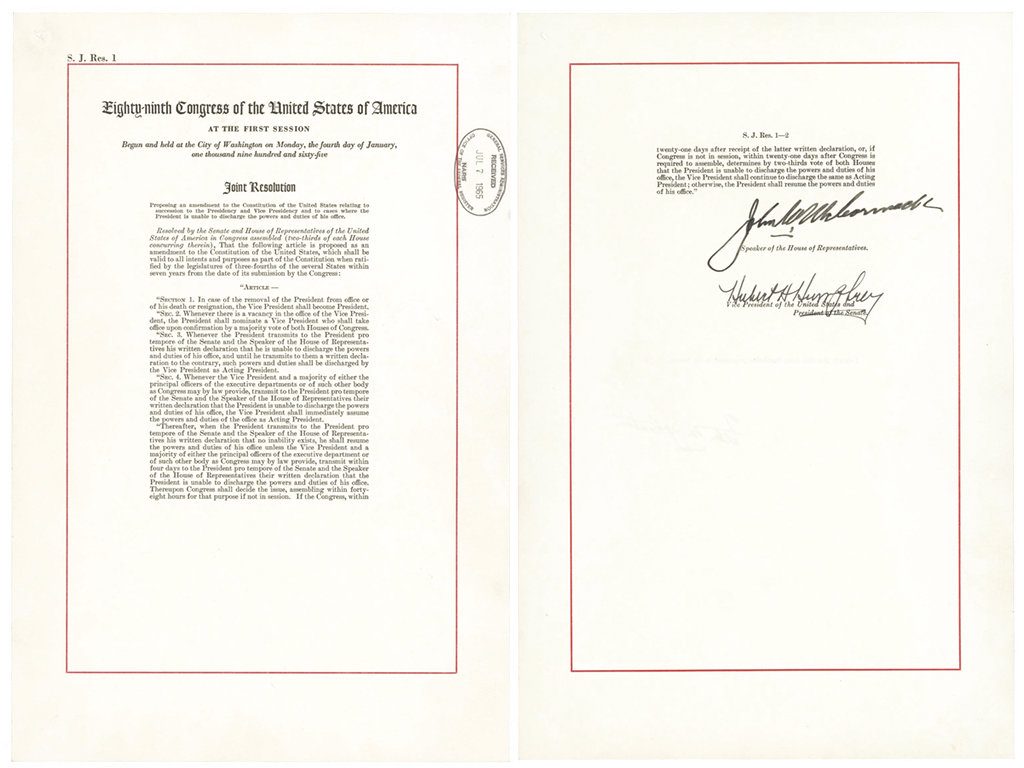
The author wrote that “there were early whispers within the Cabinet of invoking the 25th Amendment, which would start a complex process for removing the president. But no one wanted to precipitate a constitutional crisis.” That speaks to the writer either being in the White House or having access to people who are there regularly.

This image shows a copy of the 25th Amendment, which allows the vice president to take over if the commander in chief is "unable to discharge the powers and duties of his office." Image: Associated Press
This image shows a copy of the 25th Amendment, which allows the vice president to take over if the commander in chief is “unable to discharge the powers and duties of his office.” Image: Associated Press

Kyle Pope, editor of the Columbia Journalism Review, said the decision was akin to the newspaper’s news pages protecting a source with anonymity.

“What’s different here is the scale of it,” he said. “I do think it’s a powerful statement. I wonder how the editorial side is keeping (the source’s identity) from the news side.”

He said it’s a situation in which the rules have to be made on the fly.

“If I was in this decision-making process, I would take the risk,” Pope said. “It’s a risk worth taking because the message is so powerful.”

White House Press Secretary Sarah Sanders said the administration was “disappointed, but not surprised, that the paper chose to publish this pathetic, reckless and selfish op-ed.” She called it another example of the liberal media’s effort to discredit Trump.

The newspaper’s spokeswoman, Eileen Murphy, said the Times was incredibly proud to have published the piece, “which adds significant value to the public’s understanding of what is going on in the Trump administration from someone who is in a position to know.” The newspaper had no response to Trump’s tweet that the identity be revealed for national security reasons.

The article was a coup for the Times in its endless fight for supremacy with The Washington Post, coming a day after the Post published excerpts from an upcoming book on the Trump administration by Post legend Bob Woodward.

Some of what was written in the Times column, in fact, echoes material from Woodward’s book. The book said Defense Secretary James Mattis has purposely not acted on a presidential directive to assassinate Syrian leader Bashar al-Assad, and that former Trump economic adviser Gary Cohn once removed a document from the president’s desk that would have ended a trade deal with South Korea.

The Times column said that those working for Trump made sure sanctions were placed on Russia for poisoning a Russian spy in Britain, despite the president’s reluctance to do so.

“We fully recognize what is happening,” the anonymous author said. “And we are trying to do what’s right even when Donald Trump won’t.”

Story: David Bauder

Advertisement

Passengers on Quarantined Jet Appear to Have the Flu

In this frame from video, a person walks off an Emirates plane at JFK International Airport to a waiting bus on Wednesday, Sept. 5, 2018, in New York. Image: Associated Press

NEW YORK — A large commercial jet from Dubai caused a scare on Wednesday after a pilot radioed that it would be landing at New York’s Kennedy Airport carrying several passengers and crew members who fell ill with flu-like symptoms.

The U.S. Centers for Disease Control and Prevention immediately quarantined the double-decker Emirates aircraft holding 520 passengers so it could evaluate about 100 of them. Some had complained about coughs, headaches, sore throats and fevers.

Officials said 10 people – three passengers and seven crew members – ended up hospitalized in what Emirates called a “precaution.” The rest were cleared to continue their travels while the CDC sought to determine what caused the sickness.

“Given the symptoms that we are seeing in the patients and given the history that they present, it looks like this is probably influenza,” Acting New York City Health Commissioner Dr. Oxiris Barbot said. “But again, until we have our final results late tonight we won’t be able to give a final determination on what the underlying cause is of this illness.”

On social media, passengers including 1990s rapper Vanilla Ice, posted photos and videos of a large-scale emergency response when the aircraft touched down around 9 a.m. at JFK. Video from news helicopters showed the jet stranded on the tarmac for several minutes before passengers began to emerge so they could board buses to get to the terminal.

Vanilla Ice, whose real name is Robert Van Winkle, posted a video on Facebook of an emergency response to an initial report that dozens of people could be sick. On Twitter, he described looking out the window to see several ambulances, firetrucks and police vehicles converge on the plane.

He also wrote that the sick people were seated on the “bottom floor” of the jumbo jet, “so I’m happy I’m up top.”

“Basically, it was chaos right when we landed,” Ice told reporters later Wednesday. He said the pilot announced that there was a health issue and people were sick.

Another traveler in the business class section of the aircraft, Raghida Dergham, also said in an interview that sick passengers were in a “lower level” economy section of the plane.

“I feel great. I feel fine,” Dergham said. “Nobody was alarmed. … It was handled very well.”

But other passengers said they suspected that some passengers were sick before they got on the plane and blamed the airline for not doing more to protect the health of others.

“Why did they allow them on the flight? … I sat with them for 13 hours. If it’s a virus, we’re all getting sick,” said Srinivasa Rao.

Passenger Erin Sykes posted a video of officers in masks and gloves taking the temperature of passengers on the tarmac.

In an interview, Sykes said she saw a few passengers being taken off the plane first for medical attention, but she added that “many, many” others were showing signs of illness.

“Very intense coughing. Violently sick. Going into the bathroom a lot,” she said when asked to describe the scene.

She added: “These people should know not to travel in a confined space with other healthy people.”

Said another flier, Zeph Shamba, said he saw at least one man on the 14-hour flight coughing and vomiting.

“People were worried because we don’t know what it is. And we get down there and guys with masks on their noses and stuff like that,” Shamba said. “It’s like the plane from hell.”

Story: Tom Hays

Advertisement

Hot News

LATEST NEWS

Bangkok
overcast clouds
27 ° C
28.3 °
25.9 °
81 %
2.3kmh
100 %
Wed
27 °
Thu
33 °
Fri
31 °
Sat
32 °
Sun
29 °