30 C
Bangkok
Saturday, June 27, 2026
Home Blog Page 2149

Bali Volcano Emits Wispy Plume of Steam, Flights Resume

A woman collects flowers during harvesting with a backdrop of the Mount Agung volcano covered by clouds in Karangasem, Bali, Indonesia, Monday, Dec. 4, 2017. Gushing ash from Bali's Mount Agung volcano has dissipated into a wispy plume of steam. Indonesia's disaster mitigation agency said Monday the volcano remains at its highest alert level but most of Bali is safe for tourists. Photo: Firdia Lisnawati / Associated Press

KARANGASEM, Indonesia — Gushing ash from Bali’s Mount Agung volcano has dissipated into a wispy plume of steam, and Australian airlines that canceled some flights to the Indonesian resort island on the weekend have returned to near-normal schedules.

Indonesia’s disaster mitigation agency said Monday the volcano remains at its highest alert level but most of Bali is safe for tourists.

The exclusion zone around the volcano still extends 10 kilometers from the crater in some directions. More than 55,000 people are living in shelters.

Airlines Jetstar and Virgin Australia, which canceled flights over the weekend even as the ash cloud shrank dramatically, said they were resuming services Monday.


The region’s volcanic ash monitoring center in Darwin, Australia, has stopped issuing advisories for Agung, reflecting that it’s currently posing no threat to aircraft. It would resume advisories if there’s another eruption.

Tens of thousands of tourists were stranded when ash closed Bali’s international airport for nearly three days last week.

Indonesian government volcanologists say Agung’s crater is about one-third filled by lava and there is still a high risk of more eruptions.

The volcano’s last major eruptions in 1963 killed more than 1,100 people and it was active for more than a year.

David Boutelier, a geologist at the University of Newcastle in Australia, said the chance of a violent explosion is still “very high” but possibly not as high as several weeks ago because pressure is being released.

Advertisement

Cheat, Murderer, Idiot and Thug

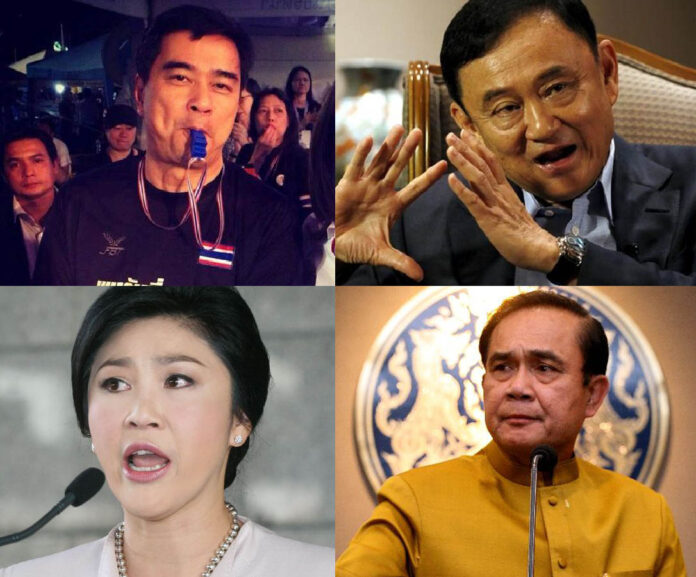
Clockwise from top left, Abhisit Vejjajiva, Thaksin Shinawatra, Yingluck Shinawatra and Prayuth Chan-ocha.

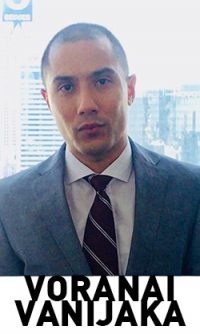
Voranai VanijakaAll political leaders have lovers who support them come what may and haters who deride them no matter what they do. Here we shall focus on what the haters say. Why? Because it’s more fun that way.

Liem means edge and liem-jud literally means extreme edge. Figuratively, it’s a slang term for a mischievously cunning cheater. Hence, haters of former Prime Minister Thaksin Shinawatra, who was convicted of corruption, would ridicule the edges of his square-shaped face, saying that he is liem-jud.

Empty words and sweet nothings, these are the accusations against former Prime Minister Abhisit Vejjajiva. Haters say he’s full of sweet emptiness, because he speaks well – but can’t get anything done. They also called him a murderer for the military crackdown in April and May of 2010.

Haters mock former Prime Minister Yingluck Shinawatra as e-ngo. E being a derogatory term for a woman and ngo meaning stupid. There are also the accusations she flirted with President Barack Obama on his visit to Thailand in November 2012. As such, haters also called her something else, which we shall not repeat here.

So we have had as our prime ministers, according to the haters, a corrupt cheat, an incompetent murderer and a stupid b-word, plus something else we shall not repeat. But that’s all in the past. What have we got in the present?

Haters accuse Prime Minister Prayuth Chan-ocha of being a clueless bully and a thief. Clueless in terms of political governance and economic management, among other things. A bully in regard to his character. A thief for taking the country by gunpoint. As is evident over the past three-odd years, the prime minister relishes in power, loves the spotlight and holds contempt for anyone who questions him. His standard response to any critical question is as follows:

Pounding or pushing the podium, or both. Tight-lipped, bulged-out eyes and angry face. Shooting out the ever-reliable rhetorical question, “you want to bring back street violence?” Then lobbing the threat of summoning that person for a “talk,” which is taken to mean detention camp, as so many politicians, journalists and activists have suffered. Just yesterday it was a social media personality. All the while, pointing and waving his arms about aggressively. That’s pretty much the end of the conversation, any conversation.

Nug-leng, which means thug or gangster, is a term also employed to refer to the prime minister. Lovers use it with a positive connotation, a compliment on his supposed manliness. Haters give it a negative connotation. Think of an alternate incarnation, in which the prime minister would call himself Grand Master P, doing drive-bys in a lowrider.

He wears gold teeth and shiny bling. Favorite drink?  Gin and juice. Grand Master P lives the thug life and writes gangster-rap lyrics about returning happy vibes to the ‘hood. But he’ll bust a cap into anyone who dares talk back or even look at him the wrong way.

Back in May 2014, the prime minister was some four months away from retirement, with the life of a grandpa playing golf and spending time with family ahead of him. Instead, he paved a destiny for himself by launching a military coup d’etat. And here we are today, instead of a happy grandpa, Thailand gets a grumpy uncle.

The prime minister is a man who has complete faith in himself and his place in this world. With such a magnificent ego, he profoundly believes in his own righteousness, if not flawlessness. He can never be critiqued or questioned.

This past Monday, the prime minister was down in Pattani province on a meet-and-greet tour with the people. Parunyu Charoen, a 34-year-old fisherman, questioned him on amending fishing laws.

They stood face to face, the fisherman empty-handed, while the prime minister held a microphone. The fisherman spoke loudly and matter-of-factly about the issue. The prime minister suddenly shouted angrily into the microphone, “Calm down! Don’t raise your voice like that at me! You understand?! I’m listening to you! Speak to me respectfully!” He signaled to his entourage and then stormed off, still holding the microphone. He said “thank you” spitefully as he was marching out, then continued complaining into the microphone about how he shouldn’t be talked to in such a manner. A social media furor ensued.

Fortunately, there was no podium to pound on or push aside, and no threats of returning to street violence or sending someone detention camp. But the theme remains, which is: How dare you question me?

No doubt, the prime minister was rattled, shaken and stirred. An ego may seem magnificent on the outside, but as with most bullies, it’s rather fragile on the inside.

The prime minister can bully, threaten and detain politicians, journalists and activists. This is because all three professions are easy targets, often vilified by society: the first for being corrupt, the second for being fake and bias and the third for being a tool for interest groups. But when a fisherman, an everyday working man, stood up to him, it’s an entirely different ball game.

There’s a reason why all leaders, whether democratic or dictatorial, pander to the people. It’s not so easy to vilify the people with one broad stroke, as it is with politicians, journalists, activists, soldiers, policemen, businessmen, etc. The elites may make snide remarks about the people in private, but publicly everyone wants to be seen as championing the working man.

One working man stood up, the prime minister stormed off in impotent rage. What if a million working people stood up? He might run off to play golf and spend time with the family, never to return to politics. It would chart a new course for a nation.

However, it’s also a matter of who to lead on this new course and in which direction.

Advertisement

A Hero’s Welcome for Toon Bodyslam in Bangkok

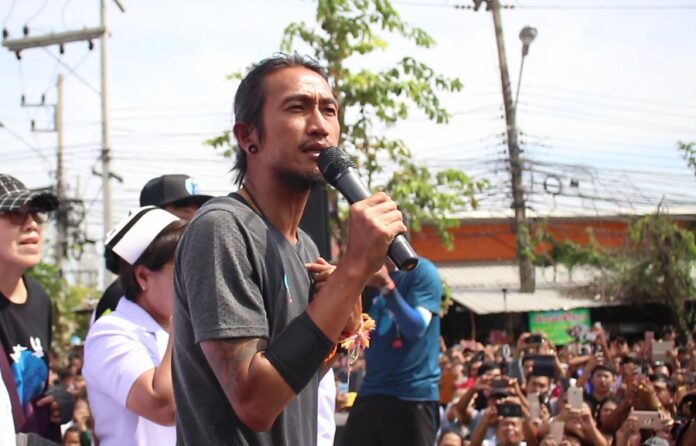
BANGKOK — Rock musician turned philanthropist Toon Bodyslam, who’s been running on a quest to raise money for hospitals, is due to arrive in Bangkok on Sunday afternoon.

In the capital, an array of events and a state entourage fit for a hero’s welcome await Toon, whose real name is Artiwara Kongmalai. The prime minister is set to meet him tomorrow, and he will be greeted at the western edge of Bangkok by the provincial governor.

As of this morning, the Bodyslam frontman was running in Nakhon Pathom province, receiving donations from the crowds along the highway. In a live video of the run, organizers occasionally ask supporters not to interfere with Artiwara, lest another injury occurs.

“Please don’t pull at him,” a narrator said. “P’ Toon isn’t angry when that happens. But please, we’re pleading with you, don’t do it.”

Artiwara is on a mission to run from Thailand’s southernmost point to its northernmost reaches to raise money for 11 public hospitals. He has run more than 1,000 kilometers since he set out earlier this month and raised more than 355 million baht, and he’s expected to raise millions more in the run through the capital city.

At one point today, a roadside gas station owner donated 1 million baht. Another million baht has been pledged by a group of Mahidol University alumni, the organizers said. Some cars passing by Artiwara honk horns to show support.

Not to miss out on the spectacle, state officials are lining up to receive the rocker. Gov. Aswin Kwanmuang, accompanied by other high-ranking officials, will meet Artiwara at a rest stop in the Thawi Watthana district and hand him donations collected from all 50 districts of Bangkok.

At about 3pm he will start running from the rest stop toward the metropolis. He will arrive in Bangkok’s city center via the Thonburi Bridge before heading to the King Power duty free shopping mall – his biggest sponsor – to receive a donation of 25 million baht.

Police will close down some traffic lanes so Artiwara and his team can make their way downtown, said deputy metro commander Jirapat Phumjit. Police also requested that motorists not slow down to take pictures of Artiwara because it may cause accidents.

He won’t run tomorrow. Instead, Artiwara will meet junta chairman Prayuth Chan-ocha at Government House. Gen. Prayuth has previously spoken in support of Artiwara’s fundraising effort for the country’s hospitals.

Artiwara will resume running on Tuesday, which also falls on Thailand’s National Day holiday.

Advertisement

In Flynn, Mueller Unearths More Lies – And a Key Witness

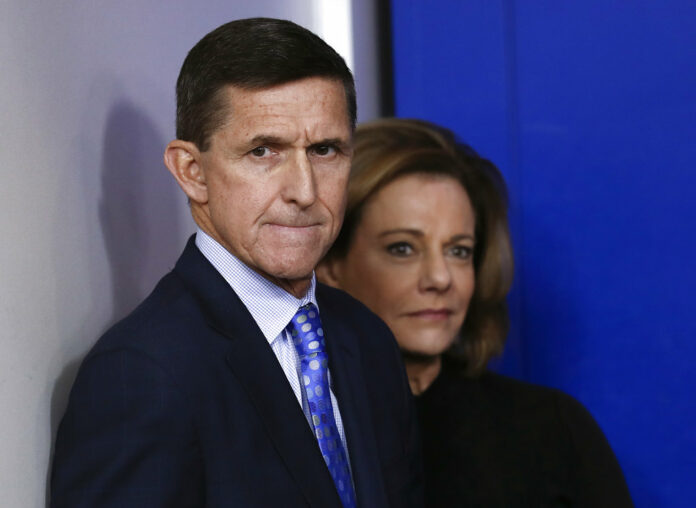
Then-National Security Adviser Michael Flynn, joined by K.T. McFarland, then-deputy national security adviser, on Feb. 1, 2017, at a daily news briefing at the White House. Photo: Carolyn Kaster / Associated Press

WASHINGTON — More smoke but no smoking gun.

Michael Flynn’s guilty plea Friday added a new layer of lies to the far-reaching investigation into ties between President Donald Trump and Russia, and put heightened scrutiny on the president’s son-in-law, Jared Kushner.

But Flynn’s admission, and all of the criminal cases thus far, have not resolved the fundamental question special counsel Robert Mueller is seeking to answer:

Did Trump’s campaign collude with Russia to win the election?

Still, Mueller has left no doubt that his investigators have amassed a wealth of knowledge about the contacts between Trump associates and the Russians, and they’re looking to gather more facts from Flynn, a new key cooperator.

By forcing Flynn’s assistance, Mueller gains someone who can put him in the room with Trump and his closest advisers during the campaign, transition and the early days of the administration, times where Trump associates have acknowledged communicating with people connected to Russia.

In the hours after Flynn admitted lying about his contacts with a Russian government official, two names surfaced as integral players in his actions.

Kushner was identified as a “very senior” transition official, who directed Flynn to contact foreign governments, including Russia, about a U.N. Security Council resolution last December. And KT McFarland, who served as Flynn’s deputy national security adviser, was a “senior” transition official involved in discussions with Flynn about what to relay to Sergey Kislyak, then Russia’s ambassador to the U.S., about the response to U.S. sanctions levied by the Obama administration.

Kushner and McFarland weren’t named in court papers. But McFarland’s involvement was confirmed by two former transition officials who spoke on condition of anonymity because they weren’t authorized to publicly discuss the matter. One of the officials confirmed Kushner’s involvement.

Flynn became the fourth person known to have been charged in Mueller’s probe and the second, after former campaign policy adviser George Papadopoulos, to cooperate with investigators.

For both Flynn and Papadopoulos, prosecutors employed a similar, and textbook, strategy by accepting a limited guilty plea and turning the defendants into government cooperators. Papadopoulos and Flynn both pleaded guilty to lying to the FBI about their foreign contacts but not for their underlying conduct.

Still, Flynn’s plea to a single felony count of false statements made him the first official of the Trump White House to admit guilt so far in Mueller’s criminal investigation as court papers made clear that senior Trump officials were aware of his outreach to Russian officials in the weeks before the inauguration.

That revelation moved the Russia investigation, which has overshadowed Trump’s agenda throughout the year, deeper into the White House and raised questions about the accuracy of administration assertions that Flynn had misled Vice President Mike Pence and other officials about his calls with Kislyak.

Though prosecutors also had investigated Flynn lobbying work on behalf of the Turkish government, the fact he pleaded guilty to just one count, and faces a guideline range of zero to six months in prison, suggest prosecutors see him as a valuable tool and are granting a degree of leniency in exchange for his sharing what he knows.

Flynn, a 58-year-old retired U.S. Army lieutenant general, accepted responsibility for his actions in a written statement: “My guilty plea and agreement to cooperate with the Special Counsel’s Office reflect a decision I made in the best interests of my family and of our country.”

Immediately after Flynn’s plea, White House lawyer Ty Cobb sought to put distance between Trump and the ex-aide, saying, “Nothing about the guilty plea or the charge implicates anyone other than Mr. Flynn.”

For his part, the president ignored reporters’ shouted questions as he welcomed the Libyan prime minister to the White House, and aides canceled media access to a later meeting between the two. He did appear briefly at an afternoon White House holiday reception for the media, where he offered season’s greetings and departed without addressing the Mueller investigation.

Trump grew close to Flynn during the campaign. The general was a vocal and reliable Trump surrogate, known for leading crowds in “Lock her up” chants regarding Democrat Hillary Clinton’s use of a private email server. After his election victory, Trump elevated Flynn as his top national security adviser.

But Flynn’s White House tenure was short-lived. He was forced to resign last February following news reports revealing that the Obama administration officials had informed the Trump White House that Flynn had discussed sanctions with Kislyak, a fact at odds with the public assertions of Pence. The officials warned that the discrepancy made the administration potentially vulnerable to Russian blackmail.

After Flynn’s departure from the White House, Trump retained a special interest in his former adviser. Former FBI Director James Comey, whose firing in May precipitated the appointment of Mueller as special counsel, has said Trump asked him in a private Oval Office meeting to consider ending the investigation into Flynn. Comey has said he found the encounter so shocking that he prepared an internal memo about it.

That FBI investigation was the basis of the court case against Flynn, centering on a series of conversations that Flynn had with Kislyak during the transition period between the November election and the Jan. 20 inauguration.

Prosecutors say Flynn on Dec. 29 spoke with an unnamed senior transition team official about what, if anything, to say about sanctions that had been imposed on Russia one day earlier by the Obama administration in retaliation for election interference. Flynn requested the Russian ambassador “not escalate the situation” and respond “in a reciprocal manner,” a conversation prosecutors say he then reported to transition team members. Just days later, Vladimir Putin opted not to retaliate.

Another conversation with Kislyak occurred one week earlier after a “very senior member” of the presidential transition team directed Flynn to contact foreign government officials, including from Russia, about a U.N. Security Council resolution regarding Israeli settlements.

In a striking rupture with past practice, the Obama administration refrained from vetoing the condemnation of the settlement expansion, opting instead to abstain. The rest of the 15-nation council, including Russia, voted unanimously against Israel. At the time, Israel was lobbying furiously against the resolution and the Trump team spoke up on behalf of the Jewish state.

Former U.S. officials and foreign diplomats said Kushner led the transition effort to defeat that U.N. vote.

During his conversation with Kislyak, prosecutors say, Flynn requested that Russia vote against or delay the resolution, though he admitted in his plea deal that he later lied to the FBI by saying he had not made that request.

Story: Chad Day, Eric Tucker

Advertisement

Give it a Rest, Toon!

Toon Bodyslam gives a high-five to a child Saturday in Prachuap Khiri Khan province

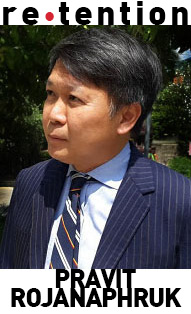
Re•tention: Pravit RojanaphrukRocker-turned-philanthropic fund raiser Toon Bodyslam will finally arrive in Bangkok on foot tomorrow, Sunday, after a month of running.

Toon has covered a distance of 1,000 kilometers so far to raise over 355 million baht for 11 public hospitals.

There is no doubt Toon, 38, will raise hundreds more millions as he continues to jock his way toward the northern tip of Thailand as the rocker’s running has become a national phenomena.

My concern for Toon, whose real name is Artiwara Kongmalai, is simple.

I am worried for his knees, specifically his kneecaps, after two injury breaks so far. It’s also an enigma as to why Toon has to continue to run, instead of doing something else, in a bid to raise more funds for needy hospitals.

Could he not just hold concerts instead? What about having other high-profile public figures join a relay run for the rest of the route?

Toon covers a distance of some 50 kilometers to 60 kilometers per day on average. He has to clock in another 1,000-plus to reach the northernmost reaches of Thailand. It will require roughly another month of running, and he is literally risking his health, or his kneecaps, as a result.

Humans basically evolve from apes and are not physically engineered to walk straight on two feet for such a long period, not to mention run.

While it seems Toon really likes running, he risks permanently damage as a result. Why can’t he just walk then?

Perhaps it’s about sacrifice. If you don’t sweat or suffer severely, it seems people won’t be moved to donate.

I am reminded of Jesus Christ dying on the cross for all Christians. Or the Buddha starving himself in an attempt to attain enlightenment.

As they say in body-building parlance: “No pain, no gain.”. It may be added that no sacrifice, no sympathy; no running no money, at least in this case.

Supporters and fans of Toon may be yearning for a hero, and indeed Toon deserves to be called one, even though we may argue why the illegitimate military government cannot tighten their belts a bit and buy fewer weapons and more medical equipment instead so Toon can take a rest.

One Blackhawk helicopter costs around 700 million baht, roughly the same sum of money Toon expects to raise.

Yearning for a hero, no public figure has so far urged Toon to stop running and ruining his knees. This despite Toon having to already take two breaks to rest from injuries last month.

A hero must be extraordinary, superhuman even. A hero it seems, cannot be heroic if he or she doesn’t take high risk and make unfathomable sacrifice. If that bad day eventually comes, public hospitals will surely compete to offer Toon free knee arthroplasty – a surgery to replace the weight-bearing surfaces of the knee joint in order to relieve pain or disability.

I feel sorry for Toon. People in this society are suckers for heros, and Toon has been sucked into becoming one. Now he can’t stop running. He doesn’t need to continue to run to continue to raise money. He can continue to raise money without running.

The truth is, Toon has done more than enough. Others: rockers, movie stars, public figures, sports stars, and Buddha forbid, even junta leaders, should beg him to stop. It’s time others, people including dictator Gen. Prayuth Chan-ocha, to run on his behalf, covering say 10 kilometers each to make this whole philanthropic campaign more inclusive and participatory.

It would be a needless shame if Toon ends up ruining his kneecaps.

No feel-good campaign should be reckless. It’s time people take up Toon’s baton before it’s too late. It’s also time to ask why the military government, while able to shop for more military toys from China and the United States in preparation for a war that is not even on the horizon, could not afford to properly equip state hospitals with life-saving medical hardware.

It’s time for Toon to run less, and it’s time for people to demand more from the military regime.

Advertisement

Israeli Sentenced to Die for Killing Fellow Expat

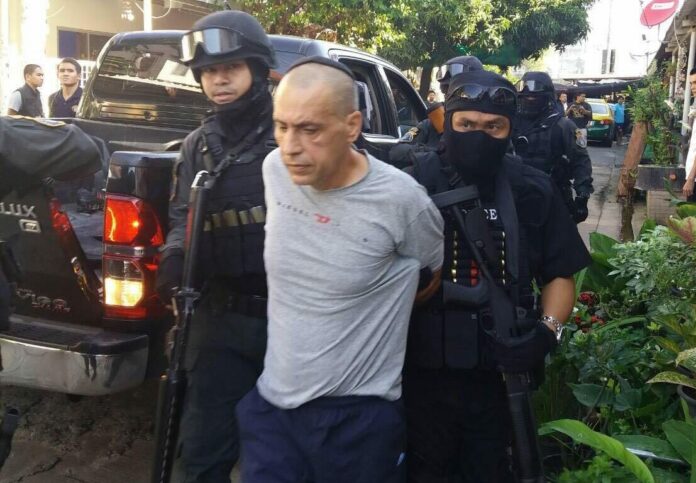
Police commandos detain Shimon Sakira Bitton on Nov. 14, 2016 in Bangkok

Update: Israeli Embassy on Monday declined to comment on the verdict. 

BANGKOK — An Israeli man has been sentenced to die for the murder of a fellow Israeli last year, police said Saturday.

Shimon Sakira Bitton, 50, was convicted and sentenced to die one year after he was arrested on suspicion of killing Eliyahu Cohen, a 63-year-old Israeli policeman, and hiding his body under poured concrete. The court convicted and sentenced him on the same day, according to the officer in charge of the investigation.

“It’s up to defendant whether to appeal the ruling,” Col. Jirapob Puridej said Saturday. Defendants have 30 days to appeal their convictions.

Read: Parents of Missing Woman Linked to Israeli Murder Suspect Seek Help

He continued, “I am happy to have successfully brought the criminal to justice. We did everything in accordance with the facts.”

The Israeli Embassy has not made a statement and could not be reached Saturday for comment.

Police said Bitton murdered Cohen with the aid of his 17-year-old son in a fit of jealous rage. They began investigating Bitton after Cohen’s relatives told the Israeli Embassy he went missing.

Investigators also linked him to a previous murder and concealed body from 1997. He served jail time before being booted out of the country, only to return years later under a new name. The suspense over Cohen’s murder escalated when family of Bitton’s Thai wife also reported her as missing.

Although Thailand retains death penalty in serious crimes like first degree murders, an execution has not been carried out since 2009.

A juvenile court verdict in the trial of Bitton’s son is yet to be out.

Col. Jirapob said Bitton’s missing wife, Nantiya Saengurai, is still unaccounted for. She remains in the missing persons database and could not be ruled as deceased by the court for lack of evidence.

“There is no evidence anyone has killed her,” the colonel said. “For the court to declare someone dead, there must be some evidence, or a body. But in her case, there’s no trace of her at all. Not even one witness.”

Related stories:

Murder Suspect’s Mistress Told to Say His Wife Was Dead

More Bodies in Israeli Murder Suspect’s Past

Missing Israeli Found Buried Under Fresh Concrete

Advertisement

Junta Detains Facebook Star for ‘Inciting Unrest’

Natchapol ‘Mark Pitbull’ Supattana speaks in a Dec. 1 video posted on YouTube.

Update: The junta released Natchapol Supattana from custody on Saturday evening. 

BANGKOK  — A social media personality known for his fiery criticism of the authorities was detained Saturday morning on order of the ruling junta after he suggested the government’s popularity is plummeting.

Natchapol Supattana, aka Mark Pitbull, was sent to a special military prison for “attitude adjustment” following comments he made about the government, according to a junta spokesman, who also warned that others making similar critiques on Facebook and YouTube could share the same fate.

“Some of his information was not based on facts … and appeared to be inciting unrest,” spokesman Piyapong Klinpan said in an interview. “So national security officers invited him for discussion and attitude adjustment.”

In a video posted to his Facebook page, which has more than 500,000 followers, soldiers are seen arriving at Natchapol’s residence at about 8am. Their leader introduces himself as a representative of the junta, and informs him that they are to take him to 11th Army Circle, a base converted into prison for those detained in national security matters.

“Today we want to talk to you about your behavior on YouTube,” an officer told him. “We will discuss the details later.”

Col. Piyapong said Natchapol has not been charged so far, and the military plan to release him by day’s end. However, he does not rule out possible prosecution.

“If his words affected or damaged others, those affected might press charges in the future,” the spokesman said.

Natchapol routinely gives commentary on law enforcement and current events. His rhetoric was so fervent that it earned him a nickname “Pitbull” among his supporters. He recently made headlines when he launched a fundraising effort to pay for the legal costs of a teacher convicted of vehicular manslaughter who wanted her ruling overturned.

Although the junta spokesman did not specify which video led to today’s detention, Natchapol posted an hour-long video last night in which he criticized Monday’s crackdown on environmental protests in the south.

“I believe the government is in a downturn, because they keep making enemies. Friends who used to love them are now parting ways,” Natchapol said.

He went to on to say “the people are the most powerful” group, with a pledge to build a network of 100,000 citizen activists to oppose corruption and other social ills.  

Since seizing power in a May 2014 coup, the junta has outlawed all protests and public expression against its regime. Those violating the ban were often sent to “attitude adjustment” sessions in military bases or even prosecuted in the courts.

Spokesman Piyapong said others who make “inciting” remarks like Natchapol could be next in line.

“If their behavior matches the same nature, we will intercept it,” Piyapong said. “When someone criticizes or makes reference to anyone, they must be responsible for what they say.”

Advertisement

Southern Flooding Claims First Victim (Video)

Sumalee Kaenyuk’s car where she was found dead Friday morning in Trang.

TRANG — A nurse driving to work early Friday morning died when a storm surge swept her car off a bridge and into a canal where she drowned.

Sumalee Kaenyuk became the first victim of flooding that has plagued the Thai south since last month after her vehicle plunged from the Khong Kham Bridge on Tesarassada Road in the Ratsada district of Trang province. Her body was recovered at about 3am.

“When the police brought up the car and we saw she was dead, we all ran to hug her and cry,” said Chainarong Makpeng, director of a local hospital where Sumalee worked. “She was a nurse that was loved by everyone. [She was] very hard-working and sacrificed herself for her patients. I am so sorry for her family.”

Read: Unchecked Development, Poor Planning Set Stage for Flood Crisis

nurse1
Sumalee Kaenyuk, 39.

Sumalee, 39, was on the way to the hospital to clock in for her midnight shift when heavy rain caused her to lose control of her vehicle and crash through the bridge’s railing, police said.

She is survived by her husband and two sons, 8 and 10.

On Tuesday, seven districts of Yala province were declared disaster areas, where residents have been displaced from nearly 4,000 small communities and 488 schools closed.

Since mid-November, Yala has been the worst-hit of at least five provinces inundated by floodwaters. Disasters have yet to be declared in Nakhon Si Thammarat, Narathiwat and Pattani provinces.

In Narathiwat, around 580 households have been displaced.

Flooding, which often results in fatalities are nearly annual occurrences caused by poor infrastructure, urban sprawl and wetlands destruction, according to local city planners, flood relief officers and environmentalists.

2 rYESqwj e1512122794706
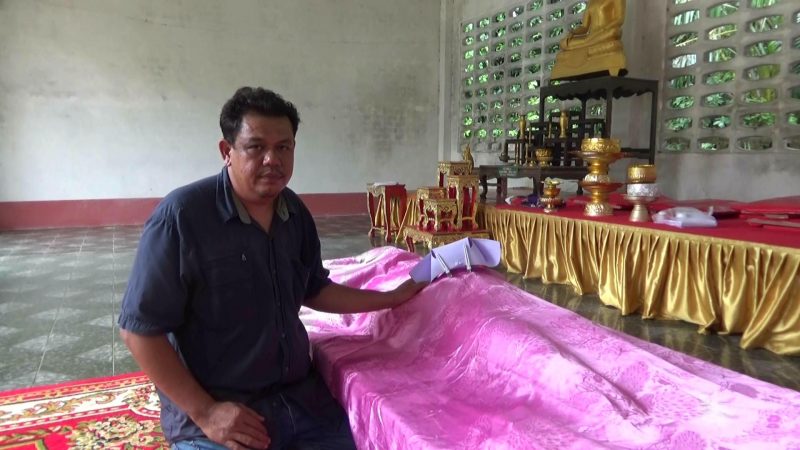
Wongsathit Kaenyuk with his wife Sumalee’s body Friday morning at Wat Khlong Muan.
IMG 4332 e1512122811338
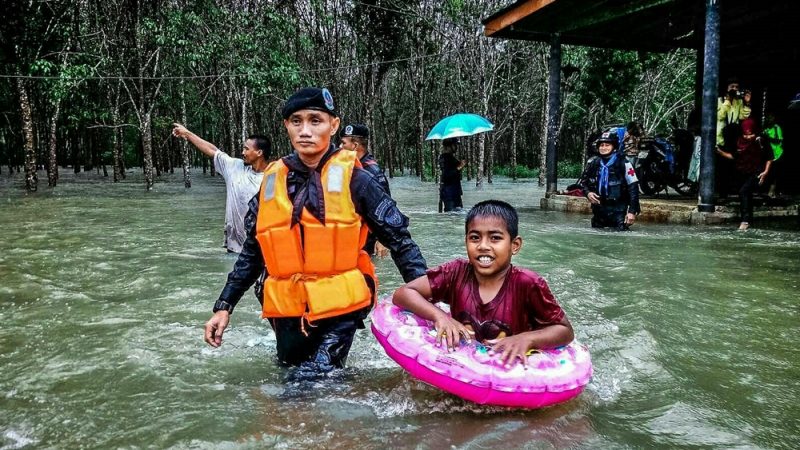
Soldiers evacuate residents Monday in Narathiwat.
DSC08003 1
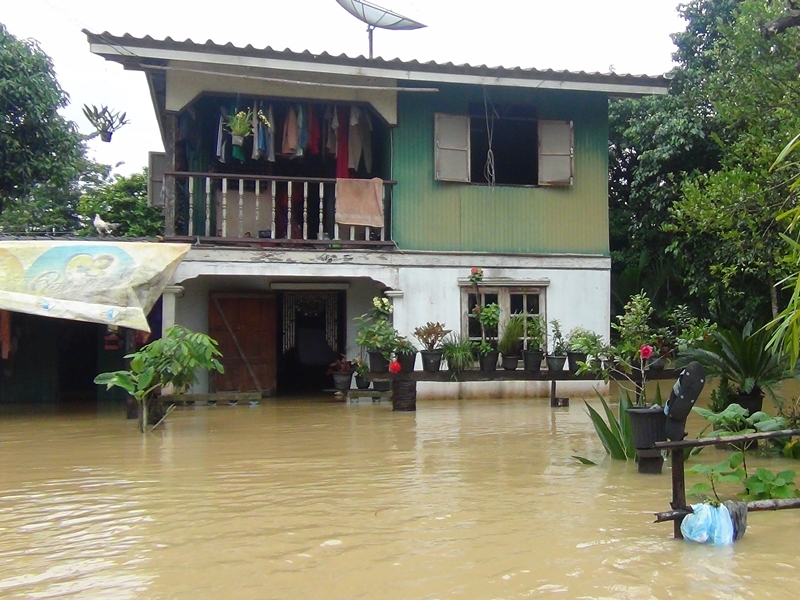
Flooding Tuesday in Yala.

Related stories:

Unchecked Development, Poor Planning Set Stage for Flood Crisis

Why Was Bangkok Not Warned of Flooding?

Advertisement

King Grants New Land For Zoo Move, Uniforms For Police

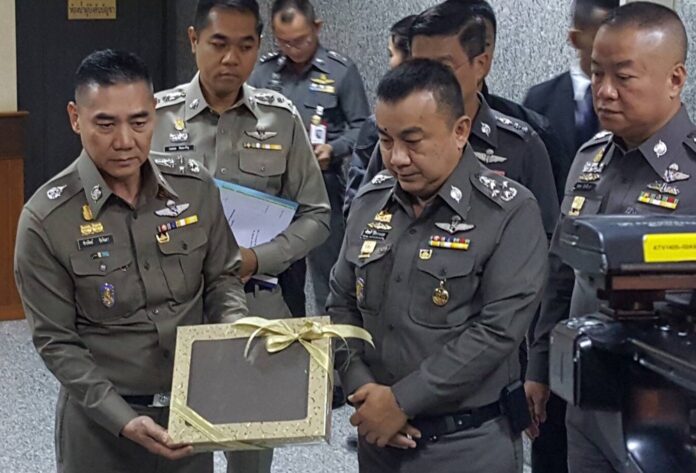
Police commissioner Chakthip Chaijinda shows reporters Friday a sample of a new khaki shade to be implemented in police uniform nationwide.

BANGKOK — On the orders of King Vajiralongkorn, police will be given new uniforms, and Bangkok’s oldest zoo will move to a larger space outside the city.

Police spokesman Krissana Pattanacharoen said Friday that a single khaki shade, officially called Sor Nor Wor 01, will be implemented across the police force to display a sense of unity. Currently, each unit uses their own shade of khaki despite regulations which call for a single color.

“Every police officer deeply appreciates it,” Col. Krissana said.

A sample fabric and color pattern was delivered to police commissioner Chakthip Chaijinda today from the palace.

A committee will be formed to design the final look of the new uniform. Gen. Chakthip will be the first to wear it “as an example,” Krissana said, adding that it’s not yet clear when the new attire will be implemented nationwide, or how much it will cost.

Dusit Zoo, a much-beloved weekend destination for many Bangkokians for generations, will move to a new home on land granted by King Vajiralongkorn, a zoo official said Friday. The current site sits next to the Ananda Samakhom Throne Hall, a royal estate belonging to the king and recently closed to the public.

The new zoo will be built in Pathum Thani province, north of Bangkok, and will be much larger than the original site, said the official, who asked to remain anonymous because the person is not authorized to speak to the media.

“His Majesty is very merciful,” the official said. The date of the move has not yet been finalized.

Since succeeding his late father and ascending to the throne in December 2016, King Vajiralongkorn has introduced a number of changes to the kingdom.

His reign has seen a new form of salute, new haircut regulations for the armed forces and transfers of agencies responsible for palace affairs to his direct control.

Advertisement

Kinokuniya Pulls Oxford Researcher’s Book on 2010 Bangkok Unrest

Community members and Redshirt supporters massed near an army cordion on May 14, 2010. Minutes later, a young soldier opened fire on the crowd, killing a civilian.

BANGKOK — One of Bangkok’s largest booksellers has quietly pulled a book about the 2010 political unrest without explanation.

“Owners of the Map,” a new book by an Oxford fellow whose study of Bangkok’s motorcycle taxis was overtaken by the tumultuous events of 2010, was recently removed from the virtual shelves of Kinokuniya, a Japanese bookseller with several branches in Bangkok.

Author Claudio Sopranzetti, who lived in Thailand several years to conduct his research, said he noticed Wednesday that Kinokuniya’s listing for the book, which has yet to find domestic distribution in Thailand, had vanished from the bookseller’s website.

“Three days ago it was available on the Kinokuniya’s website for purchase and then it suddenly disappeared, you cannot find it anymore now,” Sopranzetti wrote in a message.

Kinokuniya has declined to discuss the book’s removal. There was no response to repeated inquiries made in numerous calls placed Thursday and Friday. One representative said the book was “out of stock” and another denied any knowledge of its removal. Both declined to give their names.

An employee working in one of Kinokuniya’s stores said the book had specifically been mentioned by title recently in regular communications about problematic works. The employee, who asked not to be named, said staff were told to tell customers that it was unavailable due to “inappropriate content.”

Someone in Kinokuniya’s management team on Friday also declined to explain the title’s removal and warned a reporter to “think carefully” before naming Kinokuniya as the bookstore, saying there could be consequences including retaliation against its employees. She also declined to give her name.

Discretionary Censorship 

Sopranzetti said he understands that bookshops have the right to decide which products to sell but does not believe they should do so without explanation.

“They have all the right to decide they were not interested in the book in the first place, but they did post it on their website so this is not the case,” Sopranzetti said. “What is worrisome here is the attempt to make this go away silently, the quiet erasure of a book, and the clumsy denial of doing it.”

The manager of a Kinokuniya store in Japan said the company has a policy not to import certain books, such as those with obscene nudity or relating to religious cults.

“Sometimes staff members decide together which books should or should not be imported,” said Mikio Sunaki, manager of Kinokuniya’s Shibuya-ku branch in Tokyo. “But if it’s the law, we have to [follow] to protect ourselves.”

9780520288508 e1512115045483

Sunaki said he had no information about decisions made by Kinokuniya in Thailand. Any censorship policy, he said, should be consistent with the laws of the nation.

The book is still available on the bookseller’s US website.

A surge of state censorship in the wake of the 2014 coup saw a commensurate willingness to self-censor in the private sector.

Two weeks after the coup in June 2014, the Associated Press reported that Kinokuniya had “pulled from its shelves political titles that could be deemed controversial.”

Thailand has a long list of censoring and banning books, mostly because they contain monarchy-related content. In 2013, Asia Books withdrew two titles, “Nai Nai” and “Dream the Impossible Dream,” due to “sensitive content.” In 2014, police banned “A Kingdom in Crisis,” by Scottish former journalist Andrew M. Marshall.

Thailand’s largest English-language bookseller Asia Books doesn’t have “Owners of the Map” in stock but offers it to customers on special order.

Police Denial 

But Kinokuniya did not remove the book on any order, according to Thai authorities.

Orders to ban publications are issued by the intelligence wing of the police force known as the Special Branch Police. Deputy commander Chayapol Chatchaidet said his agency had not banned Sopranzetti’s work.

“It’s not in it,” Maj. Gen. Chayapol said, referring to their database of banned books after checking it for “Owners of the Map.”

More so, Chayapol said the agency only bans books or magazines after publication. It’s a bureaucratic process that involves review by an agency committee.

“Someone cannot unilaterally order a ban,” he added.

Sopranzetti said he does not believe there is much controversial content to his book, which he describes as “an academic analysis of migration, economy, and political struggle in the last ten years in Thailand, seen from the point of view of everyday people ….” but said he was “heartbroken” that it wouldn’t be available domestically.

“On a personal level, I spent the last decade learning Thai, studying the history of the country, doing interviews and dedicating myself to understand [sic] more Thailand and show the struggles, resilience, and strength of its people, seeing that fear – because of fear we are talking – will make the results impossible for people there to read it is heartbreaking.

As to the decision to remove the book, he can only speculate.

“I think [it] is no secret that the Thai monarchy has a different popular following now than it had twenty years ago,” he said. “A section of the book is about how this transformation happened and I think this is what worried them.”

Sopranzetti, who has been a contributor to Khaosod English, is a postdoctoral fellow at Oxford’s All Souls College. “Owners” is his second work based on experiences and observations of 2010 since “Red Journeys: Inside the Thai Red-Shirt Movement” was released in 2012.

Additional writing and reporting Todd Ruiz and Teeranai Charuvastra 

Advertisement

Hot News

LATEST NEWS

Bangkok
scattered clouds
30 ° C
31.6 °
30 °
81 %
2.4kmh
47 %
Fri
30 °
Sat
37 °
Sun
36 °
Mon
36 °
Tue
34 °