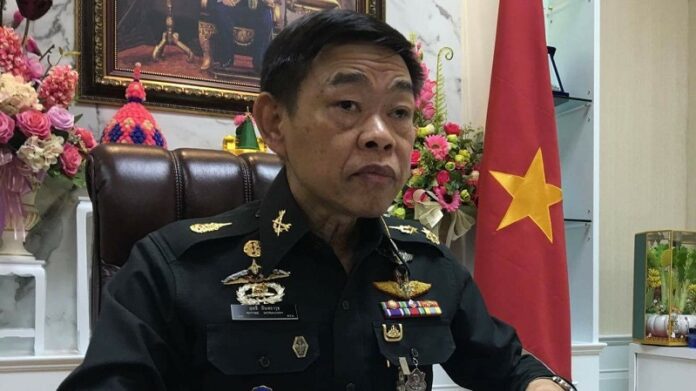
The director of Army Cyber Center, Maj. Gen. Rittee Intravudh in an undated file photo. Photo : Matichon
BANGKOK — Hacktivists posted online Tuesday documents they say contradict army denials it has purchased decryption devices that would allow access to encrypted computer traffic.
As cyber battles sparked by the passage of the new Computer Crime Act continue, online activist group Citizens Against Single Gateway on Monday posted screenshots purportedly obtained from an army procurement database. Listed among purchases were items used to crack the standard security protocols people use to access web servers securely.
“I can assure that there is no such equipment in the army’s procurement plan,” the director of Army Cyber Center, Maj. Gen. Rittee Intravudh, said in response Monday. “This issue can be looked into. Because no organization under the army has any reason to use such a device.”
SSL or Secure Sockets Layer is the standard protocol widely used to encrypt data between a user’s browser and web server to ensure privacy. In 2013 it came to light that the U.S. NSA had developed a means to defeat SSL.
Rittee said the information was distorted by the opposition in order to attack the army. He said he had no idea where the images came from.
Online activists have been bringing government, police and military sites down in protest of the new Computer Crime Act since it was approved unanimously on Dec.16. They also posted some pictures they claimed prove they are able to penetrate government systems.
On Monday Deputy Prime Minister Prawit Wongsuwan said nine people were detained for hacking government websites, but only a 19-year-old man was handed over to police. No details were given about the other eight detainees.
Responding to the Rittee’s dismissive response, the group posted on Tuesday another document showing the Ministry of Information and Communication Technology formed a committee in 2014 to monitor online media. It was also tasked to test decryption systems to find the best one for use.
In 2015 the Thai army and police were found to be customers of a surveillance malware and intrusion system designed by a vendor called Hacking Team in order to get into private mobile phone and computer systems, according to the document obtained by WikiLeaks.
The military regime says it has no intention of trampling rights and needs better tools to fight cyber crimes, most significantly, cases of royal defamation. It was also used these powers to prosecute its persistent critics.
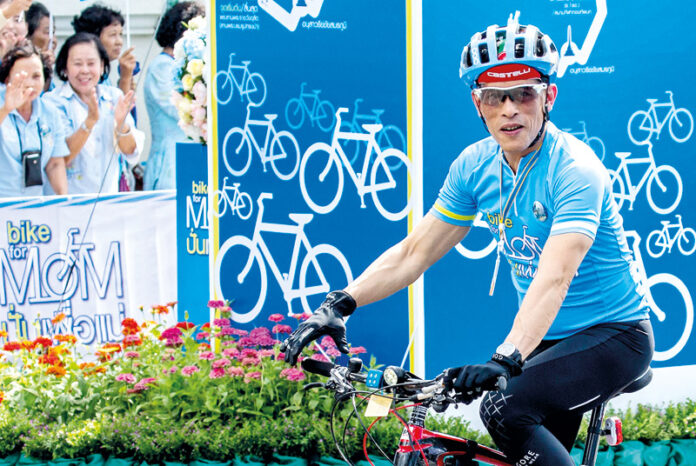
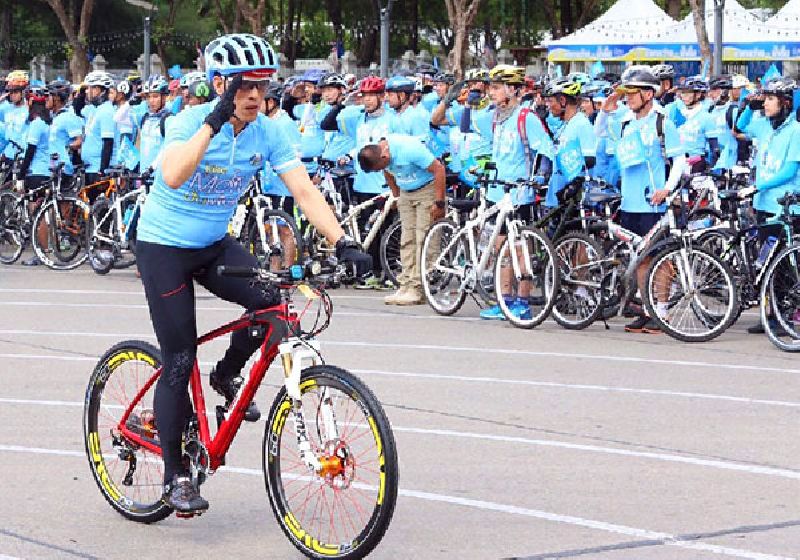
Crown Prince Vajiralongkorn rides a bicycle on Aug. 16, 2015, during a cycling event in Bangkok dedicated to his mother Queen Sirikit.
No one wants to read internet Top 10 lists anymore, so here’s an innovative look back at 2016’s biggest moments with lists of varying lengths.
People’s Choice: 11 Most-Read Stories
Real-world democracy had another rough year, but it thrived online with all the things to click. For better or worse, here are the stories you wanted to read the most.
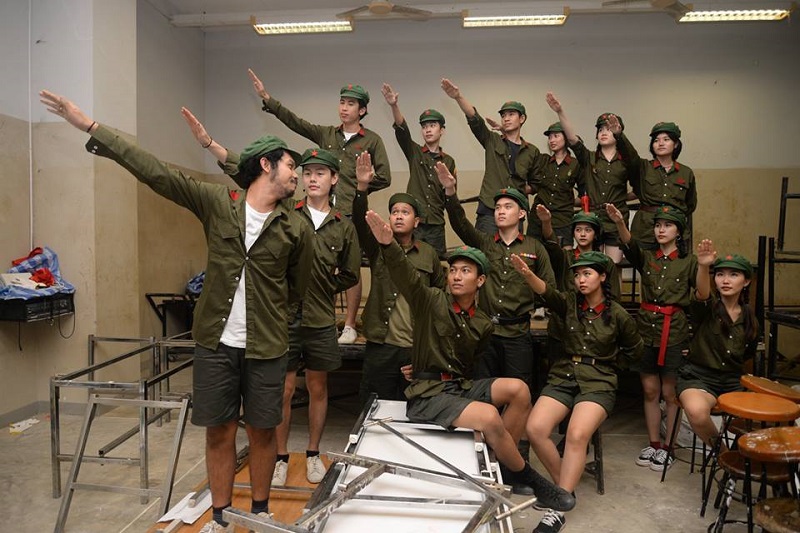
Silpakorn University students in Bangkok dress recently as Mao Zedong’s Red Guards from the bloody Cultural Revolution in the 1960s. Photo: Washirawit Santipiboon / Facebook
Were the internet less democratic, it would be less clogged with kitten videos and one weird tricks. Here are a few of the stories we knew wouldn’t win the most clicks but still needed to be told.
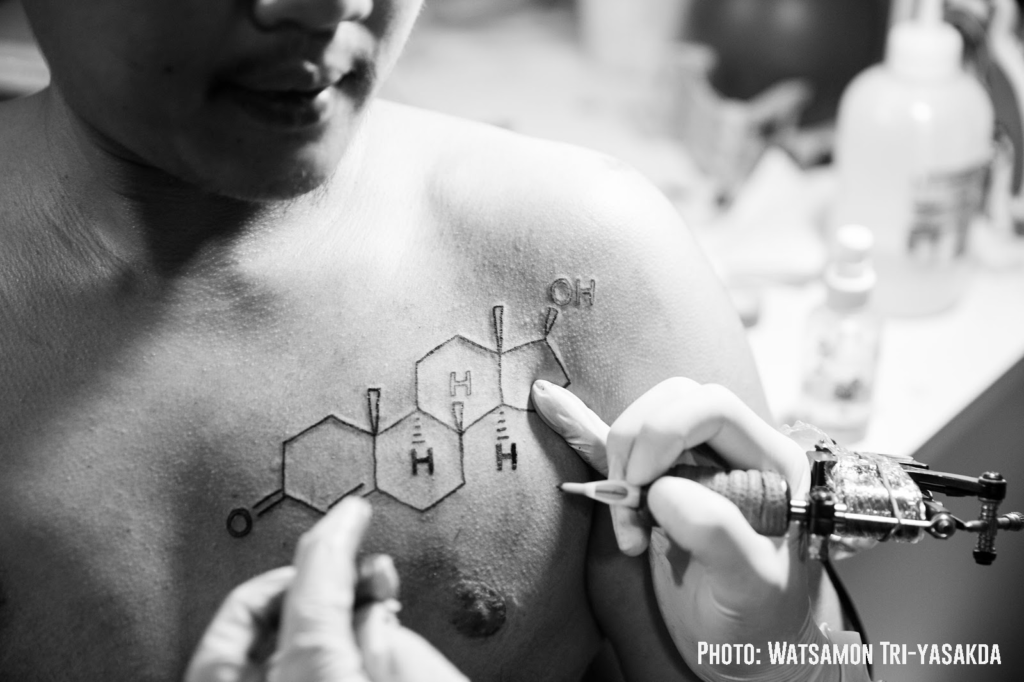
Kanattsanan ‘Mukk’ Dokput receives a tattoo in February representing the testosterone molecule to signify his transition to a male identity. Photo: Watsamon Tri-yasakda
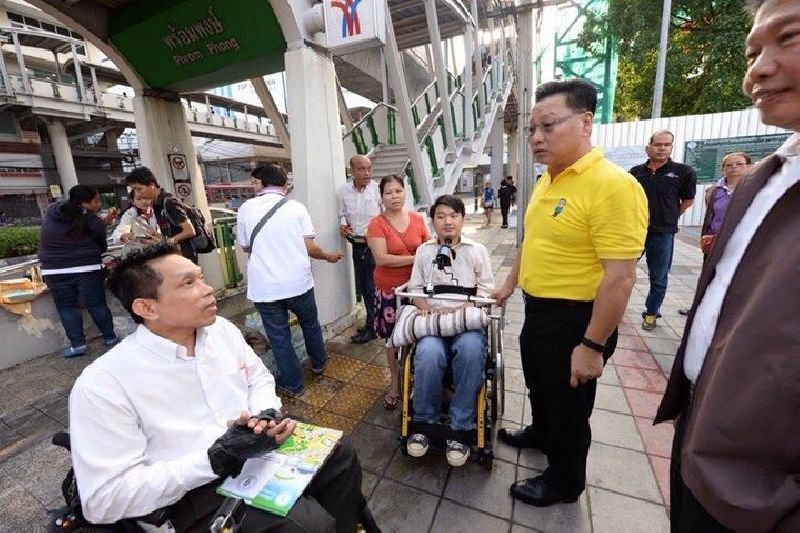
Disabled rights activist Manit Inpim, who spearheaded efforts to make the rail system accessible with Transportation for All, talks to Deputy Bangkok Gov. Amorn Kijchawengkul on Jan. 21 at BTS Phrom Phong in Bangkok.
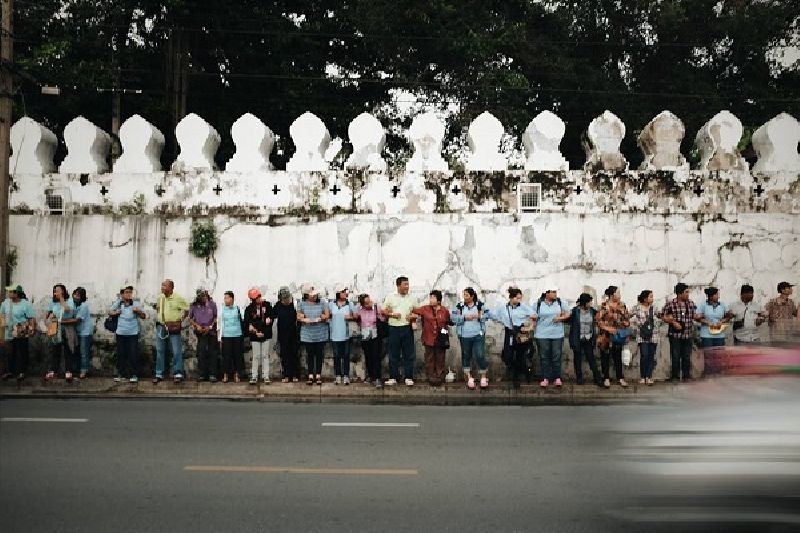
Members of the Pom Mahakan community and their supporters lock arms together Sunday in a symbolic show of opposition to eviction by the city. Photo: Matichon
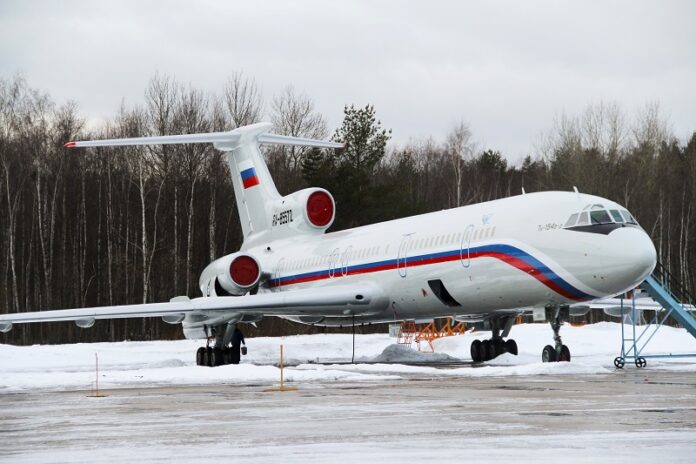
This photo taken in 2015 shows the Tu-154 plane with registration number RA-85572 at Chkalovsky military airport near Moscow, Russia. Photo: Dmitry Petrochenko / Associated Press
MOSCOW — Russia’s defense ministry says rescue teams have found a flight recorder from the plane that crashed into the Black Sea over the weekend.
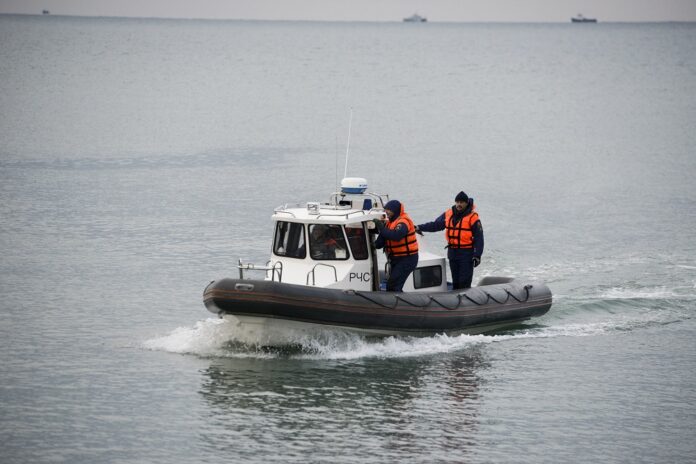
The ministry said in a statement that the flight recorder was found a mile from the shore early Tuesday morning. State television showed footage of rescue workers on an inflatable boat carrying a container with a bright orange object covered in water.
All 92 people aboard the Russian military’s Tu-154 plane are believed to have died Sunday morning when it crashed two minutes after taking off from the southern Russian city of Sochi.
The 84 passengers included dozens of singers from Russia’s world-famous military choir who were going to Russia’s base in Syria to perform at a New Year’s concert.
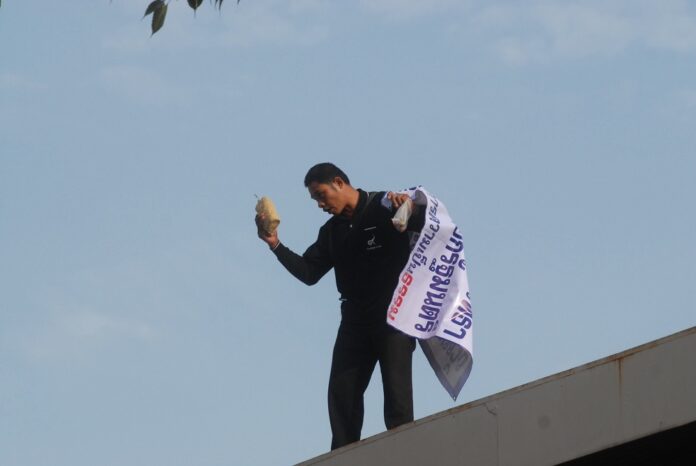
Chalerm Sornnonthee stands atop a bank near the Government House, wielding what police would later say was in fact not a large bomb on Tuesday in Bangkok.
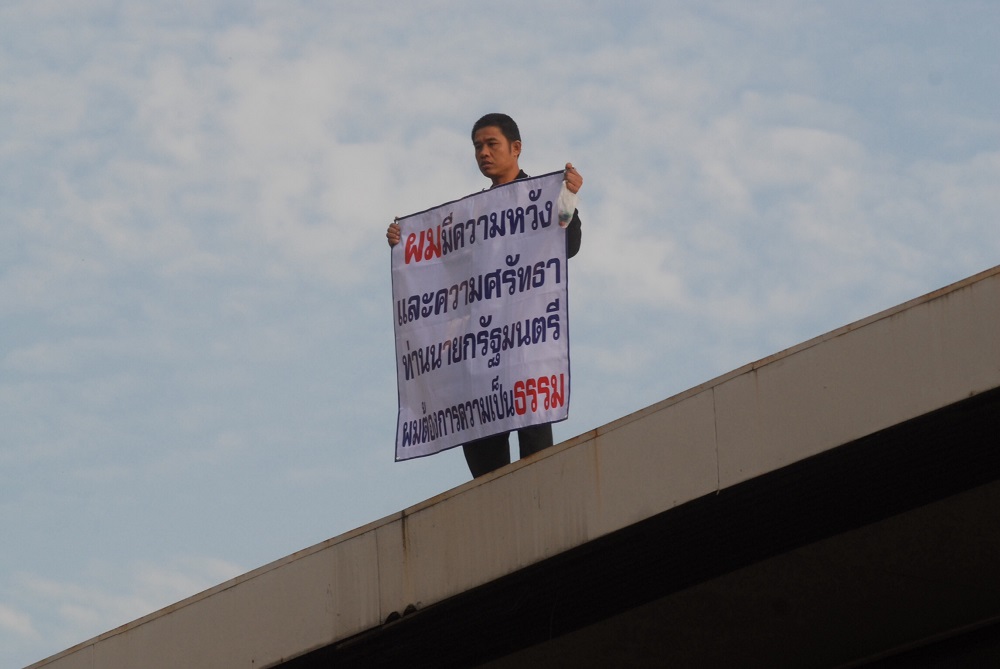
BANGKOK — A man climbed a structure near the Government House on Tuesday morning, armed with ping pong bombs and a sign demanding justice from Prime Minister Prayuth Chan-Ocha.
Chalerm Sornnonthee, 43 of Nan province, allegedly threw several ping pong bombs from atop the Government Savings Bank branch toward the regime’s seat of power, apparently to seek help with a financial problem. Police said it was his third such stunt.
“Do you know what’s going on, you higher-ups? Do you know?” he is heard screaming in a video of this morning’s incident.
Chalerm also reportedly waved around what he said was a large bomb before putting it back in his bag. An official eventually talked Chalern down from the roof at which point he was taken into custody.
“I have hope and faith in the prime minister. I need justice,” read his banner.
Chalerm was reportedly asking for Gen. Prayuth’s help with a debt he felt was unfair. As of noon, Lt. Col. Juk Jukkarat of Dusit police said they were still investigating and had yet to charge Chalerm.
The large “bomb” was not real, he added.
“It’s not a real bomb or a flare,” he said. “It’s just an item shaped like a bomb.”
Chalerm had previously come to protest at the Government House twice before, climbing a fence onto the roof of a security office in April 2015 to demand investigation of a water project in Nan province. A few months later in October 2015 he poured oil on himself and threatened self-immolation to demand another investigation.
He went home after government officials told him they would investigate.
Ministry of Emergency Situations employees search for bodies by a boat in the Black Sea, off Sochi, Russia, Monday. Photo: Viktor Klyushin / Associated Press
SOCHI — The Kremlin on Monday played down the possibility that a terror attack might have downed a Syria-bound Russian plane, killing all 92 people on board, as the nation observed a day of mourning for the victims, including most members of a world famous military choir.
The Tu-154 owned by the Russian Defense Ministry crashed into the Black Sea early Sunday two minutes after taking off in good weather from the city of Sochi. The plane was carrying members of the Alexandrov Ensemble, often referred to as the Red Army Choir, to a New Year’s concert at a Russian military base in Syria.
About 3,500 people, 43 ships and 182 divers have been sweeping a vast crash site for bodies of the victims and debris, and dozens of drones and several submersibles also have been involved in the search. Rescue teams so far have recovered 11 bodies and numerous body fragments, which have been flown to Moscow for identification.
Divers have located parts of the plane’s fuselage and other fragments, but the search for the jet’s flight recorders will likely prove challenging as they lack underwater locator beacons for easy spotting common in more modern planes.
Officials sought to squelch speculation that the crash might have been caused by a bomb planted on board or a portable air defense missile.
But some aviation experts pointed that the crew’s failure to communicate any technical problem and a large area over which fragments of the plane were scattered point at a possible explosion on board.
Evidence of a bombing of a Syria-bound military flight would badly embarrass the Kremlin, highlighting Russia’s extreme vulnerability to attacks even as it boasts its success in Syria after Aleppo fell into President Bashar Assad’s hands.
President Vladimir Putin’s spokesman, Dmitry Peskov, told reporters that an attack isn’t a likely scenario. Transport Minister Maxim Sokolov, who oversaw the rescue efforts, said investigators were looking into a possible technical fault or pilot error as the most likely reasons behind the crash.
But some experts remained skeptical, noting that the crew would have reported any technical glitch.
“Possible malfunctions … certainly wouldn’t have prevented the crew from reporting them,” Vitaly Andreyev, a former senior Russian air traffic controller, told RIA Novosti, adding that an “external impact” was the most likely reason.
Russia’s main domestic security and counter-terrorism agency, the FSB, said it has found “no indications or facts pointing at the possibility of a terror attack or an act of sabotage on board the plane.”
The plane departed from the Chkalovsky military airport just outside Moscow and stopped in Sochi for refueling early Sunday. The FSB said border guards and military servicemen were protecting the plane as it sat on the tarmac in Sochi, and the chief pilot along with the flight engineer personally monitored the refueling. The agency said that a border guard officer and a customs official were the only ones to briefly come on board in Sochi.
Some Russian media pointed at lax security at Chkalovsky outside Moscow where the plane was based, saying that it’s quite porous compared to civilian airports.
Alexander Gusak, a former chief of the FSB special forces unit, also hinted at security breaches at Chkalovsky and said that even a much more secure Sochi airport could be vulnerable.
“It’s possible to penetrate any facility. It depends on your skills,” Gusak told Dozhd TV.
Russian planes have been brought down previously in terror attacks.
In October 2015, a Russian passenger plane was brought down by a bomb over Egypt, killing all 224 people aboard. Officials said the explosive device was planted in the plane’s luggage compartment. A local affiliate of the Islamic State group claimed responsibility.
In August 2004, two Russian planes were blown up on the same day by suicide bombers, killing 89 people. A Chechen warlord claimed responsibility for the twin attacks, which were made possible by lax security at a Moscow airport.
While ruling out an attack in Sunday’s crash, the FSB said that investigators are looking into bad fuel, pilot error, alien objects stuck in the engines or equipment failure.
John Goglia, a former U.S. National Transportation Safety Board member and aviation safety expert, argued that while pilot error or bad fuel “would be high on my list,” they wouldn’t have prevented the pilot from alerting traffic controllers to the situation. He also noted that the Tu-154 has been “a pretty reliable platform.”
The Tu-154 is a Soviet-built three-engine airliner designed in the late 1960s. The plane that crashed Sunday was built in 1983, and underwent factory check-ups and maintenance in 2014 as well as earlier this year.
While the Tu-154 is no longer used by Russian airlines because it’s too noisy and fuel-hungry, the Russian military has continued to operate it. The plane has been popular with crews who appreciate its maneuverability and ruggedness.
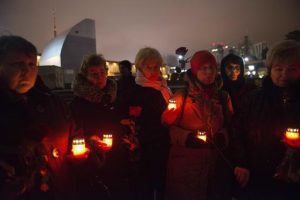
People light candles in memory of victims of the crashed plane in the center of Sochi, Russia, Sunday.
Flags were at half-staff across Russia on Monday, nationwide television stations canceled their entertainment programs and the Cabinet began its session with a moment of silence as part of the nationwide mourning. People piled up red and white carnations outside the Moscow office of the Alexandrov Ensemble, popular across the world for its fiery performances.
Vadim Ananyev, a soloist who stayed home with his family, said he was devastated.
“I have lost my friends and colleagues, all killed, all five soloists,” Ananyev told The Associated Press. “I have known these people for 30 years. I know their wives and children. I feel terrible for the children and for all that I have lost.”
Ananyev said he had received condolences from all over Russia and from abroad.
“We were loved all over the world, never mind the political situation,” he said.
In Rome, Pope Francis led thousands of faithful in silent prayer for the plane crash victims and noted that the Russian army choir had performed in 2004 at the Vatican.
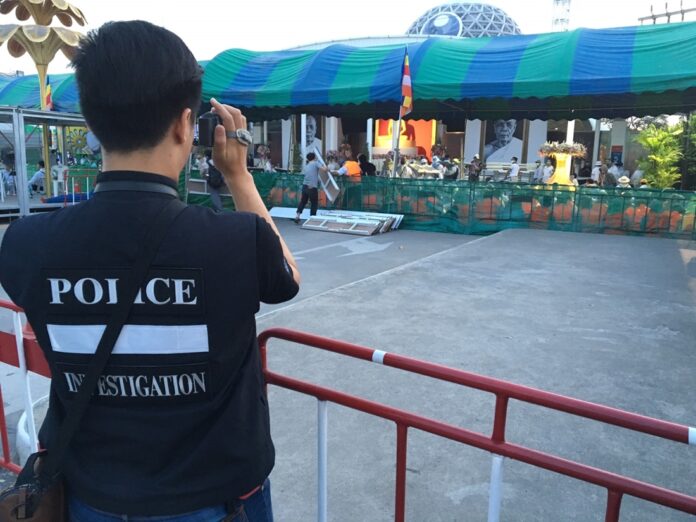
A policeman on Tuesday morning films supporters of Wat Dhammakaya inside tents and barricades at a gate of their temple complex.
PATHUM THANI — Police began Tuesday morning clearing barricades blocking the entrance to the Wat Dhammakaya complex where they seek to arrest its abbot, who’s accused of multi-million baht embezzlement.
Security forces have maintained a presence outside the large temple campus since June, when the 72-year-old Dhammachayo was charged with receiving donations that authorities said were money embezzled from a credit union. However, the official in charge of the investigation declined to say whether today’s operation would culminate in raiding the temple and finding the abbot.
Police will assess the situation and decide whether to enter Wat Dhammakaya, said Paisit Wongmuang, director of the Department of Special Investigation, or DSI.
Police spokesman Krissana Pattanacharoen said their priority is dismantling tents and barricades erected in front of the main gate to the temple complex.
“We are enforcing the law step by step,” Col. Krissana said. “What can be done for now, we do it.”
At the time of writing, police are said to be negotiating with the temple administration about the removal.
Dhammachayo is accused of receiving as donation some of 1.2 billion baht embezzlement from a credit union by its own executive, who is now serving a 16-year prison term. In November he was charged again with land encroachment for building a religious facility without a permit in Khao Yai National Park.
Through various representatives, the temple has said it believes the charges are politically motivated, and that Dhammachayo would not receive a fair trial in the courts.
Police have been unable to take him into custody because thousands of acolytes have gathered to defend the temple. Dhammachayo was last seen in public in May but is believed to remain inside. His aides maintained the abbot did not know the donations were tainted and was too ill to meet with police.
Although police officers have been posted about the temple for months, they have made no effort to stop people from entering or leaving the complex. Government leaders also said they have refrained from taking a tougher action against the sect because they want to avoid bloodshed.
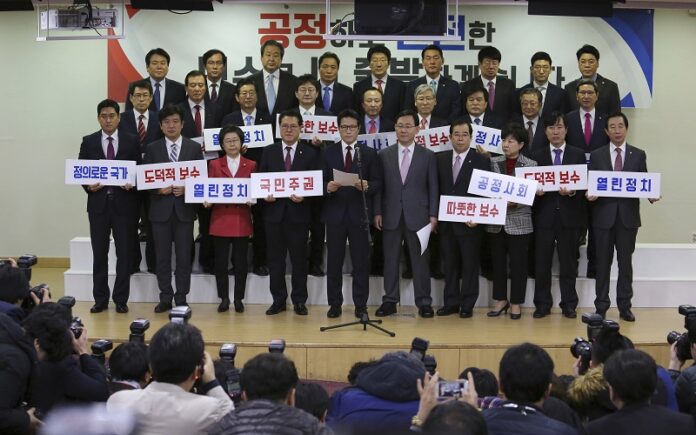
A group of lawmakers of the ruling Saenuri Party attends a press conference to announce to leave the party on Tuesday at the National Assembly in Seoul, South Korea. Photo: Ahn Young-joon / Associated Press
SEOUL, South Korea — Dozens of lawmakers split from South Korea’s ruling party Tuesday over the corruption scandal involving impeached President Park Geun-hye in a move that could shape presidential elections that might take place in just months.
The 29 anti-Park lawmakers who left the Saenuri Party planned to create a new conservative party that will likely try to lure outgoing United Nations Secretary-General Ban Ki-moon as its presidential candidate. There’s a possibility of more lawmakers leaving Saenuri in coming weeks over rifts with Park loyalists who continue to occupy the party’s leadership.
Choung Byoung-gug, one of the lawmakers who left Saenuri, accused the loyalists of “neglecting the values of real conservatism” and “shamelessly defending the infringement of constitutional values” as they continued to support the scandal-hit president.
The split came as investigators widened their inquiry into the scandal surrounding Park, who has been accused of colluding with a longtime confidante to extort money and favors from the country’s biggest companies, and to allow the friend to manipulate government affairs.
The team led by special prosecutor Park Young-soo was planning to summon the president’s jailed friend, Choi Soon-sil, on Tuesday afternoon, following their first interrogation of her on Saturday.
Ban is seen as the best hope for conservatives to win back the Blue House after Park’s collapse complicated politics for her party. Recent opinion polls put Ban slightly ahead of liberal politician Moon Jae-in, who conceded the presidential race to Park four years ago, as the favorite to win a presidential vote.
In a recent meeting with South Korean reporters in New York, Ban said he was ready to “burn” his body in devotion for South Korea, his strongest hint yet that he would run for president.
South Korea’s opposition-controlled parliament voted on Dec. 9 to impeach Park over the scandal that saw millions of people protest in recent weeks.
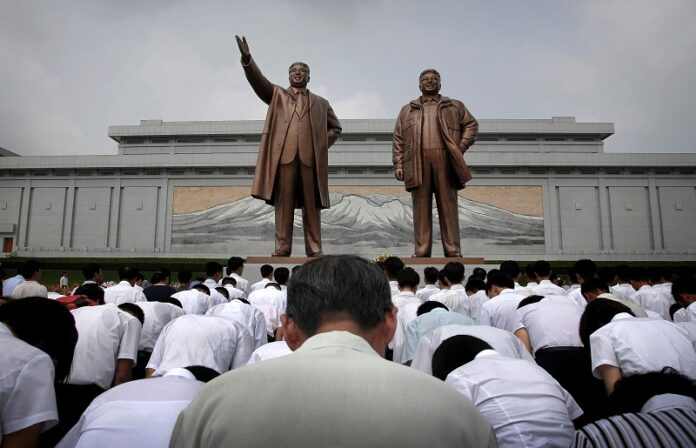
North Koreans in a 2015 photo file bow in front of bronze statues of the late leaders Kim Il Sung, left, and Kim Jong Il at Munsu Hill in Pyongyang, North Korea. Photo: Wong Maye-E / Associated Press
PYONGYANG, North Korea — With somewhere around 4,000 artists and staff, the Mansudae Art Studio, a huge complex of nondescript concrete buildings on a sprawling, walled-off campus with armed guards in the heart of Pyongyang, churns out everything from watercolor tigers to mosaics so large they seem to depict a race from another, taller planet.
But its statues — the really big, bronze, monumental ones on foreign shores — are what appear to have caught the attention of the U.N. Security Council.
In one of the odder items on the list of things North Korea can’t export under United Nations’ sanctions, statues were explicitly listed for the first time last month when the Security Council approved a raft of punishments in response to Pyongyang’s latest nuclear test, which it conducted in September.
To those familiar with the North’s exports, the move to ban statue sales wasn’t entirely a surprise. It’s one of the few things other than coal and natural resources, exports of which were also heavily restricted under the new sanctions, that North Korea can still find a market for abroad.
Moreover, sanctions advocates and proponents of isolating Pyongyang for its nuclear program believe Mansudae, and particularly its export arm, Mansudae Overseas Projects, is being used to quietly maintain, expand or obfuscate the nature of its relations with other countries.
Africa has traditionally been Mansudae’s prime export market — it’s sold to 17 African countries, ranging from Angola to Zimbabwe.
Pyongyang began exporting statues to Africa in the late 1960s, when a wave of independence movements created a new market of ideologically friendly leaders in search of grand symbols to bolster national identity and claims of political legitimacy. North Korea, looking to expand its diplomatic ties vis a vis rival Seoul, initially provided the works for free. It only started selling them from about 2000.
Business hasn’t exactly been booming.
In July, Namibia terminated the services of Mansudae Overseas Projects after U.N. monitors claimed it was involved in several military construction projects. Namibia had been a regular Mansudae customer, including the project to build its State House, which was completed in 2008.
But, on the bright side for Pyongyang, last December a $24 million museum with a huge indoor historical panorama built, designed and largely funded by Mansudae was opened near Cambodia’s ancient Angkor Wat temple complex. Unlike other projects by Mansudae abroad, it will collect proceeds from entry fees for the museum’s first 10 years of operations, or until it has recouped its investment. The museum hasn’t drawn many tourists.
The U.N. statue sanctions won’t likely hurt North Korea’s coffers much.
The North’s total income from selling statues abroad has been estimated at about $160 million, or only about $10 million a year. That’s compared with the estimated impact of the new restrictions on coal exports, which the U.S. has said could cost Pyongyang as much as $700 million.
Even so, it’s a slap at one of North Korea’s most venerable cultural institutions.
Mansudae was created in 1959 by Kim Il Sung himself. It has generated an estimated 38,000 statues and 170,000 other monuments for domestic use and, according to the website of its overseas representative office, it is divided in 13 creative groups, seven manufacturing plants and has more than 50 supply departments.
“The vast majority of the major art works of the country have been realized by Mansudae Art Studio artists,” the website says. “Their ages go from mid 20s to mid-60s and almost all are graduates of the very demanding Pyongyang University. Over half of the Merit Artists and of the People’s Artists, the two highest awards an artist can receive in DPRK, are or have been associated with the Mansudae Art Studio.”
And, sanctions notwithstanding, they appear to be as busy as ever.
Statues, mosaics or paintings of “eternal president” Kim Il Sung and his son, “dear leader” Kim Jong Il, grace virtually every large plaza, village center, significant factory and meaningful nook or cranny in the country.
At the order of North Korea’s third leader in the Kim dynasty, Kim Jong Un, the studio rushed this year to make sure every province had a Kim Jong Il statue to stand beside his father.
Kim Jong Un is not yet the object of similar immortalizations or of the pins that all adult North Koreans wear over their hearts.
Mansudae officials say the young Kim is “much too humble of personality for that.”
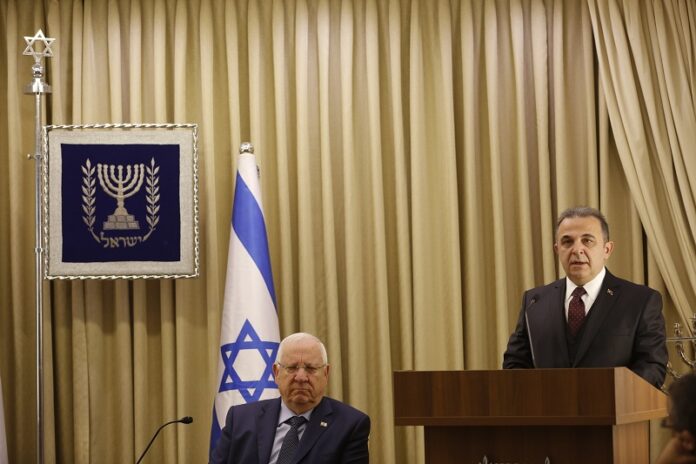
Turkish ambassador to Israel Kemal Okem, right, speaks next to Israeli President Reuven Rivlin during a ceremony to present his diplomatic credentials, Dec. 12 at the president's official residence in Jerusalem. Photo: Ronen Zvulun / Associated Press
JERUSALEM — A fake news story has touched off a tense Twitter confrontation between nuclear power Pakistan and Israel, widely believed to have a nuclear arsenal of its own, in an episode that underlines the potentially harmful impact of such stories in sensitive global affairs
In an apparent response to a fake story claiming Israel’s former defense minister threatened a nuclear attack against Pakistan if it sends troops to Syria, Pakistan’s Defense Minister Khawaja Mohammad Asif reminded Israel that “Pakistan is a nuclear state too.”
Israel’s Defense Ministry tweeted back Saturday, saying the original story on the site AWD News was “totally fictitious.”
AWD has been identified by fact-checking organizations as a fake news site.
Israel maintains a policy of nuclear ambiguity, neither confirming nor denying the existence of an arsenal. Pakistan became a nuclear power in 1998. The countries have no diplomatic ties.
There was no immediate reaction from Pakistan to Israel’s response.
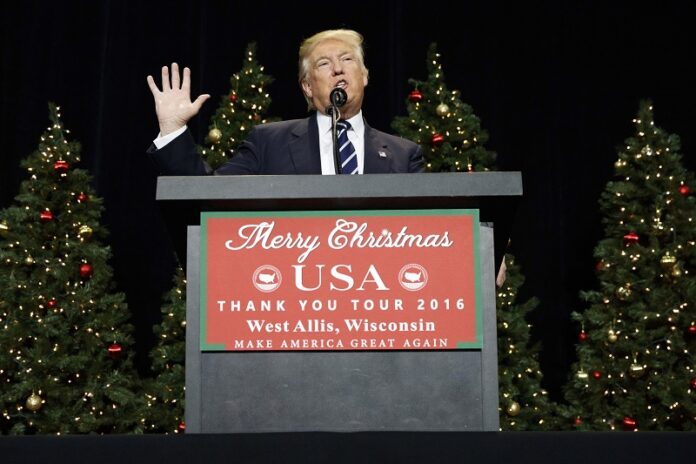
President-elect Donald Trump speaks Dec. 13 during a rally at the Wisconsin State Fair Exposition Center in West Allis, Wisconsin. Photo: Evan Vucci / Associated Press
WASHINGTON — Donald Trump spent the past two years attacking rival Hillary Clinton as crooked, corrupt, and weak.
But some of those attacks seem to have already slipped into the history books.
From installing Wall Street executives in his Cabinet to avoiding news conferences, the president-elect is adopting some of the same behavior for which he criticized Clinton during their fiery presidential campaign.
Here’s a look at what Trump said then – and what he’s doing now:
Goldman Sachs
Then: “I know the guys at Goldman Sachs,” Trump said at a South Carolina rally in February, when he was locked in a fierce primary battle with Texas Sen. Ted Cruz. “They have total, total control over him. Just like they have total control over Hillary Clinton.”
Now: A number of former employees of the Wall Street bank will pay a key role in crafting Trump’s economic policy. He’s tapped Goldman Sachs president Gary Cohn to lead the White House National Economic Council. Steven Mnuchin, the Treasury secretary nominee, spent 17 years working at Goldman Sachs and Steve Bannon, Trump’s chief strategist and senior counselor, started his career as an investment banker at the firm.
Trump is following in a long political tradition, though one he derided on the campaign trail: If Cohn accepts the nomination, he’ll be the third Goldman executive to run the NEC.
Big Donors
Then: “Crooked Hillary. Look, can you imagine another four years of the Clintons? Seriously. It’s time to move on. And she’s totally controlled by Wall Street and all these people that gave her millions,” Trump said at a May rally in Lynden, Washington.
Now: Trump has stocked his Cabinet with six top donors – far more than any recent White House. “I want people that made a fortune. Because now they’re negotiating with you, OK?” Trump said, in a December 9 speech in Des Moines.
The biggest giver? Incoming small business administrator Linda McMahon gave $7.5 million to a super PAC backing Trump, more than a third of the money collected by the political action committee.
News Conferences
Then: “She doesn’t do news conferences, because she can’t,” Trump said at an August rally in Ashburn, Virginia. “She’s so dishonest she doesn’t want people peppering her with questions.”
Now: Trump opened his last news conference on July 27, saying: “You know, I put myself through your news conferences often, not that it’s fun.”
He hasn’t held one since.
Trump skipped the news conference a president-elect typically gives after winning the White House. Instead, he released a YouTube video of under three minutes. He also recently abruptly canceled plans to hold his first post-election news conference, opting instead to describe his plans for managing his businesses in tweets. “I will hold a press conference in the near future to discuss the business, Cabinet picks and all other topics of interest. Busy times!” he tweeted in mid-December.
Family Ties
Then: “It is impossible to figure out where the Clinton Foundation ends and the State Department begins. It is now abundantly clear that the Clintons set up a business to profit from public office. They sold access and specific actions by and really for I guess the making of large amounts of money,” Trump said at an August rally in Austin.
Now: While Trump has promised to separate himself from his businesses, there is plenty of overlap between his enterprises and his immediate family. His companies will be run by his sons, Donald Jr and Eric. And his daughter, Ivanka, and son-in-law, Jared Kushner, have joined Trump at a number of meetings with world leaders of countries where the family has financial interests.
In a financial disclosure he was required to file during the campaign, Trump listed stakes in about 500 companies in at least 25 countries.
Ivanka, in particular, has been caught making early efforts to leverage her father’s new position into profits. After an interview with the family appeared on “60 Minutes,” her jewelry company, Ivanka Trump Fine Jewelry, blasted out an email promoting the $10,800 gold bangle bracelet that she had worn during the appearance. The company later said they were “proactively discussing new policies and procedures.”
Ivanka is also auctioning off a private coffee meeting with her to benefit her brother’s foundation. The meeting is valued at $50,000, with the current top bid coming in at $25,000.
“United States Secret Service will be Present for the Duration of the Experience,” warns the auction site.
Trump on Saturday said he would dissolve his charitable foundation amid efforts to eliminate any conflicts of interest before he takes office next month.
Clinton Investigations
Then: “If I win, I am going to instruct my attorney general to get a special prosecutor to look into your situation, because there has never been so many lies, so much deception. There has never been anything like it, and we’re going to have a special prosecutor,” Trump said in the October presidential debate.
Now: Since winning office, Trump has said he has no intention of pushing for an investigation into Clinton’s use of a private email server as secretary of state or the workings of her family foundation. “It’s just not something that I feel very strongly about,” he told the New York Times.
“She went through a lot. And suffered greatly in many different ways,” he said. “I’m not looking to hurt them.”