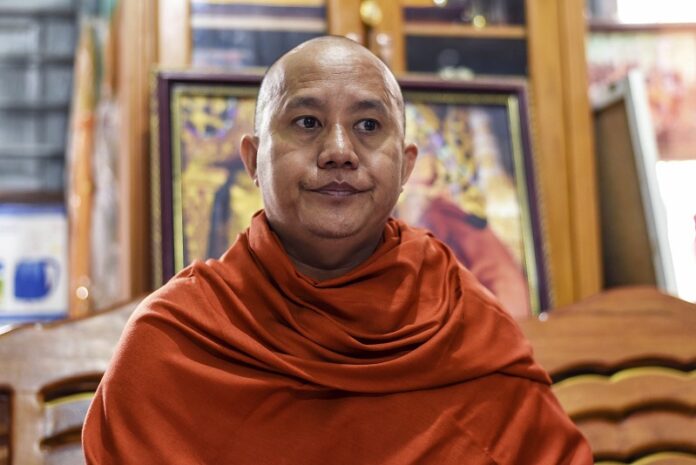
Ashin Wirathu, a high-profile leader of the Myanmar Buddhist organization known as Ma Ba Tha, is interviewed last year at his monastery in Mandalay, Myanmar. Photo: Aung Naing Soe / Associated Press
MANDALAY, Myanmar — Shunned by Myanmar’s new government and its Buddhist hierarchy, a nationalist monk blamed for whipping up at times bloody anti-Muslim fervor said he feels vindicated by U.S. voters who elected Donald Trump to be president.
Ashin Wirathu, a high-profile leader of the Myanmar Buddhist organization known as Ma Ba Tha, drew parallels between his views on Islam and those of the Republican president-elect. Trump’s campaign was rife with anti-Muslim rhetoric and proposals that included banning Muslims from entering the country and heightening surveillance of mosques. The form his actual policies will take remains unclear.
“We were blamed by the world, but we are just protecting our people and country,” Wirathu said. “… The world singled us out as narrow-minded. But as people from the country that is the grandfather of democracy and human rights elected Donald Trump, who is similar to me in prioritizing nationalism, there will be less finger-pointing from the international community.”
He even floated the idea of cooperating with nationalist groups in the U.S.
“In America, there can be organizations like us who are protecting against the dangers of Islamization. Those organizations can come to organizations in Myanmar to get suggestions or discuss,” he said in an interview at his monastery in Mandalay on Nov. 12.
“Myanmar doesn’t really need to get suggestions from other countries. But they can get ideas from Myanmar.”
Wirathu has been accused of inciting violence with hate-filled, anti-Islamic rhetoric in this Southeast Asian, Buddhist-majority country of about 55 million. Buddhist-led riots left more than 200 people dead in 2012 and forced hundreds of thousands more to flee their homes, most of them Muslim Rohingya in Rakhine state.
Anti-Rohingya sentiment remains high in Myanmar. Members of the ethnic group are widely considered to have immigrated illegally from nearby Bangladesh, though many Rohingya families have lived in Myanmar for generations.
At the same time, Wirathu’s influence has weakened in the past year. He threw his support behind the military-backed government ahead of elections in November 2015, only to see the former ruling party fall to Aung San Suu Kyi’s National League for Democracy in a landslide.
In July, a senior NLD official in Yangon said that Ma Ba Tha, also known as the Committee to Protect Race and Religion, was not needed. Calls for the official to be disciplined went unanswered. In the same month, the country’s official Buddhist clergy publicly distanced itself from the group.
“Ma Ba Tha fades with barely a whimper,” read a headline in the English-language Myanmar Times in August.
Wirathu said he has no plans of fading into obscurity.
“This government doesn’t want our Ma Ba Tha,” he said, seated behind a desk in a saffron robe as several aides took photos and video of his pronouncements. But the NLD’s attempt to thwart the group will be “hard for them,” he added, as Ma Ba Tha is not breaking any laws.
“Currently, we are waiting and looking at the situation as this government has only been here a short time and they don’t know how to manage,” he said. “So we are not doing anything like campaigning or protesting to impact the government. But we will hold meetings, issue statements, help in our role.”
For example, he said, his members have been distributing food in northern Rakhine state.
Scores of Rohingya and some Myanmar troops have been killed in northern Rakhine since suspected militants attacked border posts last month, killing nine police officers. Rohingya activists say innocent villagers are being killed, but the government says it is only fighting “violent attackers.” International media and aid groups have been kept away.
This image released by Warner Bros. Entertainment shows Eddie Redmayne, left, and Katherine Waterston in a scene from, "Fantastic Beasts and Where to Find Them." (Jaap Buitendijk/Warner Bros. via AP)
Xenophobia. Prejudice. Oppression.
Who’s up for a little escapism at the multiplex?
J.K. Rowling, embarking on her new, post-Potter blockbuster franchise with “Fantastic Beasts and Where to Find Them,” has said herself that her screenplay, which she began several years ago, was informed by world events — particularly, she noted, a rise in populism around the globe.
And so there’s definitely some darkness in “Fantastic Beasts,” despite its being a family film, complete with the sweetest little beasts (and bigger ones) imaginable — expect to see your kid melt forthwith over the lovable jewelry-imbibing Niffler (It’s stunning how many carats he can consume without gaining weight.)
But there’s also a refreshingly light tone competing with the sinister themes, thanks especially to two exceedingly appealing supporting characters headed for a sweet confection of a romance.
But first, the title: Harry Potter fans will know that “Fantastic Beasts” was a required text for Harry and his Hogwarts mates. That little book has now become the seed of a franchise — there are FOUR films to come — based on its author, Newt Scamander (Eddie Redmayne), a wizard Magizoologist with a mop haircut, a bashful grin, and one fabulous briefcase.
Why is this briefcase so great? Well, it’s magic, like Mary Poppins’ carpet bag. But while Mary basically pulled out room furnishings, Scamander has not only a menagerie of fantastical creatures, but seemingly a whole mini-planet in there to house them.
We start with Scamander just off the boat in 1926 New York, a few years before the Great Depression. Director David Yates, of the last four Potter films, has clearly spared no expense in creating this Jazz Age Big Apple, from the grand skyscrapers and period automobiles to Colleen Atwood’s delicious costumes, to of course the endlessly inventive CGI beasts.
It’s not the best time for a young wizard and his pets to be arriving. Magical folk have gone undercover. Among the No-Majs (that’s American for Muggles, or humans), zealots from the Second Salemers (as in Salem Witch Trials) are looking to destroy wizards and witches.
So the wizards’ governing body, MACUSA, is suppressing all magical beasts, lest they expose the wizards. It’s particularly inconvenient when Newt’s creatures are accidentally set loose across the city.
It becomes a race against time for Newt and three companions to rescue them and save the city from an undefined, sinister force. These companions are Tina (Katherine Waterston), an ambitious but well-meaning MACUSA investigator; Jacob (Dan Fogler), an amiable, portly No-Maj baker who gets caught up in it all; and Queenie, Tina’s mind-reading, sweetly sensitive sister (Alison Sudol).
Also in the mix: Percival Graves (Colin Farrell, in an undefined role), the mysterious director of MACUSA, and zealot Mary Lou Barebone (Samantha Morton). And there’s one more big star — bigger than all — who makes a late appearance. (We won’t spoil it here — feel free to Google.)
It’s all entertaining, lovely, expertly done. Why then does it feel as if something’s missing? Perhaps it’s our inescapable urge to compare it to the Potter phenomenon.
Or perhaps it’s that Harry was, well, a kid, who we watched grow up. “Fantastic Beasts” is obviously more of an adult story. Redmayne is charming, though less commanding than in some other roles. He has nice charisma with the winsomely earnest Waterston. But the real chemistry is between Fogler and Sudol, an unlikely couple eyeing each other coyly across the Wizard/No-Maj chasm.
Then there are the beasts — not just Niffler, but Bowtruckle, Erumpent, Murtlaf and Mooncalf, to name a few. Here, Rowling delivers as only she can. “I don’t think I’m dreaming,” Jacob says. “I ain’t got the brains to make this up.”
Other than Rowling, who really does?
“Fantastic Beasts and Where to Find Them,” a Warner Bros. release, is rated PG-13 by the Motion Picture Association of America for “some fantasy action violence.” Running time: 133 minutes. Three stars out of four.
Ferdinand Marcos takes the Oath of Office for a second term before Chief Justice Roberto Concepcion on December 30, 1969. Photo: Philippine Presidential Museum and Library / Wikimedia Commons
MANILA — Ferdinand Marcos is set to be buried at a heroes’ cemetery Friday in a secrecy-shrouded ceremony despite growing opposition after the Supreme Court ruled last week that one of Asia’s most infamous tyrants can be entombed in the cemetery, police officials said.
Police Chief Superintendent Oscar Albayalde said authorities finalized the burial plans with the Marcos family Thursday, adding the former president’s remains were flown by helicopter from his northern Ilocos Norte hometown for the burial in the military-run cemetery in metropolitan Manila around noon Friday.
Albayalde said there will only be a simple ceremony.
“There will be no state funeral. It will be very simple, the body will be carried on a hearse then brought to his tomb,” Albayalde said.
Still, the highly secretive funeral plan shocked many pro-democracy advocates and human rights victims who planned several protests nationwide Friday to oppose the burial at the cemetery, where former presidents, soldiers and national artists have been interred, unaware that funeral plans for the dictator were already underway.
The burial of a former dictator blamed for thousands of deaths, disappearances and torture of left-wing activists and anti-government politicians during his time in power is a deeply emotional issue that has divided the poor Southeast Asian nation.
Leftwing activist Bonifacio Ilagan, who was tortured and detained during Marcos’s time, protested the secretive funeral plans and said Marcos was being buried “like a thief in the night.”
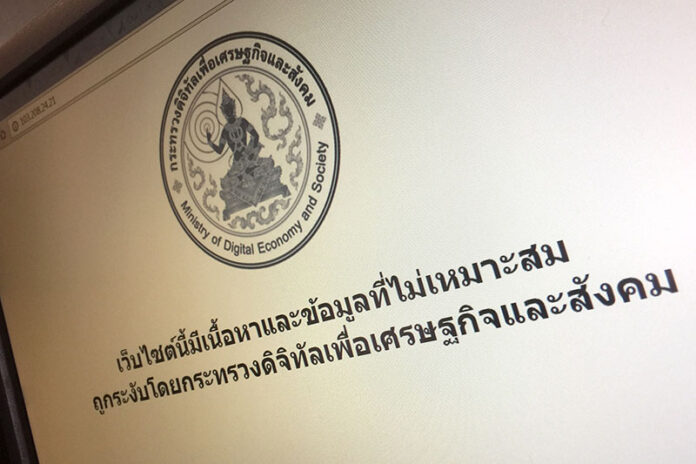
A blocked website shows a notice from the Ministry of Digital Economy and Society with the message, 'This website contains content and information that is deemed inappropriate. It has been censored by the Ministry of Digital Economy and Society' on Nov. 17. Photo: Associated Press
BANGKOK — Authorities cracking down on online insults to the royal family following the recent death of their king pressed Google and Facebook for help as they shut down 1,300-plus websites last month – more than they had in the previous five years combined, according to records released exclusively to The Associated Press.
While the nation has collectively grieved since the Oct. 13 passing of King Bhumibol Adulyadej, the government has also focused on eliminating online remarks it deems offensive to the late monarch, his queen or his heir-apparent, Crown Prince Maha Vajiralongkorn. Thailand’s lese majeste law, the world’s toughest, makes defaming any of the three a crime punishable by up to 15 years in prison.
Since the king’s death, Thailand has charged more than 20 people with making anti-royalty statements, requested deportations of suspects from at least seven countries and attempted to wipe out content it finds offensive from websites and social media.
“The amount of content restricted in Thailand under these laws is absolutely of concern, particularly as the lese majeste provisions are used to stifle legitimate dissent, both through blocking and content removal,” said Madeline Earp, who researches Asian internet censorship for the nonprofit Freedom House.
The military says the lese majeste law is necessary to safeguard the monarchy and national security.
Data compiled by the Ministry of Defense’s support group and released to the AP shows that the government shut down 1,370 websites in October, more than the 1,237 shut down in the previous five years. Just two had been shut down in September.
Thailand orders the country’s internet service providers to block offensive websites. Users who click on them see only a government seal and a statement in Thai: “This website contains content and information that is deemed inappropriate. It has been censored by the Ministry of Digital Economy and Society.”
Deputy Prime Minister Prajin Juntong said the government has set up a team to quickly control online content.
“Thais have been attacked by websites that twist the truth,” Prajin said.
The approach is different for Google, Facebook and other online and social media platforms based outside of Thailand. Prajin said he has contacted those companies and asked them to monitor and remove content that could insult the monarchy.
Prajin said Google and Facebook agreed. Both companies dispute that, and say they are only responding to complaints brought to them rather than actively seeking content offensive to the monarchy.
“We have never provided account information or content of any Facebook user to the government of Thailand, nor do we proactively monitor people’s content or conversations for potential violations of local law,” Facebook spokesman Tim Inthirakoth said after his company met with Prajin on Thursday.
Google said that last year it removed 1,331 items at the request of Thai authorities, up from 74 items in 2014. Facebook said it had five requests related to criminal cases in 2015 and didn’t produce data for any of them. Facebook and Google refused to release how many requests they’ve had since the king’s death, saying they will publish that in their regular biannual online reports.
Thailand has long censored online content deemed insulting to the monarchy, but has done so more frequently since a military coup ousted an elected government in late May of 2014. According to the Ministry of Defense data, the junta censored 974 websites in its first two years, more than three times as many as the prior government censored in its last two years.
Thai authorities are thought to be particularly concerned with websites with content about Vajiralongkorn, the 64-year-old designated heir to the throne who lacks the popularity of his father. The public at large has long traded rumors about Vajiralongkorn’s finances, hot temper and other matters. Three stormy marriages are a matter of public record. But critical news reports from abroad about Vajiralongkorn are commonly blocked in Thailand.
Thailand remains somber in many ways more than a month after the death of Bhumibol, who was 88 and the world’s longest-reigning monarch. Millions continue to dress in black or white every day, boisterous events have been canceled and mourners are flocking by the tens of thousands to pay their respects at the Royal Palace.
Online, for the first 30 days many websites and Facebook pages were also without color. Even Google’s trademark red, green, blue and yellow search box was, in Thailand, simply monochrome.
Daphne Keller at the Stanford Center for Internet and Society said internet companies doing business in countries with laws restricting speech know they will be expected to comply with the rules. One common means of doing so without deleting lawful speech elsewhere is to offer country-specific versions of services, like YouTube Thailand, said Keller.
“The company can then honor national law on the version of the service that is targeted to, and primarily used in, that country,” she said.
Emma Llanso, who directs the Free Expression Project at the Washington, D.C., based Center for Democracy and Technology, said internet companies have to grapple with how to respond when told to shut down websites.
“This is a perfect example of the kinds of conflicts that make it difficult to protect freedom of speech in the digital age,” she said.
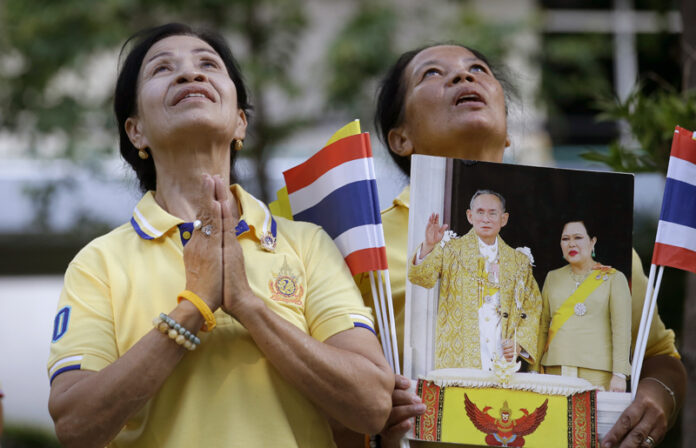
Thais hold portraits of King Bhumibol Adulyadej and Queen Sirikit as they pray outside of the Grand Palace during the celebrations marking the 70th anniversary of his accession to the throne on June 9 in Bangkok. Photo: Sakchai Lalit / Associated Press
BANGKOK — Her Majesty the Queen was diagnosed Thursday night with lung inflammation, a palace statement said.
Queen Sirikit, 84, had a high fever Tuesday, prompting doctors to give her an X-ray and discovering the inflammation, according to the statement. Her Majesty remains under doctors’ care at Chulalongkorn Hospital, but was said to be recovering.
“Today Her Majesty’s fever decreased, her respiration is good and she eats well,” it said.
Queen Sirikit is the wife of His Majesty the Late King Bhumibol, who died on Oct. 13 at 88, ending his reign as the longest-ruling monarch in Thai history.
Due to her frail health, Her Majesty has spent much of the past years at Siriraj Hospital, where her husband was also treated for a number of illnesses.
She has rarely been seen in public since her hospitalization, but she was glimpsed in the motorcade that transported King Bhumibol’s body from Siriraj Hospital to the Grand Palace on Oct. 14.
BANGKOK —Rewind to the ‘90s with Oasis, Spice Girls, Pulp and more with Dudesweet and friends next month
Dudesweet will unleash a sentimental blast from the past at a party featuring DJs such as American dance DJ Tee Skrillex along with house DJs GayAim, The Panlert Twins, Nut Lullabar and Mr. Note himself.
The party will mix its ‘90s genres with some R&B and hip-hop on the first floor; and alternative rock, grunge and live Oasis and Spice Girls covers flooding the second. Rave out on the third floor to trance, rave and Drum ‘n Bass.
The party is 20 and up.
The period party perfectionists are not allowing mobile phones or digital cameras inside to preserve the authenticity (Millennials: They didn’t exist yet). And no big eye contact lenses. To capture the retro moment, a special zine called “Third World Times” will be distributed.
Tickets are 600 baht. Advanced tickets are available at 400 baht and can be bought via Ticketmelon.
The party starts at 9 pm on Dec. 16 at Whiteline at Soi Silom 8. The nearest rail stop is BTS Chong Nonsi.
BANGKOK — For the past year, Wirada Saelim lived under a cloud of anxiety that she and her colleagues would be tried as criminals for doing journalism about a community poisoned by a gold mine.
On Wednesday the court dismissed the charges against them brought by the mine operator who had pressed charges not only under the usual defamation claim, but an unrelated law from a decade ago meant to fight cyber phishing and other online scammers.
Because the 25-year-old journalist’s news organization, Thai PBS, had uploaded the segment to YouTube, they were sued under the 2007 Computer Crime Act, a law which has veered from its original purpose to become a crippling weapon against online speech used by corporations, the government and private parties to prosecute and silence journalists, watchdogs, human rights defenders, dissidents and more.
Under the vaguely written law, people have been prosecuted for everything from posting their opinions in comments, sharing others’ posts on Facebook, promoting research later picked up by the news media, or even just messages sent over private chat.
Now the controversial law is undergoing amendment, and stakeholders from the business sector to activists and the human rights commission have come forward to insist it be fixed to stop further abuse. But far from fixing the contentious law, its latest draft looks set to further the military regime’s long-held desire to gain unprecedented control of the online sphere.
“The September draft is a lot worse compared to the August one,” said Arthit Suriyawongkul of the Thai Netizen Network, which along with Amnesty International and other groups have petitioned for its change. “While the authorities’ ability to exercise power was extended, the mechanisms to keep check of them was not.”
The amendment process will be finished by March. The man in charge of amending it, police Maj. Gen. Chatchaval Suksomjit, said Wednesday is the last chance for input at a public hearing to be held at the Parliament House.
Until then, concerned parties worry the direction it’s heading would leave the law ripe for abuse by giving more power to the authorities, and at worst, could legally enable mass censorship of the internet.
*2016’s number was collected between January to August
Weapon Against Watchdogs
Earlier this month, British labor rights activist Andy Hall abruptly left Thailand, citing judicial harassment. In September, the only case against him to win a conviction was made possible by the Computer Crime Act. Although Hall published nothing, he contributed data about labor abuses to an NGO which published a report online. A few days after arriving in Paris, Hall learned a new case had been filed against him under the act, this time by a chicken farm where he had exposed labor abuses.
That’s a long way from the Computer Crime Act’s original purpose. Written for a new millennium, it was meant to update the tools for law enforcement to handle crime in the burgeoning online era.
One poorly written clause however is held up by its critics as the main flaw which has allowed it to be bent into a weapon taken up by corporations, the government and private parties to silence speech.
Article 14 was intended to criminalize online scammers, but its broad and vague language has been interpreted as free license to go after all sorts of speech.
“Any person who commits an offense that involves importing into a computer system forged computer data, partially or entirely, or false computer data in a manner that is likely to cause damage to an individual or the public,” it identifies as criminal.
In recent years it has been interpreted to mean any information appearing online or in a computer that someone deems “false.” The Internet Law Reform Dialogue, or iLaw, says it’s been used arbitrarily against activists, whistleblowers and journalists in at least 43 cases.
Online rights activist Arthit said the charge was made possible by the words ““importing data” in Article 14.
Nuttigar, a 43-year-old online marketer, suggested that by the same logic, people could be prosecuted for posting an “only me” Facebook status only they could see.
“The Computer Crime Act has lately been used for political purposes. The government often uses it to prosecute their citizens,” she said, adding that her computer was seized and her passwords demanded without any court warrant or legal charges filed against her.
While those revising the law said they wanted to restore its original purpose to combatting online scams, an updated draft released in September was a step in the wrong direction. While the original law criminalized importing false computer data which threatened national security or caused panic, the new language broadens it to include damaging public safety, domestic economic security, public services or even infrastructure.
“The law has been broadened to be worse,” said Surachet Satitniramai of Thailand’s Human Rights Commission. “It will make people fear expressing their view and censor themselves.”
Nuttigar Woratunyawit is escorted to prison April 29 after bail was denied by the martial court in Bangkok.
New Powers for Police
The September draft would expand data-collection powers to police in all criminal matters.
One main concern for reformists was a clause in the September draft which empowers authorities to compel service providers to hand over data traffic to be inspected, copied, decoded and analyzed, then seize their equipment if they suspect an offense. And it would make this possible in any criminal investigation, not just alleged computer crimes.
“Community webboards such as Pantip.com could be affected,” said Kittirak Moungmingsuk, president of the Open Source Education and Development Association. “If their server is seized, other content unrelated to the crime can also disappear.”
As written in the latest draft, many more websites than those with porn and lese majeste could disappear behind the ICT Ministry’s banner block warning.
It would empower a committee to arbitrarily censor online content. The most surprising part of that, according to Arthit, is that the committee could get a court order to remove or block any content it deems objectionable on moral grounds, even if it is completely legal.
This change prompted the concern among business sector who said it was deeply against junta’s policy to push digital economy. Thai Digital Confederation which consists of people from many professions working mainly on the internet has been petition against it since August.
Chatchaval, the head drafter, said there is nothing for the public to be worried about. He said the language in the draft leaves it up to the courts and appealed to a desire for law and order.
“It’s not like the authorities can just shut things down,” Chatchaval said. “It is a balance. We seek the court’s permission only when it involves a case. What would happen if we have no rules? Should anyone think they can do anything?”
Before the law passes and finally comes into effect, Arthit said he just hopes concerned members of the public will come forward to demand their rights be protected, as the drafters will respond to pressure from the other side of room.
“Authorities taking the national security side may worry that the law should give them enough power,” Arthit said. “Now it depends on whose voice is louder.”
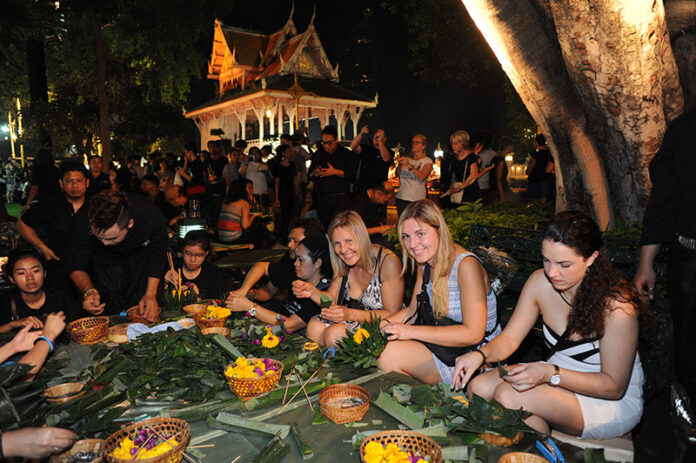
Visitors weave baskets to be floated in the Chao Phraya River on Monday at Santi Chai Prakan Park in Bangkok.
BANGKOK — “Life goes on” was the key message Thailand’s top tourism official conveyed Wednesday night at a public forum on how the country’s tourism is weathering the death of its longest-reigning monarch.
Playing down the impact of His Majesty the Late King’s death on one of the kingdom’s biggest money-makers, Tourism Minister Kobkarn Wattanavrangkul recounted her visit to a luxury hotel bar where she saw scenes of leisure returning to normal a month after the government declared a ban on public entertainment, forcing the once free-wheeling capital to go quiet.
“Life goes on,” the minister said at the panel hosted by the Foreign Correspondent’s Club of Thailand. “If you’ve been to Bamboo Bar at Mandarin Oriental, you will see there’s still jazz. People ask me, can I drink wine? Yes you can! There was music everywhere.”
Despite dire reports from the private sector, Kobkarn said things are looking up. Festivities are making a comeback just before the year’s end with sport tournaments, jazz festivals and New Year’s Eve parties.
“There will be parties. We are working on big events,” Kobkarn said when asked what to expect Dec. 31. “Certainly something is coming up. What it will look like we don’t know yet. We want to make it memorable.”
Apart from a New Year’s Eve party, authorities are planning more events around the nation.
Bangkok will see a festive end to the year, she said.
“I talked to owners of Siam Paragon and CentralWorld. There will be Christmas trees,” Kobkarn said. “It will be the biggest place for selfie.”
Grim Numbers
A bleak counterpoint to Kobkarn’s exuberant assertions are the numbers coming in from the tourism sector.
Tourism, which by one estimate generated 20.8 percent of the 2015 GDP, took a direct hit from the shutdown. Sa-nga Ruangwattanakul, adviser and former head of the Khaosan Road Business Association, said establishments in the famous backpacker district lost up to 70 percent of revenues last month.
“We had zero revenue in entertainment,” he said at the panel discussion.
There’s also been a drop in European arrivals, he said, citing factors such as economic crises in the West and wariness of political trouble in Thailand.
However, like Kobkarn, Sa-gna expects the situation to improve from November onward. For instance, live bands returned to bars this week, and the tourists are returning, he said.
“We expect to see recovery in November,” said Sa-nga, who’s also CEO of a hotel and bar group on Khaosan Road. “We expect that the total annual revenue will be 20 percent less than last year.”
But whereas the foreign tourist market has improved somewhat, the president of a domestic travel guild said tourism within the kingdom is still in a deep downturn.
“Since His Majesty the King passed away, tourism has slumped. People have postponed their trips or canceled them altogether,” Phuriwat Limthavornrat said Thursday. “For October, [domestic] tourism revenues are almost entirely gone. Almost 100 percent.”
He continued, “Thai people like to have fun. Since they can’t party while they travel, they decide not to go out at all.”
Phuriwat said he thought the situation would improve once the entertainment ban was lifted, but it turned out people aren’t in the mood.
“We predicted that after 30 days, customers would start traveling again, because things would be relaxed,” said Phuriwat, whose tour company saw 15 cancellations throughout October. “But people still feel that it’s not appropriate yet.”
He said domestic tourism will have to wait at least until January to see any meaningful recovery.
De facto leader of the Cambodia National Rescue Party (CNRP) Kem Sokha (left) seen here with exiled leader Sam Rainsy in 2012 in Manila, Philippines. Photo: VOA / Wikimedia Commons
PHNOM PENH — A Cambodian court has sentenced an opposition lawmaker in absentia to 18 months in prison for suggesting the authorities were involved in the July killing of a popular political analyst who spoke critically of the government.
Judge Ei Thavrak of Phnom Penh Municipal Court found Senator Thak Lany of the Cambodia National Rescue Party guilty Thursday on two charges, defamation and inciting chaos. Thak Lany has been abroad and did not appear at the hearing.
Her conviction is the latest in a series of legal cases against opposition leaders in what is generally seen as an attempt to disrupt their organizing efforts ahead of local elections next June.
Opposition leader Sam Rainsy has stayed abroad after a defamation conviction against him was reinstated last year.
Shards of methamphetamine hydrochloride, also known as crystal meth. Photo: Radspunk / Wikimedia Commons
JAKARTA — An Indonesian court has sentenced an American man to life imprisonment after finding him guilty of drug smuggling.
Philip Russell was sentenced Wednesday by the District Court in Semarang, the provincial capital of Central Java.
A court spokesman said Thursday that 56-year-old Russell was arrested with seven other people following a raid in January by the National Narcotics Agency on a furniture workshop in the Central Java town of Jepara. Officers found 97 kilograms (214 pounds) of crystal methamphetamine hidden inside 54 electrical generators from China that were stored in the workshop. Russell was accused of financing their import.
Indonesia has extremely strict drug laws. More than 140 people are on death row, mostly for drug crimes. Eighteen people have been executed in the past two years for drug violations.