This image released by Twentieth Century Fox shows Zac Efron, left, and Hugh Jackman in a scene from "The Greatest Showman." (Niko Tavernise/Twentieth Century Fox via AP)
“Don’t fight it,” goes the opening song of “The Greatest Showman,” sung by Hugh Jackman. “It’s coming for you, running at ya.”
Well, that’s for damn sure. “The Greatest Showman” is a one hour-and-45 minute onslaught on the senses — all peppy, fizzy ballads and frantic energy, earnest sentiments and impossibly good intentions. It’s begging for love, like a puppy serenading us with pop songs.
It’s exhausting, and messy. And that’s too bad, because Jackman really IS one of the great showmen of our time. Give the man a stage and a song, and it’s near impossible not to love him. The movie? Not so much.
Jackman plays P.T. Barnum, the 19th-century businessman and politician — but a showman above all — who founded the Barnum & Bailey circus. He did a lot more than that; the movie’s publicity notes call him “America’s original pop-culture impresario.”
OK, but they weren’t singing 21st-century pop ballads back then, and one of the movie’s biggest problems is its almost desperate determination to contemporize everything for a young audience. It’s not so much the casting of Zac Efron and Zendaya as young lovers; it’s that they and the others are given upbeat pop songs and self-empowering anthems that would perhaps sound great (if generic) on their own, but simply feel jarring when sung by 19th-century characters in period dress. It’s all the more frustrating given that the songs come from talented duo Benj Pasek and Justin Paul, who wrote the lyrics for “La La Land” and the terrific score for Broadway’s “Dear Evan Hansen.”
The film is a debut feature from director Michael Gracey, known for his work on commercials and music videos, and that’s telling, because it often feels like a collection of slickly produced music videos, loosely tied together with a plot we’re not supposed to care too much about.
It does start off with a bang — that opening number set at the circus, with Jackman in a top hat and long red coat, wielding a cane and recalling the stylish emcee in “Pippin.” Then we go into flashback, meeting the young Barnum as a poor boy, a tailor’s son. He meets the angelic girl of his dreams in a fancy mansion, and resolves to marry her. “A million dreams is all it’s gonna take,” he sings.
The song continues as the youngsters segue into adulthood: “A million dreams for the world we’re gonna make.” Their early years together are short on cash, long on, um, dreams. Wife Charity — Michelle Williams, given little to do but always genuine and touching — insists she doesn’t regret leaving her wealthy past.
Barnum loses his first job, and comes up with the idea of a museum of oddities. The first version is a bust. Then one of his little daughters tells him: “You need something alive.”
Light bulb! Barnum realizes his oddities need to be human: General Tom Thumb, the Bearded Lady, the Siamese twins. “They’re laughing anyway,” he tells one of them, “so why not get paid?” The place is a hit, and suddenly Barnum’s very wealthy.
But he needs something more: Acceptance, among the snobby elites. He convinces a young, patrician playwright, Philip (Efron) to join him in the business. They seal the deal in an energetic number set in a barroom, “The Other Side,” which reminds us of those “High School Musical” days and how we’ve rather missed Efron singing and dancing. Soon Philip will be falling in love with a beautiful, soft-spoken acrobat (Zendaya), and their mixed-race romance — scandalous back in the day — will produce the sweet yet also generic “Rewrite the Stars,” performed with the help of aerial acrobatics.
Then there’s a subplot with the Swedish soprano Jenny Lind — inspired by fact but veering into the fictional. Barnum goes to Europe to persuade Lind (Rebecca Ferguson) to tour America; the high-stakes enterprise, he reasons, will finally get him embraced by high society.
If there’s an eleven-o’clock number, it’s got to be “This Is Me,” ably sung by Broadway belter Keala Settle, a motivational anthem that seems meant to stop the show but sounds too familiar to really stir the spirits. “I’m gonna send a flood, gonna drown them out,” the bearded lady sings, and alas, it’s an apt description of what this movie seems to be doing: Drowning us in pizazz and feel-good emotion, but not making us think, or learn. In the end, not much is happening under that circus tent.
“The Greatest Showman,” a 20th Century Fox release, is rated PG by the Motion Picture Association of America “for thematic elements including a brawl.” Running time: 105 minutes. Two stars out of four.
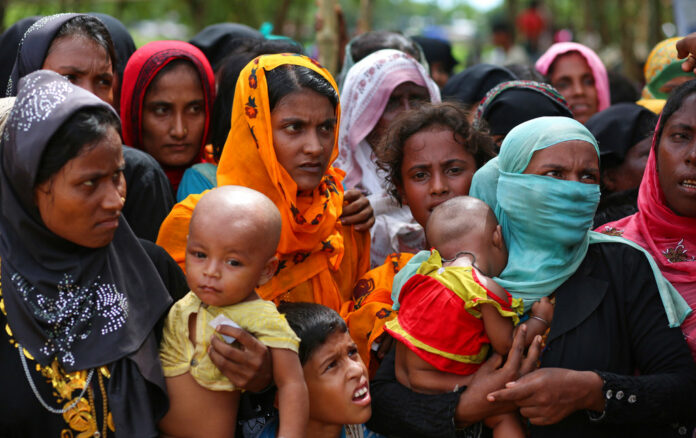
Rohingya women carry children and wait for food handouts in 2017 at Thangkhali refugee camp in Cox's Bazar, Bangladesh. Photo: Zakir Hossain Chowdhury / Associated Press
BANGKOK — Myanmar’s military said a forensic investigation has begun after the discovery of 10 bodies in a mass grave in a village in troubled Rakhine state, where the country’s security forces have carried out a brutal crackdown against the Rohingya Muslim minority.
Local officials said Tuesday that they were investigating the 10 unidentified bodies found Monday near a cemetery in Inn Din village.
Meanwhile, the United Nations’ human rights agency said that Myanmar’s government is denying a U.N. special rapporteur access to the country.
More than 630,000 Rohingya have fled to Bangladesh since security forces in neighboring Myanmar launched a violent crackdown against them on Aug. 25, turning it into Asia’s worst refugee crisis in decades.
The United Nations and the U.S. accuse Myanmar’s military of human rights violations against Rohingya in Rakhine, including killings, rapes and the burning of homes. The U.N. has condemned the violence as ethnic cleansing.
International aid group Doctors Without Borders said last week that it conducted a field survey that found at least 6,700 Rohingya Muslims were killed between August and September in the crackdown.
International rights groups blame the government and military for being unwilling to investigate possible wrongdoing by government officials and have urged the government to accept the assistance of international investigators.
“It’s critical they (the government) accept the assistance of impartial, independent investigators and allow them to immediately travel to Inn Din to probe what happened and make a full report,” said Phil Robertson, Deputy Director of Human Rights Watch’s Asia Division.
The military said in a statement Monday that legal actions would be taken against the perpetrators.
Meanwhile, Myanmar’s government has informed U.N. Special Rapporteur Yanghee Lee that it is denying her all access to the country for the rest of her tenure, the U.N.’s human rights agency said Wednesday.
Lee had been due to visit Myanmar in January to look into alleged human rights abuses against Rohingya in Rakhine.
“This declaration of non-cooperation with my mandate can only be viewed as a strong indication that there must be something terribly awful happening in Rakhine, as well as in the rest of the country,” Lee said in a statement, adding that she hopes the government will reconsider.
Pad thai vendors and river homes were tossed off the map as a new Chinatown sprung up near an MRT station, shaping the capital’s perpetual urban transformation.
In 2017, as Bangkok continued to evolve like the ever-changing organism that it is, we sought to take a snapshot of the city’s past, which year by year recedes from canal to concrete.
Old hotels, new neighborhoods and ancient tales. Tomorrow contractors will keep building and tessakit will keep evicting, but yellowed photos and snake legends bear us back into Bangkok’s past.
The Golden-Age of Old Hotels and Cinemas
We took a nostalgic look back at Bangkok’s golden age of oriental fantasy, when Vietnam War-era hotels were lit with tungsten and cinemas stood alone.
The Malaysia Hotel, and other 60s retro hotels in the city, are still frequented by old expats slopping up cheap dishes of late-night porridge. Stand-alone cinemas in various states of decay herald back to the age when celluloid was king.
Artists in June swarmed the Dusit Thani Hotel, the iconic 48-year-old hotel on Silom which in its ‘70s heyday was the tallest in the capital. They’d sketch its unique facade before it meets the wrecking ball next March.
Even Cheap Charlie’s, a 35-year-old roadside bar and a farang watering hole in Nana shut its blinds in March and relocated to On Nut earlier this month.
Evictions Riverside and Roadside
After years of efforts by City Hall, 2017 saw widespread evictionof street food carts across Bangkok. Those who welcomed the move said cleanliness and order is the law of the day, while critics said Bangkok’s was being deprivedof its soul with every guay tiew stall that disappeared from Thonglor.
Another image of Bangkok’s soul – the Chao Phraya River – lined by river homes was also evictedthis year to make way for a concrete river boardwalk.
Traveling in Time to the Old Bangkok
Chiang Mai, 1967. Photo: Phil Bradbeer.
A pillar driven into the ground 235 years ago killed four serpents and enacted a city-wide curse. Plants, canals and farms that ran wild in the metropolis’ primordial ground gave their namesaketo fifty districts. And like every April, people chucked buckets of water at each other to welcome the Buddhist new year.
Bangkok’s story is a maze of color, magic and confusion that we again attempted to tell this year.
The Changing Face of Local China
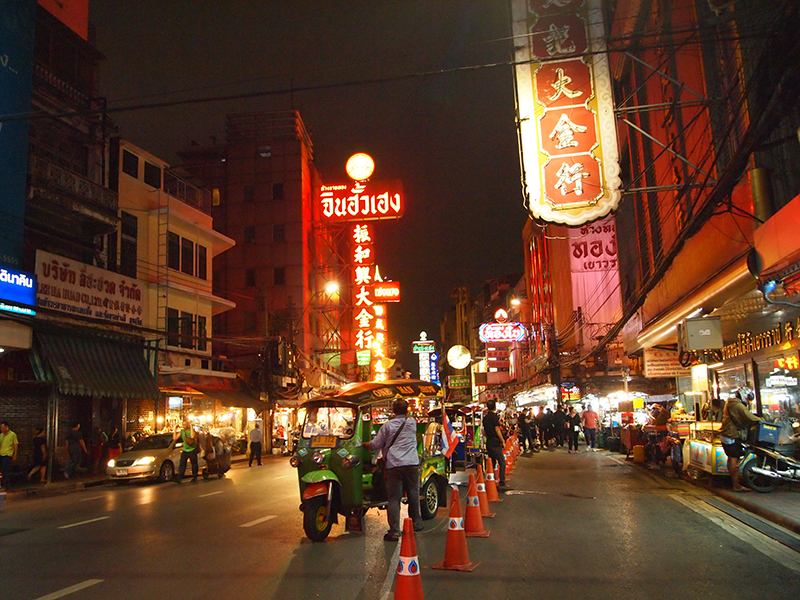
Yaowarat in June.
As skyscrapers and hipster bars increasingly open acrossthe historical Chinatown in Yaowarat, a “new” Sino-Thai neighborhood popped up around Huai Khwang. Meanwhile, we documented how the dying art of Chinese opera, or ngiew, now performs largely for temple spirits and the elderly.
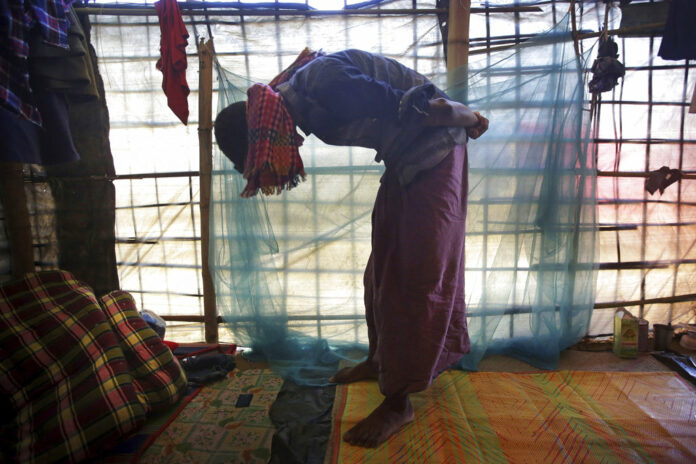
In this Monday, Nov. 27, 2017, photo, Mohamed Yaha, 18, demonstrates to The Associated Press in his tent in Jamtoli refugee camp in Bangladesh, what he saw when soldiers bound the hands of dozens of men behind their backs with nylon rope and blindfolded them with scarves taken from the women when they massacred his village Maung Nu, in Myanmar's Rakhine State. (AP Photo/Wong Maye-E)
UKHIA, Bangladesh — For six hours he hid in an upstairs room, listening to the crackle of gunfire and the screams of people being slaughtered outside his Myanmar home.
With every footstep that drew near, every cry that pierced the air, 52-year-old Bodru Duza braced for the soldiers to find him, to execute him like all the others who had fled to his compound that morning seeking a safe place to shelter. They were being blindfolded and bound, marched away in small groups, then butchered and shot as they begged for their lives.
What had started out as a quiet Sunday in northwestern Myanmar had spiraled into an incomprehensible hell — one of the bloodiest massacres reported in the Southeast Asian nation since government forces launched a vicious campaign to drive out the country’s Rohingya minority in late August.
By the time it was over, there was so much blood on the ground, it had pooled into long rivulets across the uneven earth, among bits of human flesh and the fragments of shattered skulls.
When Duza finally dared to emerge from his hiding place, he wondered how anyone could have survived.
The compound he grew up in was now consumed by an ethereal silence. His wife, daughter, and five young sons were nowhere to be seen. And as he crept toward a backdoor to escape, he stumbled upon the corpse of an unknown boy sprawled on the floor.
“Oh Allah!” he thought. “What have they done to us? What have they done to my family?”
The Associated Press reported this story with a grant from the Pulitzer Center on Crisis Reporting.
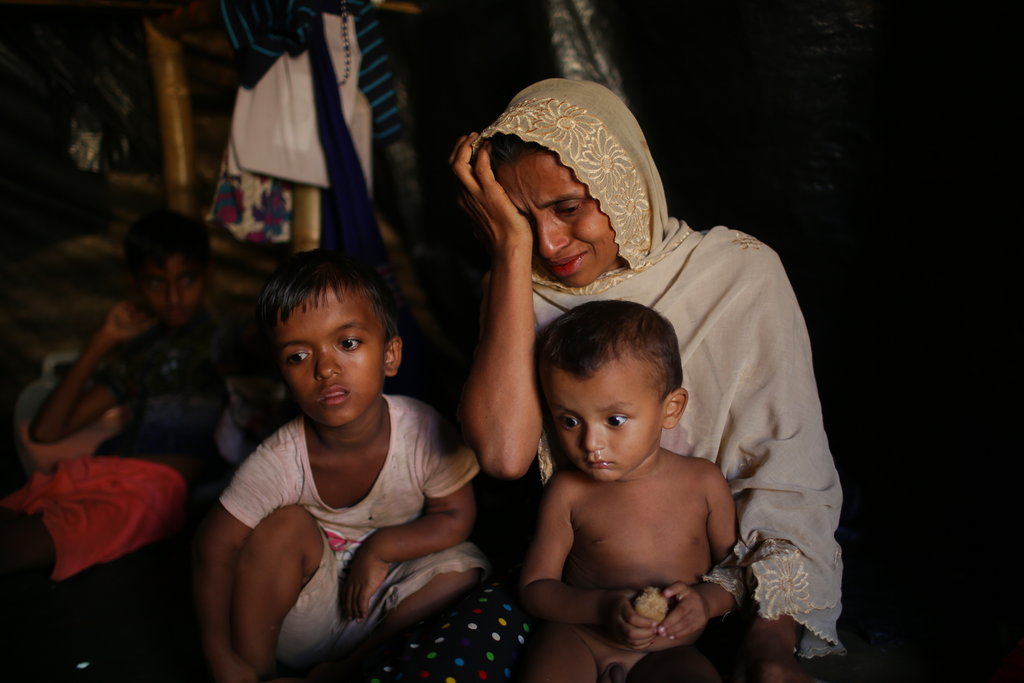
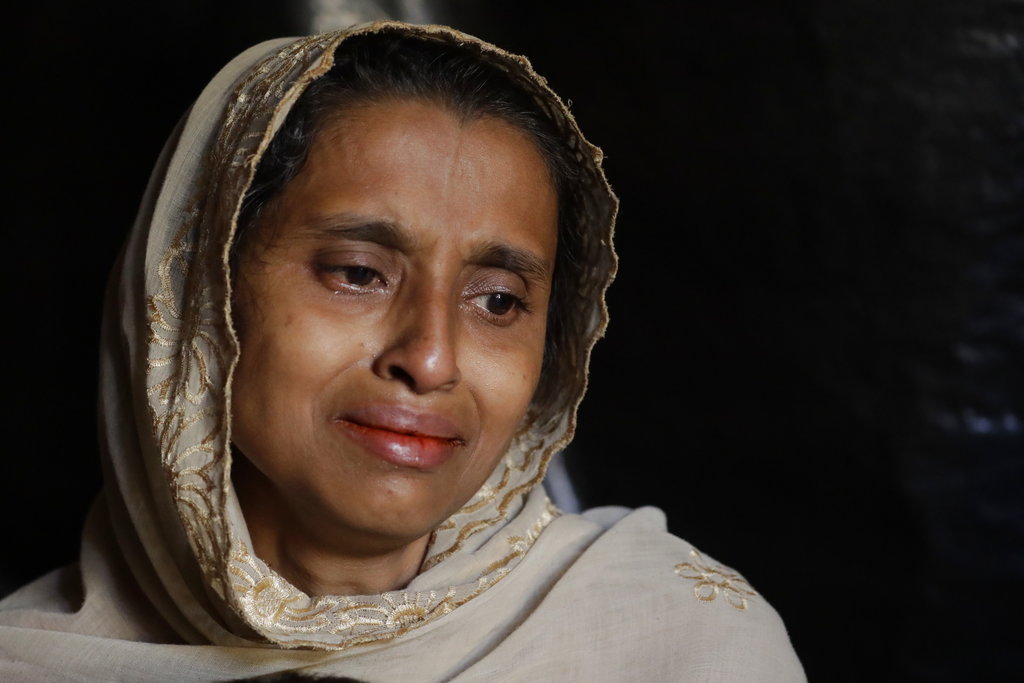
In this Sunday Nov. 26, 2017, photo, Jamila Begum, 35, cries when talking about how members of Myanmar’s armed forces accused of massacring civilians in her village Maung Nu, in Myanmar’s Rakhine State, killed her son and husband during an interview with The Associated Press in Kutupalong refugee camp in Bangladesh. (AP Photo/Wong Maye-E)
Duza’s family belonged to the ethnic Rohingya Muslim community, which has long been persecuted and denied basic rights in predominantly Buddhist Myanmar. They lived in the village of Maung Nu, where at least 82 Rohingya are believed to have been murdered on Aug. 27.
The massacre was part of a streak of violence that started before dawn two days earlier, when Rohingya insurgents staged an unprecedented wave of 30 attacks on security posts across Rakhine state. At least 14 people were killed.
The assaults triggered one of the greatest catastrophes the Rohingya have ever known: an army counter-offensive that has left hundreds of villages burned and driven 650,000 refugees into Bangladesh. The aid group Doctors Without Borders estimates 6,700 Rohingya civilians were killed in the first month of reprisals alone, and human rights groups have documented three large-scale massacres.
The Associated Press has reconstructed the massacre at Maung Nu as told by 37 survivors now scattered across refugee camps in Bangladesh. Their testimony and exclusive video footage from the massacre site obtained by AP offer evidence, also documented by the United Nations and others, that Myanmar armed forces have systematically executed civilians.
Myanmar’s military did not respond to repeated requests for comment on this story, and the government — which prohibits journalists from independent travel to northern Rakhine State — did not reply to an AP request for a visit. The army has insisted in the past that not a single innocent has been slain.
For as long as anyone could remember, there was only one place in Maung Nu that was truly considered safe. It was a large two-story residence shared by two of the village’s most prominent businessmen — Duza and his brother Zahid Hossain.
Built on a hillside more than half a century ago, the vast home was known for its three-foot-thick walls of hardened mud, which many believed to be bullet-proof and virtually impossible to burn. That mattered in Rakhine state, where the Rohingya population lived in fear of both the military and the area’s ethnic Rakhine Buddhists. Although the Rohingya have lived in Myanmar for decades, they are still seen as foreign invaders from Bangladesh who are intent on stealing land.
Despite the tensions, Hossain worked extensively with local army commanders, trading cows and rice and jointly operating a brick-making factory. Both brothers were charismatic, educated and popular. Duza, an affable man who was well-known throughout the area, had previously served as village administrator for 12 years. Many people assumed that neither he nor his compound would be harmed.
After insurgents launched their first attacks a year ago, the government had imposed strict new measures aimed at curbing militant activity. Islamic schools were closed, a curfew was put in place, and authorities ordered the removal of fences and even shrubbery so security forces could see inside private compounds.
But Maung Nu, a village of about 2,000 people also known as Monu Para, remained peaceful. Duza and his brother counted their blessings. They were among the village’s wealthiest men. They owned scores of cows and buffalo, and vast acres of rice.
Soon, it would all be gone.
A few hours after midnight on Aug. 25, fierce volleys of gunfire woke the residents of Maung Nu. Rohingya militants had launched a surprise assault on a Border Guard Police post in Hpaung Taw Pyin, less than a kilometer (a mile) to the north.
The fighting lasted until dawn. According to the government, two officers and at least six of the assailants died.
That morning a commander from the army’s Light Infantry Battalion 564, based just south of Maung Nu, called the local district administrator, Mohamed Arof, furious.
“Why didn’t you tell us about these attacks?” the commander demanded.
“I didn’t know anything about it,” replied Arof, a Rohingya. “I only heard the shooting, like you.”
The same day, police snatched Arof’s 15-year-old son from a rice paddy and took him to their camp, where he was hung with a rope along with three other teenagers, according to Arof and several witnesses. It’s unclear why the teens were killed, but word of their deaths spread quickly.
Fearing more reprisals from security forces, most of Hpaung Taw Pyin’s residents fled. Hundreds of them walked to the homes of friends and relatives in Maung Nu, in the hope they would be safe there.
And for a day, they were.
On Aug. 27, bursts of gunfire echoed across Maung Nu again. This time only the army was shooting.
Several military trucks parked on the village’s main road around 9 a.m. and began disgorging troops who fanned out on foot, firing into the air. Peering out a window of her home, 35-year-old Jamila Begum spotted several armed soldiers crossing her yard carrying coils of nylon rope.
Hundreds of people were already on the move, seeking the closest refuge — the hillside compound of Duza and Hossain, which included half a dozen other homes belonging to their relatives and a large rectangular pond. Begum’s family joined them.
Other residents were being rounded up by force and ordered to head to the compound. Some cowered inside their homes, wondering what to do. One of them, 18-year-old Mohammadul Hassan, put a woman’s veil over his face when troops burst through the front door of his home, guns drawn.
Hassan immediately recognized one of the soldiers — a skinny army staff sergeant named Baju who was well-known in the village. A member of the 564th Battalion, Baju had lived in the area for 15 years and spoke the Rohingya dialect, according to numerous villagers. Duza said Baju was also a frequent visitor to his home.
When the soldiers discovered Hassan hiding among several female relatives, they became enraged. He was dragged outside along with two of his brothers, shoved to the ground and kicked until blood poured from his left eye.
As troops ripped clothes off the women and seized their valuables, the three brothers were stripped and tied up. The soldiers marched them to Duza’s compound naked, at gunpoint, the sunbaked dirt road burning their bare feet.
In this Sunday Nov. 26, 2017, photo, Jamila Begum, 35, cries when talking about how members of Myanmar’s armed forces accused of massacring civilians in her village Maung Nu, in Myanmar’s Rakhine State, killed her son and husband during an interview with The Associated Press in Kutupalong refugee camp in Bangladesh. (AP Photo/Wong Maye-E)
Duza had never seen people so scared.
As the number of Rohingya hiding on his property rose into the hundreds, his wife, a warm woman with an easy smile named Habiba, turned to him and asked, “What’s happening? What’s going on?”
The answer came when dozens of helmeted soldiers in olive green uniforms arrived around 11 a.m., accompanied by several border guard police.
Their entrance set off a new panic. A few men in Duza’s house locked the main wooden doors and climbed the stairs to a balcony, where most of the males already had gathered.
Before joining them, Duza pulled Habiba aside.
“Please take care of our daughter and our sons.”
So many people were crammed into their house by then, though, that Habiba soon lost track of all but one child.
Outside, a soldier’s voice rose above the others. It was Baju, and he was calling on everyone to come out, assuring them they would not be harmed. As the minutes passed and nobody emerged, the calls turned menacing, and the sergeant threatened to burn the compound to the ground.
Several bursts of gunfire rang out and a young boy was struck in the forehead. The women recoiled in horror as he lay motionless before them, the back of his skull blown apart.
Seconds later, soldiers broke down the doors and began dragging people out, separating the men from the women.
Mothers and elderly women were ordered onto their knees. Some tried to push back when troops ripped off their headscarves and tore at their clothes. The soldiers first demanded their cell phones, then grabbed at exposed breasts as they snatched gold earrings, necklaces and wads of cash.
About 20 or 25 of the women — mostly attractive and young — were taken away. They were never seen again. The rest eventually were driven, along with their children, into a pair of houses on the property.
The soldiers bound the men’s hands behind their backs and ordered them into the dirt courtyard in front of the house, where they were forced face down onto the stifling ground. Most were blindfolded with masking tape or veils taken from the women. A handful who tried to resist were thrown off the balcony head-first.
Troops started to walk across the sea of people, grinding boots into their heads and beating them with rifle butts. Some of the soldiers cursed their prisoners, calling them dirty “kalar,” a derogatory word for Muslims that is frequently used in Myanmar.
Duza’s brother, Hossain, begged for the violence to stop.
“Why are you doing this?” he cried. “Why are you tying us up?”
There was no answer.
Around noon, a senior officer called a commander on his phone. The officer said they had rounded up 87 men.
“What should we do with them?”
The call ended shortly afterward, and the officer barked an order to his troops.
“Let us begin.”
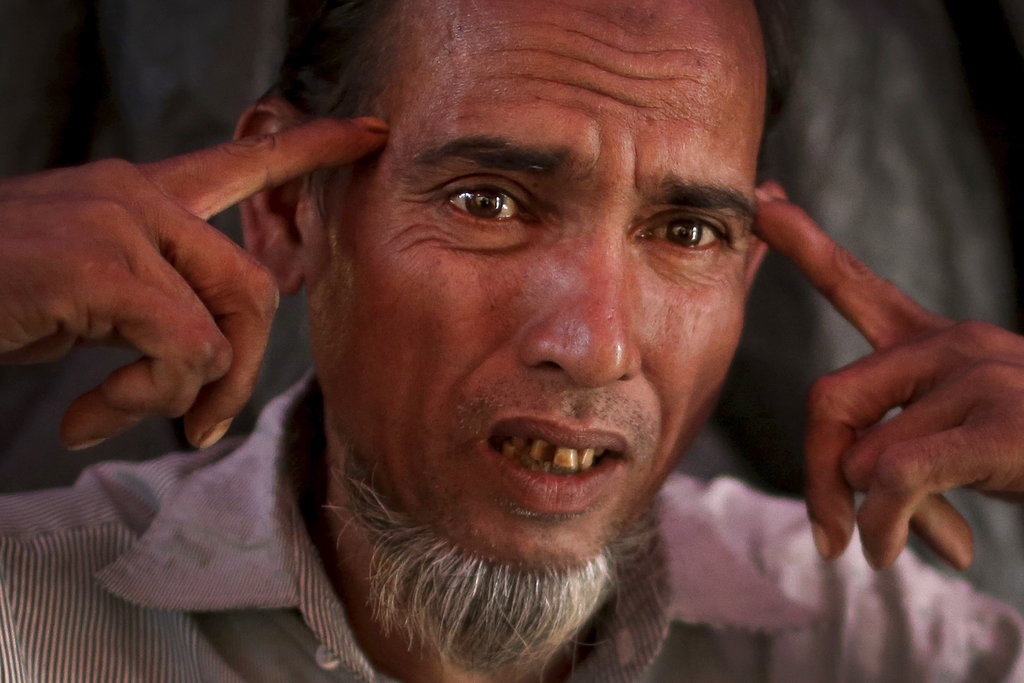
In this Tuesday, Nov. 28, 2017, photo, Shafir Rahman, 50, describes how he watched a soldier hammering a four-inch nail into the side of a man’s head with a rifle butt during an interview with The Associated Press in his tent in Jamtoli refugee camp in Bangladesh. (AP Photo/Wong Maye-E)
Duza watched through a slit in a closed window as a soldier plunged a long knife into his brother’s neck in front of their house. When two of Hossain’s sons got up and tried to run, soldiers opened fire.
Duza stepped back in shock. He scrambled to an upstairs room and crawled into the only place he could think of to hide: a foot-high space under a large wooden container normally used to store rice. He covered his legs with rice sacks and curled into a ball, trying to disappear.
Outside, screams like he’d never heard before reverberated across the courtyard.
Several soldiers hammered four-inch nails into the temples of three men on the ground with the butts of their rifles. Four other men were decapitated, including a prominent gray-bearded mullah, according to Begum.
Then a pair of soldiers — one was Baju — descended on her husband. With two-foot-long machetes, they hacked into his neck from both sides. He crumpled in the dirt, gagging on blood.
Gasping for breath, Begum stumbled toward the door. She wanted to rush to his side, to help him, to be with him — to die.
But the women in the house pulled her back.
“You can’t go,” one said, as Begum collapsed, weeping. “If you go out there, they’ll kill all of us.”
While women rocked back and forth, several children began praying. In the courtyard, they could hear people begging for their lives.
“Please Allah!” Please help us!”
“We’re dying!”
When Begum rose to look out the window again, she saw her 16-year-old son dragged away by the collar of his shirt and tied to a tree, screaming, “I didn’t do anything!”
The gunshots rang out. Begum could not bear to look.
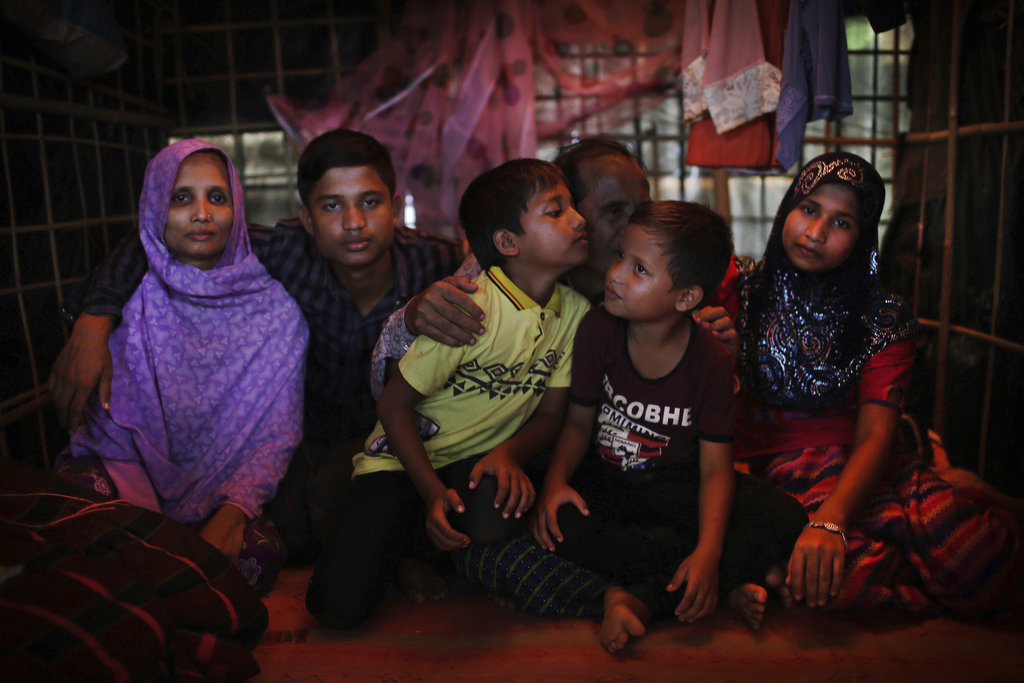
In this Saturday Nov. 25, 2017, photo, Bodru Duza, 52, third from right, kisses his sons as he sits for a portrait with members of his family in a tent in Kutupalong refugee camp in Bangladesh. (AP Photo/Wong Maye-E)
As the afternoon wore on, the carnage became more methodical.
Men and teenage boys were taken away in small groups and executed by firing squads near a forested area on the edge of the property. In some cases, a soldier blew a whistle beforehand, signaling for them to begin.
Other troops wrapped corpses in orange and green tarps and transported them downhill in three-wheeled push-carts to a pair of army trucks parked on the road. Several witnesses reported seeing soldiers digging pits and dumping bodies into them.
When Mohammad Nasir was marched to the killing ground with six others, he saw more than a dozen cadavers crumpled there under the trees. As those beside him braced for death and called out Islamic creeds — “There is no god but Allah! Mohamed is his prophet!” — Nasir wriggled loose and ran.
He made it to the far side of a small ravine before the first burst of gunfire rang out. Half an hour later, when he had run out of breath, he realized he had been shot in the elbow.
Mohammadul Hassan was taken to a pond just east of the main house. Soldiers ordered him to kneel with his two brothers, then shot them all from behind and rolled them over to make sure they were dead. When Hassan unexpectedly opened his eyes, an officer sitting on the bank walked casually forward and fired a single rifle shot into his chest. Hassan later regained consciousness, stumbled away, and survived.
That afternoon, soldiers began searching the compound for men. At one point, Baju grabbed Duza’s 9-year-old son Mohamed Ahasun, and demanded to know where his father was.
The boy said Duza had left four days earlier for another village. Baju slapped him, but let him go.
In the tiny, darkened crawl space upstairs, Duza’s mind had gone numb. He kept telling himself: “It has to stop … This has to end somehow.” Praying for survival, he waited for the soldiers to discover him, to drag him out by the feet.
But they never did. And when the guns finally fell silent, he crept slowly downstairs, and slipped away.
For the next two weeks, he traveled alone, joining the hordes of Rohingya bound for Bangladesh. They crossed streams and forests and mountains, and finally the Naf River, which separates the two countries.
When Duza got out of a boat and stepped onto Bangladeshi soil, he looked back toward Myanmar and saw half a dozen columns of smoke curling skyward from burning Rohingya homes. His family, he thought, was surely dead.
__________________________________
There is no way to independently confirm the death toll in Maung Nu. But one handwritten tally seen by The AP details the names, ages and professions of 82 people, most of them men and boys from Maung Nu and Hpaung Taw Pyin, who family members say were executed.
They are farmers and students, carpenters, businessmen and teachers. The youngest is seven years old; the oldest, 95.
According to Arof, the village administrator, at least 200 more remain missing and are feared dead.
Most of the survivors struggle to understand why so many of their neighbors were slaughtered. Arof said the army falsely believed they were supporting the insurgency, but something much deeper had driven the killing. The massacres reported since August have stood out for their high casualty toll, their ferocity, and the methodical way in which they were carried out.
“You have to understand … they hate us,” Arof said. “This didn’t only happen in our village, it happened everywhere.”
In the end, Duza was one of the luckiest survivors.
After weeks spent imagining another life without a family, he found a newly-arrived refugee with a Myanmar phone and asked to use it.
He dialed his wife Habiba’s number. A young girl answered.
He could barely believe it. It was his 14-year-old daughter, Taslima.
As tears welled in his eyes, Duza asked about the rest of his family. “Are they with you? Are they alive?”
“Yes papa! Yes!” Taslima replied. “We’re here! Everybody is fine.”
Duza’s family had been elsewhere in the compound when he fled. It would take them six more weeks to make the journey to Bangladesh.
When the family reunited in a refugee camp, Duza broke down as he hugged his wife and squeezed the children he never thought he’d see again. They had lost so much — their friends and relatives, their home, their savings, their future — but they had somehow found each other.
“It felt like living in another world,” Duza said. “It felt like a new life.”
BANGKOK — The last thing a California-raised man from Nong Khai wanted when he opened a hip-hop nightclub on the first day was a police raid.
In May, a party at the second floor of Bad Motel was not only attended by hundreds of revelers but also Thonglor police officers who told Blaq Lyte’s owner Supreda “Nick” Sotawong that his venue had been open later than what the law allows.
But more than a year has passed since the country’s nightlife came at a near strand still following the death of King Bhumibol. After the mourning period ended in late October, regular parties at venues throughout the city – formerly forced to close early – have resumed to normal business hours.
But the question is: Has it really sprung back to life? Khaosod English talked to music veterans, venue owners and managers to get insights.
While being informed by authorities to shut their doors at midnight or 1am, several venues said they were now back to closing an hour later.
After the raid in May, Nick said he and Blaq Lyte staff members would get a call from police about when they had to close. After the royal cremation in October, Nick said they were allowed to close at 2am.
Buddy’s Group registered entertainment venues on Khaosan Road – Brick Bar, Molly Bar, The Club and 999 West – are now back to closing at 2am, said Sa-nga Ruangwattanakul, adviser of Khaosan Road Business Association.
Other places confirmed to closing in the early morning as well. They include RCA dance club Onyx and pre-Cuban Revolution concept bar Havana Social on Soi Sukhumvit 11.
The fun at other locations has gone beyond 2am. Although the owners and PR staff don’t want to “say it out loud,” many year-end and New Year parties are slated to last until 3am, 4am and 5am on their Facebook event pages.
Photo: Future Factory Bangkok / Facebook
Oliver Wolfson of Whiteline in Silom said the venue’s dance floor Safe Room will go into the late hours with upgraded entertainment.
“We are working to make it a unique and fun experience,” said Wolfson.
Sitting at the corner of sois Thonglor 10 and Sukhumvit 55, new hangout Violett opened in November. The place has quickly gained a following for its quality underground music.
“Normally nightlife in Bangkok has only two styles: live Thai bands and EDM. But as it’s kinda boring these days, the clubs have started to expand into more genres,” said Violett’s manager Rawikarn Pitaklohapit, mentioning some underground hip-hop and techno clubs in the Thonglor and Ekkamai areas as examples.
“Violett intends to give people a chance to explore an alternative venue where we create a real good vibe of party and upgrade the nightlife scene of Bangkok,” Rawikarn said. “We want people to come and really have fun, dancing without caring how they look and how others look under a really intense music selection and club light and sound environment.”
Another new place opening around the same time as Violett is De Commune. Its owner Pathompol “DJ Ahivar” Chanin said the mushrooming venues in Thonglor and Ekkamai lead to big competition in the industry. To survive his business, Pathompol said he tries to introduce his place to newcomers by hosting events.
“Each place has different approaches to attract customers,” said Pathompol. “Mine is based on events. De Commune’s customers are very random. Sometimes they are friends of the DJs who perform that night.”
Kawee Soontornwan, founder of Medium Rare Live and DJ at venues in the Sathon and RCA areas, said late-night entertainment destinations aren’t limited to Thonglor, Ekkamai and RCA anymore.
“Thonglor started to get saturated to some extent,” Kawee said. “More people are looking for new places in new areas like [Chinatown’s] Soi Nana which now has Teens of Thailand and Asia Today.”
Kawee said he is opening a new place taking over former Cosmic Cafe soon.
Photo: Violett / Courtesy
Future Challenges to Bangkok’s Party Potential
While Jan “DJ Jaydubb” Bisping agrees that everything mostly has gone back to normal after the mourning period, he in a bigger picture compares Bangkok’s nightlife today to the scene four to five years ago when only a few dance clubs such as Glow and Levels dominated.
To Bisping, these days see more and more venues open their doors here and there. He mentioned Mustache Bangkok, Beam, Studio Lam, Whiteline, Safe Room, De Commune and Violett.
Photo: Safe Room / Facebook
Sure it harbors diversity and offers more options to Bangkok revelers, but Jaydubb also noticed some drawbacks, as most new places are not “paradise” as they used to be.
“People go to different places and each venue doesn’t get enough people to make it fun,” Bisping said.
The crackdown on Bangkok bars and nightclubs has intensified since the junta seized power in 2014. Frequent police and army raids leads to many venues getting shut down or having their licenses revoked.
Felix Braun, better known as DJ Moreno, said Bangkok’s electronic music scene is not the best in the region.
“Bangkok in terms of infrastructure, inhabitants and as a hub for tourists, clearly has the potential to be the number one spot in Southeast Asia. But it’s not, it’s among the worst,” Braun wrote. “The unpredictability of the authorities are [sic] to blame here but also the fact that most spots are run by people with an economic interest but not the knowledge and vision.”
Bauru's volleyball player Tiffany Abreu celebrates her team's victory at the end of a Brazilian volleyball league match Tuesday in Bauru, Brazil. Photo: Andre Penner / Associated Press
BAURU, Brazil — While playing in men’s professional volleyball leagues in Europe, heavy-hitting Brazilian player Tiffany Abreu accumulated dozens of trophies.
But she says that among her most important accolades was being named most valuable player for a match with a countryside team Tuesday night as rain leaked from the roof in a half empty gymnasium.
“I had two of those (MVP) awards playing in the men’s league. But this is a special one,” Abreu told The Associated Press in an interview after the match. “I didn’t even know until recently that I could play volleyball again.”
Abreu, 33, is the first transgender athlete in Brazil’s Superliga, the country’s top women’s volleyball tournament. She is sure to turn heads in Brazil, Latin America’s most populous nation that has often struggled to curb violence against gay and transgender people.
Abreu’s first game as a starter Tuesday was a strong effort: she had 25 points for Volei Bauru in its 3-sets-to-1 victory over Pinheiros.
Abreu played in men’s leagues in Brazil, Portugal, France, Indonesia, Spain, France, Holland and Belgium. In 2012, the volleyball player decided to stop her career and become a woman.
In Italy, She went through hormonal treatment to control the levels of testosterone in her blood stream, had sex reassignment surgery and changed all her previous identification to her new name.
Soon after, she was informed she could play again.
“I took every needed step after my agent said I could play women’s volleyball. He knows the rules and said other transsexual athletes play in smaller leagues. So I decided to come back,” she said. “I am obeying the rules, it is not as if I could just say I am a transsexual athlete and want to play.”
After her transition process was finished, Abreu got authorization from the International Volleyball Federation in 2017 to play in women’s teams.
In January 2016 the International Olympic Committee (IOC) decided that “transgender athletes should be allowed to compete in the Olympics and other international events without undergoing sex reassignment surgery.”
“It is necessary to ensure insofar as possible that trans athletes are not excluded from the opportunity to participate in sporting competition,” the IOC document says.
Earlier this year, Abreu played for a second division team in Italy. While she found support, she also said she felt pressure from heavy criticism, from fans and even teammates. She decided to return to Brazil to be closer to her family, who live in the rural state of Goias.
“Sometimes my mom still calls me Rodrigo,” Abreu said in a TV interview. “I never had to break it to my mom, I just said I was starting my transition. She loves me just as much as before.” Abreu has never met her father.
Abreu trained for months at the 2,000-seat stadium in Bauru, a conservative stronghold about 200 miles (340 kilometers) northwest of Sao Paulo. Earlier this month, she signed a contract with Volei Bauru, a team that ended the first half of the season in 9th place among 12 competitors. The top eight make it to the playoffs next year.
Abreu hopes veteran Brazil coach Jose Roberto Guimaraes takes her to the Tokyo Olympics.
“I know he is watching all of us, I want to be prepared if that opportunity presents itself,” she said.
Guimaraes told newspaper Estado de S.Paulo he doesn’t see a reason why Abreu could not be on his team — provided she earns a spot.
“Tiffany is legally apt to play in the Superliga, I don’t see any problem in calling her (to play for Brazil),” the three-time Olympic champion coach said.
She would likely receive resistance, from volleyball fans and players alike. Former Brazil player and Olympic medalist Ana Paula Henkel says Abreu should not play among women.
“It is not a matter of prejudice, it is physiology,” she said on twitter. “Most players don’t think it is fair for transsexuals to play against women. And it is not. (Abreu’s) body was built with testosterone all life long.”
Volei Bauru coach Fernando Bonatto believes Abreu is a brave woman who does not have special advantages.
“I met her much before when she played with the men,” said Bonatto. “She was much stronger then. Her power has gone down a lot because of her transition.”
Fan Mariana Florenzani, 24, says Abreu deserves to play among women.
“Yes, she is stronger than her adversaries,” said Florenzani. “But her mobility is much reduced, she is not as quick and that evens things out.”
“I think we can’t fight intolerance being intolerant,” she added.
Abreu says she shrugs off criticism and promises to keep working hard to develop as a female player.
“I say to other transgender athletes that they need to work hard because as long as their harmonization is correct, the rules are on their side,” said Abreu. “They have the right to be happy, too.”
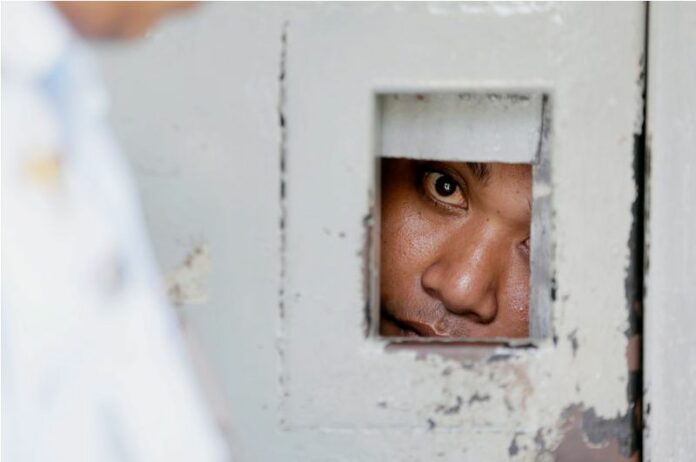
A prison guard looks through the front gate of Kerobokan prison, where death-row prisoners Australian Myuran Sukumaran and Andrew Chan were jailed in 2015 in Bali, Indonesia. EPA/MADE NAGI
BALI, Indonesia— An American man who was recaptured after escaping from an overcrowded prison on the Indonesian resort island of Bali said Wednesday he fled because of extortion by other inmates.
Christian Beasley escaped with compatriot Paul Anthony Hoffman during heavy rain on Dec. 10 from the Kerobokan penitentiary in Bali’s provincial capital by sawing through a ceiling and then climbing over a 6-meter (20-foot) -high wall behind the prison.
Hoffman, 57, from New York, who has been serving a 20-month sentence since July for robbery, was captured while trying to escape, while Beasley managed to flee and hired a motorbike driver to take him to Ubud, where he hid in a bush near a museum until midnight.
He then rode in a car to Padang Bay, a ferry port where he hired a speedboat to take him to Lombok. The 32-year-old Californian was recaptured on Saturday in an alley near a Lombok beach.
Beasley was arrested in August while allegedly trying to pick up a package containing 5.7 grams of hashish. He stood trial and the verdict was due last Tuesday, a day after his escape.
He said he has a license to use marijuana for medical reasons, but Indonesian authorities wanted him sentenced to four years or more in jail.
Appearing at a news conference Wednesday at the Badung Police station, Beasley said he was told by other inmates to pay USD $370 for security but he could not afford it and was punched in the stomach.
“They threatened me to pay protection money, that was why I left,” said Beasley, whose legs were cuffed.
“I need help, I really need help … Please help me, please help me. In my country (it) is not a crime use ganja (marijuana),” he shouted to journalists while being taken back into the jail by police.
Bali police detective Made Pramasetia said Beasley had planned to travel to East Timor before police discovered he was in Lombok through emails he sent to his mother and girlfriend.
Jailbreaks are common in Indonesia, where prisons are overcrowded with people convicted of drug crimes as part of the government’s anti-drug crusade.
Beasley’s escape was the second in Bali since June, when four foreign inmates fled through a drainage tunnel.
Two of them, Bulgarian Dimitar Nikolov Iliev and Indian Sayed Mohammed Said, were recaptured in East Timor days later and were returned to Bali. Two others, Shaun Edward Davidson of Australia and Tee Koko King bin Tee Kim Sai of Malaysia, are still at large.
Five luxury watches have been spotted on the arm of junta deputy leader Prawit Wongsuwan.
BANGKOK — An online watchdog on Wednesday spotted what looks like a fifth pricey watch on deputy junta chairman Prawit Wongsuwan’s wrist.
The discovery was made on CSI LA, a popular Facebook page that crowd-sources amateur investigations, even as the general continues to stay mum about how he acquired his multi-million baht collection of timepieces – their combined value would add up to at least 10.2 million baht – and why none of them were declared in a mandatory assets report.
“Here’s another one: Audemars Piguet Royal Oak Chronograph Automatic Blue Dial,” CSI LA wrote. “The retail price is 24,300 USD.”
An Audemars Piguet boutique at CentralEmbassy sells the watch for 613,100 baht, making it possibly the least spendy watch spotted.
Others have price tags starting at up to 3.6 million baht.
CSI LA said Prawit found it in a Matichon video of Prawit speaking at a news conference back in April.
The scandal and daily drip-drip revelations of more luxury watches have attracted widespread ridicule online.
“He’s already ‘takin’ it easy.’ From millions of baht, now it’s down to hundreds of thousands,” joked user Sanisha Net Kwanmuang, in a mocking reference to junta chairman Prayuth Chan-ocha’s demand that the media to “take it easy” on his deputy.
SURIN — A Dutch national was in police custody Wednesday on allegations he murdered his ex-girlfriend’s mother and brother in Surin province.
Rene Meeuwisser allegedly stabbed the two in a fit of jealous rage after he could not find his former partner at her family home Monday, according to the investigating officer. He said Meeuwisser denied culpability and refused to answer questions.
“There is only one possible motive for the murders,” Chetsucha Kraikaewchotiat of Sawai Police Station said. “They used to date.”
Police said the Thai woman, whose name was not released, recently broke up with Meeuwisser and cut contact with him. The Dutchman then went to her home on Monday but could not locate her, Lt. Col. Chetsucha said. An argument broke out, and police said that’s when Meeuwisser stabbed his ex’s mother and brother to death.
Officers found Meeuwisser at the hospital where he was being treated for what appeared to be deep cut wounds on his left arm, Chetsucha said, adding that the suspect blamed the injury on a motorcycle accident.
“But the wounds don’t look like it,” the lieutenant colonel said. “We have more than 90 percent of evidence tying him to the crime. Now we are waiting for DNA results. Once it’s out, it will be 100 percent.”
Meeuwisser remains hospitalized for his wounds and under police watch, he said.
Junta chairman Prayuth Chan-ocha poses for a photo Jan. 26 during his trip to Surat Thani province.
BANGKOK — Three proposals are the moving pieces which may decide how the next election plays out, who goes into it at an advantage and ultimately could allow the junta to maintain its hold on power.
The maybes in play include establishing a proxy party to represent the junta, disbanding existing political parties and allowing candidates can run as independents without any party affiliation.
All of this is making waves as familiar and controversial figures like Suthep Thaugsuban, who nominally “retired” from politics after leading the movement that paved the way for the 2014 coup, take positions in the fray.
Here’s a breakdown of the three.
Military Party
If 250 votes from junta-appointed senators aren’t enough to tip the balance in favor of re-appointing Gen. Prayuth Chan-ocha to be prime minister of a post-election government, it’s best to have the help of a real political party.
Speculation the junta and its backers are planning to roll out a new party to further their interests persists despite repeated denials and evasions by lead regime figures – most recently by Gen. Prayuth Chan-ocha on Tuesday.
Paiboon Nititawan, a former senator and member of the defunct junta-appointed National Reform Council, announced back in August 2016 that he intended to set up a new political party supporting people such as Prayuth.
Suthep Thuagsubhan, former leader of the People’s Committee for Absolute Democracy with the King as Head of State, or PCAD, has dove back in despite vowing to leave politics for good after the 2014 military coup he played an instrumental role in provoking.
Now Suthep is behind a proposal to disband all existing political parties. On Friday, he’s set to speak to the junta-appointed legislature about the need to change the law.
To build a political vehicle for itself, the junta would need a proper political platform including seasoned politicians with proven track records of delivering votes and MPs.
But that effort is unlikely to be limited only to the Paiboons of the world. It may require poaching former MPs from the Democrat Party, where once all-powerful Secretary General Suthep has long been a kingmaker.
One possible key executive in a new party could be Somsak Thepsuthin, the former head of the defunct Matchima Party (Neutral Democrat Party) who went on to hold posts as a member of the Pheu Thai Party.
Despite once being detained for a junta “attitude adjustment” session – during which he stayed well-supplied with expensive food and wine to share with other detainees and the military commanders – the influential former Sukhothai rep left Pheu Thai and recently changed his tune.
He announced Monday he was available to be recruited. Incidentally, Prayuth and his military cabinet – which has been touring the nation – will happen to be in Somsak’s Sukhothai political stronghold on Christmas Day.
Deputy Prime Minister Somkid Jatusripitak – who has a strong and enduring relationship with politicians who served former premier Thaksin Shinawatra – has been the object of speculation of heading a military proxy party. Both Somsak and Somkid have been evasive on their futures.
Somkid noted Monday that he’s over 60, suggesting he may be too old for the post, a fact which hasn’t stopped 63-year-old Prayuth, his 72-year-old deputy Prawit Wongsuwan – or speculation that Somkid would be perfect for the job.
Political commentator Chamnarn Chanruang told Khaosod English’s sister publication Matichon that Somkid is a suitable choice because he is a civilian specialized economic matters. Chamarn added that we will have to wait and see how the economy under the junta performs in the months leading to the election slated for November.
Chamnarn added that there may be more than one pro-junta or proxy party established, just in case one or two fails to be a ballot box magnet.
Party’s Over
Although Democrat Party leader Abhisit Vejjajiva said Monday that it’s okay to form a political party that supports the military, the same cannot be said about his views on rewriting elections law to disband existing parties, as his former right-hand man Suthep has resurfaced to call for.
Both Abhisit, his party and their archrivals in Pheu Thai – who were ousted in the 2014 coup – have cried foul, seeking explanations and assurances.
According to Paiboon, who is a major advocate of the move, amending the law to force all political parties to disband and register again before the election would level the playing field for newly registered parties.
The proposal has been criticized by the two major political forces as a bid to undermine their strength, particularly the Democrat Party, which claims 2.8 million members.
The party rightly fears it would be unable to reconstitute and re-register that many people in a short span of time – from whenever the junta lifts its ban hammer from politics until Election Day.
It would also be competing for members with every other party new and old trying to lure people to sign on.
Maybe this is fair. Or, maybe it is unfair for parties which have invested years – seven decades for the Democrats – to get where they are.
Going Party-Free
The third proposal – arguably the wildest – seeks to amend laws governing political parties to exempt MPs from any party membership to run as independents. Those with long memories see this taking Thai politics back to pre-1974.
Backers say such a move would free MPs from the party hegemony that dictates which way they vote. Critics say this is no liberation, as unshackling MPs from their parties would simply open them and their votes up to the highest bidder. Even weaker parties would result.
Although the media has initially linked the idea to Paiboon, the former senator disassociated himself from it Monday, saying he is not the one pushing for the move.
None of these outcomes are set, but for now, the genie seems to be out of the junta’s lamp and these factors will continue to drive the debate and speculation being put to regime leaders and pundits on a daily basis for the weeks and months to come.












































 The discovery