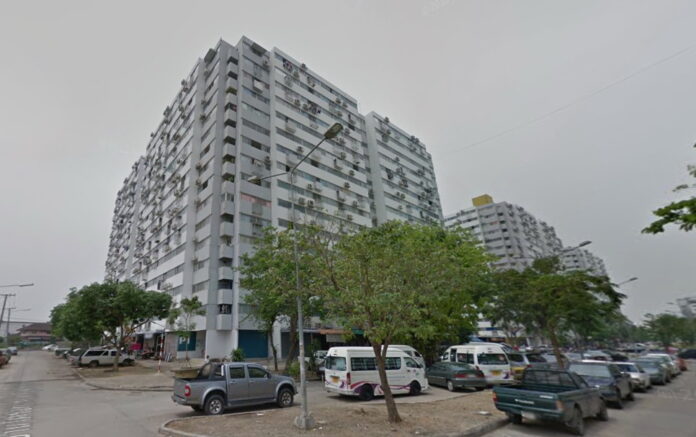
The Popular Condominium near Impact Muang Thong Thani is rented out daily to visitors of the convention center. Photo: Google
BANGKOK — A family of eight from southern Thailand said they were robbed by three masked men at a condominium where they were staying in the Muang Thong Thani housing complex early Saturday.
The family was said to be staying in four separate rooms in the complex’s Building P to visit an exhibition at nearby Impact Muang Thong Thani.
According to the victims, the gunmen kicked down the doors to the units they were renting at around 2am, took their possessions and then fled the scene.
Pak Kret Police Station chief Ritthinan Puipanthawong said officers were investigating the incident. The suspects remain unidentified.
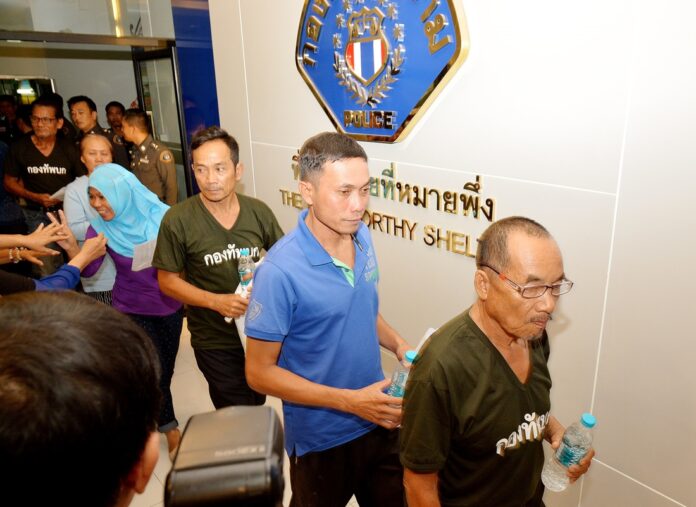
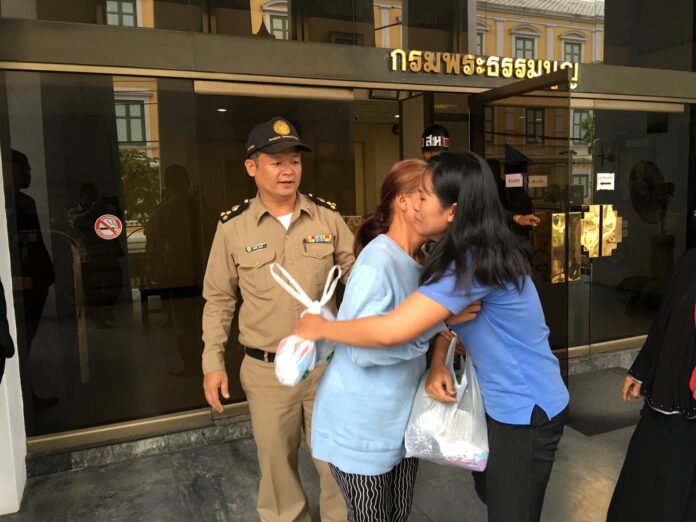
One of the alleged militants on Friday gave a hug to her supporter in front of a Bangkok military court.
BANGKOK — All of the 15 suspects arrested for allegedly plotting anti-government violence were denied bail release by the military court Friday.
The defendants, who are mostly Redshirt supporters in their 60s, stand accused of belonging to a clandestine network and conspiring in armed struggle against the state, an allegation denied by leaders of the Redshirt movement.
Thanadej Puangpoon, the attorney representing the accused, said the military tribunal ordered the 15 sent to prison even though he said they are in poor health and could not possibly interfere with any evidence.
“I explained that the suspects don’t even know who the witnesses are, so they had no way of interfering with the witnesses,” Thanadej Puangpoon, the attorney representing the accused, told reporters. “And most of the suspects are mostly in their senior age, so [being in prison] would affect their health.”
The 15 are charged with insurrection, belonging to a secret society with an intent to commit crimes, and violating the junta’s ban on political gathering.
They were taken to Bangkok Remand Prison and Central Women’s Correctional Facility. Thanadej said he hoped to apply for bail on their behalf again on Monday.
Police said they’re also looking for two other suspects in connection with the alleged clandestine ring.
Earlier today Jatupon Prompan, leader of the Redshirts’ official organization, disputed the allegation, calling it a “nonsensical farce.”
Meanwhile, Sunai Phasuk, a Human Rights Watch coordinator for Thailand, raised concerns that the suspects may not receive a fair trial, because the 15 were previously held in military detention without access to lawyers.
“It’s not transparent,” Sunai said, “Their allegation can’t be independently proven.”
He also criticized the court’s tendency to deliberate on bail request based on the nature of the crimes the suspects are charged with, instead of separately consider a bail for each of the defendants.
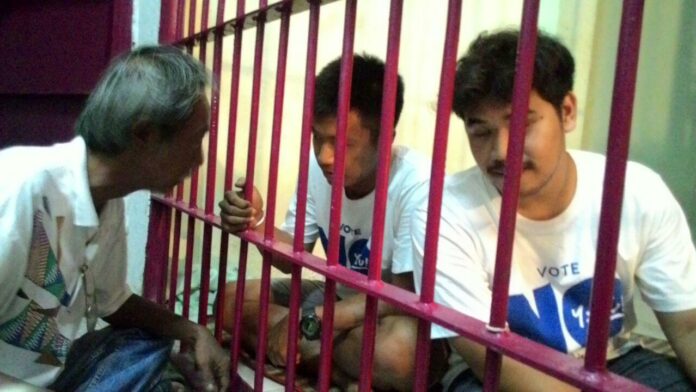
Wiboon Boonpattararaksa talks to his son Jatupat Boonpattararaksa, at center, on Aug. 6 at a police station holding cell in Chaiyaphum province. Jatupat was on a hunger strike to protest his arrest for campaigning against the charter. Photo: Thai Lawyer for Human Rights
BANGKOK — A hunger striking activist who was ordered free by a court today was instead taken before a military tribunal on a 2015 charge stemming from holding an anti-coup banner.
A leader of the northeastern activist group Dao Din, Jatupat ‘Phai’ Boonpattararaksa was originally expected to be freed from Phu Khiao Prison in Chaiyaphum province late Friday afternoon after the court approved to his release on the condition he cannot leave the country.
Jatupat had been on a hunger strike since his arrest two weeks ago for campaigning against the charter.
At 5pm Friday, police arrived at the prison to take him to Khon Kaen military court for another charge from last year. It stemmed from a May 2015 rally at Khon Kaen’s Democracy Monument at which seven Dao Din members displayed a banner which said “oppose the coup.”
Before departing to Khon Kean, Jatupat’s mother, Prim Boonpattararaksa, asked to meet her son to let him sign his university enrollment forms, but police refused.
The mother along with Jatupat’s sister then tried blocking the police vehicle, pleading with the officers in tears. After an hour, police let Prim meet her son to sign the document.
Jatupat was arrested Aug. 6 at a market in the northeastern province Chaiyaphum where he was distributing leaflets against the draft charter. He was charged for violating the Referendum Act.
The 25-year-old activist began his hunger strike immediately after he was imprisoned and refused to post bail in protest of what he said was the illegitimacy of the charges.
Fellow activist Wasin Prommanee, who was arrested at the same time, was freed on a bond.
Wiboon Boonpattararaksa, Pai’s father and lawyer, on Friday morning at Chaiyaphum’s Phu Khaio Provincial Court.
A number of rights groups, such as Human Rights Watch, had urged the government to free Jatupat, especially after he was reported to be in poor health condition following the strike.
His father, Wiboon Boonpattararaksa, a lawyer who is representing his son, staked his license and 30,000 baht to cover the 150,000 baht bond.
Wiboon said he briefly talked to his son in the court. Phai said he would end his hunger strike after he’s released.
Jatupat and Wasin are to testify in court on Monday.
A school utility worker mops a mural depicting the missing Malaysia Airlines Flight 370 at the Benigno "Ninoy" Aquino High School campus at Makati city, east of Manila, Philippines On April 8, 2014. Photo: Bullit Marquez / AP)
CANBERRA, Australia — Experts hunting for the missing Malaysian airliner are attempting to define a new search area by studying where in the Indian Ocean the first piece of wreckage recovered from the lost Boeing 777 — a wing flap — most likely drifted from after the disaster that claimed 239 lives, the new leader of the search said.
Officials are planning the next phase of the deep-sea sonar search for Malaysia Airlines Flight 370 in case the current two-year search of 120,000 square kilometers (46,000 square miles) turns up nothing, said Australian Transport Safety Bureau chief commissioner Greg Hood, who took over leadership of the bureau last month.
However, a new search would require a new funding commitment, with Malaysia, Australia and China agreeing in July that the $160 million search will be suspended once the current stretch of ocean southwest of Australia is exhausted unless new evidence emerges that would pinpoint a specific location of the aircraft.
“If it is not in the area which we defined, it’s going to be somewhere else in the near vicinity,” Hood said in an interview this week.
Further analysis of the wing fragment known as a flaperon found on Reunion Island off the African coast in July last year — 16 months after the plane went missing — will hopefully help narrow a possible next search area outside the current boundary.
Six replicas of the flaperon will be sent to Australia’s Commonwealth Scientific and Industrial Research Organization’s oceanography department in the island state of Tasmania where scientists will determine whether it is the wind or the currents that affect how they drift, Hood said. This will enable more accurate drift modeling than is currently available.
If more money becomes available, the Australian bureau, which is conducting the search on Malaysia’s behalf, plans to fit the flaperons with satellite beacons and set them adrift at different points in the southern Indian Ocean around March 8 next year — the third anniversary of the disaster — and track their movements.
Meanwhile, barnacles found on the flaperon and an adjacent wing flap that washed up on Tanzania in June are being analyzed for clues to the latitudes they might have come from. The flap is in the Australian bureau’s headquarters in Canberra where it has been scoured for clues by accident investigators.
Peter Foley, the bureau’s director of Flight 370 search operations since the outset, said the enhanced drift modeling would hopefully narrow the next search area to a band of 5 degrees of latitude, or 550 kilometers (340 miles).
“Even the best drift analysis is not going to narrow it down to X-marks-the-spot,” Foley said.
Some critics argue that the international working group that defined the current search area — which includes experts from the U.S. National Transportation Safety Board, Britain’s Air Accidents Investigation Branch, the plane’s manufacturer Boeing, Australia’s Defense Science and Technology Group, satellite firm Inmarsat and electronics company Thales — made a crucial mistake by concluding that the most likely scenario was that no one was at the controls when the plane hit the ocean after flying more than five hours.
The airliner veered far off course during a flight from Kuala Lumpur, Malaysia, to Beijing. What happened to the plane has become one of the biggest mysteries in aviation, with a wide range of theories, including that a hijacker could have killed everyone on board early in the flight by depressurizing the plane.
The current search area was defined by analysis of a final satellite signal from the plane that indicated it had run out of fuel. Scientists have determined how far the plane could have travelled from a height of up to 12,200 meters (40,000 feet) after both engines lost power.
But critics who favor the theory that Captain Zaharie Ahmad Shah hijacked the plane argue that he could have glided the plane beyond the current search area. Some say he could have made a controlled ditch at sea in order to minimize debris and make the plane vanish as completely as possible. Officials say Zaharie flew a similar route on his home flight simulator only weeks before the disaster.
Foley said his bureau’s analysts were working on the flap to ascertain whether or not it was deployed when the plane hit the water. They will test their hypothesis with the Boeing accident investigation team to validate their findings.
Recent analysis of the final satellite signals also suggest the plane was descending at a rate of between 3,700 meters (12,000 feet) and 6,100 meters (20,000 feet) a minute before it crashed. A rate of 600 meters (2,000 feet) a minute would be typical of a controlled descent.
“The rate of descent combined with the position of the flap — if it’s found that it is not deployed — will almost certainly rule out either a controlled ditch or glide,” Foley said.
“If it’s not in a deployed state, it validates, if you like, where we’ve been looking,” he said.
Crews have not given up hope of finding the plane in the current search area, which because of bad weather and 20-meter (65-foot) swells could take them until December to finish scanning.
Less than 10,000 square kilometers (4,000 square miles) of seabed, which is outside the original 60,000-square-kilometer (23,000-square-mile) high-priority search zone, remain to be searched.
More than 20 sonar contacts require closer examination by a sonar-equipped underwater drone. These are between 2,700 kilometers (1,700 miles) and 1,900 kilometers (1,200 miles) from the Australian port of Fremantle where the search ships are based.
“We are still hopeful and optimistic,” said Hood.
Foley said finding the plane was the only chance of the solving the mystery of what happened aboard Flight 370.
“We will never know what happened to that aircraft until we find it,” Foley said.
An army escort on Wednesday drives Sakarin Karuehat (in orange) to a police station in Nakhon Si Thammarat. He was released a day later.
NAKHON SI THAMMARAT — A 32-year-old Chiang Mai man accused of participating in the wave of terror attacks in southern Thailand last week has been released from military custody, police said Friday.
But police said they will file explosives-related charges against Sakarin Karuehat next week, and this time, the case will be filed in a military court, where army officers sit as judges and no appeal is possible. He was previously held incommunicado for nearly a week in a Nakhon Si Thammarat army base on suspicion of firebombing a supermarket there.
“We will probably ask the provincial military court for a new arrest warrant by Monday or Tuesday,” said Tesa Siriwatho, commander of the regional police force.
Sakarin has been at the center of a controversy that plagued the bombing investigation since it got off the ground. The swift arrest of Sakarin, who works on a oil rig in Gulf of Thailand, was slammed by some critics of the junta, and even the top police investigator, as sloppy police work. But the authorities contend they have evidence to implicate the man.
According to Lt. Gen. Tesa, police initially asked for an arrest warrant on Sakarin from a civilian court because they thought the attack on the Tesco Lotus was arson at the time.
“But after we collected evidence at the crime scene, we concluded that it was a [fire] bomb attack,” Tesa said. “So we have to cancel the outstanding warrant, and ask for a new one from the military court.”
Sakarin is accused of placing a firebomb inside the supermarket prior to the explosion on Aug. 12. Police said they have footage of him entering the venue with a plastic bag and later leaving without it.
But deputy police commander Srivara Ransibrahmanakul, who’s nominally leading the investigation, was reportedly upset about the flimsy evidence against Sakarin.
“When it comes to an investigation, you should think with your mind and not your damn feet, because this is an important and sensitive matter,” Srivara reportedly said on Tuesday to police officers in Nakhon Si Thammarat.
Some of the wounded tourists at a hospital in Hua Hin following the Aug. 11 explosion.
BANGKOK — A number of security analysts said the evidence now suggests beyond a reasonable doubt that insurgents fighting for independence in the Deep South were behind the bomb attacks in southern Thailand last week.
While the authorities continue to insist that the ethnic-religious conflict had nothing to do with the bombings which hit on the Queen’s birthday, the scholars point to methods and motives they say leaves the Barisan Revolusi Nasional, or BRN, the only viable perpetrators.
“It’s likely the southern insurgents,” Rungrawee Chalermsripinyorat, a researcher who focuses on the Deep South violence, said at a panel discussion held Wednesday. “But of course they do not call themselves insurgents. They call themselves juwae, which is a Malay word that means fighters.”
Speaking at the same panel organized by the Foreign Correspondent’s Club of Thailand, security analyst Anthony Davis said other possible candidates such as the Redshirts or a military faction can be ruled out, because the former couldn’t plan such a large-scale attack under intense surveillance, and the timing of the attack – just after the junta’s charter draft was endorsed by a landslide – ruled out the latter.
“In my opinion, it’s just common sense,” said Davis, who works for IHS Jane’s. “It doesn’t require expertise at all. All I did was simply to connect the dots.”
In a separate interview on Wednesday, Srisompob Jitpiromsri, director of Deep South Watch, also said he’s convinced the Deep South militants are the ones to blame.
“It’s clear quite clear. The evidence point that way,” Srisompob said.
Rungrawee, Davis and Srisompob went as far as naming the group that’s most likely responsible: the BRN, which means National Revolutionary Front and is often described by the authorities as the most active and well-armed southern separatist cell.
The military driving the investigation seems to disagree. On Thursday it announced the arrest of 15 Redshirt supporters, mostly in their 60s and 70s, and accused them of having ties with the bombers. The army backtracked on its claim a day later.
A Resume of Terror
Despite popular understanding, the BRN has a history of organizing attacks outside their home provinces of Pattani, Narathiwat and Yala, according to Rungrawee, Davis and Srisompob.
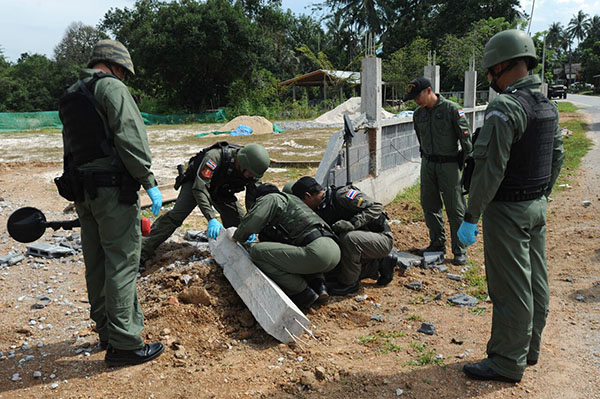
The aftermath of a roadside bomb attack in Narathiwat province in December 2014.
Founded in 1963, the group is committed to reviving the independent state of Patani, which was annexed by Bangkok over a hundred years ago, while maintaining strict secrecy about its structure.
Previous attacks thought to have been carried out by the BRN include a failed car bomb on Phuket in 2013 and a successful one on Koh Samui in 2015. The BRN was also blamed for previous waves of small, coordinated bomb attacks in the southern region.
“They have been practising this for years,” Davis said. “Instead of another car bomb, they go back to what they’re good at.”
Rungrawee said the notion that tourist destinations were never touched by the BRN are false.
“They like to target tourist sites, shopping malls, nightlife areas that they see as sinful places, and landmarks associated with the state,” she said.
Another issue is the escalation of attacks, which surprised many observers because previous coordinated attacks only took place within the Deep South provinces. But Srisompob said it’s simply the matter of the same thing on a different scale.
“If we look at the details, the methods aren’t different, it’s just they were carried out outside the region,” he said. “The bombs are not large. They are roughly same size. It’s just they plant them in more locations. It’s their tactics that change.”
Rungrawee said an earlier example of such coordinated attacks was the seven small bombings in Bangkok on New Year’s Eve 2007.
The bombs used in the attacks last week also bore hallmarks of the BRN, according to the three experts: Small, improvised devices with timers set by mobile phones bought from Malaysia.
An Offer You Can’t Ignore
Davis named two motives that could have spurred the militants to stage the attacks last week. One was the Aug. 7 referendum on the junta’s constitution draft, which the BRN opposed, as marked by a dramatic increase in IED attacks in early August, peaking the weekend of the vote. The insurgents also left graffiti denouncing the vote and the charter, Davis noted.
The constitution, which was endorsed by a large margin but rejected in the Deep South, caused particular anger among the Muslim-majority populace there because it conferred special, protected status to Buddhism.
Another possible motive was the lack of progress in negotiations, which the BRN said must include international mediation.
“But such a demand is anathema to the Thai governments, especially the military government, which wants to keep the issue domestic,” Davis said.
His view is shared by Srisompob, who suspected that the Mother’s Day bombings were staged to prod the military government back to the negotiation table. “I think they want to make news … I think they were upset about the peace talk. It had grounded to a halt.”
Davis also feared that the attacks could have been engineered by the younger generations of BRN fighters who, upset by the long years of warfare that has been raging since 2004, want to launch an endgame that exceeds all previous scales.
“What we saw was a watershed moment,” Davis said. “The BRN has crossed the Rubicon, which is dangerous,”
According to the analyst, the group will likely mount another attack if the state continues to ignore them and blame it all on unrelated but more convenient scapegoats like the Redshirts. “They didn’t cross the Rubicon just to go home,” he said.
Police on Friday escort the 15 suspects to the Crime Suppression Division in Bangkok for interrogation and news conference.
BANGKOK — Despite its previous statement to the media, the military now says 15 people under arrest for allegedly plotting insurrection against the state had nothing to do with the bomb attacks in the south last week.
Officials said they have solid cases against the suspects – all described by authorities as members of the Redshirt movement – though a Redshirt leader called the arrests groundless “nonsense.”
According to deputy junta chief Prawit Wongsuwan, the 15 suspects under custody attempted to “cause unrest” with their anti-government activities, but they had no connection with the fatal bombings of Aug. 11-12. He also said it’s not possible that the military might have arrested wrong people.
“Let me ask you, if we arrest wrong guys, how could the court issue the arrest warrants?” Gen. Prawit told reporters Friday. “And let me stress that these warrants are not related to the incidents of bombings in the seven southern provinces.”
A military court on Thursday issued arrest warrants for a total of 17 people, 15 of whom were already in military custody, while the other two had been previously detained and then released later.
In a statement released to all mainstream media agencies on the same day, the military accused the suspects of belonging to a newly formed clandestine group called Revolution for Democracy Party, a group linked to last week’s bomb attacks.
Apart from Prawit, a police investigator also disputed that link at a Friday news conference.
Maj. Gen Chayapol Chatchaidet, commander of Bangkok police’s Sixth Division, said all of the suspects were members of the militant group but they denied any relation with the recent bomb attacks.
“And evidence has not uncovered any connection so far either,” Chayapol said.
The 15 suspects are held at the 11th Army District headquarters, a Bangkok army base converted into a military prison. Chayapol said attorneys from the Lawyer Council of Thailand have been appointed to represent them in military court.
Redshirts Slam Arrests
Jatupon Prompan, chairman of the Redshirts’ umbrella organization, said the military’s allegation is baseless.
“How could it be real? It isn’t real, this Revolution for Democracy Party,” Jatupon said in a livestream on his Facebook Friday. “It’s just farcical nonsense.”
He also questioned whether it’s even possible that the suspects, who are mostly in their senior years, could have plotted such a militant operation.
“I ask you, in the reality, can it be possible?” Jatupon said. “I once sat down and talked with some army officers. They told me, some people had the idea of doing that. So, if they have an idea of going to Mars, is the military going to fight them?”
The 15 suspects currently held in military custody are:
Police Sen. Sgt. Maj. Sirirat Manorat, 71 of Phatthalung
2. Weerachut Chansa-art, 62 of Chanthaburi
3. Prapas Rojanapitak, 67 of Trang
4. Pramote Sanghan, 63 of Satun
5. Sorasak Ditpreecha, 49 of Bangkok
6.Meena Saengsri, 39 of Bangkok
7.Siritharoj Jinda, 56 of Nong Khai
8. Shinnaworn Thipnuan, 71 of Chiang Rai
9. Narong Phadungsaksri, 60 of Ang Thong
10. Sorawat Kurajinda, 60 of Maha Sarakham
11. Nueaphrai Senklang, 41 of Sakon Nakhon
12. Wichien Jiamsawas, 59 of Nakhon Sri Thammarat
13. Boonphob Wiengsamut, 61 of Chiang Rai
14. Rujira Saosomphob, 52 of Roi Et
15. Wiroj Yodcharoen, 67 of Nakhon Sri Thammarat
The two suspects said to be on the run are Police Sub. Lt. Wilaiwan Koonsawat, 54 of Nong Khai and Police Lt. Samai Koonsawat, 57 of Nong Khai.
Usain Bolt from Jamaica poses for photographers with the Jamaican flag Thursday after winning the gold medal in the men's 200-meter final, during the athletics competitions of the 2016 Summer Olympics at the Olympic stadium in Rio de Janeiro. Photo: Matt Slocum / Associated Press
RIO DE JANEIRO — Usain Bolt and Ryan Lochte commanded the Olympic spotlight Thursday for drastically different reasons.
Bolt completed an unprecedented third consecutive sweep of the 100- and 200-meter sprints, an accomplishment that further elevated his status as the most decorated male sprinter in Olympic history. He won the 200-meter race with a time of 19.78 seconds to defeat Andre de Grasse of Canada. He already claimed gold in the 100 in Rio.
Bolt did a lengthy victory lap around the stadium, proudly carrying a Jamaican flag and even taking a selfie as he jubilantly celebrated the win in what he has long said is his favorite race.
“I’ve proven to the world I’m the greatest,” Bolt said. “This is what I came here for. That’s what I’m doing. This is why I said this is my last Olympics — I can’t prove anything else.”
For all of the Olympic fanfare surrounding Bolt’s win, American swimmer Ryan Lochte and three of his teammates attracted attention for all the wrong reasons.
Lochte has been in the news all week over his ever-shifting claim that he and his teammates were robbed in a taxi at gunpoint by men carrying a badge during a night of partying Sunday. Police now say the story was made up, and that the intoxicated athletes vandalized a gas station bathroom and were questioned by guards about the incident before they paid about $50 for the damage and left.
In this Sunday frame from surveillance video released by Brazil Police, swimmer Ryan Lochte, second from right, of the United States, and teammates, appear at a gas station during the 2016 Summer Olympics in Rio de Janeiro, Brazil. A top Brazil police official said the swimmers damaged property at the gas station. Photo: AP
The episode served as a distraction from several notable events in competition Thursday, including another haul of American medals in track and field, Jordan’s first Olympic championship — in men’s taekwondo — and the U.S. women’s basketball team advancing to the Summer Games final yet again.
The U.S. track and field team is on a magnificent run in Rio. Americans took gold in the men’s and women’s 400-meter hurdles. They had a 1-2 finish in men’s shot put. Ashton Eaton, largely considered the world’s greatest all-around athlete, won gold in decathlon for the second straight Olympics. The feat may have garnered more attention if he weren’t sharing the stage with Bolt.
That’s 24 medals for the United States in track and field, including eight gold.
Brazil picked up two more gold medals, one in sailing and the other in beach volleyball. The men’s volleyball team of Alison and Bruno set off a boisterous celebration in the rain on Copacabana Beach when they won the title match. Earlier in the day, the host country claimed gold in sailing after a dramatic finish in the women’s 49erFX event. The winners tumbled into the bay as they celebrated the win.
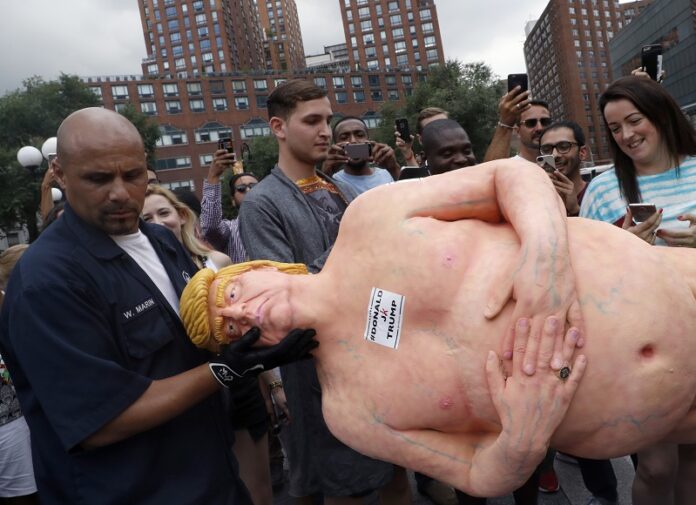
An employee of the New York City Department of Parks and Recreation removes a statue of a naked Republican presidential candidate Donald Trump on Thursday at the New York's Union Square. Photo: Mary Altaffer / Associated Press
CHARLOTTE, N.C. — For the first time since declaring his presidential run, Republican Donald Trump acknowledged that his caustic comments may have caused people pain, saying that he regrets some of what he’s said “in the heat of debate.”
A day after announcing a campaign shake-up and as he trails in the polls, the GOP nominee said that he recognized that his comments — which have angered minorities and alienated large swaths of the general election electorate — may have been ill-advised.
“Sometimes in the heat of debate and speaking on a multitude of issues, you don’t choose the right words or you say the wrong thing. I have done that,” the GOP nominee, reading from prepared text, said at a rally in Charlotte, N.C. “And believe it or not, I regret it — and I do regret it — particularly where it may have caused personal pain.”
He added that, “Too much is at stake for us to be consumed with these issues.” As the crowd cheered, Trump pledged to “always tell you the truth.”
The remarks came as Trump was trying to rescue a campaign that has struggled since the Democratic and Republican nominating conventions from a series of self-created distractions. Early Wednesday, Trump announced that he was overhauling his operation, bringing in a new chief executive and appointing a new campaign manager.
Rarely do presidential campaigns wait to advertise, or undergo such leadership tumult, at such a late stage of the general election.
Yet Trump has struggled badly in recent weeks to offer voters a consistent message, overshadowing formal policy speeches with a steady stream of self-created controversies, including a public feud with an American Muslim family whose son was killed while serving in the U.S. military in Iraq.
Trump’s decision to tap Stephen Bannon, a combative conservative media executive, as his new campaign chief, suggested to some that he planned to double down on the playbook he used in the primary, playing to his angry rally crowds and bouncing from one controversy to the next.
Instead, a new Trump emerged on Thursday: a less combative, more inclusive candidate who said he was running to be the “voice for every forgotten part of this country that has been waiting and hoping for a better future” and for those who “don’t hear anyone speaking for them.”
Earlier Thursday, Trump moved to invest nearly $5 million in battleground state advertising to address daunting challenges in the states that will make or break his White House ambitions.
The New York businessman’s campaign reserved television ad space over the coming 10 days in Florida, North Carolina, Ohio and Pennsylvania, according to Kantar Media’s political ad tracker. While Democrat Hillary Clinton has spent more than $75 million on advertising in 10 states since locking up her party’s nomination, Trump’s new investment marks his first of the general election season.
Election Day is 81 days away, with early voting in the first states set to begin in five weeks.
In his remarks, Trump struck a new, inclusive tone and tried to appeal directly to non-white voters, shown by polls to an overwhelmingly unfavorable view of the candidate.
“I will not rest until children of every color in this country are fully included in the American Dream,” Trump told his audience, again accusing Democratic Hillary Clinton of “bigotry.”
Clinton, he claimed, “sees communities of color only as votes and not as human beings worthy of a better future.”
He urged African-American voters to give him a chance, saying: “What do you have to lose by trying something new?”
Clinton’s campaign, meanwhile, brushed the speech off as just words he read from a teleprompter.
“Donald Trump literally started his campaign by insulting people. He has continued to do so through each of the 428 days from then until now, without shame or regret,” said spokeswoman Christina Reynolds in a statement.
“We learned tonight that his speechwriter and teleprompter knows he has much for which he should apologize. But that apology tonight is simply a well-written phrase until he tells us which of his many offensive, bullying and divisive comments he regrets_and changes his tune altogether,” she said.
It remains to be seen whether Trump’s reboot comes too late, and whether he has the discipline to maintain it.
Trump now trails Clinton in preference polls of most key battleground states. And his party leaders, even at the Republican National Committee, have already conceded they may divert resources away from the presidential contest in favor of vulnerable Senate and House candidates if things don’t improve.
But Trump supporters largely accepted the change of tone, even if some saw it as unnecessary.
“It takes a lot of strength to say, ‘I’m sorry, ‘ to admit — not that he was wrong, but he wished he hadn’t done it,” said Cindy Ammons, 70, a Trump supporter from Spindale, North Carolina,
Think of those house parties when your mates’ parents were on vacation. The ones where everyone was drunk, people made out in the bathroom, the music blasted and the neighbors complained. Hedonism to the fullest.
There’s a crew in town who has mastered recreating that feeling, but with better music every month at Kontraband. This Saturday night, head to Dark Bar where Kontraband DJs Azek, Delorean and Will will be calling the shots at their regular monthly thing.
“For our nights, we always bring extra sound,” Azek explains, laughing. “The shop next to Dark Bar always complains about their furniture falling over from the heavy bass.”
On this week’s Notes From the Underground, we meet the team behind what is one of Bangkok’s best-kept secrets.
By day, all three work in the creative marketing world and use this expertise to brand the event in a quirky and fun way. Their adverts take a guerrilla marketing approach, poking fun of current topics and even themselves.
“We try to push things as far as we can go without anyone getting annoyed,” Delorean says of the posters he makes. “Dark Bar has always been supportive of us, and we consider this as our home.”
The monthly event at Dark Bar is heavy on bass music, an umbrella term used to describe hybrid styles of electronic music (techno, house, dubstep, dnb) that came after dubstep’s peak in 2009.
As a bass music event, Kontraband sees the three DJs playing an eclectic selection of beats, each member contributing their own unique sound to Kontraband.
It’s said that two heads are better than one, but in Kontraband’s case, they say three is best.
In the DJ booth, Azek tends to focus more on the minimal side of dnb. While Delorean is a showman and known for fast-paced explosive mixing, his tune selection ranges from Jungle to Rage Against the Machine. Will, the quiet one, gets mad props as the most hardcore track digger of the three, meaning he always electrifies the crowd with fresh beats no one’s heard before.
The crew all hail from Europe but have been in Bangkok over 10 years and consider it home.
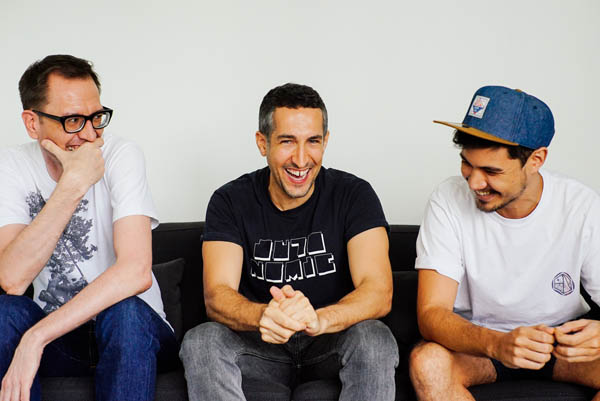
DJ Azek, aka Frenchman Jeremy Guessoum, is marketing director at digital marketing agency Grey Alchemy. DJ Delorean, aka Thai-British James Gilbody, is part owner of creative services company Invisible Ink. Rounding out the trio is DJ Will, aka Guillaume Popineau, a former French language teacher now a part of Grey Alchemy.
From left, DJs Will, Azek and Delorean. Photo: Kontraband / Courtesy
Get ready to get grimy and check out Kontraband when they rock Dark Bar again Saturday. Extra bass will be provided courtesy of them, but be warned Dark Bar is a small venue so prepare to pack it in like a can of sardines, though that’s okay because Dark Bar parties tend to be just as fun outside.
The party starts at 9pm and goes to 3am at Dark Bar, located on the second floor of the Ekkamai Shopping Mall on Soi Ekkamai 10. Door is 200 baht, but that comes with a shot of Absolut if there’s any left when you get there.
If you see me there on dance floor or outside the club come and holla at me. Until then, Dub be good to you.




































 The constitution, which was endorsed by a large margin but rejected in the Deep South,