28.8 C
Bangkok
Wednesday, September 16, 2026
Home Blog Page 1940

American Vet Cuts Off Arm to Escape Meat Grinder

Photo: John Giacamoni

JAMESTOWN, North Dakota — A 69-year-old Vietnam vet who lost a hand after it got stuck in a meat mixer while he was making sausage at his North Dakota home says he had to slice off his left arm above the wrist with a butcher knife or risk bleeding to death.

In his first public comments since the Aug. 17 accident, Myron Schlafman said he credits two police officers with saving his life by quickly applying a tourniquet before ambulance crews took him to the hospital.

“I’ve always appreciated life, but not as much as I do now,” he told KFGO radio.

Schlafman said he was taking a chunk of meat out of the mixer in the garage of his Jamestown home when he accidentally stepped on a pedal to activate the machine.

“I just looked and knew I was in big trouble,” said Schlafman, who is right-handed.

In this Sept. 25, 2018 photo, Myron Schlafman demonstrates how his arm got caught in the meat mixer Jamestown, North Dakota. Photo: KFGO Radio / via AP

The bone was severed, but his arm was still caught by muscle, nerves and skin. He grabbed the knife, which was mercifully within reach, and cut himself free.

“If I would have hesitated, I would have stood right there and bled to death,” he said.

Schlafman spent nine days in the hospital and underwent three surgeries. He will be fitted with a prosthetic in a few months, after the stump on his left arm has fully healed.

“It would be very easy to sit back, feel sorry for myself and get depressed,” he said. “I went through Vietnam. I can handle this.”

Advertisement

People Line Streets of Hanoi to Mourn President Quang

An army officer salutes as a flag-draped coffin of late President Tran Dai Quang passes on a truck-drawn artillery carriage Thursday in Hanoi. Photo: Tran Van Minh / Associated Press

HANOI — Thousands of people lined the streets of Hanoi on Thursday to pay their last respects to Vietnam’s late President Tran Dai Quang.

Many were using smart phones to catch glimpses of his flag-draped coffin as it passed by on a truck-drawn artillery carriage.

Quang died last week at 61 of what a government doctor said was a rare viral illness.

In a eulogy, Communist Party Chief Nguyen Phu Trong said Quang’s passing was a great loss to the country and praised his contributions to the nation.

Trong said Quang, who was public security minister before becoming president, had helped to “uncover and prevent many sabotage plots of the hostile and reactionary forces and other criminals.”

As president, Quang, along with other leaders, sped reforms to develop Vietnam’s socialist market-oriented economy and worked to heighten Vietnam’s international role, Trong said.

Cambodian Prime Minister Hun Sen and South Korean Prime Minister Lee Nak-Yeon were among dignitaries who paid their respects as Quang’s body lay in state at the National Funeral House.

He was to be buried in his home village in northern Ninh Binh province later Thursday in accordance with his family’s wish instead of the Mai Dich Cemetery in Hanoi where most of the high-ranking officials were buried.

Quang became minister of public security in 2011 and was elected by the National Assembly as the nation’s president in 2016.

Vice President Dang Thi Ngoc Thinh has been named acting president, the country’s first woman to hold that position. No date has been given for the election of a new president.

Advertisement

Before Wild Boars, the Untold Rescue of 4 Cave Rescuers

Diver John Volanthen arrived in July at Tham Luang Nang Non.

BANGKOK — There were a host of heroes in July’s dramatic rescue of 13 members of a youth soccer team from a cave in northern Thailand … and then there were the hapless would-be helpers from the Thai Well Water Association.

It turns out that 17 people in all were rescued by the expert foreign cave divers who rushed to lend their unique abilities to save the boys and their coach.

The story of the first four people to be rescued— barely reported and now mostly forgotten — was recounted Wednesday by the association’s president, Surapin Chaichompoo, who explained how he and three employees spent two days draining water from the cave in an attempt to help the rescue, took a nap, and found themselves trapped inside with the water rising.

He said that on their third day of being trapped, two British divers searching for the boys stumbled upon them and improvised a rescue, taking them out one by one after giving them a 30-minute crash course in diving. Surapin said they made their way through the murky waters by swimming and sometimes walking, trying to avoid sharp obstacles in the low visibility.

Surapin said he was unable to contact them afterward, but would still like to thank them.

“I really owe my life to these two divers. They were here to help the 13 people but I got stuck first after I went in to work. If they didn’t save me that day, I wouldn’t be here today,” Surapin said by phone from the northern city of Chiang Mai. “The same for the other three people. I really owe them, the two divers John and Richard. If they are abroad, I will fly over to personally thank them myself.”

The tale of the little-known first rescue resurfaced Saturday when Rick Stanton — who with diving buddy John Volanthen discovered the four on June 28, and the cave boys on July 2 — gave a talk at the annual “Hidden Earth” conference of British cavers in North Somerset in England, according to a report on the website Darkness Below, which carries news for underground explorers.

The two divers had arrived at the cave site just the day before they found Surapin and team.

“The foreign divers came here as volunteers. They are confident in their abilities.” said Surapin, who noted the amount of specialized equipment they carried. “You have to understand that these foreigners have a bit of crazy in them. They like to do crazy things. But they are very good at diving.”

Surapin and his group were part of an early group of helpers who rushed in before the rescue effort was properly organized. The others working inside the cave were apparently not as tired, however.

“When I woke up I thought to myself ‘Why is the cave half-flooded?’ So I ran out to look toward the entrance,” Surapin said. “I looked back and ran to the high mound where we were sleeping. It turned out everyone had left and it was only the four of us left. I told my guys ‘wake up, wake up.'”

Surapin said the group was not immediately worried if the waters did not rise further, because they had enough food and supplies to last a month.

Still, there were announcements to evacuate the cave and its surroundings because water levels began to rise again.

“I was telling my guys, if it can rise it can decrease. It will probably decrease in the morning,” Surapin said. “But no, the amount of water kept increasing.”

At one point, Surapin said, he began to hear clanking noises under the water that he later found out was the sound of the British divers and their oxygen tanks knocking against the cave’s walls.

“The sound was coming from the cave’s entrance and it was getting louder and louder,” he recalled. So he began throwing rocks into the water.

“The first rock I threw in didn’t get a reaction. The sound of clanking tanks was still soft,” he said. “So I threw another one. This time, the clanking noises got really loud and we heard clanking non-stop. After that I saw a flashlight begin to surface and told the guys ‘hey, there really is someone here.'”

He said when the divers found his group, “They thought they found 13 people. I told them ‘no, it’s four.’ They said ‘OK, oh my God.'”

Surapin said his three employees now say they will never go near a cave again.

“If you want me to go up a tree, I’ll go up a tree,” vowed one. “But no caves anymore, they’re scary.”

Story: Kaweewit Kaewjinda

Advertisement

Bank Promises to Fix ‘Blinding’ Bangkok Tower

Photo: To_moddang / Twitter

BANGKOK — A commercial bank on Wednesday said it would look into complaints its office tower is blinding residents.

SME Development Bank, whose headquarters are in Bangkok’s Phaya Thai business district, promised a remedy after pictures of the sun reflected from its windows went viral on social media.

“We apologize for the inconvenience that the reflected light troubles you. We are sorry,” the bank wrote in a reply to one of the complaining residents. “We will call a meeting to find ways to solve this.”

The issue was first brought to attention when Twitter user To_moddang wrote to popular news site JS100.

“@Js100radio I don’t know what building this is. It’s next to Pearl Building, Phahon Yothin,” To_moddang tweeted Tuesday. “It reflects sunlight causing people in buildings on the Ratchayothin side to suffer. Our eyes and heads are aching. Very dangerous!”

A city planning official told the media Wednesday that the 24-year-old building would be inspected to see whether its materials are indeed causing harm to the public. If so, the bank must fix it or face closure, department head Noppadol Chaipanya said.

The issue was taken less seriously on social media, where it didn’t take long for someone to compare it to the flame-wreathed tower of Barad-dur from the “Lord of the Rings” films.

Advertisement

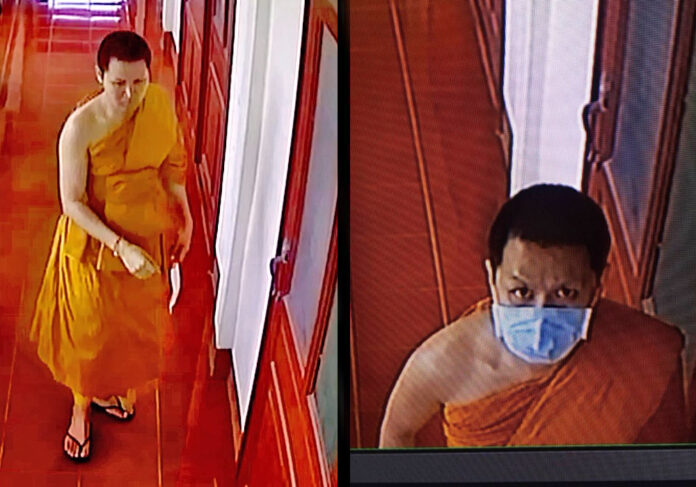
Monk-Thief Alleged to Be Serial Temple Burglar

A Chiang Mai temple burglar police identified as Panupong Lakornsri, who has been a monk for most of his life, in still images taken from a security camera.

CHIANG MAI — By day he was a Chiang Mai monk. By night, police said, Panupong Lakornsri was a serial temple raider, who stole 230,000 baht in his latest burglary.

The 26-year-old man was arrested Tuesday, two days after he allegedly broke into the abbot’s room at Wat Ban Pong to steal while the temple was hosting a religious event. He was caught in the act by a security camera.

Police said he confessed to stealing 230,000 baht from the temple, located in the northern province’s Hang Dong district, and had already spent about 170,000 baht to pay off debts. He said he fled to a temple in Lampang province and voluntarily left the monkhood.

According to police, Panupong spent most of his life in an orange robe since being ordained about 20 years ago. They also said he’d robbed many temples in Chiang Mai and Bangkok to fund more material pursuits including a car and mobile phones.

Angry community members turned out to a staged police “reenactment” of Panupong’s alleged crime on Wednesday and had to be restrained from assaulting him.

He’s accused of going temple to temple, asking to join their religious events – when collections run high – as a pretense to sneak in and steal money.

Advertisement

Thai Entrepreneur Convicted in Bogus Bomb Detector Scam

Soldiers in Pathani province display the GT200 in 2010.

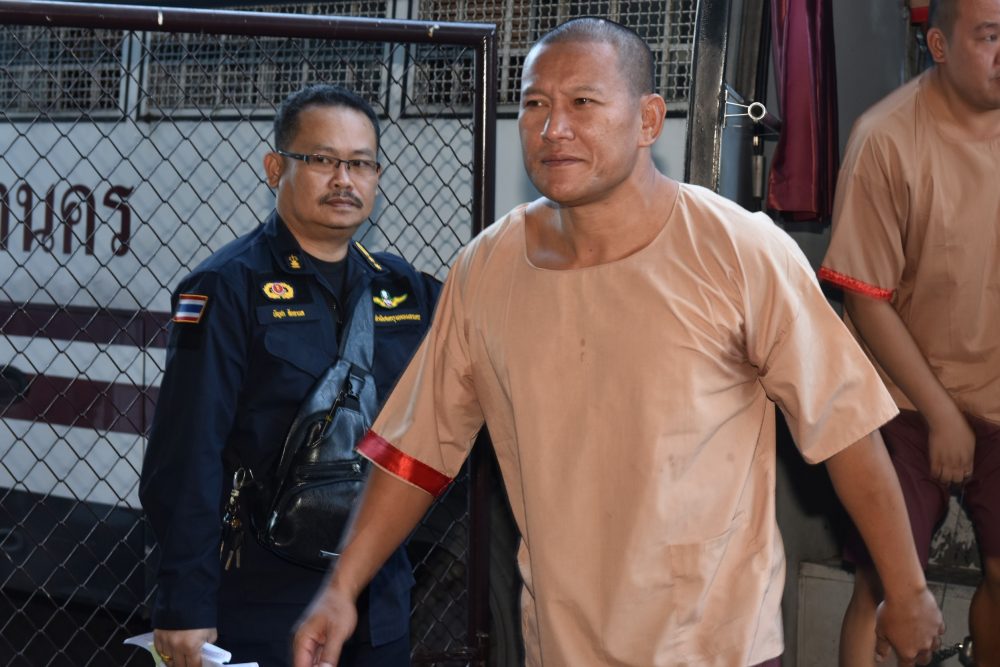
BANGKOK — A court on Wednesday sentenced a businessman to nine years in prison for selling phony bomb detectors to a royal guard unit.

Sutthiwat Wattanaki was found guilty of selling eight so-called GT200 devices to the Royal Thai Aide-De-Camp Department in 2008. He was also fined 18,000 baht for the deal, which cost the state over 9 million baht.

The prosecutors said Sutthiwat’s company, called Ava Satcom Ltd., claimed the devices could detect explosive and narcotics materials from a distance. The royal bodyguards later realized they did not work as advertised and filed charges.

Made by a British firm whose owner was jailed for fraud in 2013, GT200s were sold at about 1 million baht each to clients in Thailand. Tests revealed the devices were ineffectual and based on USD$20 golf-ball finders bought in the United States.

Sutthiwat’s lawyer pledged to appeal. The defendant has posted a bond of 900,000 baht to secure bail.

It’s the third legal action judgment Sutthiwat and his firm. In August, a civil court ordered the company to compensate the royal guards for the fraudulent deal. Last week, a court also sentenced him to 10 years in prison for selling GT200 devices to the army at a price of 600 million baht.

Related stories:
Pyramid Cult Leader Appointed to Reform Public School Curriculum
Army’s 350 Mil Baht Airship Breaks Down Again After Re-launch
Defender of Fake Bomb Detector Appointed Top Forensic Science Job
Fake Bomb Detectors in Attacked Pakistani Airport Used By Thai Army

Advertisement

Starved of Funding, BACC Unable to Pay its Bills

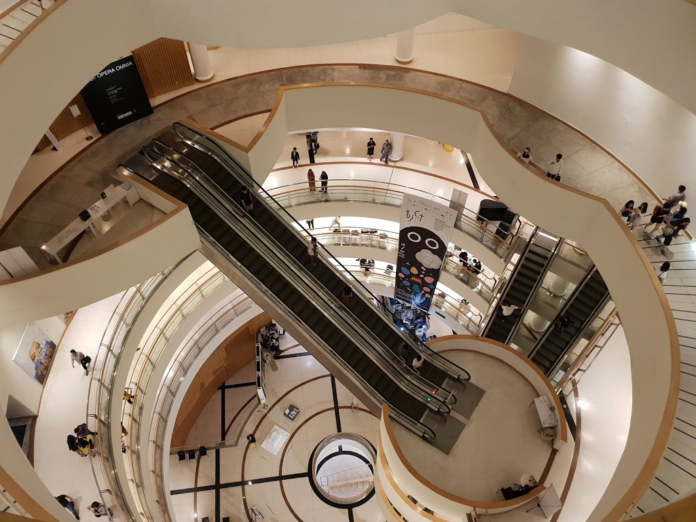
The Bangkok Art and Culture Centre interior in May.

BANGKOK — The director of a popular downtown public arts venue said City Hall has made good on its vow to defund the Bangkok Art and Cultural Centre, or BACC, by refusing to pay its utilities.

Director Pawit Mahasarinand said at a Wednesday news conference that the Bangkok Metropolitan Administration, which earlier this year tried turning the decade-old venue into a coworking space, is no longer paying the center’s electricity and water bills, which have come due.

“I don’t want to cause drama,” Pawit said, holding up a utility termination notice. “But this was sent to us this morning. So if you are going to go to the bathroom, you better hurry.”

Read: City to ‘Investigate’ Management of BACC

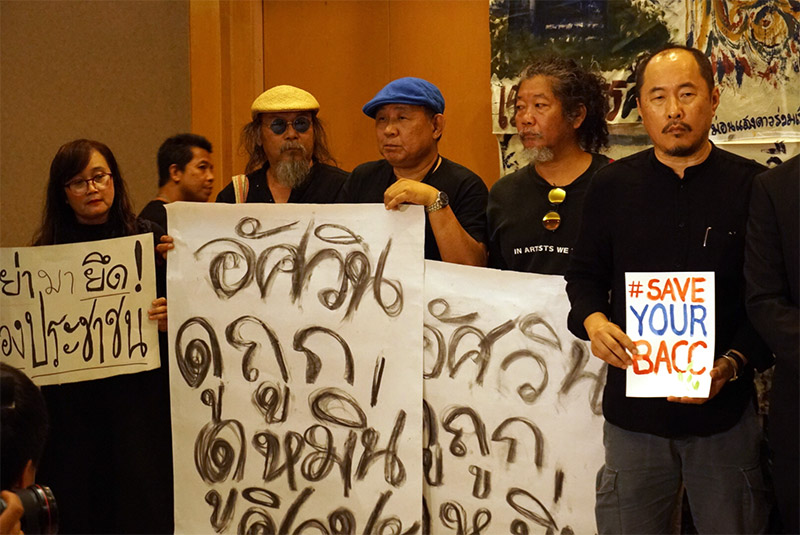
Supporters of the Bangkok Art and Culture Centre display signs Wednesday in Bangkok.

Pawit said City Hall’s Office of Culture, Sports and Tourism stopped paying the facility’s utility bills in July, not long after they backed down under public pressure from its bid to take over the arts center.

Today it owes 47,783 baht for two months’ worth of water. Pawit said monthly expenses for utilities alone amount to roughly 20,000 for water and 600,000 for electricity.

As a cost-saving measure, the venue may shave an hour off both ends of its opening and closing times.

“At this current rate of funding, the BACC can only be open until the middle of next year,” Pawit said.

At the last minute, a former deputy government instrumental to founding the BACC who now works in the prime minister’s office arrived with news. Puttipong Punnikanta said junta leader and prime minister Prayuth Chan-ocha would intervene.

“He said he understands the problem of the artist network and will find a way to fix it,” Puttipong said. “At first I didn’t think he would send me, but he urged me to come quickly. I have a personal connection to this place, since I was here since putting down the first brick.”

Though no city representatives were present, Bangkok Gov. Aswin Kwanmuang weighed in via a message posted online to reiterate that the city would not take over and the rationale for defunding it.

“The issue of managing the BACC ended months ago, as we listened to the public. Today, I reiterate that the city will not manage BACC affairs,” he wrote, blaming bureaucratic considerations for why it could not be subsidized by the government.

He detailed three times BACC funding was rejected by the interim assembly, once because of concerns it may not be legal.

“If the BACC wants to be subsidized by the city, then they have to proceed according to the law,” the governor wrote.

In May, Aswin proposed turning the arts and culture venue into a coworking space. He said the city would to take over its management because it was expensive to maintain, and would turn it into a coworking space to better serve the public.

Officials have denied a political motive, though as the most visible publicly supported arts venue, the BACC gives space to a broad range of perspectives, including some unlikely to please often-irascible authorities.

The city abandoned its takeover plan under intense public backlash but then cut off financial support by effectively reducing its budget to zero.

“I am managing this place, but I can’t speak for anyone if they have a hidden agenda about what they want to turn this place into,” Pawit said, later adding, “Back when we had an elected government, the city approved funding, but now, it doesn’t.”

Pawit said he has asked the tourism ministry to help find funding for next year and appealed for public donations to keep it open.

The center enjoys strong support from an influential demographic of Bangkok’s bourgeoisie, who Pawit appealed to for support.

“This place is built on your taxes. So if you don’t come visit, excuse me, you’re being dumb,” Pawit said. “I will make it so that even the motorcycle taxi drivers wanna walk in here.”

While the center’s contract with the city to use prime land at Pathumwan intersection expires in 2021, it’s ability to remain operational until then remains up in the air.

Related stories:
City to ‘Investigate’ Management of BACC
City Hall Won’t Take Over BACC – Won’t Fund it Either
Famed Artists Say No to City Hall Takeover of BACC
City Hall Signals Retreat on BACC Takeover Plan
The City Actually Wants to Turn BACC Into a ‘Coworking Space’
Take Risks, Include More: New Bangkok Art Center Head
Meet Bangkok’s New Governor: Aswin Kwanmuang
Caravaggio Exhibit Ignites Baroque Bangkok Drama

Advertisement

Laotian Drug Lord Gets Another Lifetime in Jail

Xaysana Keopimpha.
Xaysana Keopimpha.

BANGKOK — A court sentenced a Laotian drug lord to life in prison Wednesday after handing down his second guilty verdict in six months on narcotics charges.

Xaysana Keopimpha was convicted and sentenced by the Criminal Court along with a Thai codefendant, Choompol Panomprai, for conspiring to sell and distribute massive quantities of amphetamines in August 2016.

The sentence was reduced from death due to their cooperation with investigators, the court said.

A third man, Ratchapol Ratsapolpakorn, was acquitted of charges related to his alleged handling of money from their drug sales.

All three men were acquitted for another drug case involving selling more than 2.3 million pills of amphetamine.

Xaysana was arrested at Suvarnabhumi International Airport in 2017. He had been wanted for years for operating a transnational drug ring in Thailand and Laos.

In March, he received his first life sentence in a separate trial on related charges.

Xaysana Keopimpha arrives Wednesday to the Criminal Court in Bangkok.

Related stories:

Laotian Drug Lord Sentenced to Life in Prison

‘Benz Racing’ Charged For Lambo Link to Laos Drug Lord

‘Benz Racing’ Denies Having Connections to Laotian Drug Lord

‘Benz Racing’ Surrenders to Narcotics Cops

Soap Star’s Husband Investigated for Laundering Drug Money

Laotian ‘Drug Kingpin’ Arrested at Bangkok Airport

Advertisement

Small Hotels Guild Launches Pact With Airbnb

BANGKOK — Global room rental platform Airbnb announced an alliance Wednesday with a small hotels consortium.

Under the agreement signed today, hotels belonging to the Thai Boutique Accommodation Trade Association will be listed on Airbnb. It brings together two players in the lucrative hospitality industry seeking legal recognition in the face of an ongoing regulatory crackdown.

Airbnb representative Mike Orgill said the deal will raise visibility for hotels off the beaten path and promote local tourism, while the small hotels guild rep called on the military government to end its crackdown on unlicensed hotels.

“It will connect Thai hospitality with people around the world,” Orgill said at a news conference held at a hotel in a Phra Khanong arts district.

Read: In a First, Govt Official Stands by Airbnb Legality

Apart from being listed on the world’s best-known hospitality service, which says it served 1.6 million guests in Thailand in the past year, hotels in the trade association will also receive training and guidebooks from Airbnb on how to improve business, Orgill said.

Founded in 2016, the association represents over 50 “boutique hotels,” small-scale accommodations that tout their unique character and neighborhood interactions.

Association vice president Staporn Sirisinha said he hopes the partnership will encourage more tourists to stay in boutique hotels, which offer more experience than big chain hotels located in well known tourism areas.

“Tourism is no longer about demand and supply,” Sataporn said at the news conference. “It’s about passion and new discoveries.”

Such small independent hotels are being killed off by the military regime, Staporn complained, referring to a recent crackdown on small, unlicensed hotels and guesthouses in tourist hotspots including Chiang Mai, Phuket and Bangkok. Dozens have been closed down or threatened with closure as a consequence.

“This government is very confused with itself,” Staporn said. “They are not illegal businesses. They want to register and get legalized, but the rules are not accommodating at all. These people just want to have honest careers and become a bedrock of local economy.”

He cited personal experience in dealing with what he sees as unrealistic regulations. He once tried to turn an eight-room building into a guesthouse, but local officials refused to sign off on it because a corridor was less than 90 centimeters wide.

“Eighty percent of hotels and guesthouses [in popular areas] are considered illegal, so if they close them all down, they will be left with only 10 percent of accommodation,” Staporn said. “The government needs to be sincere about this.”

And there’s the unresolved question of Airbnb’s own legality. Condominium owners and some officials maintain Airbnb violates hotel and even immigration regulations, but the company insists it complies with the law.

In July, the company scored a symbolic win when it signed an agreement with a department under the Ministry of Interior Affairs, the first government agency to recognize Airbnb services as legal.

Orgill, who’s in charge of the San-Francisco based company in Southeast Asia, said it should be treated as a legal entity like other platforms such as Booking.com and Agoda. He said his company will continue to work with officials.

“There is a mismatch between [regulations] and the digital era,” he said. “The question is how do we bring them into the 21st century?”

Commenting on today’s cooperation between Airbnb and the boutique hotel guild, an urban planning expert urged caution, saying there are “two sides to the coin.”

In an interview, Tansorn Pornpanyapat, an assistant director of Chulalongkorn University’s urban design center, warned that while an influx of tourists can revitalize communities and boost their economies, they same boom can damage their character and sense of community.

He cited increasing gentrification of some quarters of the old city and the rush of development following extension of the metro and skytrain lines as examples.

“Communities should prepare what to do in the face of development,” Tansorn said. “I am not against development, but people in a community should prepare for it together. And Bangkok is very weak in this aspect.”

Related stories:

In a First, Govt Official Stands by Airbnb Legality

Airbnb Teases Major ‘Partnership’ With Thai Gov’t

Thai Law: Case Closed on Airbnb. Here’s Why it Won’t Matter.

Airbnb Launches New Features in Thailand, Remains Totally Illegal

Advertisement

World Leaders Laugh as Trump Boasts of His Achievements

US President Donald Trump answers a reporters question about Supreme Court Justice nominee Brett Kavanaugh during a meeting with Colombian President Ivan Duque in September at the UN General Assembly. Photo: Evan Vucci / Associated Press


UNITED NATIONS — President Donald Trump got some laughter when he addressed world leaders on Tuesday. It wasn’t intentional.

The president was highlighting U.S. gains under his watch as he opened his address to the U.N. General Assembly. He said the American economy was “booming like never before” and that his administration has accomplished more in less than two years than almost any other administration.

His boast elicited laughter from the scores of heads of state and delegates in the audience for the speech.

Trump, who has long claimed that his predecessors’ weak leadership prompted other nations “to laugh” at the US. appeared flustered and responded, “I didn’t expect that reaction, but that’s OK.”

Later, as he was leaving the U.N., he told reporters that he had meant to be funny.

“Oh it was great, well, that was meant to get some laughter, so it was great,” he said.

In his speech, Trump said the U.S. is a “stronger, safer and richer country” than when he took office in January 2017. He said “we are standing up for America and for the American people, and we are also standing up for the world.”

A little further into his speech, German diplomats appeared bemused by Trump’s latest swipe at their country as he reiterated his criticism of Germany’s planned undersea gas pipeline from Russia.

After the president’s warning that “Germany will become totally dependent on Russian energy if it does not immediately change course,” cameras showed German Foreign Minister Heiko Maas gently shaking his head, while senior diplomats smiled.

Some in the audience also grumbled during Trump’s remarks when he said “we reject the ideology” of globalism. When Trump criticized socialism, a member of the Swedish delegation frowned with disapproval.

Advertisement

Hot News

LATEST NEWS

Bangkok
very heavy rain
28.8 ° C
31.1 °
25.9 °
80 %
3.8kmh
98 %
Wed
30 °
Thu
30 °
Fri
33 °
Sat
30 °
Sun
31 °