































30 C
Bangkok
Saturday, June 27, 2026
Home Blog Page 2562

Everything You Were Afraid to Ask About Thai Rice Subsidies

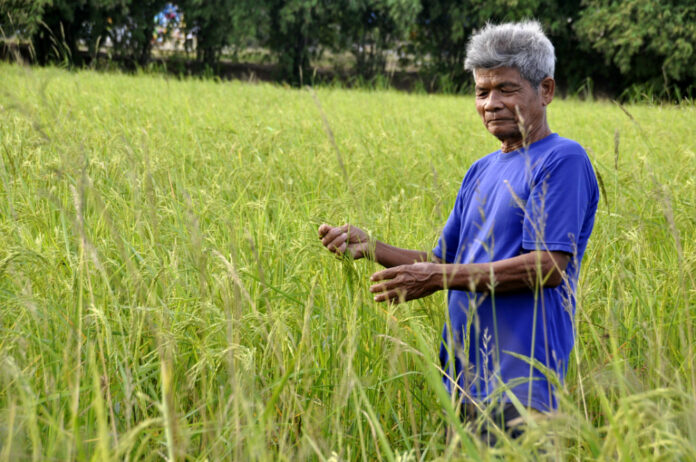
A farmer in a rice field Monday in the northeastern province of Nakhon Ratchasima.

BANGKOK — When the military government approved spending at least 20 billion baht to guarantee prices for rice farmers, two questions were raised: How did it differ from the subsidy program that lost billions under Prime Minister Yingluck Shinawatra, and how would it succeed this time?

Answering those questions is tricky however. Expert opinions vary wildly, often depending on the political persuasion of the source. One economist critical of both governments’ programs said the junta’s more conservative scheme is unlikely to suffer the same losses – but also unlikely to work. And the consensus of economists in general is that the regime is wrong to blame market conditions on politically motivated manipulation of the market.

One thing made clear by economists is that this type of price-pledging subsidy has been implemented by governments since the 1980s, long before Yingluck’s election in 2011.

While critics doubt the scheme’s fundamental effectiveness, experts said it isn’t intended to move big market changes but rather stabilize volatile prices over the course of the harvest season, which runs about four months.

“The point is not to improve long-term problems about the price,” said Decharut Sukkumnoed, a agricultural economics lecturer at Kasetsart University. “To improve the price of rice, you need to fix some other issues.”

It’s a matter of managing supply to keep prices stable. Otherwise, at the beginning of the harvest period, the glut of rice hitting the market drives them down. The subsidy works by allowing farmers to “sell” their rice to the government at a fixed price. It’s actually a loan secured by their inventory. Later in the season, the farmers can reclaim their rice for sale at a better market rate and repay the “loan” to the government.

Farmers dry rice grains Monday in Buriram province.

Despite being directly involved in farmer welfare issues and skewing pro-democracy, Decharut finds fault in both approaches taken by Yingluck then and the military regime now.

The lecturer explained that in order for the program to work, the government must set the right buying price. Decharut said it must be higher than what the milliers are offering to farmers at the beginning of the season, when the market is oversupplied, to attract farmers. At the same time – and here’s where some gambling happens –  it must also be lower than where the price lands at the end of the season.

This increase is supposed to happen because the rice bought from the farmers is held in reserve, lowering supply and therefore driving up prices, assuming demand is relatively inelastic.

So for the program to succeed and be effective for farmers, the right price must be set and enough farmers must participate to affect the market.

“It’s basic principle of economics, neither Yingluck nor Prayuth invented it,” he said.

Read: Fining Yingluck for Rice Subsidy in ‘Grey Area,’ Critic of Policy Says

He said there were some big policy differences that could make for different results.

Yingluck’s biggest mistake was announcing a price – 15,000 baht per metric ton – while campaigning in the election. While that may have helped secure the support of her rural constituents, she was stuck with that promise when harvest season came around and it proved much higher than the market could bear.

Her government also committed to buying an unlimited amount of any type of grain at that price, regardless of its market value.

The result was that at the end of the season, when prices were still low, a lot of farmers didn’t reclaim their rice and default on their loans. The government was left with silos full of aging stock.

Where Yingluck was too soon, Decharut said Prayuth was too late to be effective.

“The perfect timing would have been early October,” Decharut. “It was late now. Some rice was already sold to the market.”

The regime’s lower guarantee of 13,000 baht only for a relatively small quantity of premium jasmine rice made for a safer bet.

But Decharut said its low quantity, capped at two million metric tons, was another reason it was would not be effective.

“Will it help lift the price up in the end, because the amount of rice they are buying is very low compared to the whole market?” he said.
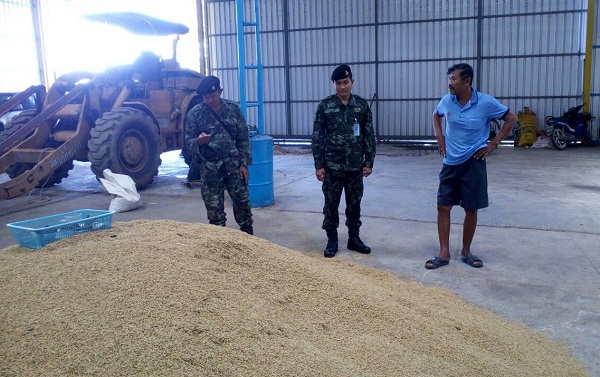
Soldiers inspect a mill in Phichit province in the north of Bangkok Wednesday.

No Foul Play

Most agricultural economists, including a fierce critic of Yingluck’s program, agree that the government is falsely blaming the current market conditions on supply-side political sabotage.

Prime Minister Prayuth Chan-ocha suggested Tuesday the worst price for rice in years was caused by market manipulation by millers in cahoots with the political opposition. He even dispatched soldiers to the provinces to investigate.

Under pressure and accused of being responsible for the plummeting prices, the Thai Rice Mills Association on Thursday dissolved its executive committee.

“I don’t have the competence to collude with millers nationwide,” said President Manus Kitprasert as he announced his resignation, explaining it was impossible to control the thousands of mills nationwide.

Manus said millers base their prices to buy from farmers on what exporters are willing to pay. Experts agree the pricing situation was out of the control of the millers. In fact, they had long expected this year to be the worst for one simple reason: an oversupply of rice.

Economist Viroj NaRanong of the Thailand Development Research Institute wrote Wednesday on Facebook that strong rice production combined with lower consumption led to the depressed market conditions. Nine million metric tons of rice bought during Yingluck’s administration were also left in the country’s stock.

Viroj declined to answer questions Friday and urged the media to publish his entire, lengthy post.

The world rice market isn’t likely to recover anytime soon either. Global rice stocks at the end of this year are forecast to grow to their highest levels in over a dozen years, according to the U.S. Department of Agriculture.

Rice prices in the kingdom depend on the world market and are usually decided before orders are placed, Viroj wrote.


Related stories:

Rice Subsidy Returns: Gov’t Approves 20 Billion Baht For Farmers

Fining Yingluck for Rice Subsidy in ‘Grey Area,’ Critic of Policy Says
Pheu Thai Says 35.7B Fine Denies Yingluck Due Process

Yingluck ‘Confused’ by Signals on Rice Subsidy

Advertisement

Bangkok Cops Investigated For Allegedly Kicking Gambler to Death (Video)

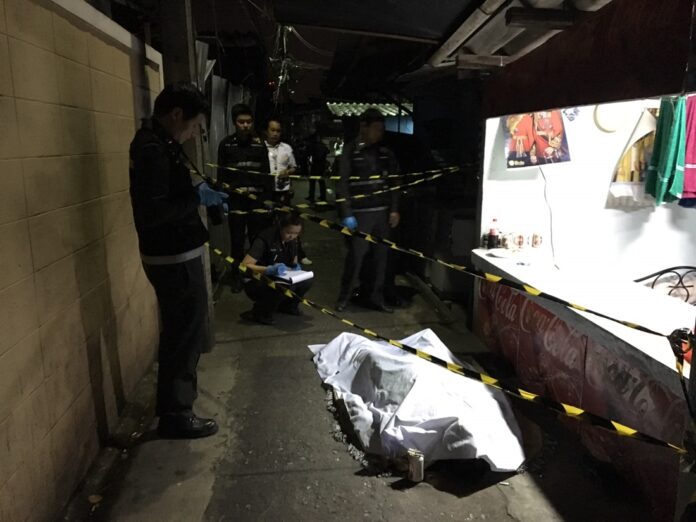
An officer takes notes Wednesday morning at the spot where Don Daengchantip, 34, was allegedly beaten to death in Bangkok.

BANGKOK — Police on Friday said an investigation was being launched into a group of policemen who during the course of a raid on a gambling den were seen kicking a suspect senseless who later died of his injuries.

Don Daengchantip, 34, was cornered and beaten by officers from Sutthisan Police Station as he attempted to flee a suspected gambling den in Bangkok’s Samsen Nok district. A police spokesman said it would take up to 30 days to establish why Don died and who was responsible.

“Please don’t rush to judgment yet,” Col. Kritsana Pattanacharoen said by telephone. “We must be fair to both sides.”

Kritsana said police and other experts would jointly conduct an autopsy on Don’s body to ascertain the cause of death. The results are expected in 30 days, though police can extend it to 60 more days if needed, the spokesman said.

A formal inquiry was also set up to discover whether the policemen involved in Don’s death were guilty of excessive force.

Don, who worked as a driver for a Japanese businessman, was betting hi-lo with fellow gamblers when police officers raided their den early Wednesday morning. Don attempted to flee and swung a fist at his pursuers once cornered, prompting the officers to subdue him, according to eyewitness Wichan Kwanmuang.

In security camera footage of the incident, a man is seen attempting to break free, at which point four or five other men all begin delivering swift kicks to him on the ground.

Wichan told reporters police kicked Don until he passed out. The suspect was later pronounced dead at the scene by rescue workers. He left behind a 2-year-old daughter.

Don’s family can file a complaint against police if they believe he was a victim of excessive force, police spokesman Kritsana said.

Advertisement

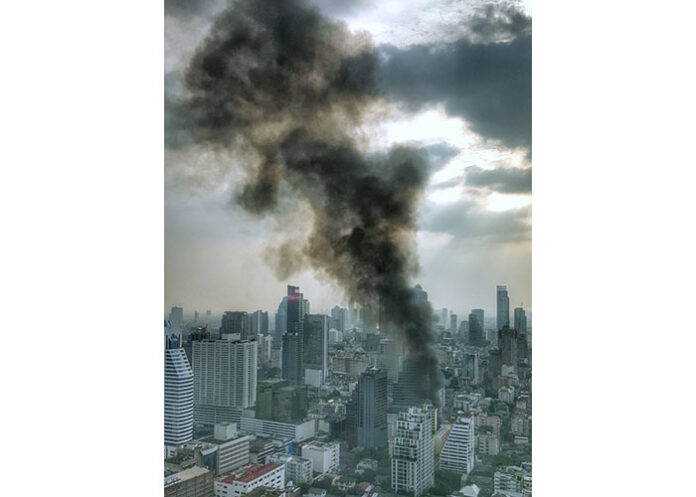
Fire in Bangkok’s Bang Rak Injures 1 Woman

Photo: 3ho8 / Twitter

BANGKOK — A woman was being treated for burns after a fire broke out Friday afternoon near the Russian Embassy in Bangkok.

Col. Nakorn Thongpanich of Bangrak police said the fire began at about 4pm, destroying five residences in Soi Santiphap. The woman, who was unidentified, was taken to a hospital for treatment.

The fire has since been brought under control, he said.

https://twitter.com/melodyph_/status/794469260391088129

Advertisement

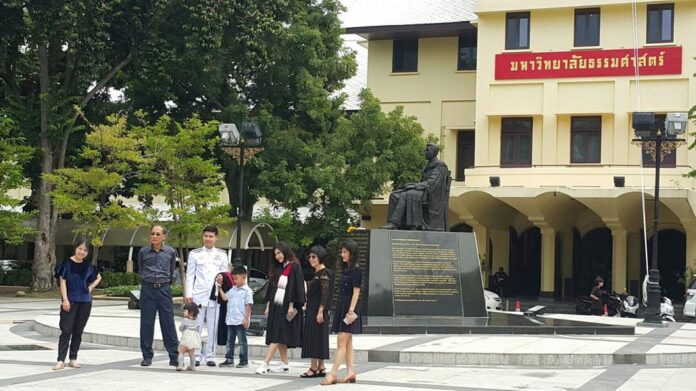
Expect Worse Traffic Around Grand Palace With Thammasat Graduation

A graduate and family in black Friday at a graduation ceremony practice at Thammasat University.

BANGKOK — Traffic around the the Grand Palace was expected to be worse this weekend as Thammasat University would hold its graduation practice ceremonies as mourners continue to stream in.

Those who come to express their condolences over His Majesty the Late King or congratulations to Thammasat’s graduates were advised to use public transportation, traffic police said Friday.

Just as the weekend prior, a total of 27 roads leading to the palace will be closed from 8:30am to 8pm. A free shuttle service will run during those hours.

Read: Thammasat Graduation Bans ‘Congratulations’ in Favor of Condolences

Cars coming to drop off graduates can only enter the university from Phra Athit Road and cannot park inside the university, according to Maj. Gen Jiraphat Poomjitraksa.

In practice, it may prove difficult to reach Phra Athit Road as many surrounding roads will be closed, including the Phra Pinklao Bridge and Ratchadamnoen Avenue.

Traffic police recommended graduates and guests park at nine shuttle stops far from the area, such as at Impact Muang Thong Thani and Future Park Rangsit. From there they can take the free shuttles, originally intended for mourners, to the university.

Out of sensitivity to those paying their respects to the Late King, Thammasat University this week announced it would ban flowers and overt expression of joy including “Congratulations” signs.

The same plan will be in effect Nov.12-13 when the official graduation ceremony of more than 8,000 students takes place.

Mourners at the Grand Palace are expected to increase 30 percent to 50 percent this weekend.

Advertisement

Koreans Donate Kimchi to Needy at Kimchi Festival

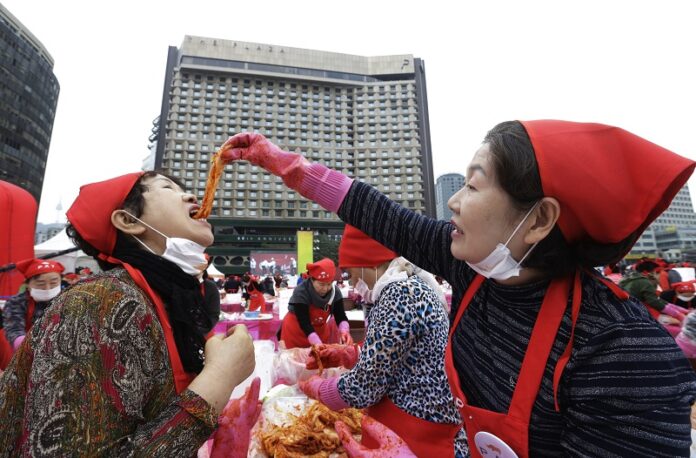
Volunteer Kim Yeon-sook, left, tastes kimchi, Korean pickled vegetables, from her colleague Lee Hyun-sook as they make it to donate to needy neighbors for winter preparation on Friday during the Seoul kimchi festival in Seoul, South Korea. Photo: Ahn Young-joon / Associated Press

SEOUL — Thousands of South Koreans and tourists gathered at the Seoul kimchi festival on Friday to make 50 tons of the traditional pungent vegetable by mixing cabbage, other leaves and chili sauce and donate it to needy neighbors.

It’s the third year the event has taken place and volunteers spoke of their happiness at being able to help others.

“I am very pleased that I can help financially challenged or isolated neighbors through making kimchi,” said volunteer Kang Gum-suk.

Another participant, in Kyoung-ja, said that “the fact that such a sharing culture is being spread in South Korea makes me happy.”

Advertisement

Hospital, Police Trade Blame as ‘Millionaire Pretty’ Treated For Stress

Kritrada Tabtimphol in a photo posted Aug. 26. Photo: Kritrada Zomy Tabtimphol / Facebook

BANGKOK — Three days after an internet celeb allegedly injured three people on a busy road, she had yet to be charged with any crime, and the results of a drug test were still unavailable.

On Friday, the case which has invited complaints about two-tiered justice didn’t seem to be moving forward, with the head police investigator and a hospital director pointing fingers at each other over delayed test results for Kritrada Tabtimphol.

Read: Cops Waived Sobriety Test for Net Idol ‘Millionaire Pretty’

Kritrada, a successful online entrepreneur known as “Millionaire Pretty,” behaved erratically after allegedly causing a multi-vehicle accident Tuesday but was allowed to depart without undergoing any sobriety test. She’s since been admitted to a hospital for treatment of “stress,” where a blood test was conducted upon her arrival.

“We submitted the request on Nov. 2, but the [hospital] still hasn’t sent it to us,” said Papinawit Senaplaeng, deputy inspector of Huai Khwang police. “They’re waiting for the director to sign it first.”

Songpol Chawaltanpipat, director of Ratchaburi Hospital, denied any request had reached him. Kritrada, 28, is being treated in his hospital’s psychiatric ward for stress.

“I haven’t received any documents from the police,” Songpol said by telephone. “When did they say they sent it to me? … Maybe it hasn’t arrived yet?”

Songpol also said hospital staff needed to check the results for accuracy before sending the report to police.

“We have to wait and confirm them. It takes a little time. There can be false positives and false negatives,” the hospital director said. He would not give any timeframe.

The crash took place Tuesday afternoon in front of the Esplanade shopping mall.
Kritlada allegedly caused eight vehicles to crash and shouted about a bomb when she exited her BMW. She also appeared to be praying or meditating in the road.

Under the law, any motorist involved in an accident who does not submit to a sobriety test is automatically charged with driving under the influence. Yet police waived that for Kritrada, saying she was too deranged.

Capt. Papinawat said police couldn’t test her at the police station because she was acting like a madman and couldn’t communicate with officers. Police eventually let her be taken away by her family. They took her to the hospital, where she was tested upon arrival.

Papinawat denied making an exception and said legal prosecution would proceed despite the delay.

“It won’t affect the case at all. If we find any substance in her body, we will simply file an additional charge [of DUI],” the police captain said. “It won’t affect the court case.”

Papinawat added that police have yet to file charges relating to reckless driving and injuring others because she was still being treated for stress, and the doctor in charge would not allow police officers to speak with her.

“I talked with the doctor yesterday, and he said the patient is not in a condition to give testimony,” Papinawat said.

The incident has prompted some to lash out at the authorities for seemingly sparing Kritrada from the full force of the law, similar to other cases of traffic accidents involving the prominent or wealthy.

“She’s just doing the same as many other well off celebrity or hiso elites have done before her,” user Baerboxer wrote in response to the news in the ThaiVisa forums.

Related stories:

Claiming Insanity, Fatal Crash Suspect Jenphop Wants Trial Shelved

Praewa Completes Community Service, 4 Years After Court Orders It

Out of Sight and Mind, Actress’ Fatal Crash Case Ends Without Jail Time

Prosecutor Backtracks on Bringing Red Bull Heir to Court

Advertisement

Thousands Protest In Jakarta Against Gov’s Alleged Blasphemy

Muslim protesters march Friday during a demonstration in Jakarta, Indonesia. Tens of thousands of hard-line Muslims converged Friday on the center of the Indonesian capital to demand the arrest of its minority-Christian governor for alleged blasphemy. Photo: Achmad Ibrahim / AP

JAKARTA, Indonesia — Tens of thousands of hard-line Muslims converged Friday on the center of the Indonesian capital to demand the arrest of its minority-Christian governor for alleged blasphemy.

Fearing violence, police have put on a show of force supported by soldiers and public order officers, while embassies closed, some shops shuttered and Jakarta’s normally traffic-clogged streets were nearly empty of cars.

The predominantly male demonstrators, most wearing white shirts and skull caps, massed at the Istiqlal Mosque for the protest following weekly Friday prayers and marched on the nearby presidential palace. Protests are also taking place in other cities including Medan on Sumatra, Makassar in Sulawesi and Malang in East Java.

The accusation of blasphemy against Jakarta Gov. Basuki “Ahok” Tjahaja Purnama, an ethnic Chinese and minority Christian who is an ally of the country’s president, has galvanized his political opponents in the Muslim-majority nation of 250 million, and given a notorious group of hard-liners a national stage.

The Islamic Defenders Front, a vigilante group that wants to impose Shariah law, is demanding Ahok’s arrest after a video circulated online in which he joked to an audience about a passage in the Quran that could be interpreted as prohibiting Muslims from accepting non-Muslims as leaders. The governor has apologized for the comment and met with police.

“We are here because we want to defend the verses of God that have been abused by Ahok,” said Nasrullah Achmad, who came from Bekasi, a Jakarta satellite city, with dozens of others from his Islamic study group. They raised clenched fists and shouted “God is Great.”

“Only one thing can stop us: Ahok’s arrest,” said Achmad.

Some protesters snapped selfies of themselves wearing headbands emblazoned with “Arrest Ahok” and others cheered as speakers denounced him with hate-filled language. Many held aloft flags and banners with slogans such as “Ahok is an enemy of Islam.”

Blasphemy is a criminal offense in Indonesia and prosecutions have increased in the past decade though most people practice a moderate form of Islam. Amnesty International documented 106 convictions between 2004 and 2014 with some imprisoned for up to five years.

Television showed Ahok visiting a Jakarta neighborhood and talking to residents, who greeted him enthusiastically.

President Joko “Jokowi” Widodo and other national figures have called for a peaceful demonstration amid fears Islamic State group supporters might try to cause chaos.

The simmering political climate has provided an opening for the Islamic Defenders Front to burnish its credentials as protector of Indonesia’s majority faith at the expense of mainstream Muslim groups.

Ahok, who is seeking a second term as Jakarta governor, is popular with the city’s middle class. He is adored as a blunt speaker who doesn’t tolerate corruption and articulates a vision to make the chaotic, dysfunctional city more like clean, orderly and efficient Singapore.

But the anti-corruption stance has made him enemies, and the evictions of thousands of the city’s poorest people to make way for urban improvement has stoked anger and resentment and played to a stereotype of Chinese as exploiters of Indonesia’s poor Muslim masses.

On the national stage, Ahok is ranged against former President Susilo Bambang Yudhoyono, whose son is a candidate for Jakarta governor, a position that is a stepping stone to national leadership.


Story: Niniek Karmini and Ali Kotarumalos


Related stories:

Police to Lock Down Indonesian Capital for Blasphemy Protest

Advertisement

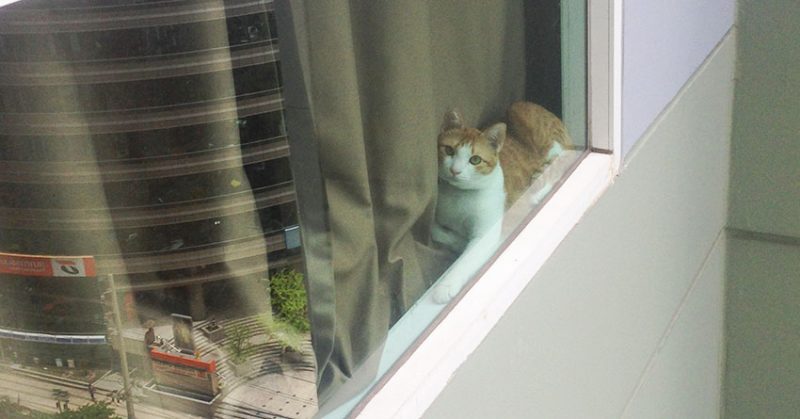
Pet Lovers Play Cat and Mouse (and Puppy) in Bangkok’s Condos

Juju, 2, juxtaposed over a Bangkokian sunset. Background Photo: Mike Behnken / Flickr

Top: Juju, 2, juxtaposed over a Bangkok sunset.  Original image: Mike Behnken / Flickr

BANGKOK — It was soon after Katrina Ganikaa Lavery accidentally shared some pics with her landlord that she realized she had made a terrible mistake. Some of the photos showed her mom playing with Juju, her 2-year-old cat.

That was in March. For months afterward she dodged questions about whether she had a pet until the landlord arranged to come check the apartment.

“I arranged with my good friend to keep my cat at her apartment for the day my landlord was supposed to come, and the whole week I was cleaning the apartment like crazy,” Katrina said.

She even hid her tall cat tree inside a closet, behind a bunch of towels and boxes. The landlord’s inspection was cursory, but soon after Lavery received a call from her cat-sitting savior.

“Apparently, someone in her building reported that they had heard a cat in her room, so her landlord was on the way to go check if there was an animal there,” said Katrina, 22. “I had to rush all the way across town to pick up my cat so that my friend wouldn’t get in trouble as well!”

That’s the reality for pet owners in Bangkok, a city with a burgeoning pet culture that runs up against “no pets allowed” at most condominiums and apartments.

“Honestly, the whole condos-not-allowing-pets-in-Bangkok is so annoying and I really find it limits the amount of animals that can be fostered and adopted in Bangkok,” said Emma Scannell, a 28-year old Briton who’s lived in Thailand four months.

Juju, 2, at her condo in the Parkland Grand Asoke.

There is no law forbidding pets in apartment complexes or condos, yet most complexes prohibit them nonetheless.

Why? Neighbors, said one developer.

“We’re concerned that pets will make loud noises, and their poop and pee may bother people living in the condo,” said Pratheep Tungmitithum, chairman of Supalai Corp., which builds homes, townhouses and condos.

Those policies are left up to each building’s management, he said, noting that 90 percent of Supalai’s condos don’t allow pets.

The Address (AP Thai) and Ideo (Ananda Development), for example, forbid all pets except fish in a tank. Developer Sansiri doesn’t allow any furry companions in their Bangkok condos, but dogs shorter than 15 inches and lighter than 10 kilograms can vacation at their Hua Hin properties.

The outcome of the battle over pets are elaborate games of cat and mouse such as that played by Lavery and Juju.

But management at some places are okay with keeping an open secret.

“Have whatever pets you want, but if management sees, we will need to issue a warning,” whispered someone answering the phone at The Lofts Ekkamai, who declined to give his name.

Hiding bark-monsters and meow-machines is a matter of discretion.

A Persian cat peeks from inside a closet. Photo: Alex / Flickr

“There are definitely people hiding their pets around, and there’s usually no problem unless the owner’s neighbors complain,” laughed a woman answering the phone at The Met Sathorn, who also didn’t want to be named for fear of repercussions from her employer.

Even in strict no-pet zones, some get by with tipping staff with cash or food to keep their secret safe.

That’s the advice Sheridan, a 29-year-old Australian woman, got from her real estate agent who showed her a condo on Soi Sukhumvit 65: Bribe security and cleaning staff money every week to keep her kitten and bunny secret. Sheridan asked that her last name be withheld for the sake of their continued cohabitation.

“Thai people always keep it a secret, and if you have rescued it they usually don’t care so much, as you have saved a life,” Sheridan recounted the agent telling her.

Then there’s Lindsay, who like Sheridan spoke on condition of anonymity, who has lived in Thailand for a decade.

When the 40-year-old American’s cat escapes outside, the security guards bring it back to her.

“Most of what we do is try and make sure that the neighbors are happy, and we give extra-nice gifts to the security guards at the end of the year,” she said.

A Shiba Inu hides under a bed. Photo: AJScharleston / Flickr

There are a few condos which allow – even welcome – pets.

Ekamai Gardens charges 5,000 baht per pet every six months, and M Condo allows all pets under 15 kilograms. Others such as Insaf Towers and portions of Happy Condo Ladprao 101 allow owners to have any pets without any charge or limit.

“We stipulated we needed pet-friendly accommodation when we were searching, and although it limited our options somewhat, we still had several options to choose from,” Kirsten Ramsay, a kiwi here already for a year with her two cats, wrote online in Bangkok Pet Lovers. At the pet-friendly Insaf Towers, neighbors even cat-sit for each other.

Petra Rylichova, 47, came from the Czech Republic to Thailand five years ago. She lives in Ekamai Gardens with her dog, two cats, hamster and fish. Although technically pets are forbidden in common areas, she said the management doesn’t care when she takes her dog for a walk.

“Pets are not allowed in common areas such as the pool or playground or your own balcony. I found that very strange and actually nobody cares. When I go out with my dog I walk through the garage and it is no problem at all.”

Advertisement

Ex-Maxim Model Arrested for Shoplifting at Emporium

Natcharot ‘Tak’ Ployplye arrested Thursday, at left, and in a 2010 magazine spread, at right.

BANGKOK — A former model may be charged with both theft and drug use after she was caught stealing a dress from from the Emporium shopping mall, police said Friday.

Natcharot “Tak” Ployplye, 30, a Miss Maxim contestant in 2010, was arrested Thursday morning after she attempted to run off with a 9,500 baht dress she was trying on at the high-end shopping mall on Sukhumvit Road.

Natcharot had tried on the dress and then asked store manager Woraya Seniwong Na Ayutthaya to get her a larger size. As Woraya turned to fetch her another dress, she said Natcharot started speed-walking out of the store without paying for the one she had on.

Woraya quickly called security, and Natcharot was arrested for theft by police.

“I was the one who caught her. She looked like she was on drugs but refused to give her real name and refused to pee for a urine test,” Lt. Col. Achirawet Suphanpesatch said Friday.

She later tested positive for drugs, he added, saying that Natcharot’s theft charge may be compounded by a count of drug use.

Advertisement

Constitution Monument Pushed Aside for Rail Line

A crane begins removal of the Defense of the Constitution

BANGKOK — In the end, no one was there to defend the Defense of the Constitution.

After standing proud in the middle of Ramintra junction for 80 years, the historic site that commemorated a victory over the royalist counterrevolution in 1933 was moved Thursday night to make way for a new elevated rail line linking Mo Chit to the northern suburb of Pathum Thani.

The operation was done without much fanfare, though a religious ceremony was briefly held for the souls of government soldiers killed in the civil strife, whose ashes are interred inside the memorial.

Read: Why is Popular Culture Afraid of the 1932 Revolution?

The Defense of the Constitution Monument, more commonly known as the Crushing Rebellion Monument, marked the government’s victory over a group of pro-palace generals who rebelled in 1933 to overturn the revolution of the previous year that replaced absolute monarchy with democracy.

The monument has mostly been ignored, its only significance being a landmark at a busy intersection. But in 2010, Redshirt supporters and progressive activists started organizing rallies there. The monument became a rallying point for those who see themselves as the reincarnation of the forces which brought democracy to Thailand 83 years ago.

But it stood in the way of construction of the Green Line, so plans were made for its relocation. The sight of a crane removing the monument in the dead of night came as some ultra-royalists threaten to destroy other legacies of the 1932 democratic revolution, such as a plaque marking the spot where revolutionary leaders announced the end of absolute monarchy.

Two years ago, authorities demolished an 80-year-old monument to the constitution in Buriram province.

However, as history geeks and activists were relieved to find out, the Defense of the Constitution Monument didn’t go far. Its new location stands just 100 meters from the original site.

An undated file photo of Redshirt rally at the Defense of the Constitution Monument. Image: Prachatai

Related stories:

Ultra-Royalists Threaten To Destroy 1932 Revolution Plaque

Why is Popular Culture Afraid of the 1932 Revolution?

On Anniversary of Democracy, Cops Intercept and Arrest Observers (Photos)

Advertisement

Hot News

LATEST NEWS

Bangkok
scattered clouds
30 ° C
32.2 °
30 °
80 %
2kmh
48 %
Fri
31 °
Sat
36 °
Sun
36 °
Mon
36 °
Tue
34 °