































23.9 C
Bangkok
Monday, July 6, 2026
Home Blog Page 1737

Trump, NK Leader Kim Jong Un to Hold 2nd Summit

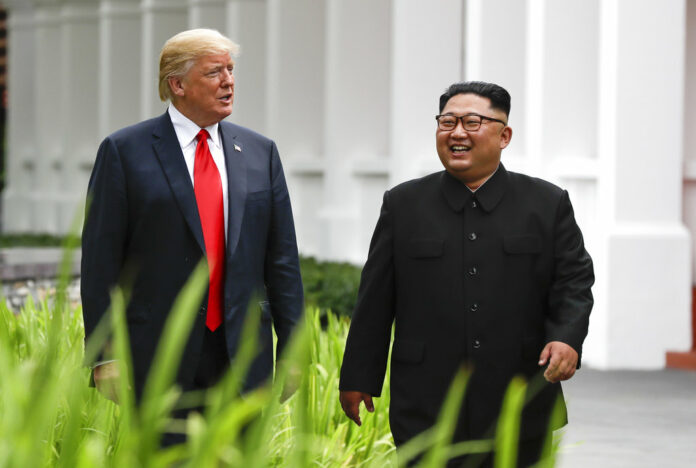
U.S. President Donald Trump, left, and North Korea leader Kim Jong Un walk from their lunch at the Capella resort on Sentosa Island in Singapore on June 12, 2018. (AP Photo/Evan Vucci)

WASHINGTON — President Donald Trump will hold a second summit with North Korean leader Kim Jong Un to try to broker a deal to coax the North to give up its nuclear weapons, the White House announced Friday.

U.N. Secretary-General Antonio Guterres said “it’s high time” for serious negotiations between the United States and North Korea to outline a roadmap for the denuclearization of the Korean peninsula. The U.N. chief told a news conference at U.N. headquarters in New York on Friday that a roadmap would allow both sides “to know exactly what the next steps will be, and to have predictability in the way negotiations take place.”

News of a second meeting with the reclusive North Korean leader came after Trump’s 90-minute meeting in the Oval Office with a North Korean envoy, Kim Yong Chol, who traveled to Washington to discuss denuclearization talks. Trump and Kim Jong Un are to meet near the end of February at a place to be announced later, said White House press secretary Sarah Huckabee Sanders.

“The United States is going to continue to keep pressure and sanctions on North Korea until we see fully and verified denuclearization,” Sanders said. “We’ve had very good steps and good faith from the North Koreans in releasing the hostages and other moves. And so we’re going to continue those conversations and the president looks forward to the next meeting.”

In May, North Korea released three American detainees and sent them home with Secretary of State Mike Pompeo after his meeting with the North Korean leader in Pyongyang.

The second summit signals stepped-up efforts by both countries to continue talks. Trump has exchanged letters with the North Korean leader amid little tangible progress on the vague denuclearization agreement reached at their first meeting last June in Singapore.

On Friday, Pompeo met with the North Korean envoy at a Washington hotel before the White House meeting, and the two had lunch together afterward.

Trump has spoken several times of having a second summit early this year. Vietnam has been considered as a possible summit venue, along with Thailand, Hawaii and Singapore.

Since their Singapore sit-down in June, several private analysts have published reports detailing continuing North Korean development of nuclear and missile technology. A planned meeting between Pompeo and the envoy, who is North Korea’s former spy chief, in New York last November was abruptly canceled. U.S. officials said at the time that North Korea had called off the session.

The special U.S. envoy for North Korea negotiations, Steve Biegun, is set to travel to Sweden for further talks over the weekend.

The talks have stalled over North Korea’s refusal to provide a detailed accounting of its nuclear and missile facilities that would be used by inspectors to verify any deal to dismantle them. The North also has demanded that the U.S. end harsh economic penalties and provide security guarantees before it takes any steps beyond its initial suspension of nuclear and missile tests.

Harry Kazianis, a North Korea expert at the Center for National Interest, said any talks between the two nations are a positive development, but the hard work of negotiating an agreement has only begun.

“Both nations must now show at least some tangible benefits from their diplomatic efforts during a second summit, or risk their efforts being panned as nothing more than reality TV,” Kazianis said.

As a possible first step, Kazianis said, North Korea could agree to close its nuclear centrifuge facility at Yongbyon in exchange for some relief from U.S. sanctions or a peace declaration ending the Korean War. The three-year war between North and South Korea ended in 1953 with an armistice, not a peace treaty.

“Such a deal allows both sides to come away with a much-needed win that can breathe new life into negotiations,” he said.

South Korea said it expects the second summit between Trump and Kim to be “a turning point in firmly establishing a permanent peace on the Korean Peninsula.”

Kim expressed frustration in an annual New Year’s address over the lack of progress in negotiations. But on a visit to Beijing last week, he said North Korea would pursue a second summit “to achieve results that will be welcomed by the international community,” according to China’s official Xinhua News Agency.

Kim’s latest trip to China, his fourth since last year, came as the North’s strongest ally has encouraged negotiations with the U.S. while at the same time arguing in favor of an immediate easing of sanctions.

The U.S. and North Korea seemed close to war at points during 2017. The North staged a series of weapons tests that brought it closer to its nuclear goal of one day being able to target anywhere on the U.S. mainland. The two sides then turned to insulting each other: Trump called Kim “Little Rocket Man” and North Korea said Trump was a “dotard.”

Independent analysts are highly skeptical that North Korea will easily abandon a nuclear arsenal constructed in the face of deep poverty and probably seen by Kim as his only guarantee of his government’s survival. But Retired Gen. Vincent Brooks, former U.S. commander of American and allied forces in South Korea, told “PBS Newshour” that he believes Kim is serious about getting rid of his nuclear weapons.

“I do. I think that the dance is going to be very important here, though, as we think about how we go from where we were to where we all want to be,” Brooks said. “First, we ought to take him (Kim) at his word. And it’s not an easy thing to accept, especially given the track record of North Korea.

“But this is a new leader in North Korea … and, indeed, there’s evidence that he’s serious about committing to what he said. For example, we’ve now gone 415 days without a strategic provocation, test or demonstration. I think that’s a signal by itself that Kim Jong Un has moved in a different direction.”
Advertisement

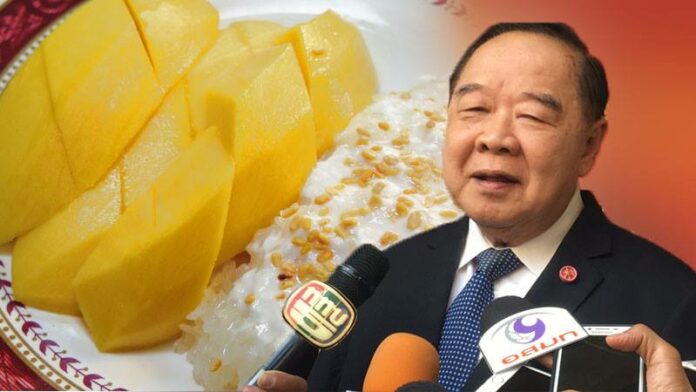
Prawit to Feed Sticky Rice to Chinese at ‘Record-Breaking’ Feast

BANGKOK — The man behind a viral disparaging remark about Chinese tourists is scheduled to feed them five tons of mango sticky rice Sunday.

In an event titled “We Care For You,” deputy junta chairman Prawit Wongsuwan will inaugurate the feast of Thailand’s most famous dessert for 10,000 Chinese tourists, the government said Friday.

Officials also hope the event – held next to a lake in Muang Thong Thani – will break the Guinness World Record for the biggest sticky rice mango banquet ever. They said representatives from the reference book would be present.

The feast is co-hosted by multiple private and government entities, including the interim parliament, the tourism ministry, the tour companies association and Sino-Thai communities. Organizers said the event – which will be broadcast on state media – will give a good image of Thai hospitality.

Chinese arrivals, which were booming in early 2018, were stunted by a deadly ferry sinking in July which killed 47 Chinese tourists.

Gen. Prawit said at the time the ship was run by a Chinese firm and that the incident occurred because the “Chinese did it to the Chinese,” causing outrage on social media in China.

Although yearly arrivals for 2018 exceeded a historic milestone of 10 million in December, monthly arrivals were lower than during the same period last year.

Advertisement

Too Many Monkeys: Hua Hin to Sterilize 1,200 Macaques

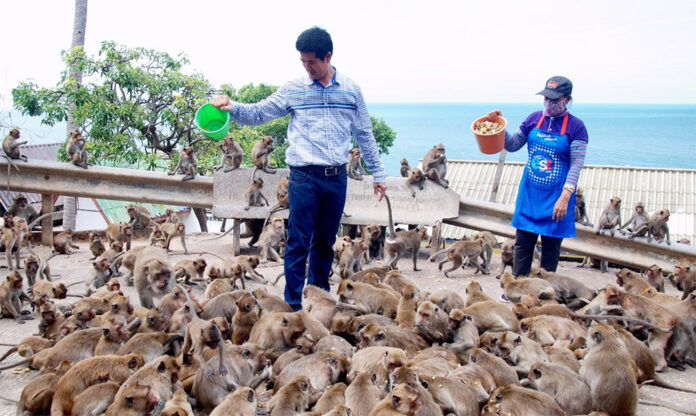
A tourist pours a bucket of slop onto a swarm of monkeys in Hua Hin in an undated photo. Photo: Matichon

HUA HIN — Hua Hin city will spend 1.2 million baht to sterilize 1,200 macaque monkeys in a bid to control their growing population.

Macaques at Khao Takiab, a mountain along the famous sea resort area of Hua Hin in Prachuap Khiri Khan province, are popular with tourists, who often feed and take photos with them.

The city of Hua Hin said the population of 3,000 macaques is too large, adding that they’re causing chaos in nearby communities.

It said that despite sterilizing 600 monkeys in the past two years, the population is still increasing.

Busaba Chokesuchart, vice mayor, City said Friday that the city will sterilize 1,200 monkeys this year, starting with 600 in February and another 600 in July.

It costs 1,000 baht to sterilize one monkey. Hua Hin City will also ask tourists to only feed monkeys at designated spots to maintain a clean and hygienic environment.

Advertisement

Bhumjaithai Woos Farmers With Weed, Thai Raksa Chart Blasts Junta

BANGKOK — While no one knows when the next election will be held, political parties have begun testing their messages in advance of the next poll.

The Bhumjaithai Party unveiled a policy platform Thursday meant to appeal to its heartland in the nation’s east while a Pheu Thai splinter party began marketing its ideas in Bangkok.

Announced in Buriram province, the home of its former influential leader, Bhumjaithai said it would support farmers growing up to six marijuana plants and set up a fund to facilitate a profit-sharing program for rice farmers.

The party, which has expressed a willingness to work with the military government, is led by Anuthin Charnwirakul. Anuthin expressed his readiness Thursday to serve as prime minister if elected.

The party said farmers and others in the industry could elect representatives to manage the rice fund to improve profit-sharing, said party sec-gen Saksiam Chidchob, the younger brother of former leader Newin Chidchob, who has withdrawn from politics.

The fund would be tasked with finding cheap loans for farmers, issuing insurance to their crops, determining export quotas and ensuring fair profits. A potential boon to farmers that may not sit well with other players in the industry, Saksiam said the scheme would see farmers get 75 percent of the profits with the rest going to mill operators, exporters and rice sack producers.

Also provocative is a party policy allowing farmers to legally grow and sell up to six marijuana plants for medical purposes. The secretary general said that with marijuana for medical purposes becoming legal, Thailand can learn from California, which has become the biggest legal marijuana market in the world.

He said one marijuana plant can yield up to 1 kilogram of buds per year worth about 70,000 baht.

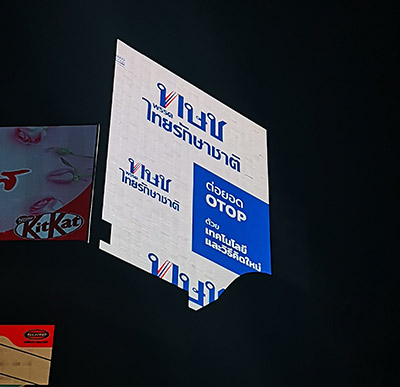
'Improving OTOP with technology and innovation,' says a sign promoting the Thai Raksa Chart Party that recently went up in Bangkok.
‘Improving OTOP with technology and innovation,’ says a sign promoting the Thai Raksa Chart Party that recently went up in Bangkok.

For palm oil producers, the party will support construction of power plants that utilize it to produce electricity. It also vowed to pass laws promoting biofuels from more diverse agricultural sources.

In education, the party said it will encourage learning online via smartphones. “If brothers and sisters can watch films, listen to music online with their smartphones, why can’t brothers and sisters learn on smartphones?” Saksiam said.

As for healthcare, the party said it would support better pay for community health volunteers and increase use of telemedicine to offer diagnoses and care without requiring travel to often inundated town and district hospitals.

Saksiam said over the past four decades, public health volunteers, also known as local doctors, have proven to be reliable but they need better compensation and support. He suggested a monthly compensation for public health volunteers ranging form 2,500 to 10,000 baht per month.

In Bangkok, the Thai Raksa Chart Party, which broke off from the Pheu Thai Party powerhouse of Thaksin Shinawatra, put up dozens of LCD campaign spots around the capital, including at the Victory Monument.

The ads present the party as heir to the now defunct Thai Rak Thai Party both in its uncannily similar party logo and slogan, “New Thinking. Do Anew. Dare to Change.” “New Thinking. Do Again” was once a slogan of Thai Rak Thai, a Pheu Thai predecessor that was dissolved by the courts following the 2006 coup that ousted Thaksin.

In a video released Thursday, party leader Preechapol Pongpanich criticized the military dictatorship as unaccountable and blamed it for the nation’s economic underperformance.

“Dictatorship often comes with a system called ‘lack of scrutiny,’ the party leader said.

Advertisement

Defense Ministry Defends New Lot of Chinese Tanks

A file photo of VT-4 battle tanks delivered to Thailand in 2018. Photo: Norinco

BANGKOK — A transparency gadfly on Friday slammed the military’s latest purchase of 14 Chinese battle tanks as an unnecessary waste of money – a claim disputed by the defense ministry.

The 2.3 billion baht used to buy the VT-4 tanks could have been better spent on infrastructure and public health, Srisuwan Janya wrote in an online post. The new tanks will join a battalion of 39 Chinese-made tanks the army bought last year.

Srisuwan also questioned why the military has only relied on Chinese arms suppliers in recent years. Defense ministry spokesman Kongcheep Tantravanich said the People’s Republic offers the best deals.

“If we were to buy American tanks, they’d be twice as expensive,” Maj. Gen. Kongcheep said. “Who wouldn’t prefer Mercedes-Benz over Isuzu? But this is all we can afford. That’s what the armed forces want. They are being frugal.”

VT4inaction
A VT-4 battle tanks fires its cannon Jan. 24, 2018, during a demonstration in Saraburi province

The tank is powered by a turbocharged diesel engine, seats three and comes standard with a 125mm large-caliber gun augmented by an anti-aircraft heavy machine gun and anti-infantry machine gun, according to maker Norinco’s specs.

The purchase was announced Wednesday by the military just days after new army chief Apirat Kongsompong visited the Chinese defense minister in Beijing. Gen. Apirat said at the meeting that Thailand would work even more closely with the Chinese military throughout 2019.

In a statement, the army said its arsenal of US-made M-41s was now four decades old and must be replaced. The armed forces initially considered buying tanks from Ukraine, but broke the deal off due to conflict there, it added.

The 14 new tanks will come with thousands of rounds of ammunition, the army said. They are the latest weaponry Thailand has bought from China, following the purchase of missiles, armored vehicles and submarines.

In today’s interview, Kongcheep defended the dependence on Chinese arms.

“China is now at the forefront of military technology,” the spokesman said. “They even have AI. We should stop looking down on them.”

Related stories:

Admiral Behind Submarine Deal Defends Need for ‘Dream Weapon’

Advertisement

BTS Fails to Keep Accessibility Promises for 4th Year

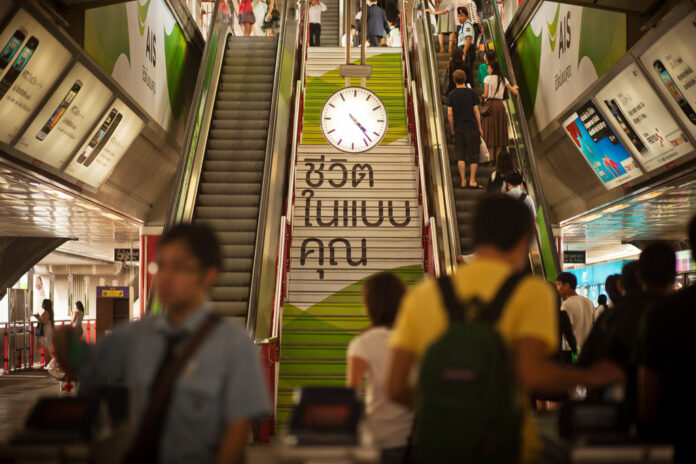
A file photo of stairs and escalators at BTS Siam. Photo: Nopphan Bunnag / Flickr

BANGKOK — The BTS Skytrain remains inaccessible to all commuters four years after a historic legal victory for disability activists.

Activist Manit Inpim this week accused the city of failing to do its job, saying he is unaware of any progress since 256 million baht was approved nearly eight months ago for construction of elevators at all exits of every station.

“I haven’t seen the latest situation, but I believe the installation is still not done,” he said this past week. Monday will mark five years since the Supreme Administrative Court gave the Bangkok Metropolitan Administration, or BMA, a one-year deadline to make stations throughout the elevated rail system accessible to commuters with disabilities.

Since then, years of inaction and delays have raised doubts about the BMA’s intent to comply with the court order and led the original litigants to go back to the courts.

Panurak Klannurak, the BMA’s newly appointed transport director, said by phone this week that they still haven’t found a contractor to do the work, and he doesn’t know when they will.

In May, the city promised the new elevators would be ready within four months of finding a contractor.

Every year since 2015, Khaosod English has checked in on the anniversary of the landmark 2015 court ruling. In 2016, city officials blamed infrastructure issues for missing the deadline but promised all work would be done that September. When 2017 began with no progress and more vague assurances, disability activists filed one of the kingdom’s first class-action lawsuits, which sought large compensatory damages. The lawsuit stalled, but by this time last year, nearly every station had at least one lift. It still fell short of the original high court ruling that the system be made accessible, as many elevators only connected one side of the street.

This past year has not been more encouraging to their cause.

Manit, who uses a wheelchair, shattered a glass elevator door at BTS Asok in March in a fit of rage after he was denied its use without filling out paperwork. A court-ordered joint-inspection of the rail network was carried out as part of the litigation, and the funds were approved for the additional elevators.

And going forward, it’s unclear the city will do better. When a new BTS extension to Samut Prakan opened last month, it didn’t take long for the public to be baffled by a wheelchair ramp at BTS Sai Luat that led to a ditch filled with weeds and rubbish.

Pakapong Sirikantaramas, the Mass Rapid Transit Authority governor, said in a phone interview Wednesday that the authority had talked to the owner of the land beside the elevator and had begun work expanding the ramp.

Manit said he doesn’t understand why the city continues to let such problems happen. He said his network inspected the construction work and submitted written suggestions to the authority six months before it opened.

“Why does BMA have to turn very simple things into something so complicated? This is how the people are thinking of them,” he said. “We’ve done enough work. Now it’s their responsibility to complete the work as promised. BMA has to act as an employer. It should take measures to accelerate the process.”

Ongoing efforts to force compliance by going back to the courts have stalled as well.

After winning administrative delays of the class action suit filed two years ago, the BMA convinced the civil court it should be heard in the administrative court, according attorney Sonthipong Mongkolsawas, who represents the plaintiffs. The case was dropped after the administrative court ruled it was not a venue for class actions.

About 430 commuters with disabilities responded by jointly suing the BMA in the administrative court for the same damages in a case that is ongoing.

On another front, Manit and five other activists sued the MRT subway in November over its lack of accessibility, demanding 16.8 million baht in compensation.

Related stories:

Transit Authority to Look Into BTS Wheelchair Ramp to Nowhere

City Hall Approves 256M Baht For BTS Elevators

Disabled Activist Rages After Denied Elevator at BTS Asok

BTS Class-Action Suit Back on Track After Year Delay

Three Years of Excuses Later, BTS Still Not Accessible

City Hall Challenge Delays Decision on BTS Accessibility Suit

Advertisement

Defending Champ Gone: Sharapova Ousts Wozniacki in Australia

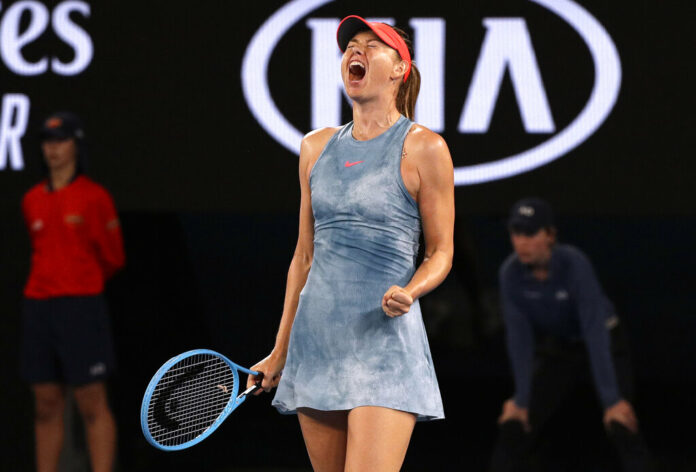
Russia's Maria Sharapova celebrates a point win over Denmark's Caroline Wozniacki during their third round match Friday at the Australian Open tennis championships in Melbourne, Australia. Photo: Kin Cheung / Associated Press

MELBOURNE, Australia — Maria Sharapova smacked a forehand winner – the sort she’s hit so many times, at so many key moments, over the years – to take control against defending champion Caroline Wozniacki at the Australian Open. Sharapova balled up her fists, shut her eyes, threw back her head and let out a yell.

She showed she’s ready to be a Grand Slam factor once again.

Sharapova grabbed the last four games to eliminate Wozniacki 6-4, 4-6, 6-3 in nearly 2½ hours Friday and reach the fourth round at Melbourne Park, building the statement-making victory with aggressive groundstrokes that gave her a 37-10 edge in total winners.

“I haven’t played many matches in the last year, especially against top players,” Sharapova said. “And these are the kinds of matches I train for.”

She cut her 2018 season short in September because of problems with her surgically repaired right shoulder.

Sharapova is seeded only 30th at Melbourne Park, where she won the 2008 title for one of her five Grand Slam trophies but hasn’t been past the quarterfinals since 2015.

The 31-year-old Russian missed the tournament in 2017 during a 15-month doping suspension that was triggered by a positive doping test during the previous year’s Australian Open.

Wozniacki was the No. 3 seed in Australia, a year after beating Simona Halep in the final to claim her first major championship.

Next for Sharapova is a matchup against Australia’s Ash Barty, who beat Maria Sakkari 7-5, 6-1 to equal her best showing at any major tournament.

“I know,” Sharapova said, “it’s going to be a tough crowd.”

No. 15-seeded Barty took two nearly years off from the tennis tour after the 2014 U.S. Open and played cricket during that time.

“Her story is phenomenal,” Sharapova said. “I know she took a little break and came back and just resurged.”

Against Wozniacki, Sharapova hung in there in a back-and-forth contest.

Wozniacki led 3-2 in the third set after holding at love. But Sharapova finally gained the upper hand with a break for a 4-3 lead, clinched with that big forehand she was so excited about.

After holding to go up 5-3, Sharapova broke yet again to end it, closing with a big cross-court backhand.

“The level was quite high,” Sharapaova said. “I knew I was going to get a tough match.”

Advertisement

Students Appalled by Haphazard Forced Cut (Video)

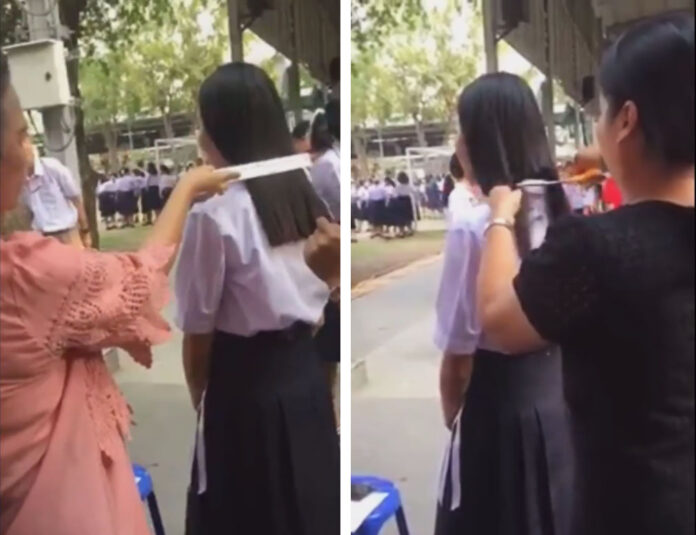
Kanchananukroh School teachers cut the hair of a Matthayom 4 student on Jan. 10 in Kanchanaburi.

KANCHANABURI — A teacher presses a ruler onto the nape of a student’s neck while the other crudely shears five inches of her straight locks off in a matter of seconds.

Kanchananukroh School in Kanchanaburi City was gaining viral infamy Friday not for its academics or athletics, but a haphazard haircut forced upon a student with hair deemed too long.

“Teachers warned her many times, but she didn’t get her hair cut according to the rules,” administrator Phawadee Jittamai said, defending the haircut. “We cut her hair according to the school rules in the student handbook. The student who posted the clip also damaged the school’s reputation and will have their behavior scores docked.”

Phawadee said the haircut happened Jan. 10 to a Matthayom 4, or Grade 10 student.

While it’s not uncommon for teachers to summarily enforce school dress codes, including hair cuts, rare footage of it happening combined with its crudity drew debate.

The video’s views exploded after it was posted to a popular Facebook page for hot topics to more than 650,000, with more than 3,000 people sharing it since Thursday afternoon.

Tanawat Wongchai, 20, a former student president at Chulalongkorn University and outspoken progressive, said schools should end such practices.

“We have to have to allow students to freestyle hair, which will eliminate this problem,” Tanawat said. “Although this student may have broken the rules, the teacher’s problem-solving method should not employ violence and violate student’s rights.”

Under Education Ministry rules, boys’ hair must be no longer than their hairline and girls’ must keep it no longer than the nape. Schools have the leeway to allow longer hair, but it must be tied up properly.

Still, both rules could be overridden by individual school rules.

“If dress codes and hair don’t have an effect on studies, then the rules should be updated to go with the times,” Tanawat said, referencing Bangkok Christian College’s recent uniforms-optional experiment.

“So strict about rules, but Thai education is one of the worst in the world,” Facebook commentator Rungsi Sutthimanus wrote.

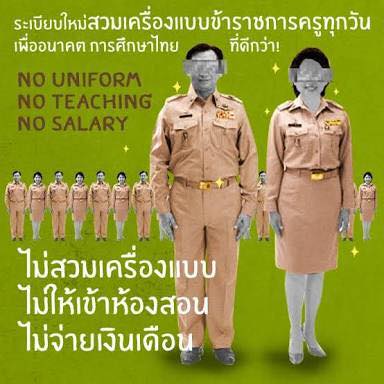
Songyok Daf pointed out that the teachers in the clip are themselves violating the dress code by not wearing their official government khakis.

A graphic demanding teachers also follow dress codes by wearing their government-issued uniforms or receive no salary, first posted in 2013. Image: New Culture / Facebook

“Teachers dress however they want, let down their hair, wear casual dress and wear silk, like an MP’s wife,” Songyok wrote, attaching a graphic advocating teachers’ uniforms.

However, around a fourth of commenters sided with the time-worn practice, many saying it had happened to them. Some advocated for the girl to be expelled.

“In my day, they shorn my head so unevenly that I went home looking like a gecko. My mom said I deserved it because she already told me to cut my hair. These days people are so sensitive,” Sanong Kookratoke commented.

“Teachers, cutting their hair counts as violating their rights, so don’t bother,” Techaniti Prajakwong wrote. “If she was already warned and punished and still broke the rules, then just leave the school!”

Related stories:

Abusive ‘Buddhist Camp’ One of Top 10 Worst SOTUS Incidents of 2018

Meet the Unlikely Band Taking on University Tradition

Parties Stake Out Positions on ‘SOTUS’ Hazing

SOTUS 2018: Hazing Hits High Schools

Advertisement

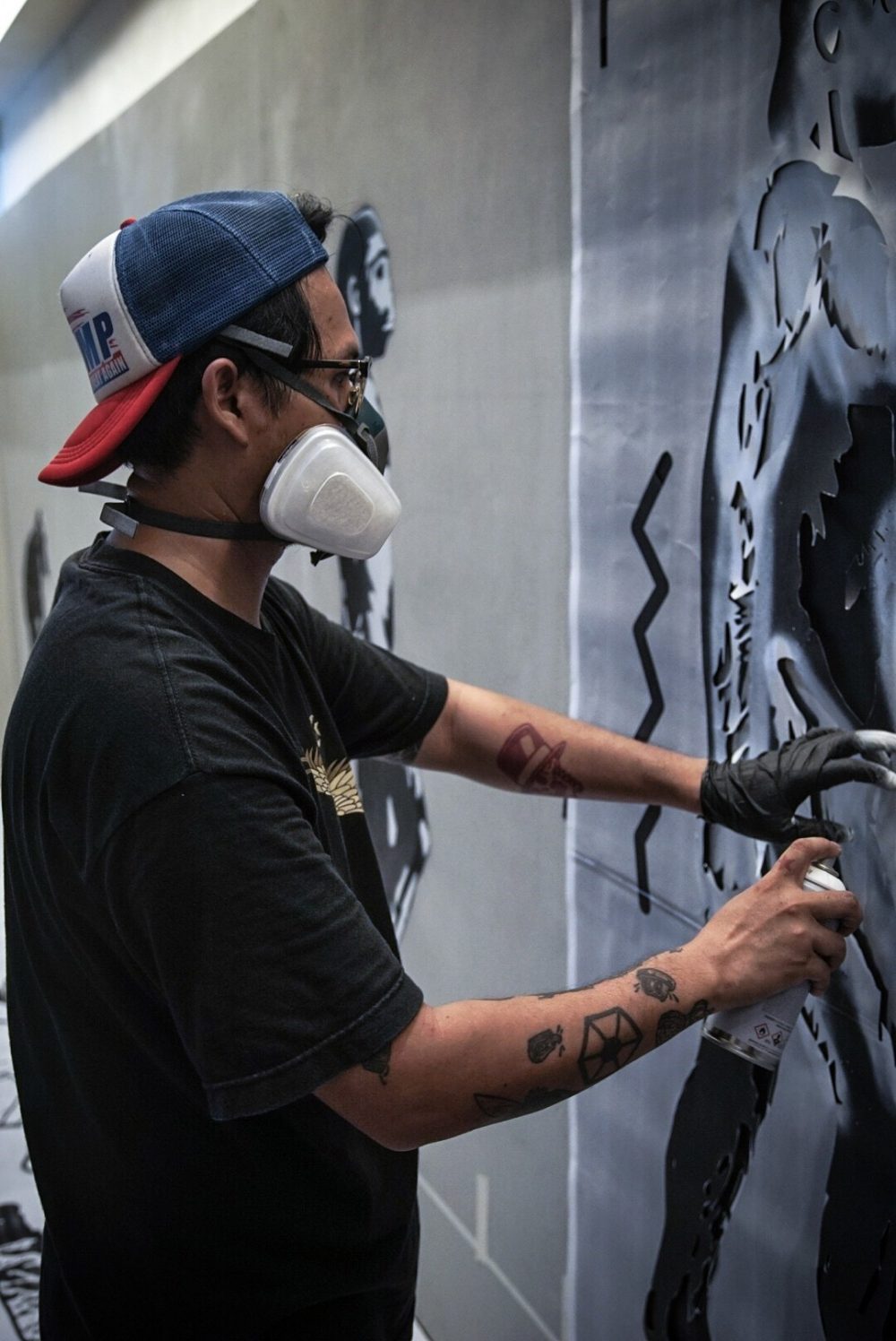
Dangerous Art: Fame is Peril For Anonymous Artist Headache Stencil

BANGKOK — A junta leader’s face appeared on an alarm clock over Sukhumvit Road. The mural, a challenge to the general then engulfed in scandal, lasted two days before it was painted over.

For the attention it got in the media, the work’s creator was awarded equal parts fame and peril. With security forces hunting him, he fled his own condominium which had been staked out by security forces.

“My life has changed forever since,” the artist, who creates his work anonymously, said in a recent interview. “Who would think that spraying on a wall, what I had done for four years, would put me in that much trouble?”

It’s been one year since Headache Stencil issued what he described as a wake-up call to the nation over corruption in the military government exemplified by junta deputy chairman Prawit Wongsuwan’s watch scandal.

In that time, fear of being hunted by the authorities hasn’t stopped the street artist from addressing other hot-button issues through his preferred format: stencil graffiti.

A black panther with a mute icon became the iconic image after a powerful mogul was accused of poaching a black panther. Crying eyes appeared beside the stump of a 50-year-old tree felled by the city.

“I read a lot of news and my work depends on what I’m into at the time,” he said, adding that he researches his topics beforehand. “I can’t be reckless. I gotta be responsible for what I do, especially when my works are shared on social media.”

Combining stencil works, political messages and a mysterious identity draws inevitable comparisons to another famous artist. But being called “Thailand’s Banksy” obviously doesn’t sit well with Headache Stencil.

“It’s flattering in a way. But if people call me that because they think I copy Banksy’s works, I don’t know what to say because in fact I don’t. So every time I’m about to do something, I gotta see if Banksy has done it already?”

OcpPByzM86DCU8Op utjhDReRkSyNJ8NOwY8ta 3U9IIflJigw3nDK0JUpxdZM7p3
A street mural depicting junta deputy leader Prawit Wongsuwan was up temporarily in February 2018 in Bangkok. Photo: Headache Stencil / Facebook

Whose Headache?

Agreeing to be interviewed by Khaosod English, Headache was comfortable in his own residence. He opened the fridge to fix an artificial lime juice with one hand while the other gripped a vape pen. Over a table covered with mirrored sheets that he uses to cut his stencils, Headache reminisced about his past and the international fame he earned overnight.

Headache is a “30-something” man born and raised in Bangkok. He discovered stencils during a university year when his roommate bought a second-hand photocopier. The walls of his university soon became the canvas for his “experiments.”

“I started calling myself [Headache Stencil] because I knew what I did is going to cause people headaches. I’ve been a troublemaker since I was a kid,” he said.

After graduating, Headache did not daub a wall with graffiti again until after the 2014 coup, when he was in Chiang Mai. Frustrated by bars and clubs being ordered shut early, Headache grabbed a spray can again to mock Gen. Prayuth Chan-ocha by likening the junta chairman to Dr. Evil of “Austin Powers” villainy.

There are always problems in our society that need to be solved, and I think I’ll never run out of things to talk about

A friend, also an artist, encouraged him to enter an international contest in Australia. He was selected to be one of 84 finalists, and the only one from Southeast Asia.

O1OnwEg0IAKx4HygTqSVhnwCefEnEvhJNXTujhQche6dm1U9zLfpbimom3IyzZmEGFzwsvUUG6QGQbI8S1nTbyhGzCEJe gSb GHoq64 ADng214RcsKh
A 2014 mural of Gen. Prayuth Chan-ocha as Dr. Evil.

Back home, Headache didn’t make any headlines until his alarm clock mural caught a reporter’s eye one morning.

The news went out and people learned about Headache Stencil. His Facebook followers leaped from a few hundred to more than 50,000.

Despite gaining a larger audience, the street artist still struggled to find a venue for his first exhibition this past July. He was rejected by many galleries.

“I understood them though. No one wanted trouble. Plus, it’s never a guarantee that my works could sell. Who would wanna buy political art?”

Eventually, his first exhibition, called Welcome to the Dark Side, found a home at Voice Space, the event hall of Voice TV, a broadcaster known for its critical reporting. Spanning the hall was a maze with graffiti art on the walls. The concept was meant to be a relatable metaphor for Thais and Thailand: trying to find a way out.

Fearing it being shut down by the authorities, Headache never announced the venue in advance and instead relied on word of mouth and social media.

SGm1Wl8Krv7VP0oBcrCT7M2sd86eOzOnFDAL Gy1OeDThc5ZoTKJpQoFXDcz1RXSR6T2TaJuSKMWbEh0jjy7RGqIBqWvkIcJrAOAitegJHXyi4u9vwePSNNUVhv2BfaCLWnLwZUi
Headache Stencil’s graffiti of a black panther. Photo: Headache Stencil / Facebook

‘Not Only Graffiti Anymore’

As Thai muralists like Alex Face, Rukkit and Mue Bon gain respect and commercial success, there’s been a surge of graffiti art in urban areas such as Bangkok, Chiang Mai and Khon Kaen.

The big change in attitudes toward graffiti was made clear when Bangkok’s old Charoen Krung district turned itself over to some of the world’s best muralists three years ago as part of the Bukruk Urban Arts Festival.

IMG 0976 e1547790043209
Photo: Headache Stencil / Facebook

“We used to be disgusting to people. But these days many of us have helped improve communities, we’re even given permission by the property owners to spray on their walls,” Headache said.

In March, at the peak of black panther outrage, a veterinary clinic offered space for 10 muralists to emblazon a 15-meter-by-3-meter wall to demand justice.

“It’s not only graffiti anymore. It’s street art. We make the neighborhood pretty, and we send out messages to the public.”

But life remains under military rule in a society controlled by the powerful and unaccountable. Even at home, talking privately, Headache struggles to answer some questions, pausing and restarting. He admits there are things he must be careful about.

“With the power and things that are unspeakable, it’s forced me to yoo pen,” Headache said, using Thai slang that means going with the flow to avoid conflict.

“How can I keep my ideology so I can continue to do what I do? … It’s like chess. If you’re captured, you’re out of the game. But if you take a step back sometimes, you can be a winner some day.”

OaC3eH Nd5RstnWa6Wt4rYPFALnCcnxsnIwkdegLcMFClaaO34 TDsz35hXV0S3OvMGi0OqBqP40ufOcFJCyiyM4NPds 7lqCgdYaUqO7j8FezXLOzuBCmLUJoDFyw0kUdVQhSkd
One of the most recent works by Headache Stencil depicts a student wearing a mask, following the heavy smog which clouds over Bangkok for more than a week. Photo: Headache Stencil / Facebook

Asked when, or if, junta leaves the power, what’s next for him, Headache said he would continue to hit other issues that have persisted a long time.

“[Prayuth] was not the first prime minister in the chair when I have seen problems in society. Actually, I’ve seen them through my life,” he said, mentioning corruption and canals jammed with trash.

“There are always problems in our society that need to be solved, and I think I’ll never run out of things to talk about,” he added.

Prostitution and drug issues are two topics that he’ll take on in an upcoming project at a gallery in Patpong (Check his Facebook page for details). Headache will also hold his second exhibition, Thailand Casino, Feb. 24 through the end of March at WTF Gallery and Cafe. The bar-gallery space is located on Soi Sukhumvit 51 and can be reached by foot from BTS Thong Lo.

Related stories:

Artist Mourns Felled Rain Tree Through Graffiti

Prawit Muralist Says Police ‘Hunting’ Him Then Vanishes

Watch Scandal Gets Bangkok Street Mural

Advertisement

Election Rally Fears Counterprotest to Instigate Violence

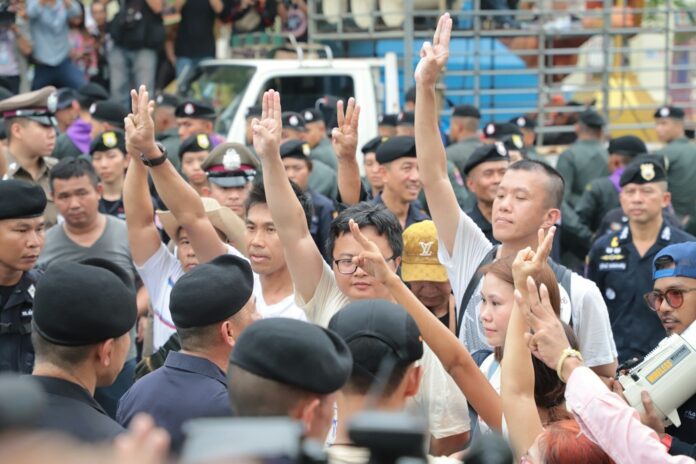
Pro-democracy protesters raise the anti-junta three finger salute on May 22, 2018.

Update: Pro-democracy leaders announced Friday afternoon that their rally would be moved down the road to Thammasat University.

BANGKOK — An organizer of tomorrow’s pro-democracy rally said Friday he fears clashes could break out after a counterprotest was announced for the same site.

The Democracy Monument protest to demand timely elections will be met by another gathering by a heretofore unknown group calling itself “Unity Before Election.” One of the leading pro-election activists has withdrawn from the rally, citing fears of violence, but campaigner Sirawith Seritiwat said the event would go ahead.

“We may adjust our activities and change our plans. We are discussing the matter,” Sirawith said in an interview. “We are looking for ways to avoid clashes.”

March 24 May Be Suitable for Election: Wissanu

Sirawith spoke hours after Nuttaa “Bow” Mahattana – the face of previous peaceful rallies calling for elections – said she would not attend Saturday’s protest.

“I have evaluated myself, as one of the leaders, and I believe I may not have the capability to ensure everyone’s safety,” Nuttaa wrote online.

The counterprotest was called by Facebook page “Unity Before Election,” which has only about 100 followers. It includes no means of contacting the page’s administrators.  

“No peace, no election. Join us in a show of force to end unrest,” the post said, adding that the rally would take place at 3pm at Democracy Monument – roughly the same time Sirawith’s protesters are set to gather.

It is unclear who’s behind the group. Junta spokesman Winthai Suvaree said he’s not aware of the group’s existence, while Chanasongkram Police Station chief Chakkrit Chosoongnoen described them as “members of the public.”

“They are not opposed to elections,” Col. Chakkrit, whose jurisdiction covers the monument, said by phone. “They simply want to see peace and order.”

Chakkrit said police would deploy more officers to keep the two protests in order.

But Sirawith believes the counterprotesters are agent provocateurs organized by the military to incite violence.

“From what I’ve heard, they are set up by the Internal Security Operation Command,” the activist said. “They are trying to draft people from the ranks to harass us.”

The past 14 years in Thailand have been marked by skirmishes between protesters of different ideologies, which have at times turned fatal. Citing the need to establish peace, the military seized power in May 2014 after months of street protests in the capital against the elected government.

Advertisement

Hot News

LATEST NEWS

Bangkok
light rain
23.9 ° C
26.6 °
23.9 °
56 %
2.8kmh
100 %
Sun
29 °
Mon
31 °
Tue
36 °
Wed
31 °
Thu
33 °