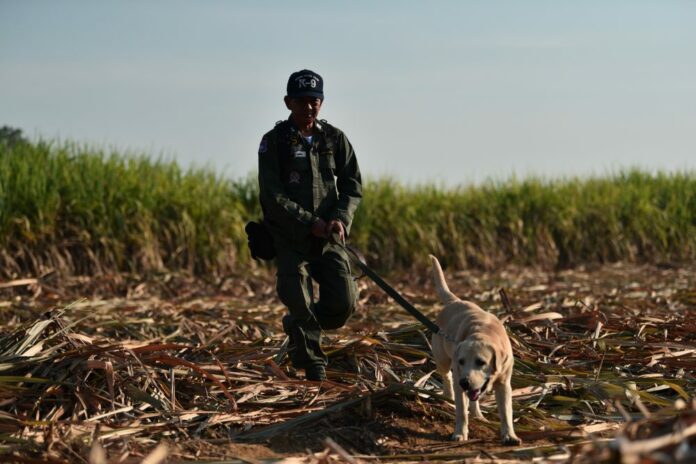
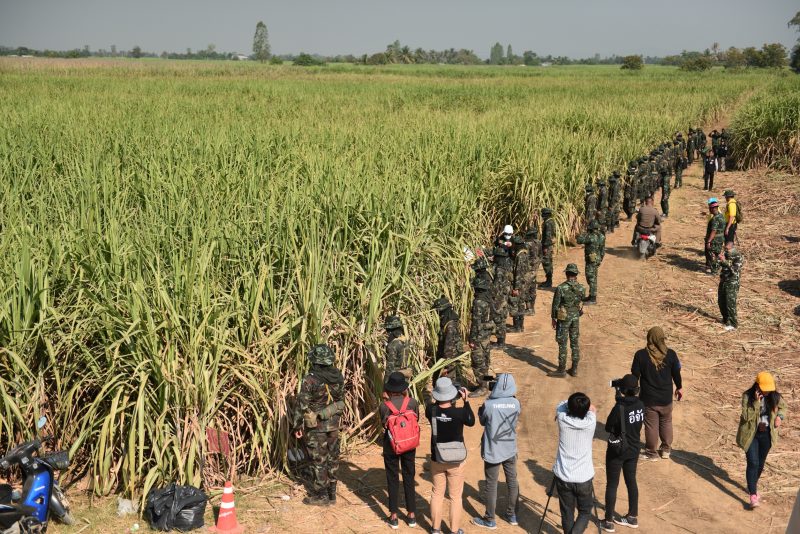
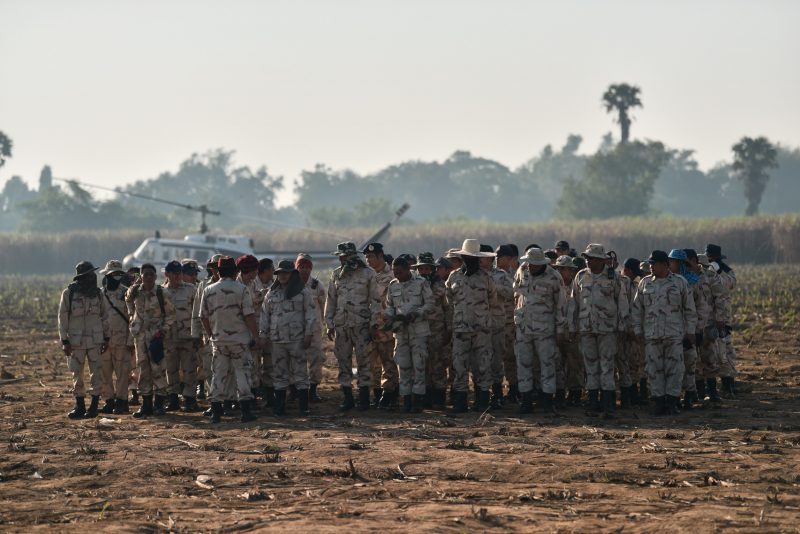
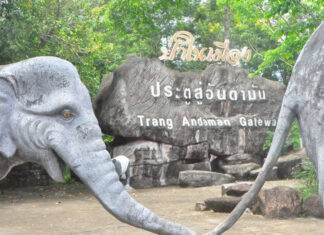
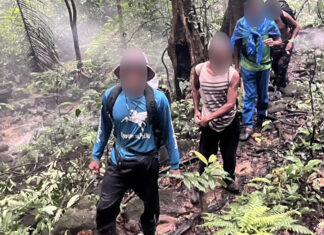
SUPHAN BURI — A search and rescue operation for a 2-year-old boy entered its ninth day Tuesday with more than 100 police officers and sniffing dogs.
Sului Piew’s whereabouts are still unknown since he went missing over a week ago while he was out playing with a friend near a sugarcane plantation in Suphan Buri province. Officials haven’t ruled whether the son of Burmese migrant workers may have gotten lost, had an accident or been abducted.
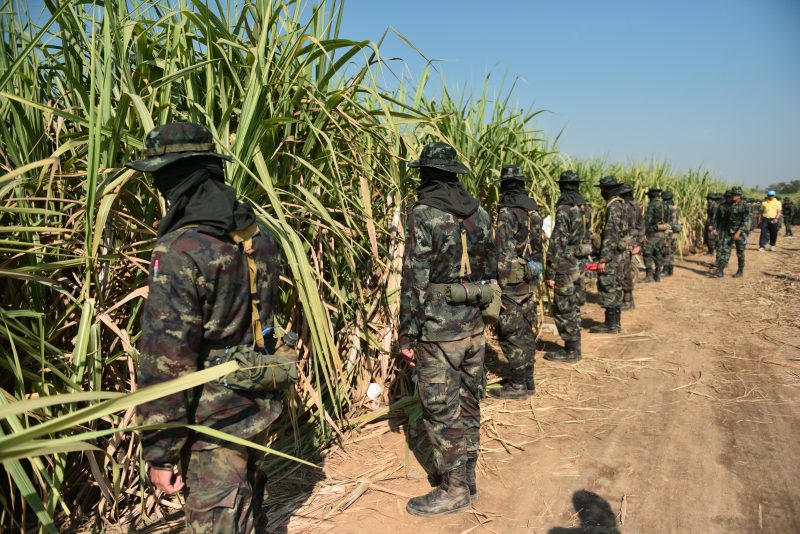
Since Wednesday, rescue workers, police and soldiers were deployed across an 80-acre field to find Sului. Divers also checked nearby ponds for signs of the boy. The latest to offer assistance to the search operation were mahouts and their elephants.
Sului’s 3-year-old friend, the last person who saw him, has been questioned by officers and child specialists, according to Lt. Gen. Sompong, chief of Border Patrol Police. The friend sounded the alarm, allegedly telling her parents she saw the 2-year-old being abducted.
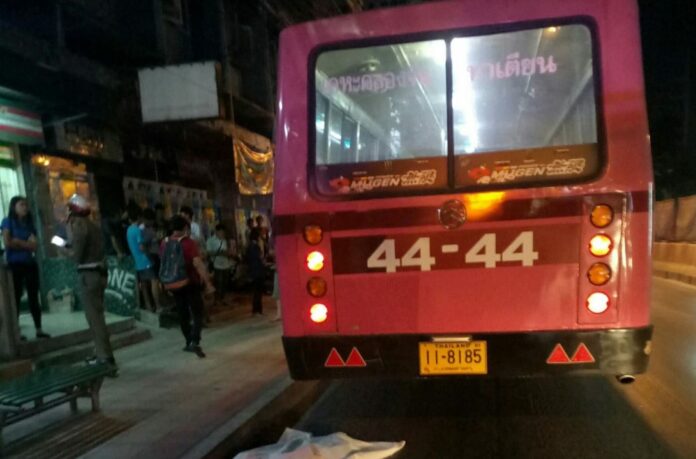
A bus No.44 at the scene of a Monday incident in which a 77-year-old woman was killed on Lat Phrao road, Bangkok. Photo: Ruamkatanyu Foundation
BANGKOK — Police on Tuesday were looking for the driver of a bus that ran over and killed an elderly female passenger last night in the capital.
The victim, who was struck by a No. 44 bus at about 7:30pm on Lat Phrao road in Wang Thonglang district, died at the scene following the incident. Police said they charged 22-year-old driver Jatupol Imsook, who quickly fled, with fatal reckless driving.
Prajan Prompak, the bus conductor, said the 77-year-old victim was getting off the bus at Soi Lat Phrao 66 when she lost her balance, fell from the sidewalk and under the bus that was pulling out at the same moment. She sustained a fatal head injury.
The bus is privately owned and operated by Raavechoek Company.
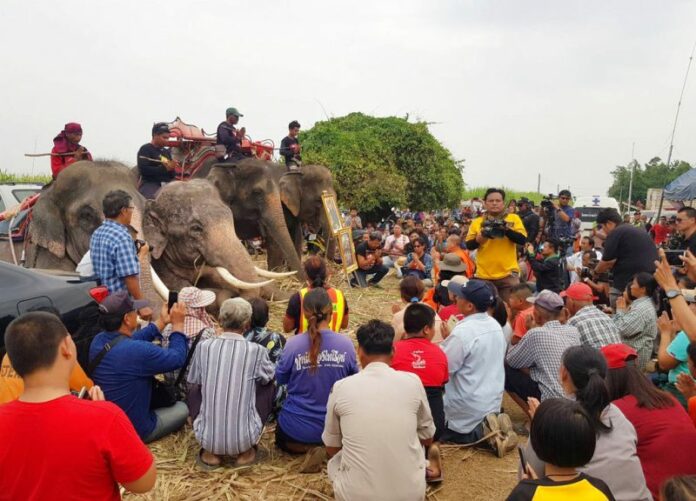
In this Sunday, Dec. 23, 2018, photo released by Suphan Buri City, four mahouts and their elephants attend a prayer session with rescue workers and officials before joining the search operation, in Suphan Buri, Thailand. Photo: Suphan Buri City via Associated Press
BANGKOK — Four elephants mounted by their mahouts have joined the search for a 2-year-old boy from Myanmar who has been missing in Thailand for a week, as hundreds of rescuers combed through a sugarcane field for traces of the missing child.
Sului Piew, a son of migrant workers from Myanmar, went missing Dec. 17 when he went out to play near the sugarcane plantation where his parents work. Nimit Wanchaithanawong, the governor of Suphan Buri province, said Sului’s family was alerted of his disappearance when his 3-year-old friend told her parents that she saw Sului being abducted.
“We set up a search operation center near the field and we will continue with the search in full steam,” Nimit, who is in charge of the search operation, said Monday. “It’s been more than a week and the child is so young. These few days will be very critical to all of us.”
The search for Sului officially began last Wednesday and has involved hundreds of volunteer rescue workers, police officers and soldiers who have been deployed to search an 80-acre field of around 2-meter-high (6.5-foot-high) sugarcane plants. A team of divers has also searched nearby ponds to find clues of the boy’s whereabouts.
The latest to offer assistance to the search operation are the mahouts and their elephants from a neighboring province.
Laithongrien Meepan, the elephants’ owner, said the animals would be able to scour the vast sugarcane plantation for signs of life because they can sense the presence of life.
“If we find a child, or dogs lying around, they know not to step on that,” Laithongrien said. “Mahouts can look out into the distance and elephants will raise their trunks to smell.”
Junta leader Gen. Prayuth Chan-ocha, left, poses with his Laotian counterpart in 2014 in Milan, Italy.
BANGKOK — The friends and wife of a prominent anti-monarchist exiled in Laos said they fear he might have been disappeared after they lost contact with him for two weeks.
Romchalee Yammy Sinseubpol, a political exile in Laos said she and an unspecified number of friends went to check Surachai Danwattananusorn’s resident Monday morning – more than two weeks after they lost contact with him – and found no one. She said all doors had been left open and that some documents appeared to be missing.
She posted on Facebook saying the place appeared to have been searched. She and her friends fear that he may have been “forced to disappear.”
“The last thing Yam and friends would like to ask from all of you is to remember this democratic hero… who dedicated himself to pro-people ideology,” wrote Romchalee.
When contacted Monday afternoon, Romchalee said she cannot disclose further information until having consulted with her peers, but confirmed that the situation remained the same as of press time Monday.
In a related development, Surachai’s wife, Pranee Dawattanasunorn pleaded that her husband and two male aides be safely released.
“I could only plead those involved to let them go,” said Pranee, who lives in Nakhon Si Thammarat province and lost contact with Surachai since Dec. 10.
Surachai, fled Thailand two days before the May 22, 2014 coup and has since been active on social media promoting his ideology.
Speaking on the phone, Pranee said Laotian authorities had asked friends to come and take away his valuables on Monday but that his gold, cash and gun had gone missing.
Pranee said Surachai is ailing from heart conditions, diabetes and high blood pressure and could be in serious danger without his heart medicine.
On Monday, Deputy Prime Minsiter Prawit Wongsuwan said he didn’t know where Surachai could have gone.
“I don’t know where he is and why he has disappeared now after four years,” adding that he had contacted the Laotian authorities, who had told him they were unaware of Surachai’s whereabouts.
Prime Minister Gen. Prayuth Chan-ocha, left, and Deputy Prime Minister Pridiyathorn Devakula in 2014.
BANGKOK — A former Deputy Prime Minister under Gen. Prayuth Chan-ocha’s first administration launched a scathing attack on the premier Monday detailing why he wouldn’t support his former boss to become PM again after elections.
Writing for Isranews Agency and Daily News in a long article, Pridiyathorn Devakula cited eight reasons for which he wouldn’t support Prayuth to become an elected prime minister. These included lack of fiscal discipline – particularly on military spending – close ties with China at the expense of Thailand, reinforcing military supremacy over civilians, nepotism and lack of will to do the right thing.
“What’s very ugly is that the state’s budget has been used to boost his popularity and political parties on his side,” Pridiyathorn wrote, adding that the so-called mobile cabinet meetings upcountry are nothing but another thinly-disguised political campaign.
Reacting to the criticism, Deputy Prime Minister Gen. Prawit Wongsuwan accused Pridiyathorn of having a “personal dislike” for Prayuth.
Pridiyathorn also criticized the military regime in which he once served for using state money in cash handouts to the poor just before the promised elections.
On military supremacy over civilian, Pridiyathorn said civilians became the governed under the military.
“Summoning people to have their ‘attitude adjusted’ by the military inside military compounds and their overseeing of officials’ work at the Interior and Agriculture ministries at a local level makes it feel as if the army is the ruler and civilians are under military rule,” the former deputy premier wrote.
Pridiyathorn cited the slow investigation by the National Anti Corruption Commission over the alleged irregularities in the construction of the controversial Ratchapak Park the military built in Hua Hin, Prachuab Khiri Khan province as another reason for his disapproval of Prayuth’s candidacy.
He also spoke of the lack of fiscal discipline as another reason for not supporting the junta leader. Pridiyathorn – who was in charge of the economy during the first year of the military regime – expressed concerns about excessive future budget commitments made for the purchase of arms. He referred to the 3 trillion baht pledged to buy submarines and added that the government’s expenditures are “growing faster than its income” and fiscal deficit.
He added that the future budget the military government committed to over the next five years, at 117 trillion baht, is the highest in history.
“If Gen. Prayuth is prime minister anew he would likely choose a person who would yield to him to become finance minister. There will be greater fiscal deficit… debt will grow to the point where the financial status of the country will weaken,” he said.
Pridiyathorn sad that another reason for which he does not support Prayuth for prime minister is his perceived “lack of decisiveness” due to the fear of losing popularity. He cited that the regime’s retreat from pushing for a coal-powered plant in Krabi province as an example. He said Prayuth would not be able to push for reforms if he became prime minister again due to his indecisiveness.
He also criticized Prayuth’s lack of appropriate behaviour when abroad. He added that Prayuth often strays from the main issues when addressing the public abroad to the point where foreign media stated that “Thailand’s military junta is led by a clown.”
Lastly, Pridiyathorn accused the junta leader of often speaking with “hostility” and “angry mood.”
“He has never been careful in speaking. He doesn’t even know how a person who is a prime minister should conduct himself or speak to be appropriate,” Pridiyathorn wrote.
In further reactions, Prawit also denied that Prayuth was trying to set up an oil company in an attempt to eventually establish a monopoly in the industry with his army friends as alleged in one of the eight reasons cited by Pridiyathorn for not supporting Prayuth.
“There’s none. What old company? There’s none… It’s just personal dislike,” Prawit said Monday.
Key members of the government join Palang Pracharat Party on Sep. 29, 2018.
YASOTHON — A resident of Yasothon province who posted a video of what he alleged to be an election irregularity was sent to an attitude adjustment session at a local police station, officials said Monday.
Kiatburut Panlert, who alleged that recipients of state welfare cards were forced to sign up for a pro-junta party was taken to a police station and briefed by security officers before being released, the head of the Loeng Nok Tha district told reporters. He said the issue was based on a misunderstanding.
Kiatburut maintained he was doing the right thing.
“Right now I’m fine. There are people ready to help me if anything happens to me,” he wrote online. “Thank you for all your support (Don’t be afraid when doing the right thing. It’s our country. We have the rights to scrutinize any lack of transparency).”
In a video posted online Sunday, Kiatburut said officials handing out government welfare cards to low-income residents forced them to pay 100 baht and register as members of the Phalang Pracharat Party. The party supports junta chairman Prayuth Chan-ocha’s bid to become an elected prime minister in elections slated for February.
“Look at this. This is a lack of transparency right here,” Kiatbutur says in the video, waving a form of party application in front of the registration booth. “Apart from failing to lead the country, they are also stupid!”
In a statement, the Loeng Nok Tha district office said Kiatburut initially received a complaint from an elderly woman who wanted to sign up for a welfare card but ended up at the nearby Palang Pracharat booth by mistake.
Party staff then misunderstood the woman’s intention and gave her the registration form, the statement said.
But the explanation failed to convince critics of the government who accused Palang Pracharat of election fraud. Convincing members of the public to join a political party in exchange for rewards is punishable by party disbandment under election regulations.
“All the state functions seem to willingly facilitate convenience for Palang Pracharat Party’s political activities in many steps,” Redshirt leader Jatuporn Prompan told reporters. “But personally I think it’s good they are being obvious about it, because it will be easy for the public to make decisions.”
The pro-government party has been mired in controversy since its inception when four members of the junta’s cabinet joined it as executives, raising conflict of interest complaints from the opposition.
An investigative news agency also alleged that some seats at the party’s 600-million-baht fundraising banquet were purchased by state agencies such as the Tourism Authority of Thailand and Bangkok Metropolitan Administration.
Government officials insist no taxpayer money was used to buy seats at the event, which cost 3 million baht per table.
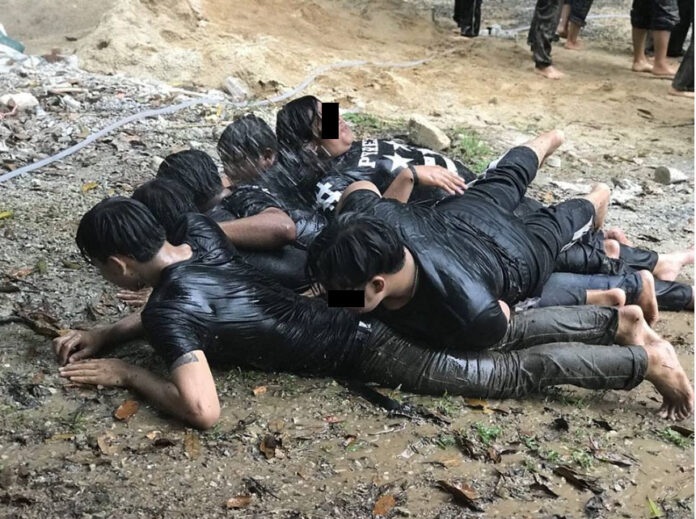
Engineering freshmen being hazed in the SOTUS tradition in September at Rambhai Barni Rajabhat University in Chanthaburi. Photo: Anti Sotus / Facebook
BANGKOK — From spleens being burst as a result of beatings and screaming university chants while rolling in mud, to an abusive religious camp where students were forced to stand reciting pledges until 5am, activists ranked the worst instances of hazing to break the news in 2018.
The anti-hazing watchdogAnti Sotus ranked the worst offenses of the hazing tradition of Strength, Order, Tradition, Unity and Spirit (SOTUS), in 2018, with four of the top ten involving high-school students.
“It’s kind of a hall of fame. Or is it a hall of shame?” Bandhukavi Palakawong na Ayudhya, an activist in the Anti Sotus group said. “Personally the worst one for me was the guy who was kicked until his spleen burst, because it was so violent.”
The following rankings are based on both online polls held by Anti Sotus and Anti Sotus admins, with 350 votes from netizens weighing for half of the votes, and rankings by the 20 activists in the group weighing in for the other half.
Maejo University, Rajabhat University, Rajamangala University, Kasetsart University and Chiang Mai University tied with King Mongkut’s Institute of Technology Ladkrabang in the top five worst universities for hazing overall.
“Maejo is one of the only unis that have sanctified and institutionalized their SOTUS in their rules, while others unis change them. Maejo have shown that they stand by their SOTUS,” Keerati Panmanee, secretary-general of Anti Sotus said Monday.
Bandhukavi said that Chiang Mai University students have a SOTUS activity where they are forced to run up a mountain.
Since the above five are not highly-ranked universities, Anti Sotus created a separate ranking for competitive universities. Thammasat received the best score for the most gentle SOTUS activities, followed by Chulalongkorn and Mahidol. Silpakorn, Kasetsart and Chiang Mai University were ranked to have “harsh SOTUS” activities.
Keerati said that in 2019, there should be less violent SOTUS activities since awareness is increasing and more people are sending in social media tips – but the kind of SOTUS where students are pressured into strange activities or donating money lives on.
“Sometimes it’s influential alumni who are perpetuating this tradition,” he said. “They could increase methods of brainwashing kids to love their institution.”
Topping the list was a Sriyaphai School in Surat Thani where Matthayom 4 (Grade 10) students were forced to attend a three-day Dhamma Camp where students were forced to watch disturbing clips of corpses and animals being killed. When students couldn’t stomach eating food after watching the clips, all their food was put into a single pot and were made to watch their teachers eat it.
Students were also made to stand until 5am pledging that they would never use drugs, with many fainting from sheer exhaustion. Disturbed students sought psychiatric help, with some dropping out of school.
Although the camp happened four years ago, news of it first broke in November in an anonymous Pantip post. Then, Facebook user Jettepon Kraimark came forward and said he was the older brother of one of the students who attended.
“After he came back from the camp, he kept apologizing…he couldn’t sleep. At night he would wake up and prostrate at our feet, apologizing for being gay, but we already knew about him,” Jettapon said. His brother had to get psychiatric help.
Jettepon’s post encouraged others to come forward with their own Buddhist camp experiences.
“Before sleeping at 11pm we watched clips of corpses and babies being born. At 3:30am we had to do chants until the morning. We didn’t eat dinner and I have low blood pressure so I went out to puke,” commented user Praphapan Pompan. “The damn monk said through the mic that in my past life, I had an abortion.”
Anti Sotus admins agreed that the dhamma camp was resonating because many have experienced similar camps.
“For me, the dhamma camp was ranked the worst SOTUS activity because it’s something that is so normal that a lot of people experience but it’s really horrific,” Keerati said.
“This is a very religious Buddhist school, but the admins lack understanding on how to organize a proper camp,” Bandhukavi said.
Thewarit Buasiri, Anant Jub-akart and Samart Sukhontha turn themselves in July 20 at Thung Maha Mek Police Station. Photo: JS100
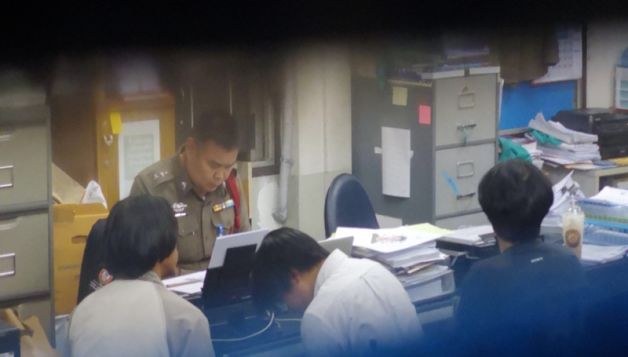
Coming second was when Pawarit Rangsit, 19, a student at Rajamangala University of Technology Krungthep was beaten during hazing by three upperclassmen until his spleen burst. According to activists, this case was the first criminal prosecution for SOTUS hazing since Thewarit Buasiri, 21, Anant Jub-akart, 20, and Samart Sukhontha, 21, were charged with grievous bodily harm.
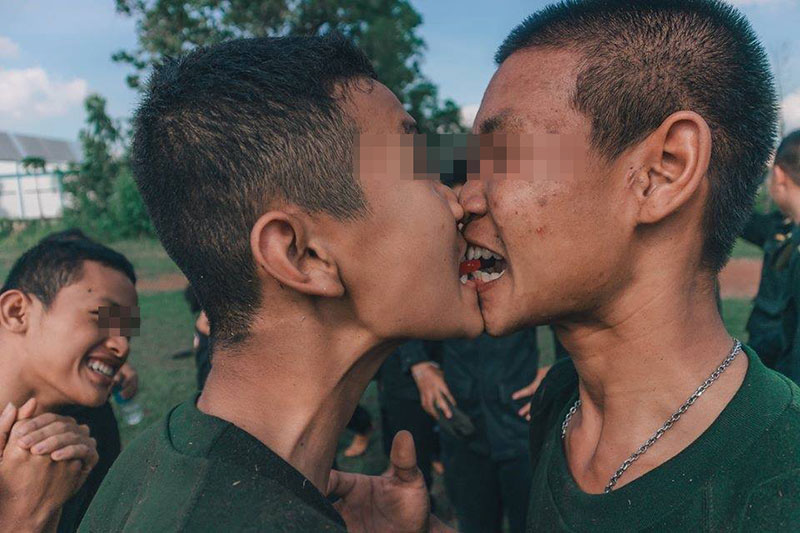
In August, five upperclassmen at King Mongkut’s University of Technology North Bangkok were suspended for forcing freshmen to pass a single piece of candy between them, putting them at risk of transmitting hepatitis, herpes and other illnesses.
Students at Silpakorn University’s Faculty of Education in August were forced to chant the university’s history and faculty’s slogan. If they made any mistakes, they had to chant “ E-D-U-C-A-T-I-O-N EDUCATION!” at the top of their lungs. A recordingof the hazing was sent to the activist group.
“Faculties of Education are known for harsh SOTUS, because of their philosophy of creating teachers that cow their students,” Keerati said.
5. Ground-kissing
Students at Suan Kularb Chonburi kiss the ground Friday in a hazing ritual. Photo: Anti Sotus / Facebook
High school students were forced to kiss the ground at Suan Kularb Chonburi School as part of a hazing ritual.
“It’s worrying that SOTUS, normally in universities, is spreading to high schools. High schoolers have been using SOTUS in even worse ways than university students,” Bandhukavi said.
A student who was rushed to the hospital after being hazed at the Rajamangala University of Technology Lanna.
6. Bizarre Dress Codes
Upperclassmen at the Faculty of Nursing at Mahidol University in September created 30 dress code rules out of thin air, including forcing students to wear formal ceremonial uniforms, always wearing a bowtie and only clear-colored contacts.
7. Rolling Naked in Mud and Hay
Freshmen at the Rajamangala University of Technology Lanna were made to roll around naked in a muddy field and on dried rice stalks. Upperclassmen poured saline water haphazardly on the wounds they suffered. One student was rushed to hospital, and the perpetrators of the activity were fined 200 baht each.
Technical universities and engineering programs are also known SOTUS hotbeds.
“They have this dek chang [vocational student] culture which is mostly populated by guys. So the SOTUS activities there are usually physically tough,” Keerati said.
8. Hazing High Schoolers
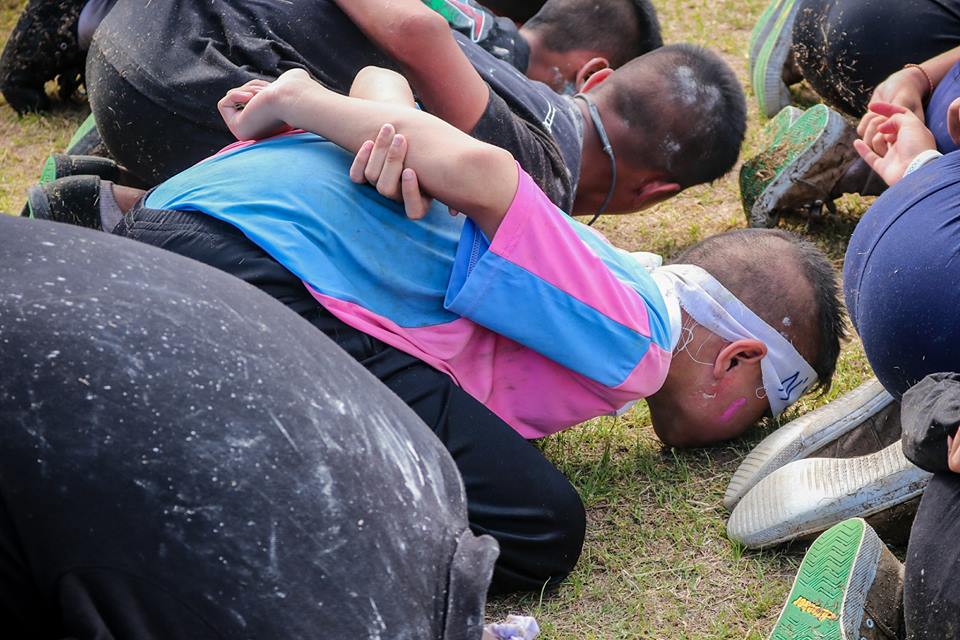
Another instance of hazing hitting high schools, Grade 10 students at Prince Royal school in Chiang Mai were blindfolded and verbally abused while being forced to scream apologies and roll around on the athletic quad.
9. More Mouth-to-Mouth
Similar to the incident in King Mongkut University, Matthayom 4 students in the Reserve Officers Training Course program at Kusumanwittayakom School in Sakon Nakhon were forced to pass candy mouth-to-mouth in June.
Photo: Anti Sotus / Facebook
10. Chanting and Mud-Rolling
Photo: Anti Sotus / Facebook
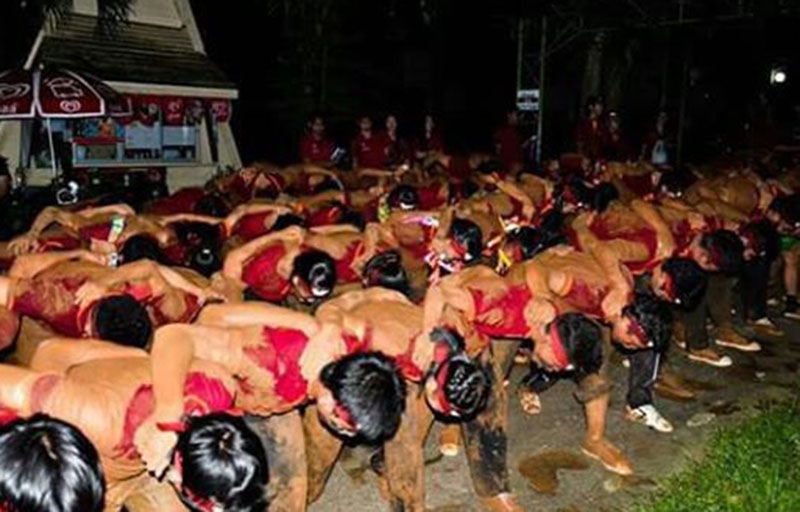
Last but not least, engineering freshmen at Rambhai Barni Rajabhat University in Chanthaburi were forced to scream university chants while rolling around in mud in September.
Duangpetch “Dom” Promtep, 13, while in Luang Cave.
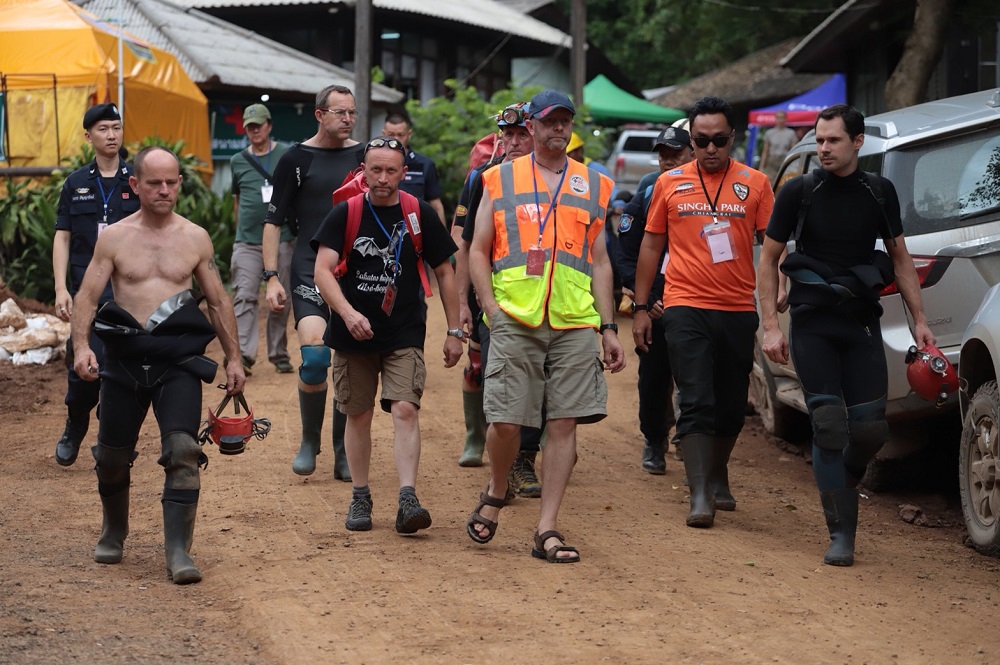
To the surprise of none, it was the against-all-odds miracle rescue of 13 boys and their football coach from a cave in Chiang Rai that had people clicking Khaosod English like people snatching up pineapple-patterned Hawaiian shirts this year.
Apart from interest in what was one of the world’s biggest stories of the year, you wanted to read about relatable or potentially useful topics such as visa crackdowns, medical marijuana, cross-cultural love and vanishing watering holes. And – according to our sophisticated tracking of every move you make (read: Google Analytics) – you’ve maintained a healthy appetite for outrage.
Unsurprisingly it was this story – with more twists and turns than the cave chambers themselves – that drew the most interest, at least after it turned out the “Wild Boars” were still alive. We’d like to think it helped that our two reporters on the scene were breaking so much news that they couldn’t feel their arms come Day 18 of the ordeal.
Of course, our most-read story of 2018 was when we were the first to report that two boys had been safely extracted, a stunning development that immediately topped/r/all, breaking our site.
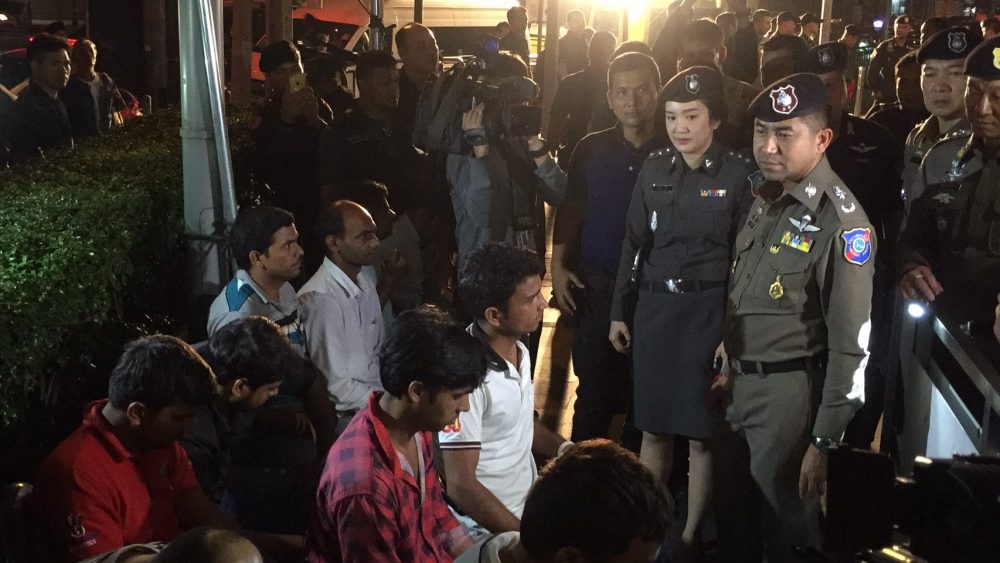
What started a year earlier became a weekly news formula. Apart from changing numbers of arrests, where they happened and what quotable thing Surachate “Big Joke” Hakparn would say, the biggest change to the police “crackdown” on foreigners was a branding change from the cringe-worthy “Operation Black Eagle” to “Operation X-Ray Outlaw Foreigner.” It was probably the location where this February raid occurred – Bangkok’s Soi Cowboy – that made many readers’ hearts skip a beat.
With 47 million views and counting, rap video “My Country’s Got” (“Prathet Gu Mee”) broke the Thai internet for its scathing criticism of the ruling junta and social elite. Of course the video didn’t really set YouTube on fire until the artists were threatened with prosecution, a dumb move that was – surprisingly – quickly dropped.
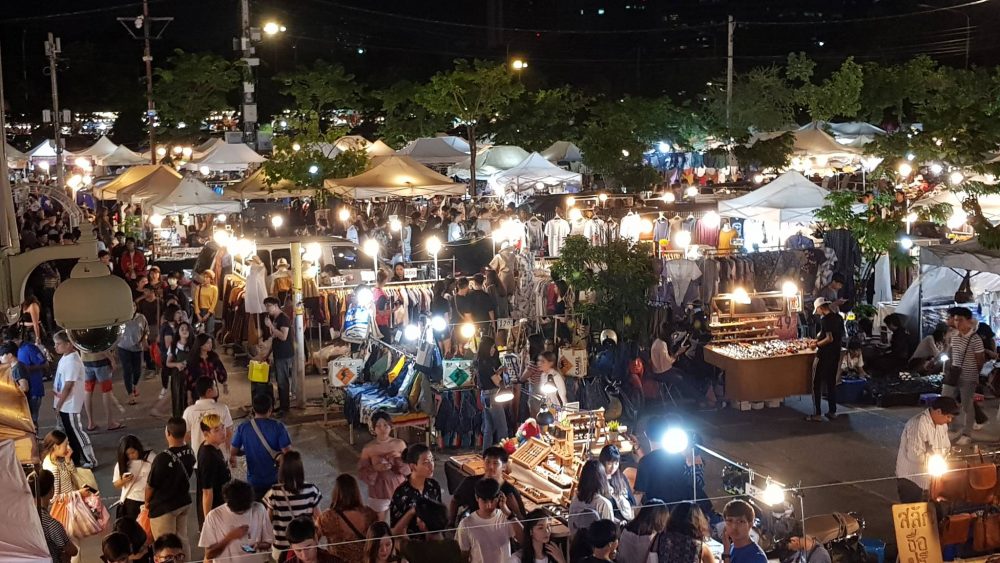
Nobody but nobody hates the closure of outdoor hangouts as much as you guys, and many mourned the loss of this popular evening market in the Chatuchak district at the end of August.
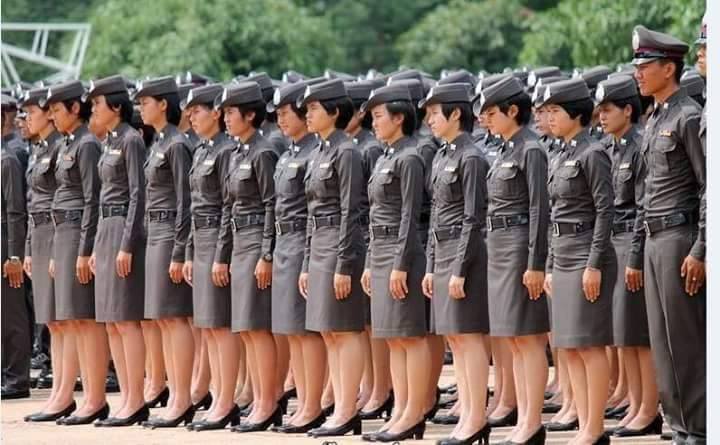
The sudden, shocking announcement that women would be blocked from the primary channel to entering the police force surprised us as much as it did you.
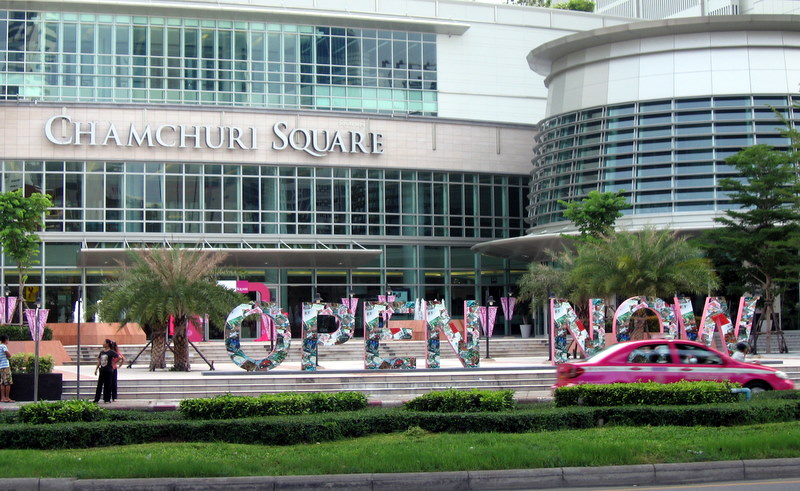
Chamchuri Square, where the One-Stop Service Center for Visas and Work Permits is located. Photo: William Ng / Flickr
Here’s an unspoken headline-writing rule: Add the word “visa” somewhere and brace for traffic. This perennial favorite kept on giving this year, especially when officials announced they’d finally made good on a long-discussed plan for eligible foreigners to receive four-year professional visas.
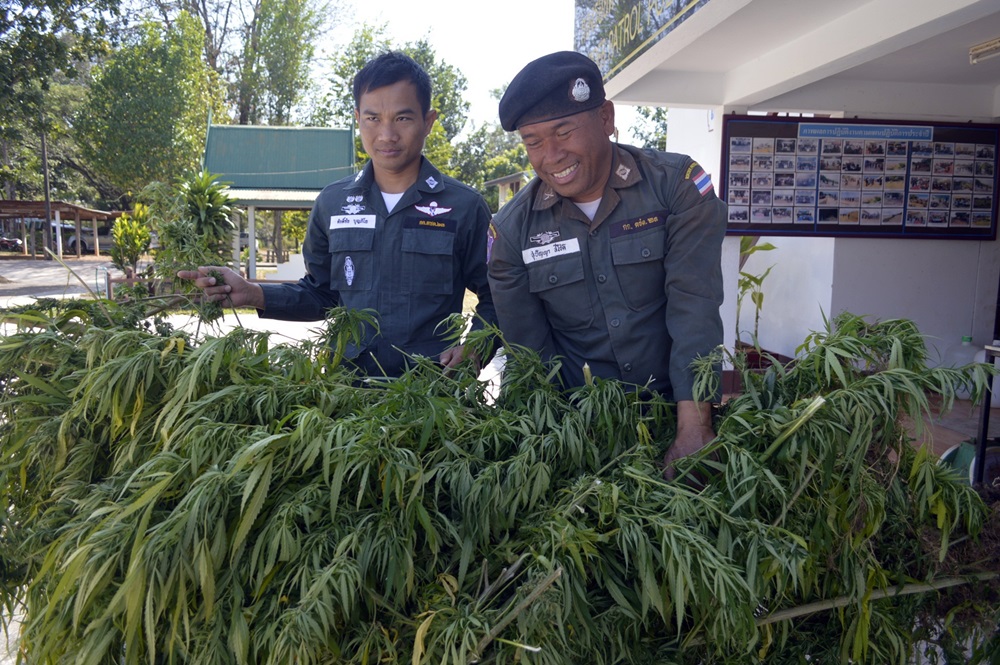
Border patrol police show off their haul of confiscated marijuana Jan. 23, 2017, in Nakhon Phanom province.
The slow burn and mounting anticipation of legal weed has sent the 420 community into a frenzy. Honestly, we didn’t know there were so many of you – but that’s cool. We have closely covered the decriminalization processfor more than two years, and it could very soon be a done deal since parliament just unanimously approved the draft law legalizing medical cannabis. Yet, there be dragonsahead.
The only one of our long reads, the things we pour dozens of hours into, to crack the Top 10 wasn’t on a weighty matter of social injustice or political furor – nope, it was something a little more universal: love, sex and marriage. Our Valentine’s Day special on the less-examined pairing of Thai men and Western women featured interviews with five such couples and went on to spawn both love-affirming fuzzies and vile nastiness in the ole’ comments hole.
Little Read, Much Work
On the flip side, here the stories we labored over intensely, debated furiously, rewrote aggressively and edited meticulously for many dozens of hours. To these, you said “meh” and withheld the clicks and shares that sustain us. But mad, we be not; rather, we’ll keep on keepin’ on because these are the topics most in need of oxygen and sunlight.
Men Killing Women at Alarming Rates, And We All Share Blame
READ ARTICLE
Also Read:
Women Died When ‘No One Helped'
Police, legal system, society fail to protect victims
Cult of Misogyny Flourishes Online
Toxic attitudes take cues from real world
Three stories on sexual and domestic violence, a persistent and too-common issue in Thai society with few means of eradication. As news on such violence appeared to surge, these reports explore cultural roots that enable it not only from the victims’ sides, but also former abusers’ own perspectives. The articles follow how abusers felt their actions had been justified and how it was possible to change their mindsets – turning them into activists fighting to spread awareness to as many men as they could.
Shwe Zin Thin, a 23-year-old Burmese migrant residing in Thailand’s Ranong province. Photo: Shwe Zin Thin / Courtesy
Not only does this report emphasize one of the biggest challenges migrants and refugees face today, it offers a solution – online universities – that can break down barriers such as limited language proficiency, fear of being deported and poverty.
One activist dedicates her efforts to end sexual violence by educating society about one simple concept that it has apparently failed to register: consent. Her platform has given voices to many victims to share their stories in this noteworthy attempt to break the taboo about sex and the culture of victim blaming.
Ken, a student of political science at Chulalongkorn University, on campus recently. Photo: Taylor McAvoy
Caving into the pressure of excelling in school, students have taken to overdosing on medication to perform in class and exams. This report examined how teenagers compromised on their health for the sake of academic success – and how it almost destroyed their social and personal lives.
A disturbing report that revealed the conditions in which an animal facility kept dogs following a nationwide campaign to take them off the streets due to a rabies scare. Khaosod English obtained photos and footage showing overcrowded pens where hundreds of diseased and dying dogs were negligently crammed, drawing outrage from the public and animals rights organizations.
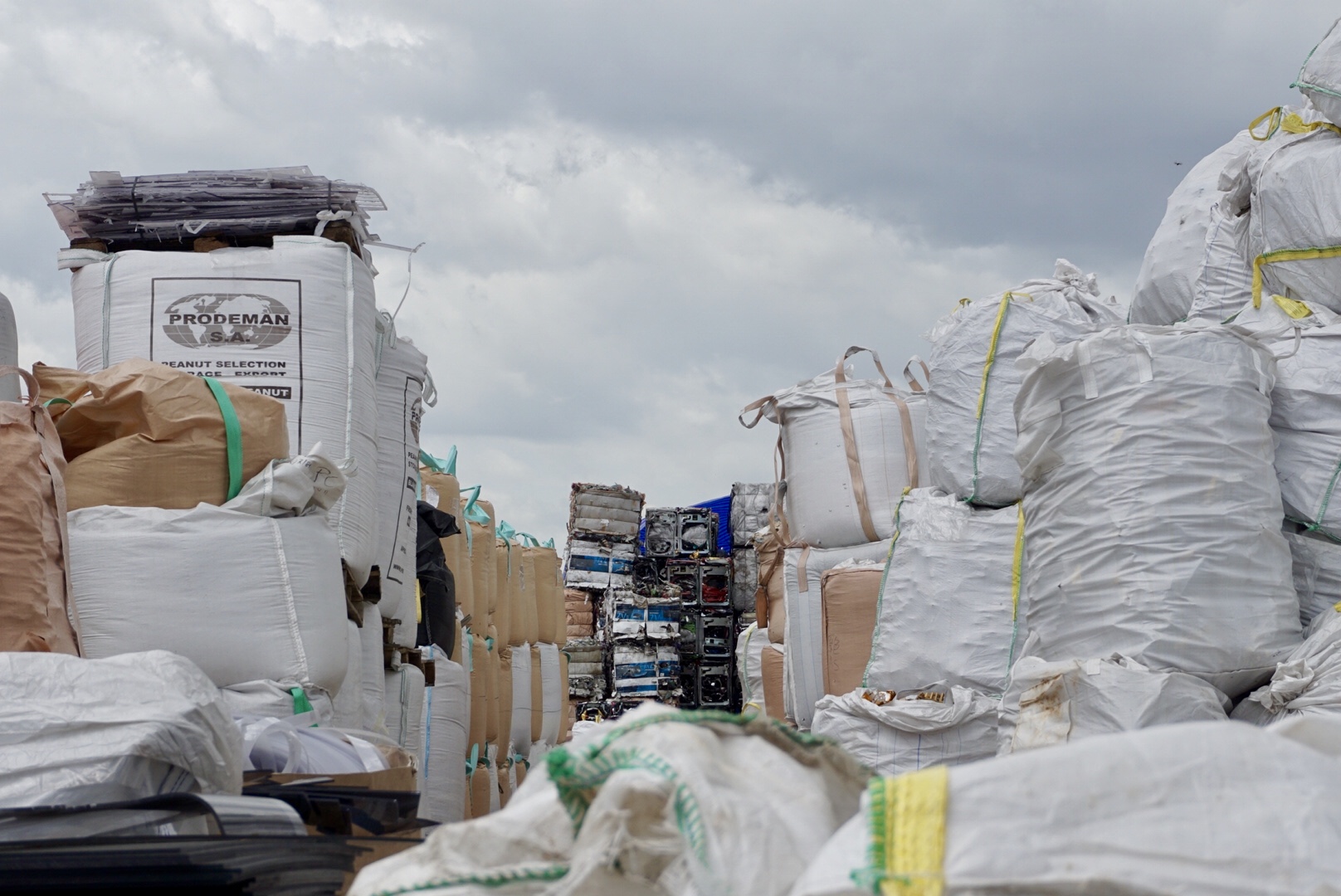
Piles of garbage on June 13 tower over a Pathum Thani facility accused of illegally importing waste.
Large amounts of toxic, electronics trash that were found dumped in several spots turned out to be illegal waste factories in and around Bangkok. A local community near one of the factories spewed their concerns on the lack of central policies to address the trash surge, while a special order from the ruling junta was blamed for contributing to the problem.
A PLACE OF THEIR OWN
Between Poverty and Disability, Hard Lives Made Harder
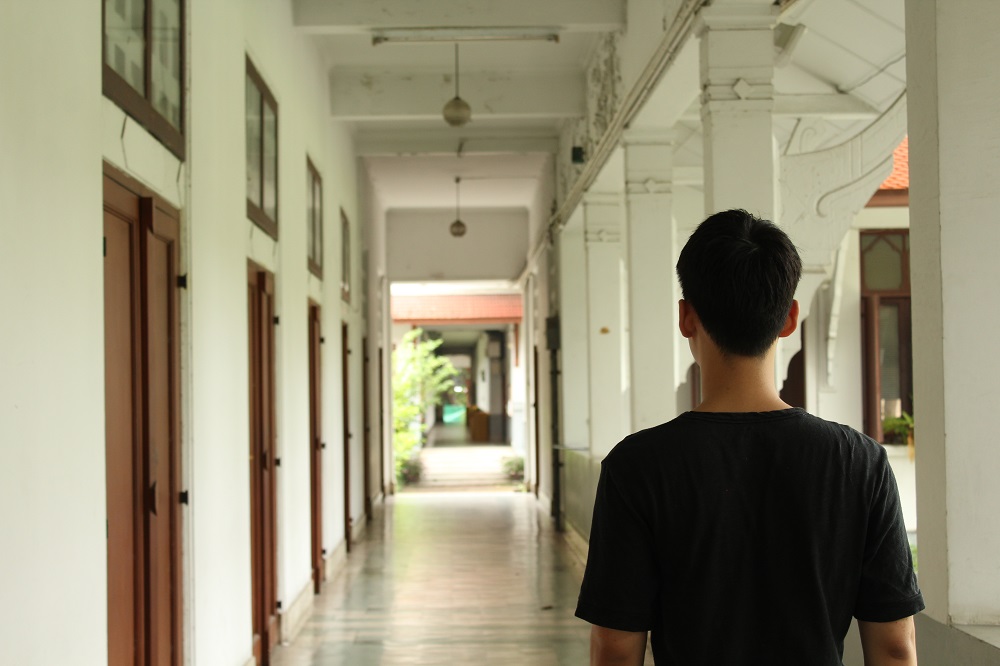
For developmentally disabled youth in one of Bangkok’s poorest communities, poverty compounds neglect. One school offers a place for them and promotes care over shame.
For Girls, Sterilization Cast as Protection
Forced sterilization is embraced as an unfortunate necessity by doctors, parents and caregivers. But it singles out girls, and advocates say other options are ignored.
READ ARTICLE
By Asaree Thaitrakulpanich
Fewer than one in 10 Thais with developmental disabilities get appropriate treatment and education. At one hectic school in the poorest part of Bangkok, an overwhelmed group of teachers does their best to give them better lives. Yet even those efforts raise questions as we learned it remains standard practice to sterilize the girls without their consent, something chalked up as either a necessary evil or easy way out for the adults.
A boy eats papaya donated to House of Blessing Foundation.
A stunning one-third of all food produced goes not into mouths but waste bins. Supermarkets and hotels chuck away perfectly good bread and groceries while many go hungry – but a tiny food waste foundation is trying to change that.
BANGKOK — A pro-democracy activist and a Pheu Thai Party member on Monday said they’ll pursue legal action over a sex tape they allege was filmed by a third party to discredit them.
The decision came after the video clip of Nuttaa Mahattana; a leading activist in the pro-democracy movement, and former minister Watana Muangsook having sex in a Bangkok hotel room was posted online Friday.
Although Nuttaa initially said she would let it pass, the activist today said she’d like to make an example of the case.
“A human rights organization told me yesterday that if we filed police complaints, it would help their work regarding all violations of activists,” she said. “It’ll be for the greater good, whether the people responsible are captured or not.”
The couple only went public about their relationship after the tape was leaked, saying they had kept it under wraps because they were worried it would be utilized for their opponents’ political agendas.
The clip was shot from different angles, with one showing them walking out of their cars outside the hotel and one from inside the room. Both have accused it to be “a dirty tactic” by the military to distract public attention and discredit them politically.
The army chief on Friday denied any involvement in the tape’s leak.
Junta deputy Prawit Wongsuwan today said he doesn’t think the military was behind this incident, but acknowledged monitoring “political movements that cause disruption and conflict.”
In an online post Monday, Watana said he would sue all people behind the tape which he said was meant to destroy him and the work of his party.
“The dictators might think this dirty trick would discourage or destroy me and my party, but it only allows the public to see even clearer, not only their incompetence in governing the country that has caused hardship to all Thai people, but the dirty work they attempt,” the post read.
Nuttaa said their legal team has started building a case against several parties, including the hotel owner and those who filmed them, but she doesn’t know when they’ll be able to go to the authorities.
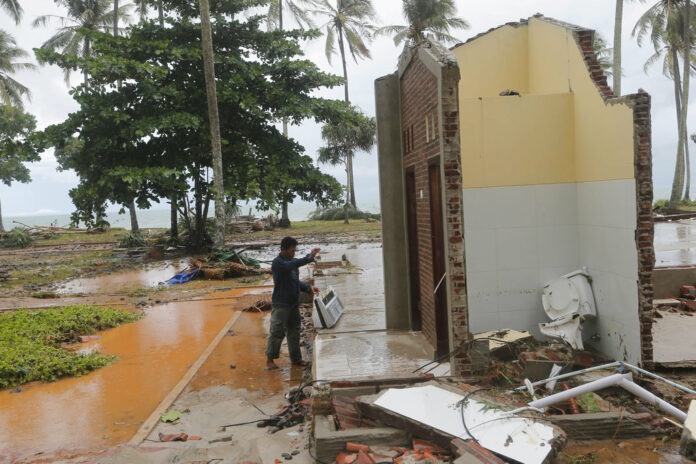
A resident looks for a usable item Monday following a tsunami at a cottage in Tanjung Lesung, Indonesia. Photo: Tatan Syuflana / Associated Press
TANJUNG LESUNG, Indonesia — Doctors worked to help survivors and hundreds of people searched on debris-strewn beaches for more victims Monday from a deadly tsunami that smashed into houses, hotels and other buildings without warning in the darkness along an Indonesian strait.
The waves that swept terrified people into the sea Saturday night along the Sunda Strait followed an eruption and possible landslide on Anak Krakatau, one of the world’s most infamous volcanic islands.
At least 281 people were killed and more than 1,000 were injured. Dozens are missing from the disaster areas along the coastlines of western Java and southern Sumatra islands, and the numbers could increase once authorities hear from all stricken areas.
The Indonesian Medical Association says it is sending more doctors and medical equipment and that many of the injured are in need of orthopedic and neurosurgery expertise. It says most patients are domestic tourists who were visiting the beach during the long holiday weekend.
It was the second deadly tsunami to hit Indonesia this year, but the one that struck the island of Sulawesi on Sept. 28 was accompanied by a powerful earthquake that gave residents a brief warning before the waves struck.
On Saturday night, the ground did not shake beforehand to alert people to the oncoming wave that ripped buildings from their foundations in seconds and swept terrified concertgoers on a resort beach into the sea.
Dramatic video posted on social media showed the Indonesian pop band Seventeen performing under a tent on Tanjung Lesung beach at a concert for employees of a state-owned electricity company. Dozens of people sat at tables while others swayed to the music near the stage as strobe lights flashed and theatrical smoke was released. A child could also be seen wandering through the crowd.
Seconds later, with the drummer pounding just as the next song was about to begin, the stage suddenly heaved forward and buckled under the force of the water, tossing the band and its equipment into the audience.
The group released a statement saying their bass player, guitarist and road manager were killed, while two other band members and the wife of one of the performers were missing.
“The tide rose to the surface and dragged all the people on site,” the statement said. “Unfortunately, when the current receded, our members were unable to save themselves while some did not find a place to hold on.”
Disaster agency spokesman Sutopo Purwo Nugroho said Monday morning that 281 deaths had been confirmed and at least 1,016 people were injured.
The worst-affected area was the Pandeglang region of Java’s Banten province, which encompasses Ujung Kulon National Park and popular beaches, the agency said.
Indonesian President Joko “Jokowi” Widodo expressed his sympathy and ordered government agencies to respond quickly to the disaster.
“My deep condolences to the victims in Banten and Lumpung provinces,” he said. “Hopefully, those who are left have patience.”
In the city of Bandar Lampung on Sumatra, hundreds of residents took refuge at the governor’s office, while at the popular resort area of Anyer beach on Java, some survivors wandered in the debris.
Many of those affected were domestic tourists enjoying the long holiday weekend, but foreigners were visiting the area ahead of Christmas as well.
“I had to run, as the wave passed the beach and landed 15-20m (meters, or 50-65 feet) inland,” said Norwegian Oystein Lund Andersen, in a Facebook post. The self-described photographer and volcano enthusiast said he was taking pictures of the volcano when he suddenly saw the water racing toward him. He and his family fled safely to higher ground.
The damage became apparent after daybreak Sunday. Nine hotels and hundreds of homes were heavily damaged by the waves. Broken chunks of concrete and splintered sticks of wood littered hard-hit coastal areas, turning beach getaways popular with Jakarta residents into near ghost towns. Debris from thatch-bamboo shacks was strewn along beaches.
Yellow, orange and black body bags were laid out, and weeping relatives identified the dead.
Scientists, including those from Indonesia’s Meteorology and Geophysics agency, said the tsunami could have been caused by landslides – either above ground or under water – on the steep slope of the erupting Anak Krakatau volcano. The scientists also cited tidal waves caused by the full moon.
The 305-meter (1,000-foot) -high Anak Krakatau, whose name means “Child of Krakatoa,” lies on an island in the Sunda Strait between Java and Sumatra islands, linking the Indian Ocean and the Java Sea. It has been erupting since June and did so again about 24 minutes before the tsunami, the geophysics agency said.
The volcanic island formed over years after the 1883 eruption of the Krakatoa volcano, one of the largest, most devastating in recorded history. That disaster killed more than 30,000 people, launched far-reaching tsunamis and created so much ash that day was turned to night in the area and a global temperature drop was recorded.
Most of the island sank into a volcanic crater under the sea, and the area remained calm until the 1920s, when Anak Krakatau began to rise from the site. It continues to grow each year and erupts periodically.
Gegar Prasetya, co-founder of the Tsunami Research Center Indonesia, said Saturday’s tsunami was likely caused by a flank collapse – when a big section of a volcano’s slope gives way. It’s possible for an eruption to trigger a landslide above ground or beneath the ocean, both capable of producing waves, he said.
“Actually, the tsunami was not really big, only 1 meter (3.3 feet),” said Prasetya, who has studied Krakatoa. “The problem is people always tend to build everything close to the shoreline.”
Indonesia, a vast archipelago of more than 17,000 islands and home to 260 million people, lies along the “Ring of Fire,” an arc of volcanoes and fault lines in the Pacific Basin. Roads and infrastructure are poor in many areas, making access difficult in the best of conditions.
A powerful quake on the island of Lombok killed 505 people in August. And the tsunami and earthquake that hit Sulawesi in September killed more than 2,100 people, and thousands more are believed buried in neighborhoods swallowed by a quake phenomenon known as liquefaction.
Saturday’s tsunami also rekindled memories of the massive magnitude 9.1 earthquake that hit Indonesia on Dec. 26, 2004. It spawned a giant tsunami off Sumatra island, killing more than 230,000 people in a dozen countries – the majority in Indonesia.