Petra Kvitova of the Czech Republic serves in her third round match of the French Open tennis tournament against Shelby Rogers of the U.S. in May at the Roland Garros stadium in Paris. Photo: Michel Euler / Associated Press
PRAGUE — Two-time Wimbledon champion Petra Kvitova has been injured by a knife-wielding attacker at her home.
The player’s spokesman, Karel Tejkal, says Kvitova suffered a left hand injury and has been treated by doctors.
Tejkal says the incident, which he described as a burglary, occurred Tuesday morning in the eastern Czech town of Prostejov. He says Kvitova’s injuries were not life-threatening.
Also Tuesday, Kvitova withdrew from the Czech Republic team at next month’s Hopman Cup mixed-team tennis tournament because of an earlier foot injury.
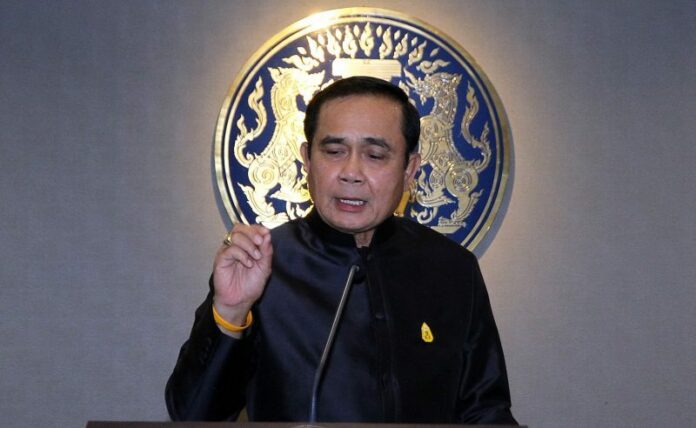
Gen. Prayuth Chan-ocha speaks Dec. 20 at the Government House in Bangkok.
BANGKOK — Prime Minister Prayuth Chan-ocha on Tuesday dismissed online dissidents as uninformed and urged them to end their online rebellion.
Since the new Computer Crime Act was passed Friday, net freedom activists have brought down key government websites to express their anger in attacks which continued throughout Tuesday.
Speaking at the Government House, Prayuth said their actions were illegal.
“Most people understand the reasons and necessity behind the act, but they don’t express their opinions,” the general and junta leader said. “Most people who express their opinions are the people who are putting up resistance to it.”
Hacktivist group Citizens Against Single Gateway, which came together in 2015 to oppose plans to centralize and control internet infrastructure, has posted regular updates about the campaign it said will continue until midnight and possibly longer.
Responding to a message purportedly from a civil servant complaining they could not receive their salaries due to the outages, the group fired back at Prayuth, colloquially referring to him by his nickname.
“This is a cyberwar that we didn’t start. We warned you that we’re gonna bring this to the next level,” read the message posted at about 4pm. “Uncle Tuu, rethink your actions. If you don’t, we guarantee that people won’t get their salaries for sure.”
Those protesting the law have said they are angry lawmakers took no heed of public- and private-sector objections to the law’s erosion of freedoms and rights when it was passed unanimously by the rubber-stamp parliament.
In response, Prayuth also played down the controversial law’s critics as uninformed, saying they were sharing content opposed to it on social media without really reading what it said.
“This makes me wonder. Since we’re mostly a Buddhist country and the act says ‘good morality,’ don’t you know what that is? Does the media know what that is? If you do, stop having so many problems with it,” he said. “What’s the problem with good morality? Good morality is peace and national stability. If you don’t understand these terms, then don’t even try to do anything else.”
Part of the law empowers an unelected committee to censor or block any content it deems “immoral.”
Prayuth said that was necessary due to the dangers of social media.
“You use social media more than me. When you do it, do you see dangers on it or not? There’s illegal drugs, pornography, inappropriate language and libel on there.”
In the past year, the military regime has used the Computer Crime Act to jail its critics and political opponents, as well as go after people suspected of insulting the royal family, a crime known as lese majeste.
The general continued, saying that the state wouldn’t pore over everything but focus on urgent cases that could cause social unrest.
“No one wants to police social media because it’s tiring,” he said. “Society should help protect each other and create peace.”
Finally, he shrugged off the attacks as ineffective.
“If you use anything too much, traffic will be heavy and it will be disabled for a bit. But we can continue working, no problem,” Prayuth said.
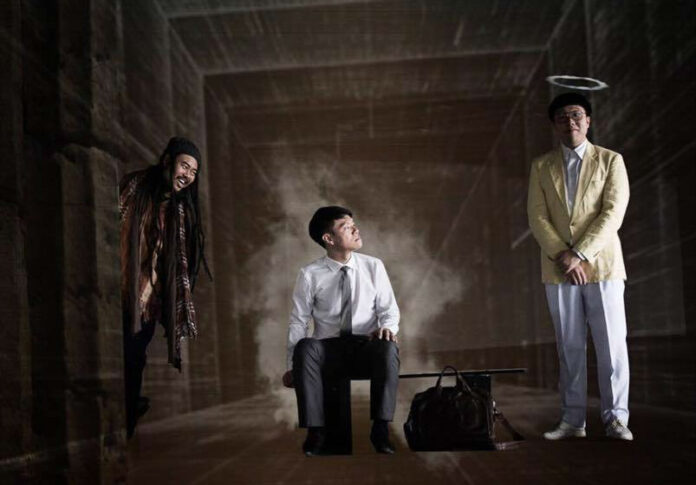
Promotional photo of ‘The Chanchila.’ Photo: Monkey Army Theatre / Facebook.
BANGKOK — Go on a romp through philosophy and religion next year with an absurd-existential play about a dead man the afterlife isn’t sure what to do with.
“The Chanchila,” opening in January at a new Thonglor art venue, is about a man who dies abruptly and is caught in the middle. After living a mostly unremarkable life, heaven doesn’t know where to send him. So an apprentice angel is sent in to review his life and see whether he truly accomplished nothing or simply was a victim of life’s circumstances.
After producing the existential drama “Crossing Nirvana” in 2015, director and theatre professor Sornchai Chatwiriyachai is back with a second original play with ambitions no less than to find the meaning of life.
Tickets are 500 baht and 350 baht for students. Advanced tickets are 450 baht and can be booked via the Monkey Army Theatre.
English surtitles will be provided.
Performances begin at 7:30pm from Jan. 6 through Jan. 22, with matinee shows at 2:30pm on Saturday and Sunday. The show will take place at Syrup The Space, a new art venue on the second floor of Liberty Plaza, at the north end of Soi Thong Lor. It can be reached from the Soi Thong Lo Pier via the Khlong Saen Saep boat taxi or taking the red bus from BTS Thong Lo.
Wildlife officials display a tiger pelt recovered from the Tiger Temple
For Thais, episodes of nepotism, corruption, suspicious deaths and state impunity are as familiar as a lakorn plot remade for the 100th time.
But even by that standard, 2016 was notable for terrible stuff that happened with all the consequences for those responsible one expects in a world where a wai and a shaved head can substitute justice.
It was a year that saw underage sex slaves rescued from not-so-hidden venues, the discovery of dead tiger cubs in a commercial Buddhist temple and numbing mass fatalities that could have been prevented if officials would have only done their jobs.
Here are some of the low points of 2016 as we reflect the end of yet another year in which justice and accountability seem as elusive as ever.
Keeping it in the Family
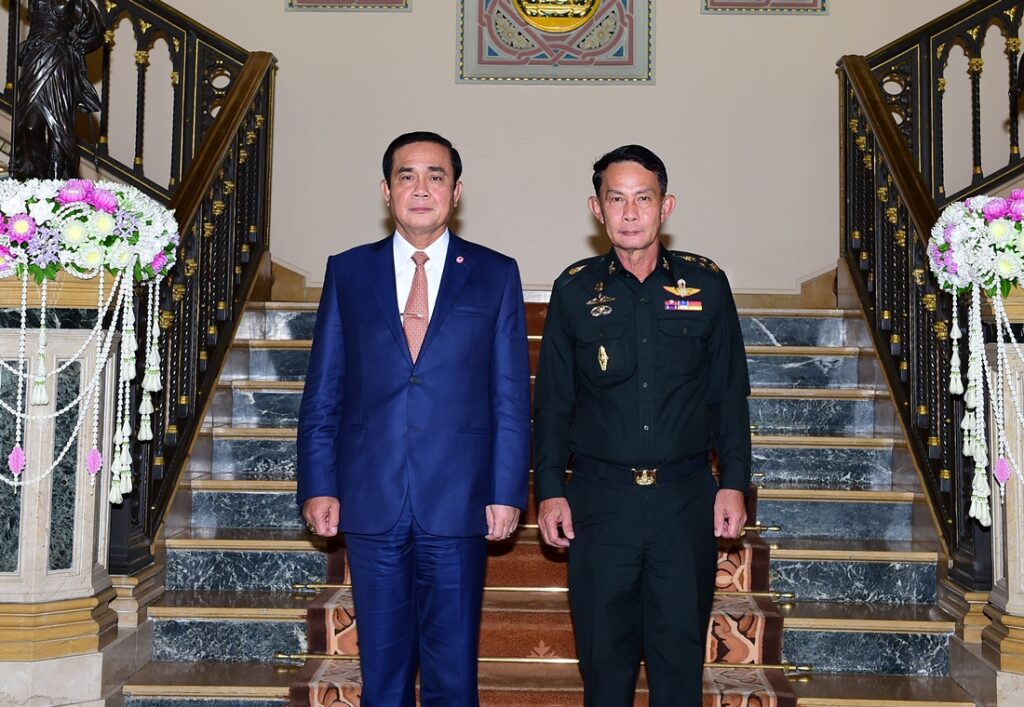
Prayuth Chan-ocha poses for photo with his brother Preecha Chan-ocha on Wednesday at Government House
The junta accused the administration it toppled of nepotism, but it was Preecha Chan-ocha, a brother of junta chairman Prayuth Chan-ocha, who found himself facing those allegations this year.
It first emerged in April that Preecha appointed his younger son Patipat Chan-ocha, who had no military experience or training, as an army officer in a secret order later leaked onto social media. When challenged, the general said it was okay because everyone else did it: “Many people in the army do it. It’s not like only my son does it.”
His family was back in the spotlight when some criticized the excessive reverence and privilege granted to his wife, Pongpan Chan-ocha. Holding no formal rank or office in the armed forces, Pongpan was often given elaborate welcome ceremonies fit for royal family members, and she was often flown by military aircraft.
A few weeks later, an investigative news agency disclosed that a construction firm owned by Preecha’s other son, Pathompol Chan-ocha, received nearly 27 million baht in contracts from an army unit that Preecha had commanded.
Preecha insisted his wife and his son didn’t break any laws or regulations. After a brief investigation, the military ruled that no favoritism was involved, to the surprise of no one.
Hidden in Plain Sight
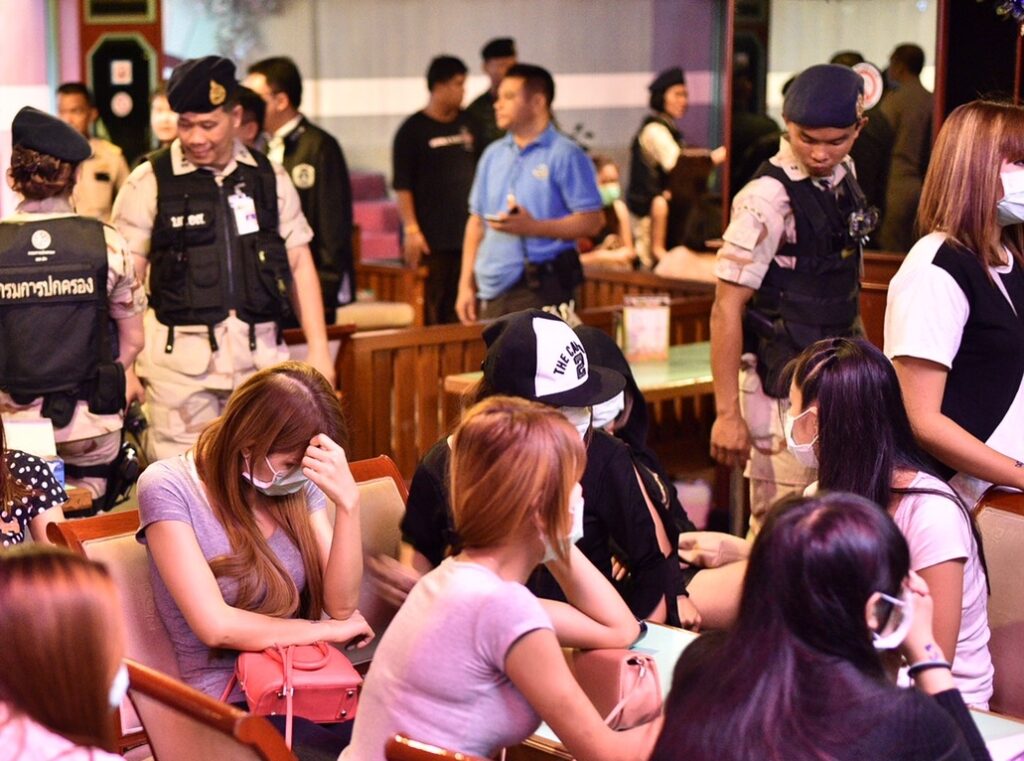
Officers from the Ministry of Affairs raid the Nataree brothel on Bangkok’s Ratchadapisek Road.
Not that it’s obvious from walking down many streets, but prostitution is illegal in Thailand. That doesn’t stop commercial sex from flourishing in hotspots such as Bangkok’s Ratchadapisek Road, a government-sanctioned entertainment zone lined with so-called “massage parlors” that are fronts for massive brothels.
In July, soldiers and security forces, tipped off by a foreign NGO, rescued 15 underage girls and trafficked sex workers from Nataree, one of the longstanding flesh parlors in the area. They also found a ledger said to list bribes paid to different police agencies, such as 10,000 baht for Tourist Police; 30,000 baht for Special Brand Police and 76,000 baht for Immigration Police.
The national police launched an investigation into the matter, but no officer was ever found guilty. An arrest warrant was issued for Nataree owner Prasert Sukkhee, but he was never arrested.
Come Fly (and Dine on a 600,000 Baht Meal) With Me
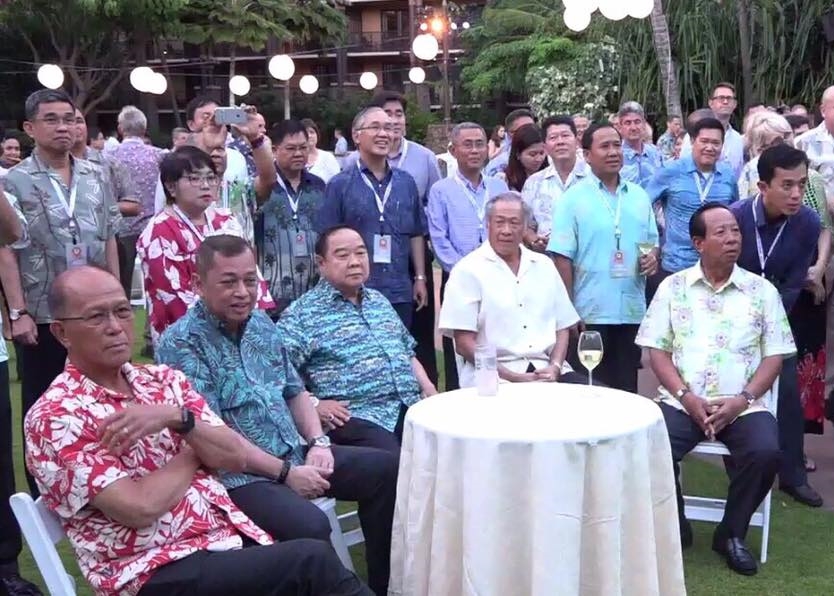
An undated file photo of Prawit Wongsuwan and his entourage in Hawaii. Image: Matichon
If you want to fly from Bangkok to Hawaii, it’s going to set you back at about 40,000 baht for a roundtrip ticket, according to a quick search on Expedia. But if you’re deputy chairman of the military junta, then bad news for you, it’s going to cost you and your entourage 535,000 baht for the same trip.
To fly Prawit and 38 officials for an informal meeting with American defense officials in Honnululu in October, it cost taxpayers 20.9 million baht, of which 600,000 baht was spent on in-flight dining alone. Three million baht was spent on unspecified “processing fees.”
Outrage over the pricey flight intensified after there were also allegations that Prawit’s romantic interest, Channel 5 anchorwoman Chonratsamee Ngathaweesuk, was on the state-funded trip with the general. Immigration records show that she wasn’t.
The government maintained that the flight cost was in line with bureaucratic procedures.
Lights Out for Sukhumbhand
Bangkok Governor Sukhumbhand Paribatra at news conference.
Go back to the beginning, and 2016 was greeted with a 39 million baht New Year’s light show organized by City Hall. It didn’t impress many; some said it was just ugly. They were impressed to find out however that it cost 10 million baht more than it should.
The auditor-general later announced there was sufficient evidence Bangkok Gov. Sukhumbhand Paribatra colluded with other city officials to embezzle the extra funds. The twice-elected governor responded by insisting on his innocence, threatening to sue anyone who suggested otherwise and refusing to step down.
His defiance was cut short when junta chairman Prayuth Chan-ocha removed him in August with the absolute power he granted to himself under the notorious Article 44.
Tiger (Trafficking) Temple
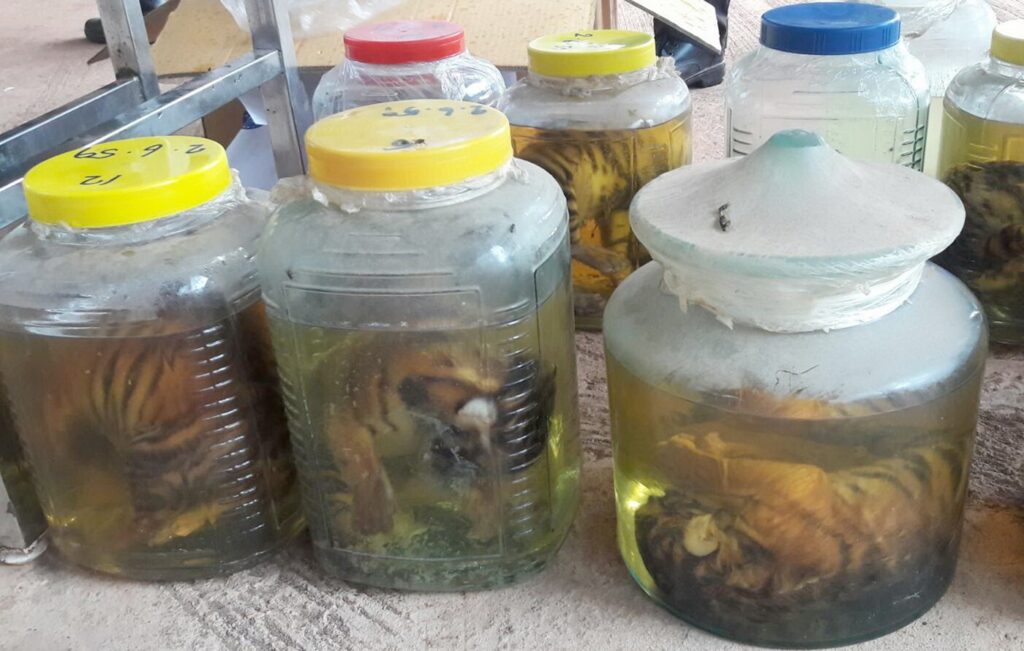
Jars containing dead tiger babies found June 2 during a raid on the Tiger Temple in Kanchanaburi province.
For years, activists campaigned against the so-called “Tiger Temple” in Kanchaburi, which multiple independent investigations had said was involved in trafficking the very animals it claimed to protect. After years pleas, wildlife officials finally raided and shut it down in June for profiting on tigers and the other wild creatures it kept illegally.
Upon searching the temple, known formally as Wat Pha Luang Ta Bua Yanasampanno, officials stumbled on a horrible discovery: more than 40 dead tiger cubs, tiger parts in jars and a whole lot of dead wildlife. Apparently the monks were even using tiger parts to make magic amulets for sale.
Animal rights campaigners were vindicated, and temple abbot Phra Visuthisaradhera and other administrators were eventually charged with illegal possession of wildlife. The abbot denied all charges and will defend himself in court, according to Adisorn Noochdamrong, deputy chief of the national parks department.
All 147 tigers kept as entertainment for tourists at the temple have been moved to an enclosure overseen by wildlife officials, but some animals such as deer and antelopes are still roaming in the former temple, Adisorn said, adding that officials would soon rescue them.
The Totally Preventable School Fire Tragedy
Deputy Minister of Education Surachet Chaiwong consoles a survivor of the fire on May 25 at a hospital in Chiang Rai province
Pitakkiat Witthaya School, run by a Christian charity foundation, is home to young girls from impoverished hill tribes in the mountainous province of Chiang Rai. Seventeen of those children were burned alive a fire that gutted the boarding school’s dorm on a May night.
Investigators later revealed the victims died from smoke inhalation, some of whom perished in their sleep. The building was equipped with neither smoke detectors nor fire alarms; officials said it predated such regulations.
The incident exposed a serious flaw in Thailand’s fire hazard regulations: Although the law mandates all public buildings – regardless of when they were built – must be furnished with such equipment, the actual enforcement is up to local officials.
And in the case of Pitakkiat Witthaya School, when the officials realized the building was not up to code, they answered the deaths of 17 girls by “reprimanding” the school’s administrators and telling them to buy proper equipment. The upgrade never happened.
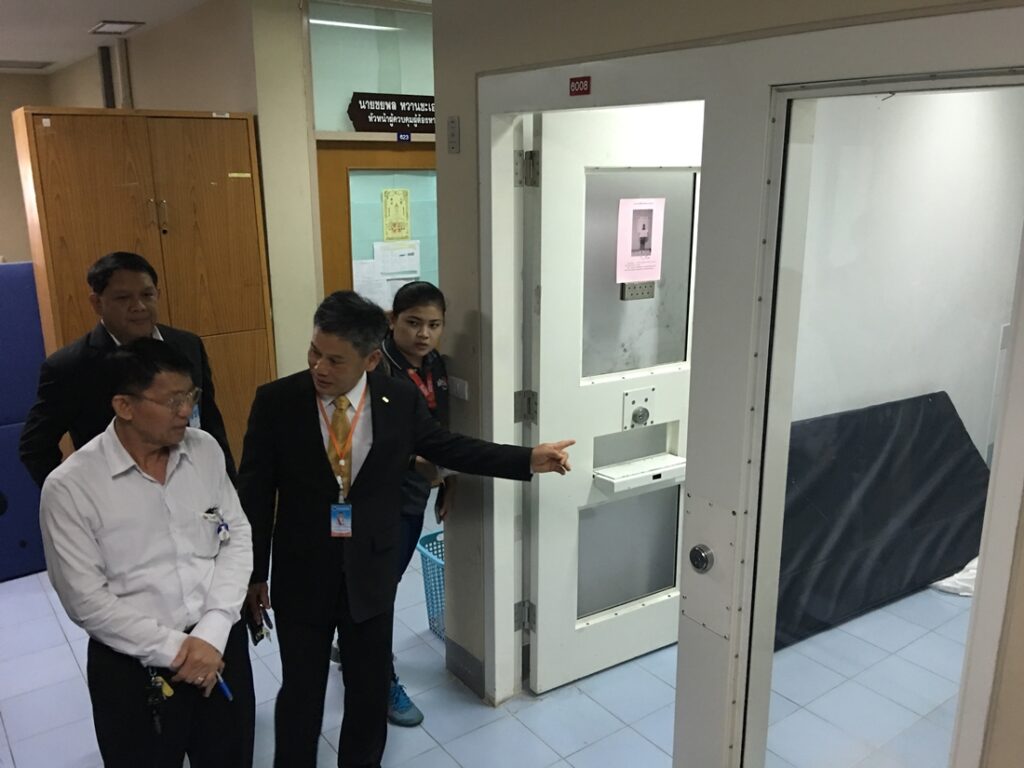
Officials lead media on a tour of the detention room at DSI headquarters where the agency claimed Thawatchai Anukul hanged himself the day earlier.
Land official Thawatchai Anukul was a key witness in a massive fraud case. He was accused of handing out public land deeds to wealthy resort owners in Phuket, Surat Thani and Phang Nga provinces. He is estimated to have given away public land worth about 10 billion baht.
His crucial testimony, which might have exposed a larger conspiracy, never reached the court, however, as Thawatchai was found dead in a holding cell at the Department of Special Investigation in the early hours of Aug. 30.
At first, the DSI said Thawatchai hanged himself, a claim doctors rejected as ridiculous for the bruises and injuries to his body. Few were impressed when the DSI responded by blaming the doctors – saying the injuries were the result of CPR gone wrong.
A formal autopsy established in October that Thawatchai was murdered. An ongoing inquest effort will determine who killed the former official. The scandal was just the latest in a long tradition of suspects dying under suspicious circumstances while in the custody of Thai authorities.
Small Corruption, Mass Casualties in the Case of the Missing Insurance
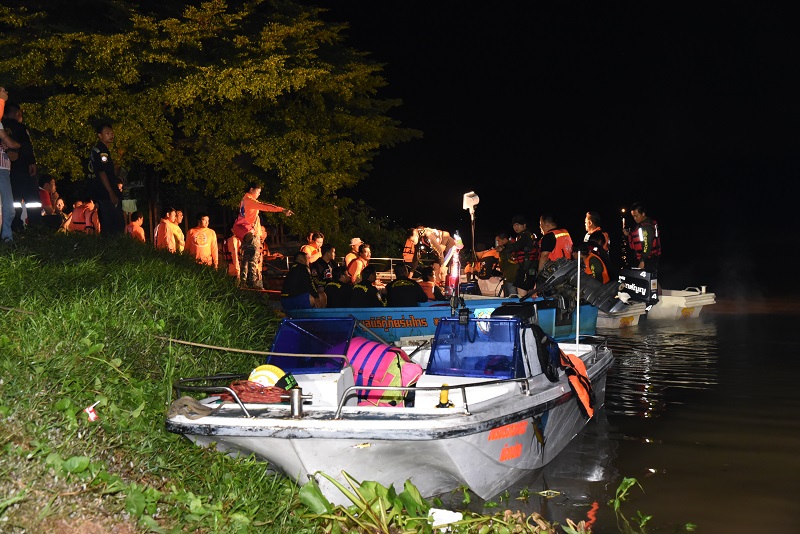
Rescue workers at the scene in Ayutthaya province.
The tragedy of 28 religious pilgrims drowning in September didn’t end with the deaths. It later turned out the insurance money which should have gone to the victims’ families could not be paid because marine officials pocketed the premiums.
Sunthorn Pansueathong, who owned the boat that capsized after striking an embankment in Ayutthaya province, was shocked when police told him his boat license was renewed without the mandatory insurance, even though he paid officials at the Marine Department for it.
An investigation found the two officials who handled the license renewal kept the fees for themselves instead of passing them along to the insurance company, according to department director Sorasak Saensombat.
Both officials have been “transferred to inactive posts,” and an inquiry is deliberating on their punishment, Sorasak said.
Sunthorn and boat captain Wirat Chaisirikul also face separate charges for overloading the vessel beyond capacity.
As for the families, the government takes no responsibility for its officials’ wrongdoing.
HMAS Success scans the southern Indian Ocean in 2013, near the coast of Western Australia, as a Royal New Zealand Air Force P3 Orion flies over, while searching for missing Malaysia Airlines Flight MH370. Photo: Rob Griffith / Associated Press
SYDNEY — For two years, a handful of ships have diligently combed a remote patch of the Indian Ocean west of Australia in a $160 million bid to find Malaysia Airlines Flight 370. On Tuesday, investigators made what was surely a painful admission: They have probably been looking in the wrong place.
The latest analysis by a team of international investigators concluded that the vanished Boeing 777 is highly unlikely to be in the current search zone and may instead be in a region farther to the north. But though crews are expected to finish their deep sea sonar hunt of the current search area next month, the possibility of extending the search to the north appeared doubtful, with Australia’s transport minister suggesting the analysis wasn’t specific enough to justify continuing the hunt.
The latest twist in the search for Flight 370 highlights the extraordinary difficulty officials have faced in their attempts to find the aircraft based on the faintest scraps of data. All along, officials have said they are not simply looking for a needle in a haystack – they are looking for the haystack.
On Tuesday, the haystack was poised to shift again, with the release of a report by the Australian Transport Safety Bureau, which is leading the search for the plane. The report is the result of a November meeting of international and Australian experts who re-examined all the data used to define the search area for the aircraft, which vanished during a flight from Kuala Lumpur to Beijing on March 8, 2014, with 239 people on board.
In the years since the plane disappeared, experts have analyzed a series of exchanges between the aircraft and a satellite to estimate a probable crash site along a vast arc of ocean that runs through the southern hemisphere. A deep sea search of a 120,000-square kilometer (46,000-square mile) stretch of water along the arc has so far come up empty.
In November, the experts went back over the satellite data, along with the results of a new ocean drift analysis of the more than 20 items of debris likely to have come from the plane that have washed ashore on beaches throughout the Indian Ocean. The analysis, which looked at where the items washed up and when, suggested the debris originated in an area farther north along the arc from the current search zone.
Given the number of aircraft parts found so far, the team concluded that there must have been a debris field floating on the surface of the water when the plane crashed. So they eliminated an area that had already been the subject of a surface search by air crews in the early stages of the hunt.
That left a 25,000-square kilometer (9,700-square mile) area immediately to the north of the current search zone as the most likely place where the plane hit the ocean, the report said.
The investigators concluded that there is “a high degree of confidence” that the plane is not in the current search area. And they agreed that the new area needs to be searched.
“The experts concluded that, if this area were to be searched, prospective areas for locating the aircraft wreckage, based on all the analysis to date, would be exhausted,” the report said.
However, a new search would require fresh funding commitments from the countries involved in the hunt. Malaysia, Australia and China agreed in July that the $160 million search will be suspended once the current stretch of ocean is exhausted unless new evidence emerges that would pinpoint the plane’s exact location.
Australian Transport Minister Darren Chester suggested an extension of the hunt based on the latest analysis was unlikely, noting that the report “does not give a specific location of the missing aircraft.”
“As agreed at the Tripartite Ministers meeting in Malaysia in July we will be suspending the search unless credible evidence is available that identifies the specific location of the aircraft,” Chester said in a statement. “The search for MH370 has been the largest in aviation history and has tested the limits of technology, and the capacity of our experts and people at sea.”
Malaysia’s Transport Minister Liow Tiong Lai did not explicitly rule out a new search, but said in a statement “we remain to be guided as to how this can be used to assist us in identifying the specific location of the aircraft.”
Australian government oceanographer David Griffin, who worked on the drift analysis, said he is confident the plane is in the newly identified search area, though he conceded it doesn’t completely rule out the possibility that the plane was somehow missed by search crews in the current search zone.
“It could have been where we were searching, absolutely, but the new information does clarify that immediately north is more likely,” Griffin said.
As part of their analysis, Griffin and his team built replicas of the first piece of debris that was found – a wing fragment known as a flaperon that was discovered on Reunion Island off the African coast in July last year. The team then set the replicas adrift, measuring how fast they traveled and noting how much the wind influences their rate of speed. They then ran computer simulations of how the aircraft parts could have drifted, which helped paint a picture of where they originated.
The newly identified search zone does include an area that was searched very early on in the hunt, but crews didn’t comb a wide enough area to rule it out, Griffin said. “They didn’t go quite far enough away from the arc to cover all possibilities,” he said.
The fact that crews were so close to the area now identified as the likeliest crash site – coupled with the lack of commitment to search the new area – is sure to frustrate families of those on board, who have been pushing the governments involved in the hunt to continue searching for their loved ones.
“They should keep searching no matter how much money they will spend,” said Li Jingxin, whose brother was on the plane. “The cost of the search has nothing to do with us relatives. They should also raise the amount of compensation (to families) to make up for the time lost while they searched the wrong place.”
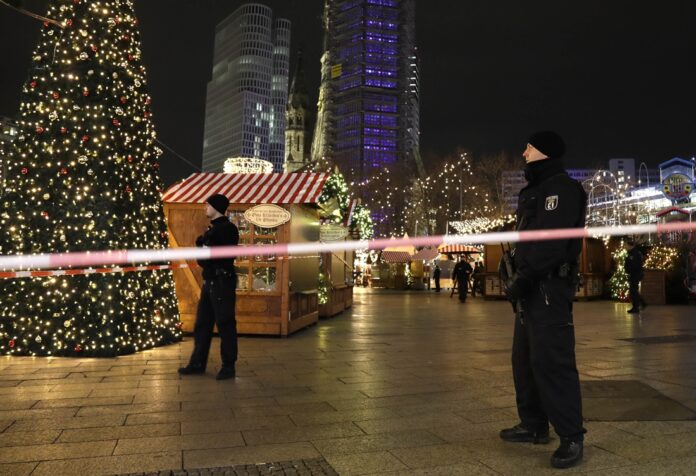
Police guard a Christmas market after a truck ran into the crowded Christmas market in Berliin Berlin, Germany, Monday, Dec. 19, 2016. (AP Photo/Michael Sohn)
BERLIN — Police said Tuesday that the driver who rammed a truck into a crowded Christmas market in the heart of the German capital, killing at least 12 people and injuring nearly 50, did so intentionally and that they are investigating a suspected “terror attack.”
The truck struck the popular Christmas market outside the Kaiser Wilhelm Memorial Church late Monday as tourists and locals were enjoying a traditional pre-Christmas evening out near Berlin’s Zoo station.
“Our investigators are working on the assumption that the truck was intentionally driven into the crowd at the Christmas market on Breitscheidplatz,” Berlin police said on Twitter.
“All police measures concerning the suspected terror attack at Breitscheidplatz are being taken with great speed and the necessary care,” they said.
Hours earlier Germany’s top security official had refrained from pointing to an intentional act, but said evidence pointed in that direction, while the White House condemned “what appears to have been a terrorist attack.”
The crash came less than a month after the U.S. State Department called for caution in markets and other public places across Europe, saying extremist groups including Islamic State and al-Qaida were focusing “on the upcoming holiday season and associated events.”
The Islamic State group and al-Qaida have both called on followers to use trucks in particular to attack crowds. On July 14, a truck plowed into Bastille Day revelers in the southern French city of Nice, killing 86 people. Islamic State claimed responsibility for that attack, which was carried out by a Tunisian living in France.
After the Berlin attack, dozens of ambulances lined the streets waiting to evacuate people, and heavily armed police patrolled. Authorities on Twitter urged people to stay away from the area, saying they need to keep the streets clear for rescue vehicles.
Among the dead was a passenger in the truck, who succumbed as paramedics treated him, Berlin police spokesman Winfried Wenzel said. Police said later that the man was a Polish national, but didn’t give further details of who he was or what happened to him.
A suspect believed to be the driver was picked up about 2 kilometers (1½ miles) away, near the Victory Column monument. He was being interrogated, Wenzel said. The truck was registered in Poland, and police said it was believed to be stolen from a building site there. They didn’t give a specific location.
The Polish owner of the truck said he feared the vehicle, driven by his cousin, may have been hijacked. Ariel Zurawski said he last spoke with the driver around noon, and the driver told him he was in Berlin and scheduled to unload Tuesday morning. “They must have done something to my driver,” he told TVN24.
Federal prosecutors, who handle terrorism cases, took over the investigation, according to German Justice Minister Heiko Maas. In Washington, White House National Security Council spokesman Ned Price said the United States was in contact with German officials and ready to help in the investigation and response.
U.S. President-elect Donald Trump blamed Islamist terrorists, though it was unclear what that assessment was based on. He said Islamic extremists must be “eradicated from the face of the earth” and pledged to carry out that mission with all “freedom-loving partners.”
But German officials said shortly after the attack that it was too early to call the crash intentional.
“I don’t want to use the word ‘attack’ yet at the moment, although a lot speaks for it,” Interior Minister Thomas de Maiziere told ARD television. “There is a psychological effect in the whole country of the choice of words here, and we want to be very, very cautious and operate close to the actual investigation results, not with speculation.”
Germany has not experienced any mass-casualty attacks by Islamic extremists, but has been increasingly wary since two attacks by asylum-seekers in the summer that were claimed by the Islamic State group. Five people were wounded in an ax rampage on a train near Wuerzburg and 15 in a bombing outside a bar in Ansbach, both in the southern state of Bavaria. Both attackers were killed.
Those attacks, and two others unrelated to Islamic extremism in the same weeklong period, helped stoke tensions in Germany over the arrival last year of 890,000 migrants.
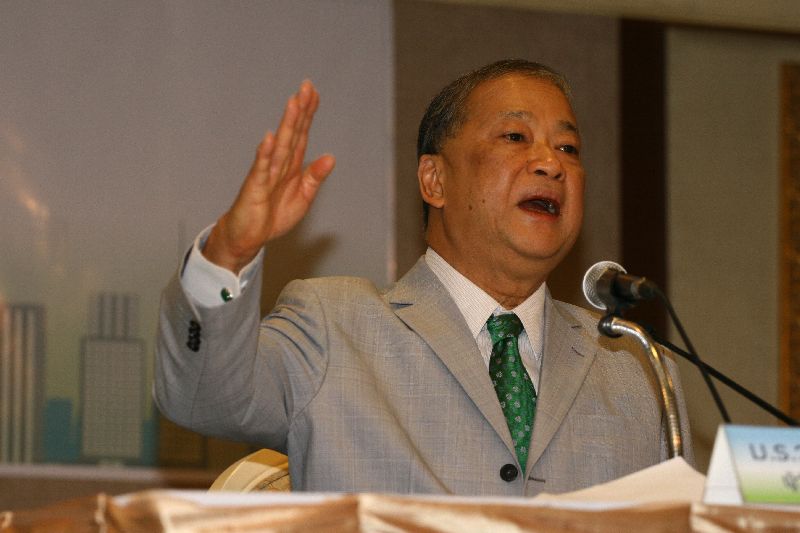
The disconnect between the hype and reality of Thailand’s world-class bureaucracy hit new lows Friday when telecom DTAC, the new Digital Economy and Society Ministry, and our friends at The Nation hosted a talk on cryptocurrency and the blockchain revolution.
The guest of honor? Alex Tapscott, one of the authors of the event’s eponymous book, “Blockchain Revolution.”
Economic innovation was the topic, but while one side talked about a money that is open, borderless and free from government, the other spoke of a centralized government project tying payments to our phone and ID numbers.
Yes, on the same stage, on the same day, we had both Bitcoin and PromptPay, two systems with radically different philosophies.
The event was supposed to be opened by acting Digital Economy Minister ACM Prajin Juntong, but he didn’t show and it was left to a senior civil servant.
Back when I was a speechwriter at the former ICT Ministry (yes, I was!) the chain of seniority for keynotes was usually, in descending order: minister, vice-minister, permanent secretary, deputy permanent secretaries or whoever was free that day.
In this case, Whoever-was-free-that-day, aka Whoever, described PromptPay as Thailand’s latest and greatest miracle of innovation that was so much like Bitcoin and the Blockchain Revolution.
Never mind the tiny detail that PromptPay is the antithesis of Bitcoin. While the new tech ministry is promoting centralized, government control of money, Bitcoin offers financial freedom in a totally decentralized network where nobody needs to be trusted because nobody can censor or exclude others.
It’s like going to church to hear the Antichrist praised only because it’s mentioned in the same book.
Alex Tapscott, at center, at Friday’s Blockchain Revolution event in Bangkok. Photo: Alex Tapscott / Facebook
That said, Whoever did ask Tapscott for advice on how blockchain can be used in government. Whoever was even decent to stay until the talk was over and then some. This is something ministers or permanent secretaries rarely do once the photo-op is over, so credit due for trying.
Tapscott spoke of how Blockchain is akin to the parable of the Blind Men and the Elephant – it is different things depending on which part you touch. It is an asset class – one of the best-performing of 2016 – it is also a settlement network, digital cash, and the ability to tokenize and transfer assets securely between total strangers using untrusted parties across the internet without fear of repudiation.
Music and images can be copied at will over the Internet. While that has its benefits, the same is not true of digital cash or other tokens – such as electoral votes – which must never be copied.
That’s where blockchain comes in, as the answer to making uncopyable digital tokens a reality.
Blockchain is the technology behind Bitcoin. The “chain” is the linkage between all accounts which get finalized using immense computing power. Changing any part of the chain – like by trying to add or remove some value – in the past would require recomputation of all subsequent transactions, making for an immutable ledger (more on that later).
Tapscott noted that India’s ongoing mess with demonetization has seen Bitcoin use rise 300 percent as people struggle to find alternatives that are safe from simple confiscation or invalidation on government whim.
But Blockchain is more than just Bitcoin. Tapscott spoke highly of Ethereum, a nascent Bitcoin successor, that takes decentralization further with DAO – distributed, autonomous organizations – where everything is decentralized on a pseudonymous yet public ledger.
Everything that happens to the funds, from investment decision votes all the way to imbursement of funds, happens transparently on a blockchain. Never mind that the first DAO imploded spectacularly due to a coding error, the idea of a new type of autonomous organization is here.
Trust is a commodity around which financial systems are built, and the possibility of establishing trust at no cost opens up new doors where organizations can do away with borders, banks and lawyers.
Things became interesting when Tapscott made a glowing reference to Hernando De Soto’s book “The Mystery of Capital,” and how Blockchain completed the Peruvian economist’s line of thinking toward the creation of more effective and fair governments and societies.
Those here in 2003, when the ICT Ministry was established, may remember talk about digitization of assets for farmers to enter the formal economy. That was one of Thaksin Shinawatra’s most positive messages in his early years before he turned to the Dark Side. De Soto’s book was the bible Thaksin and his chief advisor, Pansak Vinyaratn, swore by. Ministries were ordered to make De Soto’s vision a reality. Indeed, much of the early ICT policy was derived from De Soto.
That gets back to the question, as another interlocutor tried to raise later, of possible conflict between the technology’s “immutable ledger” and censorship.
How could the unchangeable be changed to comply with a court order?
Not that Bitcoin ever stood a chance in Thailand’s world-class bureaucracy. I asked Tapscott how Thailand could adopt Bitcoin, given the Bank of Thailand essentially criminalized its use.
Does that mean Thailand would deny itself all the benefits of Bitcoin to protect its status quo?
“I’m not going anywhere near that question,” was his public response, though he did encourage everyone to open a Bitcoin wallet and try it out.
Understandable given that Tapscott probably didn’t want to be hauled out by the men in fatigues for pointing out that the Bank of Thailand says it embraces openness while remaining a control freak.
One of my Fintech guru friends claims an estimated USD$526 million in cryptocurrency flowed through Thailand during the past 18 months without the BOT any the wiser.
Then there’s Poor Lars Norling. Despite being introduced as a pioneer in blockchain and the internet, the DTAC CEO spoke more about Thai internet penetration and the importance of network investment before getting to blockchain.
“Blockchain has the potential to transform all kinds of businesses in Thailand and contribute to the country’s growth through disruptive technology, aligning with the government’s Thailand 4.0 development model,” he said.
He said developing a sustainable digital economy requires the wide embrace of new tech such as Blockchain by all sectors.
“The government plays a key role in setting policy and strategy, focusing on promoting and developing business creation and eliminating obstacles in order to maximize benefits to the people and establish a digital infrastructure and spectrum development strategy, leading to sustainable development of Thailand.”
Ending on an optimistic note, Norling did say that Thailand had this chance to become a leader in blockchain technology. If only, Lars, if only.
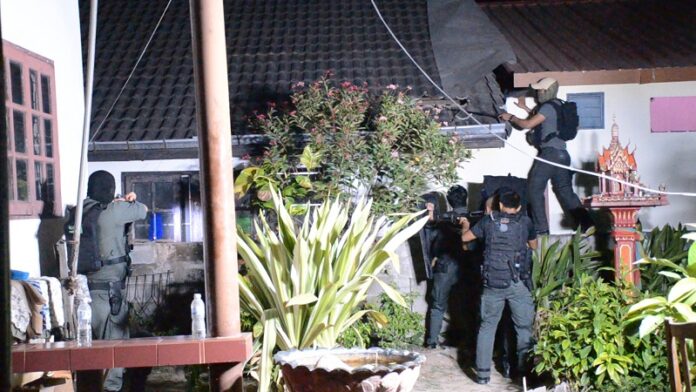
Police encircle the home of Woraphot Kiriya, 38, in Udon Thani province during a 10-hour overnight standoff that ended Tuesday morning.
UDON THANI — A domestic call turned into a standoff lasting over 10 hours when a man took his own wife hostage at their home before police were able to finally rescue her Tuesday morning.
Police said they waited a long time before eventually breaking into the Udon Thani home where Woraphot Kiriya, 38, had locked himself in with his wife because he had already beaten her and they were afraid he would use his 9mm pistol.
“The reason we didn’t rush in was because he had security cameras around the house,” police Col. Netiphong Thatthamle said. “So we tried to get his mother and mother-in-law to negotiate with him.”
After he was apprehended, Woraphot tested positive for drugs. He was charged with drug use, assault and unlawful restraint. Police said he has a long record of arrests for possession of ya ba, or methamphetamines, and had been released from prison in October.
His wife, La-ongdao Ngamnimit, 23, was in stable condition at a hospital.
Police first arrived at the home in Udon Thani city at 5pm on Monday after being called by Woraphot’s mother, who was also trapped inside. Wannapa Kiriya, 59, had locked herself in a separate room. Police covered a security camera then cut through a steel window at about 6pm to rescue Wannapa.
But La-ongdao remained inside.
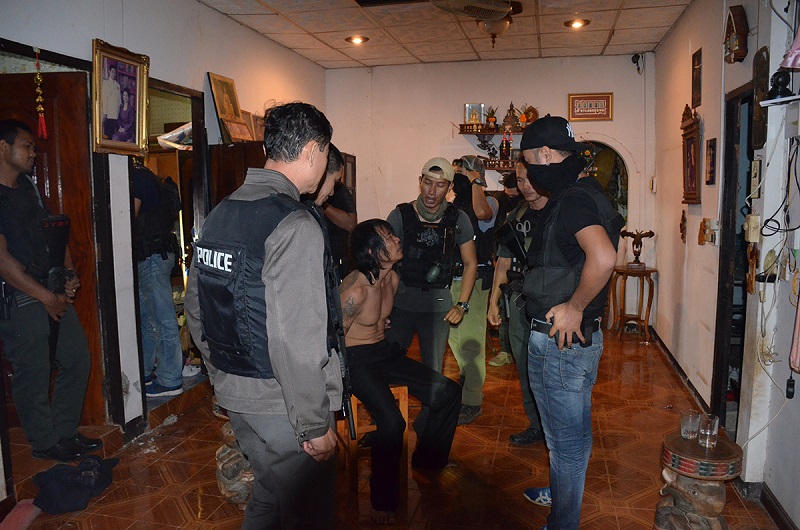
Woraphot Kiriya, 38, is captured inside his home early Tuesday morning.
The ensuing standoff continued for hours before police finally threw tear gas and stormed the home just after midnight to rescue her. They found her lying on a bed on the ground floor, unable to move because she had been severely injured by her husband.
Woraphot hid when officers entered the home. Police found him inside his mother’s wardrobe at 2:35am.
Woraphot said he misplaced his gun while attempting to flee. Police were unconvinced and were still searching the house as of Tuesday morning.
Security camera images released Dec. 20 by Pattaya police.
PATTAYA — Police in the resort town of Pattaya on Tuesday released images of an unidentified foreign man recently found dead under suspicious circumstances off the coast.
The body, clothed in diving suit and equipment, was spotted Friday near the popular Koh Larn, said Pattaya police chief Apichai Klobpetch. Police hope that anyone with information about the man, whose name and nationality are unknown, would come forward.
“We have already asked the Immigration Police. We are now checking hotels in the area,” Col. Apichai said. “We are using a force of more than 100 officers.”
The security camera images released showed a Caucasian man and an Asian woman in a shopping mall on Wednesday. Apichai said they were also looking for the woman, who remains unidentified.
According to Apichai, the man’s body had cut wounds around the neck, and autopsy results established that he died from blood loss.
However, the officer declined to rule it a murder case.
“It’s still not clear. There are two possible motives: murder or suicide,” Col. Apichai said. “The wounds are not deep enough to kill him, because his aorta was not cut.”
No possibly related missing-persons report has been filed, he added.
Anyone who thinks they have information about the victim is encouraged to contact the Pattaya Police Department at 03-842-0804.
The shadow of a Royal New Zealand Air Force P3 Orion is seen on low level cloud while the aircraft searches for missing Malaysia Airlines Flight MH370 in 2014 in the southern Indian Ocean, near the coast of Western Australia. Photo: Rob Griffith / Associated Press
SYDNEY — A look at the progressive searches for Malaysia Airlines Flight 370, which are the most challenging and expensive undertaken in aviation history.
First Search: On March 8, 2014, an air and sea search begins in the Gulf of Thailand and the South China Sea on the assumption that the plane crashed on its way from Kuala Lumpur, Malaysia, to Beijing. Malaysia reveals two weeks later that its military radar had tracked the plane flying far off course to the west.
Second Search: Analysis of satellite signals emitted by the plane in its final hours suggests that it crashed west of Australia. A sonar search appears to detect the ‘ping’ of the jet’s black box near the end of its monthlong battery life. But after 850 square kilometers (330 square miles) of seabed is searched, authorities conclude that they must have been mistaken.
Third Search: Further analysis of satellite data defined a more remote search zone 1,800 kilometers (1,100 miles) off Australia’s southwest coast in the Indian Ocean. The 60,000-square-kilometer (23,000-square-mile) search area was later doubled. In July, officials agreed the search would be suspended once crews finish scouring the area, unless new evidence emerges pinpointing a specific location of the aircraft.
Possible Fourth Search?: In December, international investigators released a report based on a fresh analysis of the data concluding that the plane is highly unlikely to be in the current search zone, and suggesting that the aircraft may instead have crashed in an area farther north. The investigators said a new search should be launched of the 25,000-square kilometer (9,700-square mile) area immediately to the north of the current search zone. But Australian officials said that was unlikely, as the report failed to identify a specific location of the plane.
Challenges: The search zone is so remote that the sonar ships spend half their monthlong shifts transiting to and from their Australian port. The ocean ranges from 600 meters (2,000 feet) to 6.5 kilometers (4 miles) deep, with the average depth being 4 kilometers (2.5 miles). The seabed has jutting ridges and volcanoes and deep, sharp crevasses.
Cost: Australia has agreed to pay $60 million and China $20 million for the current search. Malaysia has paid $80 million and has agreed to pay the balance of the final search cost.