LOS ANGELES — Actress Carrie Fisher, who played Princess Leia in ‘Star Wars,’ has died at age 60, daughter’s publicist says.
Fisher experienced medical trouble during a flight from London and was treated by paramedics immediately after the plane landed in Los Angeles on Friday Dec. 23, according to reports citing unnamed sources.
BANGKOK— No, there was not a massive explosion Bangkok on Tuesday night.
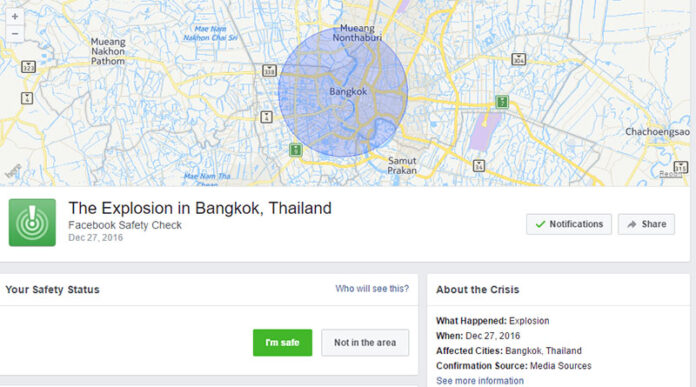
Facebook’s ‘media reports’ confirming the ‘large explosion in Bangkok.’
At about 9pm, Facebook activated its safety check-in system for a reported explosion in the Thai capital. Facebook said the crisis was “confirmed” by media reports, and users began marking themselves “safe.”
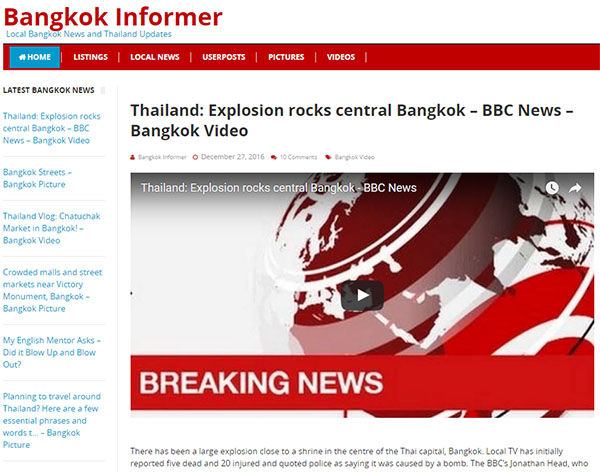
The only problem is the media report it referenced was a BBC article posted to the website of Bangkok Informer. That article appeared to have been posted more than a year ago before it was republished today and was eventually picked up by an MSN.news bot at about 8pm.
The original BBC report was about the Aug. 17, 2015, bombing of the Erawan Shrine, which killed 20 people, mostly tourists.
As of 10:15pm, the Facebook alert had been deactivated.
Image of story at Bangkok Informer
Facebook launched its Safety Check Feature in October 2014 for its users to notify their loved ones they were safe in event of disaster. The first major crisis that saw it used was the Nepal earthquake of April 2015.
In March of this year, the social media giant apologized after it erroneously sent safety check notifications worldwide after a suicide bomber attacked Lahore, Pakistan.
Will there be general elections by the end of 2017 as promised? Will the anti-cyber law movement escalate to become a threat to the junta? Will the economy further deteriorate and undo the military regime? These are some of the political possibilities raised by some when they gazed into the Magic 8 Ball for what’s to come next year.
Three hill tribe women vote Aug. 7, 2016, in Mae Hong Son province.
The junta, formally known as the National Council for Peace and Order (NCPO) and its leader Gen. Prayuth Chan-ocha, have promised time and again for two years that there will be general elections, last revised for 2017. If they went ahead according to plan, that would be three years after they staged the May 2014 coup. Some are now concerned that promise won’t be kept, and even some Thai media have speculated about it in recent months.
“I don’t think there will be elections [in 2017],” said well-known student activist Netiwit Chotiphatphaisal of Chulalongkorn University. “I don’t really have confidence in the promises of this government.”
Netiwit and others like Suranand Vejjajiva, former secretary general to Prime Minister Yingluck Shinawatra, also cited the need to complete the funerary rites for King Bhumibol as a reason why elections may be forestalled. Labor activist Wasana Lamdee said it’s difficult to know despite the junta’s roadmap, as political parties are in disarray and must adjust to new election rules as well as rules regulating political parties and politicians. None has been finalised yet.
“I have no confidence,” said Wasana, coordinator of an activist network dedicated to raising awareness of labor issues.
Not everyone rules it out. Democrat Party deputy leader Nipit Intarasombat believed next year would see general elections. He reckoned any deferment will require amending the constitution which would not be easy, as the charter was adopted in August in a public referendum.
“Amending it isn’t easy. It’s in fact difficult,” Nipit said.
Thammasat University anthropologist Yukti Mukdavijitra also thinks there will be elections but for a different reason.
“The government is really shaky now. Faith in the regime is diminishing. I think it’s time they allow for elections, ” said Yukti, adding that sticking to a firm plan will ensure stability for the junta.
Return to top for next item.
2Computer Crime Act, Economic Hardships and More Anti-junta Resistance?
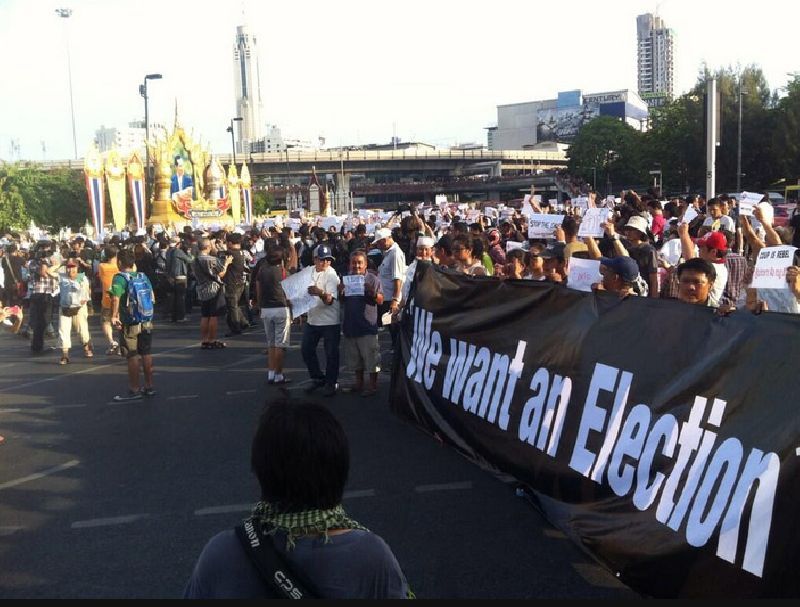
Anti-coup protesters on May 24, 2014 at Victory Monument. Photo: Matichon
Student activist Netiwit participated and organized activities critical of the military junta in 2016. The highest-profiled one saw him invite Hong Kong activist Joshua Wong in October to come and speak about democracy, only for Wong to be detained upon arrival and deported hours later.
“Next year will see more open protests [against the NCPO] by students and citizens,” Netiwit said. “Those against [the junta] must have learned many lessons by now, and they should be on the offensive, but I don’t know whether it will be successful.”
The student activist even committed himself and some of his student peers to upping the ante against the junta next year. “There will be a more politically active group next year and they will be in the news,” Netiwit said.
Another key factor, Netiwit said, is growing displeasure over the junta-sponsored National Legislative Assembly’s passage of a revised Computer Crime Act on Dec. 16. Critics say it will lead to greater censorship, self-censorship and breaching of citizen’s private information by the state. “The law affects many people,” Netiwit said, adding that the distributed and anonymous protest movement will likely spread anti-junta resistance to a new level.
While acknowledging the Computer Crime Act and its negative repercussions will be a big issue for 2017, Wasana the labor activist believes the economy, if it continues to decline, will ignite political resentment against the junta. She added that big business may even turn against the regime if it fails to deliver on the economic front. What’s more, many workers could be laid off and this could lead to unrest, she predicted.
Former official Suranand thinks a bad economy would only force the government to switch up its economic team again. But he agrees that protests will expand as the government continues to be heavy handed in its authoritarian rule.
3Yingluck Verdict
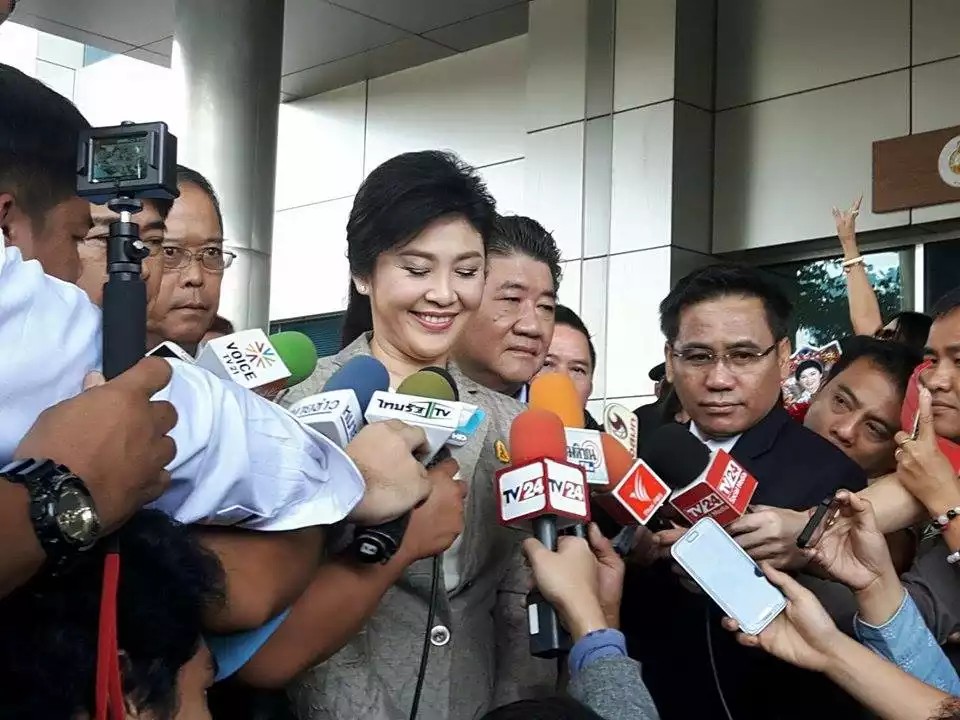
Former PM Yingluck Shinawatra speaks to reporters on Sept. 9 outside the Supreme Court. Photo: Matichon
Nipit of the Democrat Party pointed out another major political factor likely to figure prominently is the possible court sentencing of former premier Yingluck over her handling of a rice subsidy program during her tenure.
“There will be a lot of pressure as a result,” Nipit said.
Would Thailand be as colorful without magic banana trees and the boisterous ‘Uncle Tuu?’ We think not.
Amazing Thailand
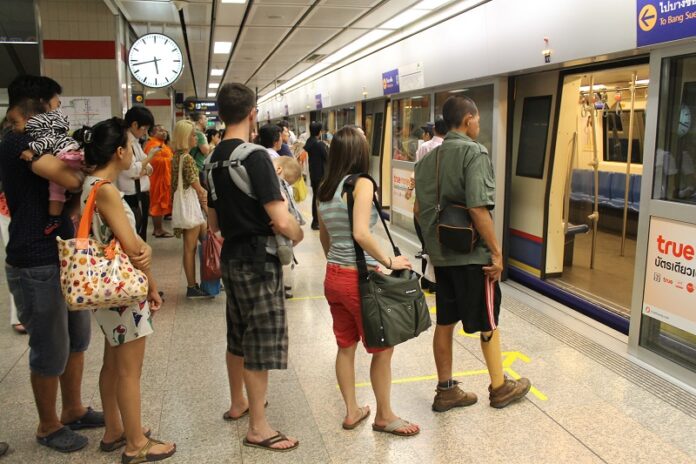
Some use the phrase “Land of Smiles” as an ironic verbal shrug every time they stub their toe. But we think it’s time to reclaim it for all the delightful wonders that keep us smiling. ProTip: Most magic plants and naga-sighting stories appear in the media just before the middle and end of the month because lottery.
A woman rides on the back of a taxi Sunday night near Suvarnabhumi Airport in a still image taken from a video. Image: Orrawan Phuakthaisong / Facebook
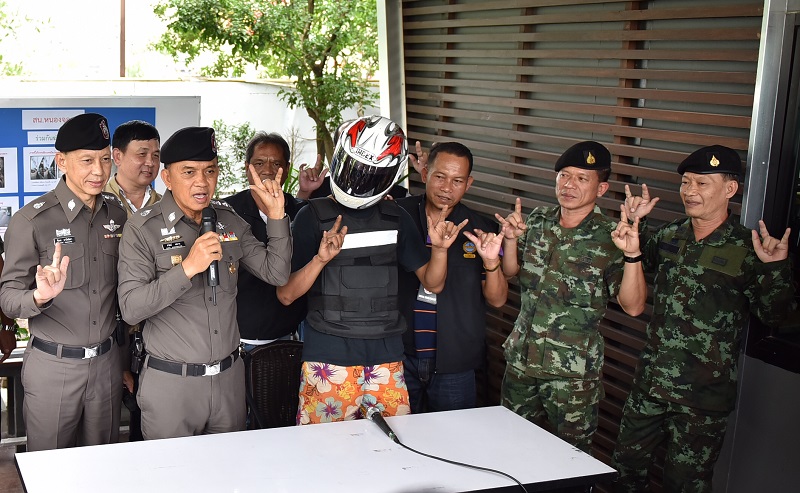
Bangkok Police Chief Sanit Mahatavorn demonstrates the ‘ILY’ sign along with police, military officers and the 18-year-old vocational student who was a murder suspect in Bangkok Wednesday.
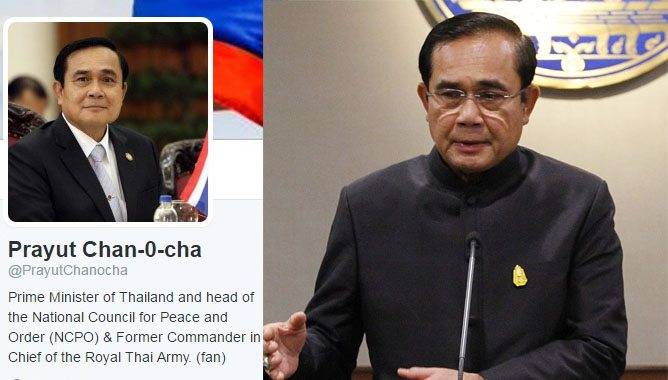
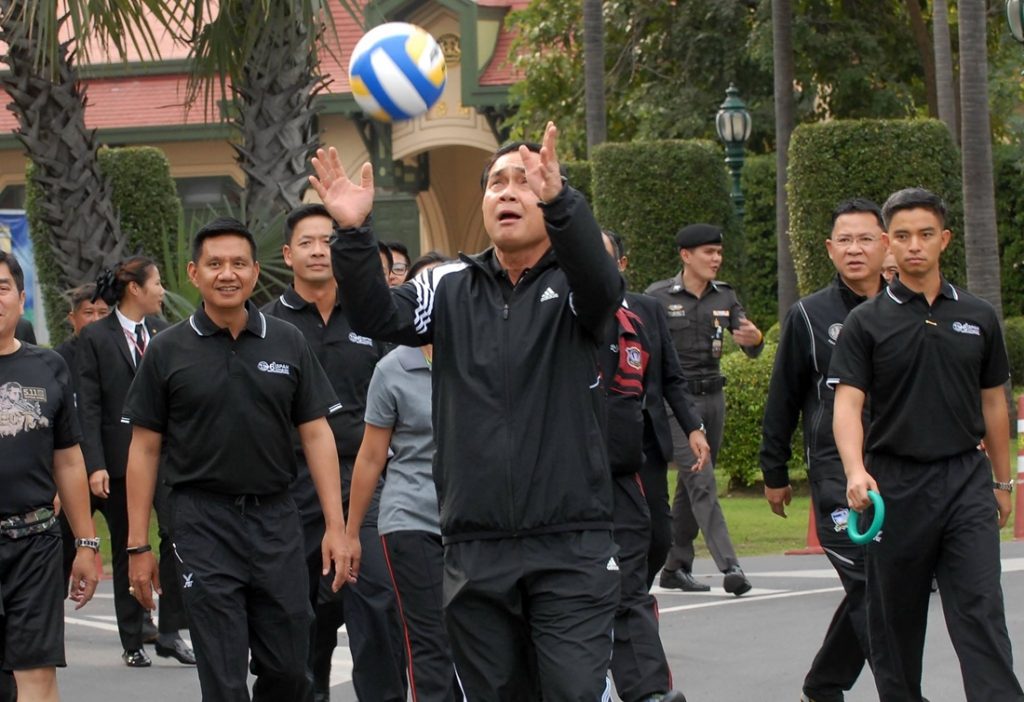
Sometimes he gets mad. Sometimes his head is in the clouds. Other times he’s inventing solutions for problems that don’t exist. The general who vowed to return happiness to the people but ever seems in short supply of it began his third year as prime minister and returns as a year-end feature for the second time.
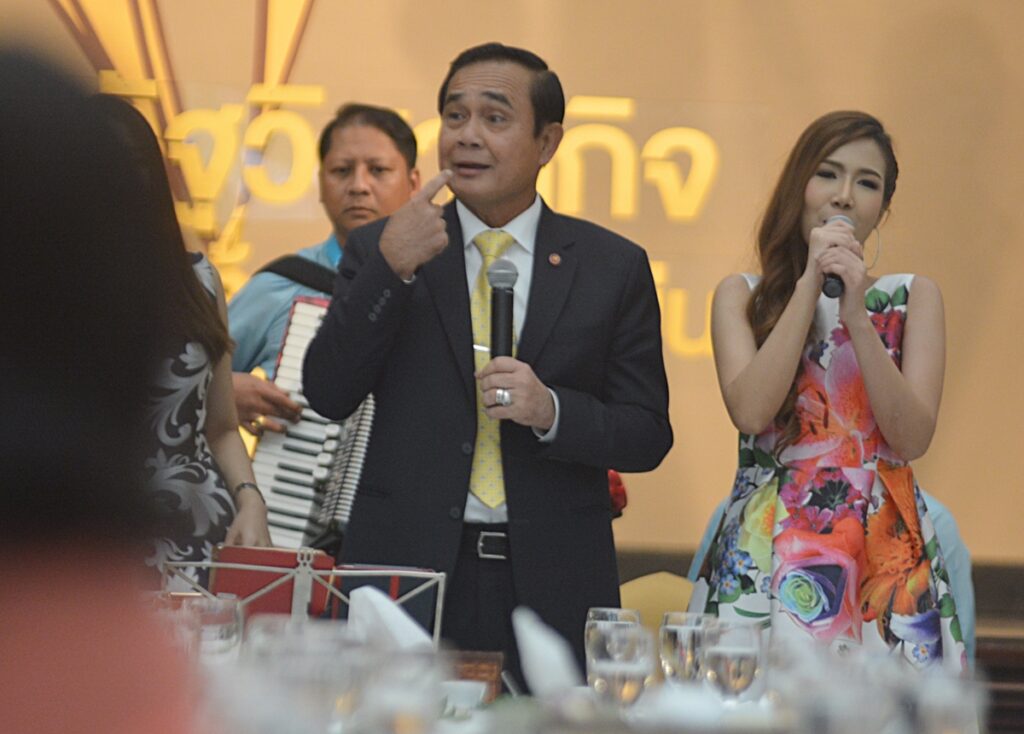
‘Such a foul mouth,’ PM Prayuth Chan-ocha says while jokingly pointing to his mouth as he sang the verse from a pop song with reporters at Government House.
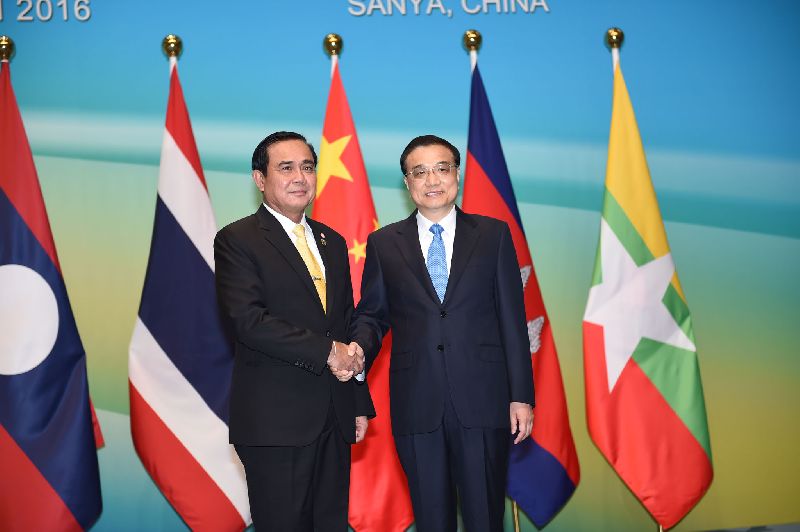
Junta chairman Prayuth Chan-ocha, left, shakes hands with Chinese Premier Li Keqiang, Wednesday, March 23, 2016, at the inaugural Lancang-Mekong Cooperation meeting in Sanya, China.
The director of Army Cyber Center, Maj. Gen. Rittee Intravudh in an undated file photo. Photo : Matichon
BANGKOK — Hacktivists posted online Tuesday documents they say contradict army denials it has purchased decryption devices that would allow access to encrypted computer traffic.
As cyber battles sparked by the passage of the new Computer Crime Act continue, online activist group Citizens Against Single Gateway on Monday posted screenshots purportedly obtained from an army procurement database. Listed among purchases were items used to crack the standard security protocols people use to access web servers securely.
“I can assure that there is no such equipment in the army’s procurement plan,” the director of Army Cyber Center, Maj. Gen. Rittee Intravudh, said in response Monday. “This issue can be looked into. Because no organization under the army has any reason to use such a device.”
SSL or Secure Sockets Layer is the standard protocol widely used to encrypt data between a user’s browser and web server to ensure privacy. In 2013 it came to light that the U.S. NSA had developed a means to defeat SSL.
Rittee said the information was distorted by the opposition in order to attack the army. He said he had no idea where the images came from.
Online activists have been bringing government, police and military sites down in protest of the new Computer Crime Act since it was approved unanimously on Dec.16. They also posted some pictures they claimed prove they are able to penetrate government systems.
On Monday Deputy Prime Minister Prawit Wongsuwan said nine people were detained for hacking government websites, but only a 19-year-old man was handed over to police. No details were given about the other eight detainees.
Responding to the Rittee’s dismissive response, the group posted on Tuesday another document showing the Ministry of Information and Communication Technology formed a committee in 2014 to monitor online media. It was also tasked to test decryption systems to find the best one for use.
In 2015 the Thai army and police were found to be customers of a surveillance malware and intrusion system designed by a vendor called Hacking Team in order to get into private mobile phone and computer systems, according to the document obtained by WikiLeaks.
The military regime says it has no intention of trampling rights and needs better tools to fight cyber crimes, most significantly, cases of royal defamation. It was also used these powers to prosecute its persistent critics.
Crown Prince Vajiralongkorn rides a bicycle on Aug. 16, 2015, during a cycling event in Bangkok dedicated to his mother Queen Sirikit.
No one wants to read internet Top 10 lists anymore, so here’s an innovative look back at 2016’s biggest moments with lists of varying lengths.
People’s Choice: 11 Most-Read Stories
Real-world democracy had another rough year, but it thrived online with all the things to click. For better or worse, here are the stories you wanted to read the most.
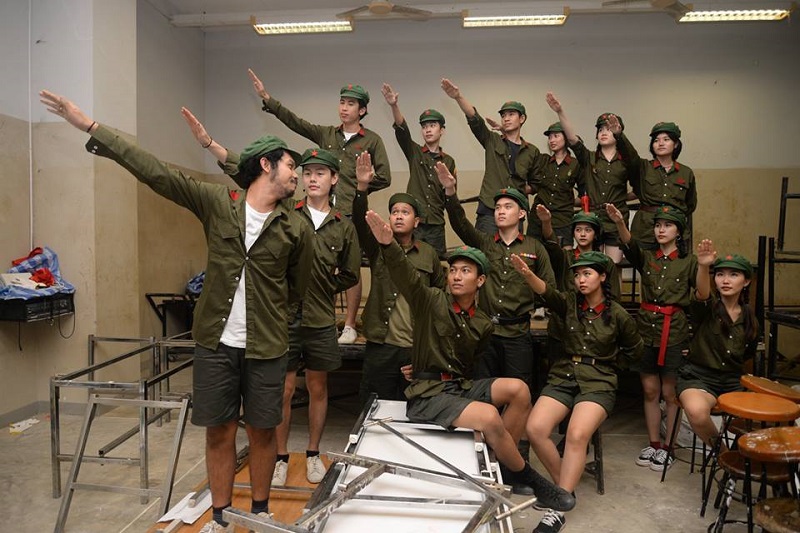
Silpakorn University students in Bangkok dress recently as Mao Zedong’s Red Guards from the bloody Cultural Revolution in the 1960s. Photo: Washirawit Santipiboon / Facebook
Were the internet less democratic, it would be less clogged with kitten videos and one weird tricks. Here are a few of the stories we knew wouldn’t win the most clicks but still needed to be told.
Kanattsanan ‘Mukk’ Dokput receives a tattoo in February representing the testosterone molecule to signify his transition to a male identity. Photo: Watsamon Tri-yasakda
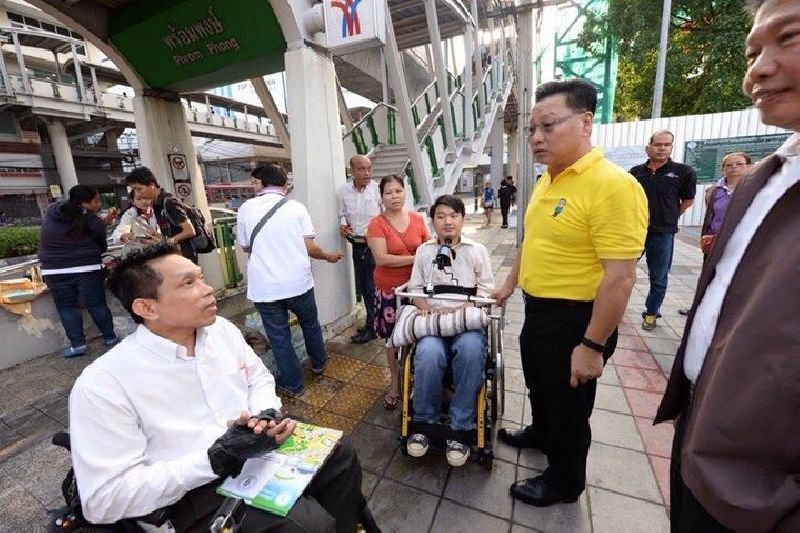
Disabled rights activist Manit Inpim, who spearheaded efforts to make the rail system accessible with Transportation for All, talks to Deputy Bangkok Gov. Amorn Kijchawengkul on Jan. 21 at BTS Phrom Phong in Bangkok.
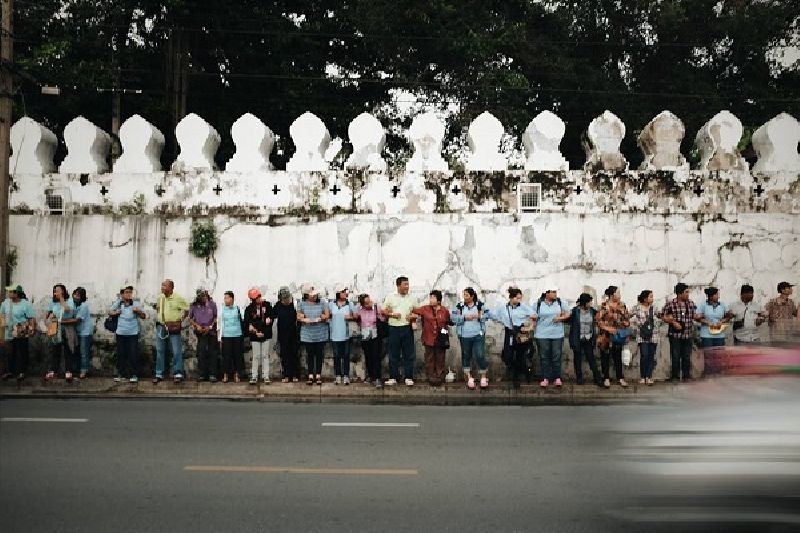
Members of the Pom Mahakan community and their supporters lock arms together Sunday in a symbolic show of opposition to eviction by the city. Photo: Matichon
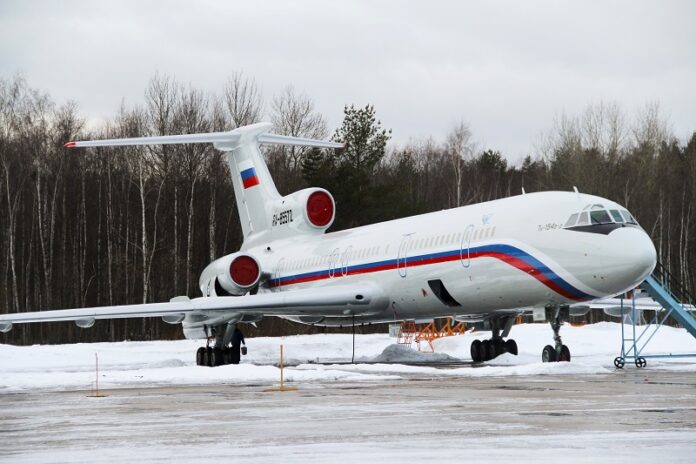
This photo taken in 2015 shows the Tu-154 plane with registration number RA-85572 at Chkalovsky military airport near Moscow, Russia. Photo: Dmitry Petrochenko / Associated Press
MOSCOW — Russia’s defense ministry says rescue teams have found a flight recorder from the plane that crashed into the Black Sea over the weekend.
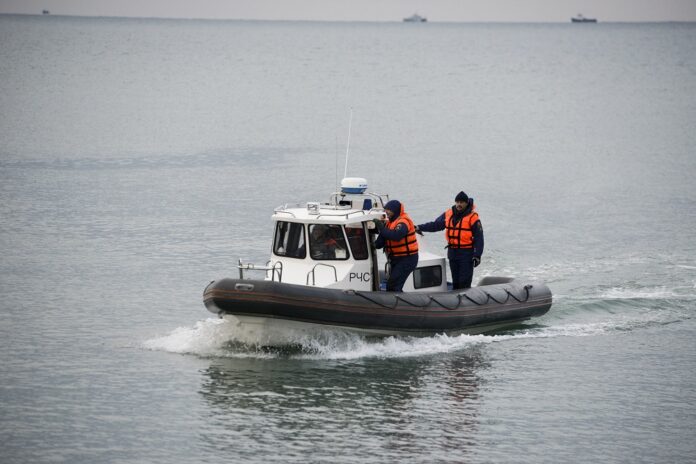
The ministry said in a statement that the flight recorder was found a mile from the shore early Tuesday morning. State television showed footage of rescue workers on an inflatable boat carrying a container with a bright orange object covered in water.
All 92 people aboard the Russian military’s Tu-154 plane are believed to have died Sunday morning when it crashed two minutes after taking off from the southern Russian city of Sochi.
The 84 passengers included dozens of singers from Russia’s world-famous military choir who were going to Russia’s base in Syria to perform at a New Year’s concert.
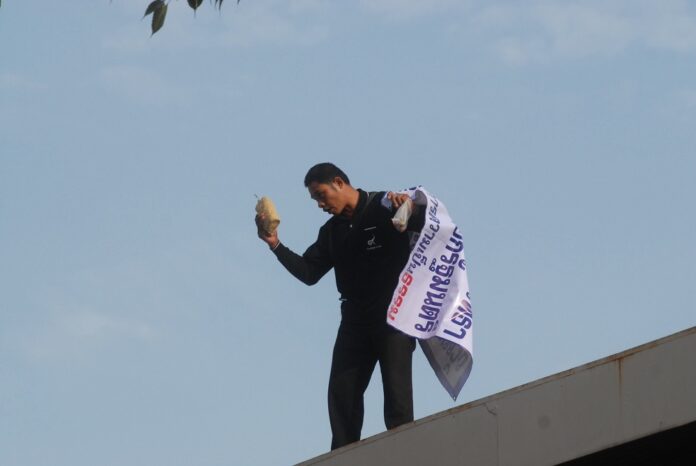
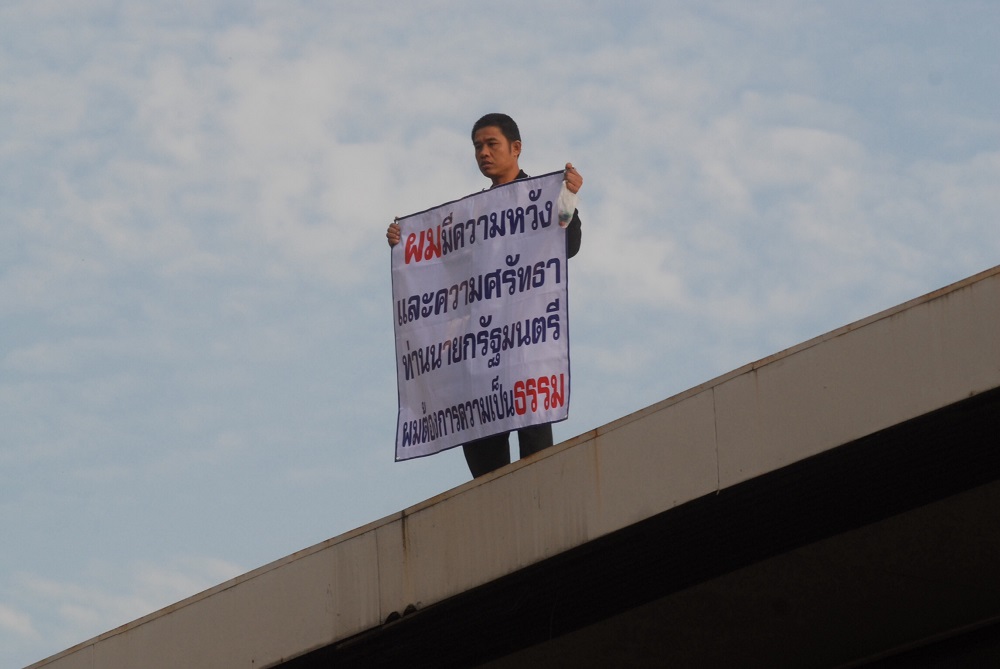
Chalerm Sornnonthee stands atop a bank near the Government House, wielding what police would later say was in fact not a large bomb on Tuesday in Bangkok.
BANGKOK — A man climbed a structure near the Government House on Tuesday morning, armed with ping pong bombs and a sign demanding justice from Prime Minister Prayuth Chan-Ocha.
Chalerm Sornnonthee, 43 of Nan province, allegedly threw several ping pong bombs from atop the Government Savings Bank branch toward the regime’s seat of power, apparently to seek help with a financial problem. Police said it was his third such stunt.
“Do you know what’s going on, you higher-ups? Do you know?” he is heard screaming in a video of this morning’s incident.
Chalerm also reportedly waved around what he said was a large bomb before putting it back in his bag. An official eventually talked Chalern down from the roof at which point he was taken into custody.
“I have hope and faith in the prime minister. I need justice,” read his banner.
Chalerm was reportedly asking for Gen. Prayuth’s help with a debt he felt was unfair. As of noon, Lt. Col. Juk Jukkarat of Dusit police said they were still investigating and had yet to charge Chalerm.
The large “bomb” was not real, he added.
“It’s not a real bomb or a flare,” he said. “It’s just an item shaped like a bomb.”
Chalerm had previously come to protest at the Government House twice before, climbing a fence onto the roof of a security office in April 2015 to demand investigation of a water project in Nan province. A few months later in October 2015 he poured oil on himself and threatened self-immolation to demand another investigation.
He went home after government officials told him they would investigate.
Ministry of Emergency Situations employees search for bodies by a boat in the Black Sea, off Sochi, Russia, Monday. Photo: Viktor Klyushin / Associated Press
SOCHI — The Kremlin on Monday played down the possibility that a terror attack might have downed a Syria-bound Russian plane, killing all 92 people on board, as the nation observed a day of mourning for the victims, including most members of a world famous military choir.
The Tu-154 owned by the Russian Defense Ministry crashed into the Black Sea early Sunday two minutes after taking off in good weather from the city of Sochi. The plane was carrying members of the Alexandrov Ensemble, often referred to as the Red Army Choir, to a New Year’s concert at a Russian military base in Syria.
About 3,500 people, 43 ships and 182 divers have been sweeping a vast crash site for bodies of the victims and debris, and dozens of drones and several submersibles also have been involved in the search. Rescue teams so far have recovered 11 bodies and numerous body fragments, which have been flown to Moscow for identification.
Divers have located parts of the plane’s fuselage and other fragments, but the search for the jet’s flight recorders will likely prove challenging as they lack underwater locator beacons for easy spotting common in more modern planes.
Officials sought to squelch speculation that the crash might have been caused by a bomb planted on board or a portable air defense missile.
But some aviation experts pointed that the crew’s failure to communicate any technical problem and a large area over which fragments of the plane were scattered point at a possible explosion on board.
Evidence of a bombing of a Syria-bound military flight would badly embarrass the Kremlin, highlighting Russia’s extreme vulnerability to attacks even as it boasts its success in Syria after Aleppo fell into President Bashar Assad’s hands.
President Vladimir Putin’s spokesman, Dmitry Peskov, told reporters that an attack isn’t a likely scenario. Transport Minister Maxim Sokolov, who oversaw the rescue efforts, said investigators were looking into a possible technical fault or pilot error as the most likely reasons behind the crash.
But some experts remained skeptical, noting that the crew would have reported any technical glitch.
“Possible malfunctions … certainly wouldn’t have prevented the crew from reporting them,” Vitaly Andreyev, a former senior Russian air traffic controller, told RIA Novosti, adding that an “external impact” was the most likely reason.
Russia’s main domestic security and counter-terrorism agency, the FSB, said it has found “no indications or facts pointing at the possibility of a terror attack or an act of sabotage on board the plane.”
The plane departed from the Chkalovsky military airport just outside Moscow and stopped in Sochi for refueling early Sunday. The FSB said border guards and military servicemen were protecting the plane as it sat on the tarmac in Sochi, and the chief pilot along with the flight engineer personally monitored the refueling. The agency said that a border guard officer and a customs official were the only ones to briefly come on board in Sochi.
Some Russian media pointed at lax security at Chkalovsky outside Moscow where the plane was based, saying that it’s quite porous compared to civilian airports.
Alexander Gusak, a former chief of the FSB special forces unit, also hinted at security breaches at Chkalovsky and said that even a much more secure Sochi airport could be vulnerable.
“It’s possible to penetrate any facility. It depends on your skills,” Gusak told Dozhd TV.
Russian planes have been brought down previously in terror attacks.
In October 2015, a Russian passenger plane was brought down by a bomb over Egypt, killing all 224 people aboard. Officials said the explosive device was planted in the plane’s luggage compartment. A local affiliate of the Islamic State group claimed responsibility.
In August 2004, two Russian planes were blown up on the same day by suicide bombers, killing 89 people. A Chechen warlord claimed responsibility for the twin attacks, which were made possible by lax security at a Moscow airport.
While ruling out an attack in Sunday’s crash, the FSB said that investigators are looking into bad fuel, pilot error, alien objects stuck in the engines or equipment failure.
John Goglia, a former U.S. National Transportation Safety Board member and aviation safety expert, argued that while pilot error or bad fuel “would be high on my list,” they wouldn’t have prevented the pilot from alerting traffic controllers to the situation. He also noted that the Tu-154 has been “a pretty reliable platform.”
The Tu-154 is a Soviet-built three-engine airliner designed in the late 1960s. The plane that crashed Sunday was built in 1983, and underwent factory check-ups and maintenance in 2014 as well as earlier this year.
While the Tu-154 is no longer used by Russian airlines because it’s too noisy and fuel-hungry, the Russian military has continued to operate it. The plane has been popular with crews who appreciate its maneuverability and ruggedness.
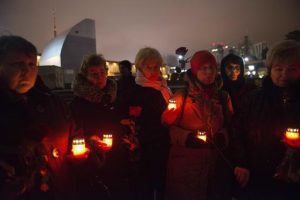
People light candles in memory of victims of the crashed plane in the center of Sochi, Russia, Sunday.
Flags were at half-staff across Russia on Monday, nationwide television stations canceled their entertainment programs and the Cabinet began its session with a moment of silence as part of the nationwide mourning. People piled up red and white carnations outside the Moscow office of the Alexandrov Ensemble, popular across the world for its fiery performances.
Vadim Ananyev, a soloist who stayed home with his family, said he was devastated.
“I have lost my friends and colleagues, all killed, all five soloists,” Ananyev told The Associated Press. “I have known these people for 30 years. I know their wives and children. I feel terrible for the children and for all that I have lost.”
Ananyev said he had received condolences from all over Russia and from abroad.
“We were loved all over the world, never mind the political situation,” he said.
In Rome, Pope Francis led thousands of faithful in silent prayer for the plane crash victims and noted that the Russian army choir had performed in 2004 at the Vatican.